
POJ 1330 Nearest Common Ancestors(Tarjan离线LCA)
Description
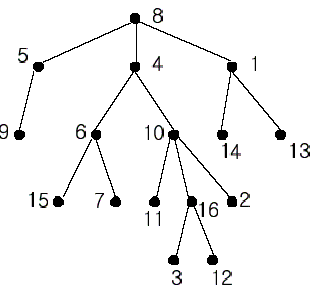
In the figure, each node is labeled with an integer from {1, 2,...,16}. Node 8 is the root of the tree. Node x is an ancestor of node y if node x is in the path between the root and node y. For example, node 4 is an ancestor of node 16. Node 10 is also an ancestor
of node 16. As a matter of fact, nodes 8, 4, 10, and 16 are the ancestors of node 16. Remember that a node is an ancestor of itself. Nodes 8, 4, 6, and 7 are the ancestors of node 7. A node x is called a common ancestor of two different nodes y and z if node
x is an ancestor of node y and an ancestor of node z. Thus, nodes 8 and 4 are the common ancestors of nodes 16 and 7. A node x is called the nearest common ancestor of nodes y and z if x is a common ancestor of y and z and nearest to y and z among their common
ancestors. Hence, the nearest common ancestor of nodes 16 and 7 is node 4. Node 4 is nearer to nodes 16 and 7 than node 8 is.
For other examples, the nearest common ancestor of nodes 2 and 3 is node 10, the nearest common ancestor of nodes 6 and 13 is node 8, and the nearest common ancestor of nodes 4 and 12 is node 4. In the last example, if y is an ancestor of z, then the nearest
common ancestor of y and z is y.
Write a program that finds the nearest common ancestor of two distinct nodes in a tree.
Input
N. Each of the next N -1 lines contains a pair of integers that represent an edge --the first integer is the parent node of the second integer. Note that a tree with N nodes has exactly N - 1 edges. The last line of each test case contains two distinct integers
whose nearest common ancestor is to be computed.
Output
Sample Input
2

16

1 14

8 5

10 16

5 9

4 6

8 4

4 10

1 13

6 15

10 11

6 7

10 2

16 3

8 1

16 12

16 7

5

2 3

3 4

3 1

1 5

3 5
Sample Output
4

3
#include<iostream>

#include<cstdio>

#include<cstring>

#include<algorithm>

#include<limits.h>

#include<vector>

typedef long long LL;

using namespace std;

#define REPF( i , a , b ) for ( int i = a ; i <= b ; ++ i )

#define REP( i , n ) for ( int i = 0 ; i < n ; ++ i )

#define CLEAR( a , x ) memset ( a , x , sizeof a )

const int maxn=10005;

int n,uu,vv;

vector<int>v[maxn];

int pre[maxn],vis[maxn];

bool root[maxn];

int find_root(int x)

{

    if(pre[x]!=x)

        x=find_root(pre[x]);

    return pre[x];

}

void Union(int x,int y)

{

    x=find_root(x);

    y=find_root(y);

    if(x!=y)   pre[y]=x;

}

void LCA(int x)

{

    for(int i=0;i<v[x].size();i++)

    {

        LCA(v[x][i]);

        Union(x,v[x][i]);

    }

    vis[x]=1;

    if(x==uu&&vis[vv]==1)

    {

        printf("%d\n",find_root(vv));

        return ;

    }

    if(x==vv&&vis[uu]==1)

    {

        printf("%d\n",find_root(uu));

        return ;

    }

}

void init()

{

    REP(i,maxn)

    {

        v[i].clear();

        pre[i]=i;

        root[i]=true;

        vis[i]=0;

    }

}

void solve()

{

    REPF(i,1,n)

    {

        if(root[i]==true)

        {

            LCA(i);

            break;

        }

    }

//   for(int i=1;i<=n;i++)

//        printf("222222  %d\n",pre[i]);

}

int main()

{

    int t,a,b;

    scanf("%d",&t);

    while(t--)

    {

        scanf("%d",&n);

        init();

        REPF(i,1,n-1)

        {

            scanf("%d%d",&a,&b);

            v[a].push_back(b);

            root[b]=false;

        }

        scanf("%d%d",&uu,&vv);

        solve();

    }

    return 0;

}
POJ 1330 Nearest Common Ancestors(Tarjan离线LCA)的更多相关文章
- POJ - 1330 Nearest Common Ancestors(基础LCA)
POJ - 1330 Nearest Common Ancestors Time Limit: 1000MS Memory Limit: 10000KB 64bit IO Format: %l ...
- poj 1330 Nearest Common Ancestors 单次LCA/DFS
Nearest Common Ancestors Time Limit: 1000MS Memory Limit: 10000K Total Submissions: 19919 Accept ...
- POJ 1330 Nearest Common Ancestors(裸LCA)
Nearest Common Ancestors Time Limit: 1000MS Memory Limit: 10000K Total Submissions: 39596 Accept ...
- poj 1330 Nearest Common Ancestors 裸的LCA
#include<iostream> #include<cstdio> #include<cstring> #include<algorithm> #i ...
- POJ 1330 Nearest Common Ancestors / UVALive 2525 Nearest Common Ancestors (最近公共祖先LCA)
POJ 1330 Nearest Common Ancestors / UVALive 2525 Nearest Common Ancestors (最近公共祖先LCA) Description A ...
- POJ.1330 Nearest Common Ancestors (LCA 倍增)
POJ.1330 Nearest Common Ancestors (LCA 倍增) 题意分析 给出一棵树,树上有n个点(n-1)条边,n-1个父子的边的关系a-b.接下来给出xy,求出xy的lca节 ...
- LCA POJ 1330 Nearest Common Ancestors
POJ 1330 Nearest Common Ancestors Time Limit: 1000MS Memory Limit: 10000K Total Submissions: 24209 ...
- POJ 1330 Nearest Common Ancestors(lca)
POJ 1330 Nearest Common Ancestors A rooted tree is a well-known data structure in computer science a ...
- POJ 1330 Nearest Common Ancestors 倍增算法的LCA
POJ 1330 Nearest Common Ancestors 题意:最近公共祖先的裸题 思路:LCA和ST我们已经很熟悉了,但是这里的f[i][j]却有相似却又不同的含义.f[i][j]表示i节 ...
随机推荐
- php前端控制器2
Front Controllers act like centralized agents in an application whose primary area of concern is to ...
- ThinkPHP 3.1.2 URL<1>
# # ThinkPHP 3.1.2 URL 本节课大纲: 一.URL规则 1.默认是区分大小写的 2.如果我们不想区分大小写可以改配置文件 'URL_CASE_INSENSITIVE'=>tr ...
- iOS插件化研究之中的一个——JavaScriptCore
原文:p=191">http://chentoo.com/?p=191 一.前言 一样的开篇问题,为什么要研究这个?iOS为什么要插件化?为什么要借助其它语言比方html5 js甚至脚 ...
- 插件化-开启另外应用的activity
1.清单文件 android:sharedUserId="com.zyh.tplugin" 2.视图 <LinearLayout xmlns:android="ht ...
- sublime2 c++的一些使用配置
1 下载安装好tdw gcc后,配置好环境变量后,配置sublime2. tools->build system-> new build system... 里面输入: { "c ...
- java--线程的睡眠sleep()
package MyTest; public class Demo1 extends Thread { public void run() { loop(); } public void loop() ...
- [置顶] Android4.0中修改挂断键(ENDCALL)的默认行为
文件: frameworks/base/core/java/android/provider/Setings.java public static final String END_BUTTON_BE ...
- 【iOS开发-72】设置状态栏的两种方式、程序生命周期以及更好地理解几大类(对象)之间的关系
(1)设置状态栏的2种方式 --第一种方式就是我们在控制器中设置,系统默认就是交给视图控制器去管理的,这样不同视图控制器能够自己定义不同的状态栏例如以下: -(BOOL)prefersStatusBa ...
- Android圆环形颜色选择器:HoloColorPicker
HoloColorPicker实现圆环形颜色选择器,可以改变颜色饱和度来选择颜色.选择颜色时,可以用手指沿着圆环滑动一个滑块,从而选择颜色. 添加以下XML至你的布局中: ? 1 2 3 4 < ...
- Android 应用程序签名
本文主要介绍Android应用程序签名的相关理论知识以及怎样公布Android应用程序. 1.签名的概念 为大家所熟知的日常生活中的签名,它是代表某个人的特殊标记,用于唯一标识某个人.而Android ...