
poj 1330 Nearest Common Ancestors 单次LCA/DFS
| Time Limit: 1000MS | Memory Limit: 10000K | |
| Total Submissions: 19919 | Accepted: 10544 |
Description
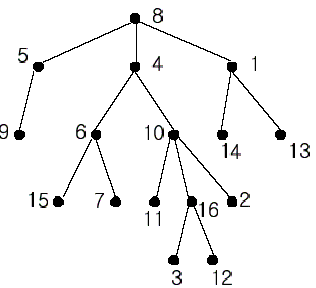
In the figure, each node is labeled with an integer from {1,
2,...,16}. Node 8 is the root of the tree. Node x is an ancestor of node
y if node x is in the path between the root and node y. For example,
node 4 is an ancestor of node 16. Node 10 is also an ancestor of node
16. As a matter of fact, nodes 8, 4, 10, and 16 are the ancestors of
node 16. Remember that a node is an ancestor of itself. Nodes 8, 4, 6,
and 7 are the ancestors of node 7. A node x is called a common ancestor
of two different nodes y and z if node x is an ancestor of node y and an
ancestor of node z. Thus, nodes 8 and 4 are the common ancestors of
nodes 16 and 7. A node x is called the nearest common ancestor of nodes y
and z if x is a common ancestor of y and z and nearest to y and z among
their common ancestors. Hence, the nearest common ancestor of nodes 16
and 7 is node 4. Node 4 is nearer to nodes 16 and 7 than node 8 is.
For other examples, the nearest common ancestor of nodes 2 and 3 is
node 10, the nearest common ancestor of nodes 6 and 13 is node 8, and
the nearest common ancestor of nodes 4 and 12 is node 4. In the last
example, if y is an ancestor of z, then the nearest common ancestor of y
and z is y.
Write a program that finds the nearest common ancestor of two distinct nodes in a tree.
Input
input consists of T test cases. The number of test cases (T) is given in
the first line of the input file. Each test case starts with a line
containing an integer N , the number of nodes in a tree,
2<=N<=10,000. The nodes are labeled with integers 1, 2,..., N.
Each of the next N -1 lines contains a pair of integers that represent
an edge --the first integer is the parent node of the second integer.
Note that a tree with N nodes has exactly N - 1 edges. The last line of
each test case contains two distinct integers whose nearest common
ancestor is to be computed.
Output
Sample Input
2

16

1 14

8 5

10 16

5 9

4 6

8 4

4 10

1 13

6 15

10 11

6 7

10 2

16 3

8 1

16 12

16 7

5

2 3

3 4

3 1

1 5

3 5
Sample Output
4

3

单次的lca,每次从u和v的depth较深的开始往上面找,然后如果一样就跳出,不一样继续找
复杂度depth[u]+depth[v]
#include <cstdio>

#include <cmath>

#include <cstring>

#include <ctime>

#include <iostream>

#include <algorithm>

#include <set>

#include <vector>

#include <sstream>

#include <queue>

#include <typeinfo>

#include <fstream>

#include <map>

typedef long long ll;

using namespace std;

//freopen("D.in","r",stdin);

//freopen("D.out","w",stdout);

#define sspeed ios_base::sync_with_stdio(0);cin.tie(0)

#define maxn 10019

#define eps 1e-9

const int inf=0x7fffffff;   //无限大

int flag1[maxn];

int flag2[maxn];

vector<int> G[maxn];//图的邻接表表示方法

int root;//根节点的编号

int parent[maxn];//父亲节点

int depth[maxn];//节点的深度

void dfs(int v,int p,int d)

{

    parent[v]=p;

    depth[v]=d;

    for(int i=;i<G[v].size();i++)

    {

        if(G[v][i]!=p)

            dfs(G[v][i],v,d+);

    }

}

void init()

{

    dfs(root,,-);

}

int lca(int u,int v)

{

    while(depth[u]>depth[v])

        u=parent[u];

    while(depth[v]>depth[u])

        v=parent[v];

    while(u!=v)

    {

        u=parent[u];

        v=parent[v];

    }

    return u;

}

int main()

{

    int t;

    cin>>t;

    while(t--)

    {

        int n;

        cin>>n;

        for(int i=;i<n;i++)

            G[i].clear();

        memset(parent,,sizeof(parent));

        memset(depth,,sizeof(depth));

        memset(flag1,,sizeof(flag1));

        memset(flag2,,sizeof(flag2));

        int a,b;

        for(int i=;i<n-;i++)

        {

            cin>>a>>b;

            G[a].push_back(b);

            flag1[a]=;

            flag2[b]=;

        }

        for(int i=;i<=n;i++)

        {

            if(flag1[i]==&&flag2[i]==)

            {

                root=i;

                break;

            }

        }

        init();

        cin>>a>>b;

        cout<<lca(a,b)<<endl;

    }

}
poj 1330 Nearest Common Ancestors 单次LCA/DFS的更多相关文章
- POJ - 1330 Nearest Common Ancestors(基础LCA)
POJ - 1330 Nearest Common Ancestors Time Limit: 1000MS Memory Limit: 10000KB 64bit IO Format: %l ...
- POJ 1330 Nearest Common Ancestors(裸LCA)
Nearest Common Ancestors Time Limit: 1000MS Memory Limit: 10000K Total Submissions: 39596 Accept ...
- POJ 1330 Nearest Common Ancestors(Tarjan离线LCA)
Description A rooted tree is a well-known data structure in computer science and engineering. An exa ...
- poj 1330 Nearest Common Ancestors 裸的LCA
#include<iostream> #include<cstdio> #include<cstring> #include<algorithm> #i ...
- POJ 1330 Nearest Common Ancestors / UVALive 2525 Nearest Common Ancestors (最近公共祖先LCA)
POJ 1330 Nearest Common Ancestors / UVALive 2525 Nearest Common Ancestors (最近公共祖先LCA) Description A ...
- POJ.1330 Nearest Common Ancestors (LCA 倍增)
POJ.1330 Nearest Common Ancestors (LCA 倍增) 题意分析 给出一棵树,树上有n个点(n-1)条边,n-1个父子的边的关系a-b.接下来给出xy,求出xy的lca节 ...
- POJ 1330 Nearest Common Ancestors(lca)
POJ 1330 Nearest Common Ancestors A rooted tree is a well-known data structure in computer science a ...
- POJ 1330 Nearest Common Ancestors 倍增算法的LCA
POJ 1330 Nearest Common Ancestors 题意:最近公共祖先的裸题 思路:LCA和ST我们已经很熟悉了,但是这里的f[i][j]却有相似却又不同的含义.f[i][j]表示i节 ...
- LCA POJ 1330 Nearest Common Ancestors
POJ 1330 Nearest Common Ancestors Time Limit: 1000MS Memory Limit: 10000K Total Submissions: 24209 ...
随机推荐
- sqlite3 的insert记录项思路
sqlite3 的insert记录项思路 1.组合一个insert的sql语句 2.判断是否需要立即执行,若不是立刻执行的语句,则插入到待处理的链表中,供后续事务处理时提交.必须有一个专门线程来对事务 ...
- Python大数据处理案例
分享 知识要点:lubridate包拆解时间 | POSIXlt利用决策树分类,利用随机森林预测利用对数进行fit,和exp函数还原 训练集来自Kaggle华盛顿自行车共享计划中的自行车租赁数据,分析 ...
- QUnit 实践一
项目准备启用Qunit, 先来尝试一下. 不说废话,上代码: <!DOCTYPE HTML> <html> <head> <meta http-equiv=& ...
- C# LINQ语句
1.select 和 selectMany SelectMany() 将中间数组序列串联为一个最终结果值,其中包含每个中间数组中的每个值 2.join语句 from x in xx join d in ...
- python进阶学习之高阶函数
高阶函数就是把函数当做参数传递的一种函数, 例如: 执行结果: 1.map()函数 map()接收一个函数 f 和一个list, 并通过把函数 f 依次作用在 list 的每个元素上,得到一个新的 l ...
- [android]Intent跳转新的Activity可以传递数据过去
两种方式: 一,直接通过Bundle对象来传递: 如果我们想要给“收件人”Activity说点什么的话,那么可以通过下面这封“E-mail”来将我们的消息传递出去 Intent intent=new ...
- epoll测试实例
C++ Code 12345678910111213141516171819202122232425262728293031323334353637383940414243444546474849 ...
- sqlserver日期推算(年,季度,月,星期推算)
DECLARE @dt datetime SET @dt=GETDATE() DECLARE @number int SET @number=3 --1.指定日期该年的第一天或最后一天--第一天为1月 ...
- Python 的內建模块
>>> import __builtin__>>> dir(__builtin__)['ArithmeticError', 'AssertionError', 'A ...
- BFS && DFS
HDOJ 1312 Red and Black http://acm.hdu.edu.cn/showproblem.php?pid=1312 很裸的dfs,在dfs里面写上ans++,能到几个点就调了 ...