
开始 Keras 序列模型(Sequential model)
开始 Keras 序列模型(Sequential model)
序列模型是一个线性的层次堆栈。
你可以通过传递一系列 layer 实例给构造器来创建一个序列模型。
The Sequential model is a linear stack of layers.
You can create a Sequential model by passing a list of layer instances to the constructor:
from keras.models import Sequential

from keras.layers import Dense, Activation

model = Sequential([

    Dense(32, input_shape=(784,)),

    Activation('relu'),

    Dense(10),

    Activation('softmax'),

])
也可以简单的添加 layer 通过 .add() 函数。
You can also simply add layers via the .add() method:
model = Sequential()

model.add(Dense(32, input_dim=784))

model.add(Activation('relu'))
Specifying the input shape
The model needs to know what input shape it should expect. For this reason, the first layer in a Sequential model (and only the first, because following layers can do automatic shape inference) needs to receive information about its input shape. There are several possible ways to do this:
- Pass an
input_shapeargument to the first layer. This is a shape tuple (a tuple of integers orNoneentries, whereNoneindicates that any positive integer may be expected). Ininput_shape, the batch dimension is not included. - Some 2D layers, such as
Dense, support the specification of their input shape via the argumentinput_dim, and some 3D temporal layers support the argumentsinput_dimandinput_length. - If you ever need to specify a fixed batch size for your inputs (this is useful for stateful recurrent networks), you can pass a
batch_sizeargument to a layer. If you pass bothbatch_size=32andinput_shape=(6, 8)to a layer, it will then expect every batch of inputs to have the batch shape(32, 6, 8).
As such, the following snippets are strictly equivalent:
model = Sequential()

model.add(Dense(32, input_shape=(784,)))
model = Sequential()
model.add(Dense(32, input_dim=784))Compilation
Before training a model, you need to configure the learning process, which is done via the compile method. It receives three arguments:
- An optimizer. This could be the string identifier of an existing optimizer (such as
rmsproporadagrad), or an instance of theOptimizerclass. See: optimizers. - A loss function. This is the objective that the model will try to minimize. It can be the string identifier of an existing loss function (such as
categorical_crossentropyormse), or it can be an objective function. See: losses. - A list of metrics. For any classification problem you will want to set this to
metrics=['accuracy']. A metric could be the string identifier of an existing metric or a custom metric function.
# For a multi-class classification problem

model.compile(optimizer='rmsprop',

              loss='categorical_crossentropy',

              metrics=['accuracy'])

# For a binary classification problem

model.compile(optimizer='rmsprop',

              loss='binary_crossentropy',

              metrics=['accuracy'])

# For a mean squared error regression problem

model.compile(optimizer='rmsprop',

              loss='mse')

# For custom metrics

import keras.backend as K

def mean_pred(y_true, y_pred):

    return K.mean(y_pred)

model.compile(optimizer='rmsprop',

              loss='binary_crossentropy',

              metrics=['accuracy', mean_pred])
Training
Keras models are trained on Numpy arrays of input data and labels. For training a model, you will typically use the fit function. Read its documentation here.
# For a single-input model with 2 classes (binary classification):

model = Sequential()

model.add(Dense(32, activation='relu', input_dim=100))

model.add(Dense(1, activation='sigmoid'))

model.compile(optimizer='rmsprop',

              loss='binary_crossentropy',

              metrics=['accuracy'])

# Generate dummy data

import numpy as np

data = np.random.random((1000, 100))

labels = np.random.randint(2, size=(1000, 1))

# Train the model, iterating on the data in batches of 32 samples

model.fit(data, labels, epochs=10, batch_size=32)
# For a single-input model with 10 classes (categorical classification):
model = Sequential()
model.add(Dense(32, activation='relu', input_dim=100))
model.add(Dense(10, activation='softmax'))
model.compile(optimizer='rmsprop',
loss='categorical_crossentropy',
metrics=['accuracy'])
# Generate dummy data
import numpy as np
data = np.random.random((1000, 100))
labels = np.random.randint(10, size=(1000, 1))
# Convert labels to categorical one-hot encoding
one_hot_labels = keras.utils.to_categorical(labels, num_classes=10)
# Train the model, iterating on the data in batches of 32 samples
model.fit(data, one_hot_labels, epochs=10, batch_size=32)Examples
Here are a few examples to get you started!
In the examples folder, you will also find example models for real datasets:
- CIFAR10 small images classification: Convolutional Neural Network (CNN) with realtime data augmentation
- IMDB movie review sentiment classification: LSTM over sequences of words
- Reuters newswires topic classification: Multilayer Perceptron (MLP)
- MNIST handwritten digits classification: MLP & CNN
- Character-level text generation with LSTM
…and more.
Multilayer Perceptron (MLP) for multi-class softmax classification:
from keras.models import Sequential

from keras.layers import Dense, Dropout, Activation

from keras.optimizers import SGD

# Generate dummy data

import numpy as np

x_train = np.random.random((1000, 20))

y_train = keras.utils.to_categorical(np.random.randint(10, size=(1000, 1)), num_classes=10)

x_test = np.random.random((100, 20))

y_test = keras.utils.to_categorical(np.random.randint(10, size=(100, 1)), num_classes=10)

model = Sequential()

# Dense(64) is a fully-connected layer with 64 hidden units.

# in the first layer, you must specify the expected input data shape:

# here, 20-dimensional vectors.

model.add(Dense(64, activation='relu', input_dim=20))

model.add(Dropout(0.5))

model.add(Dense(64, activation='relu'))

model.add(Dropout(0.5))

model.add(Dense(10, activation='softmax'))

sgd = SGD(lr=0.01, decay=1e-6, momentum=0.9, nesterov=True)

model.compile(loss='categorical_crossentropy',

              optimizer=sgd,

              metrics=['accuracy'])

model.fit(x_train, y_train,

          epochs=20,

          batch_size=128)

score = model.evaluate(x_test, y_test, batch_size=128)
MLP for binary classification:
import numpy as np

from keras.models import Sequential

from keras.layers import Dense, Dropout

# Generate dummy data

x_train = np.random.random((1000, 20))

y_train = np.random.randint(2, size=(1000, 1))

x_test = np.random.random((100, 20))

y_test = np.random.randint(2, size=(100, 1))

model = Sequential()

model.add(Dense(64, input_dim=20, activation='relu'))

model.add(Dropout(0.5))

model.add(Dense(64, activation='relu'))

model.add(Dropout(0.5))

model.add(Dense(1, activation='sigmoid'))

model.compile(loss='binary_crossentropy',

              optimizer='rmsprop',

              metrics=['accuracy'])

model.fit(x_train, y_train,

          epochs=20,

          batch_size=128)

score = model.evaluate(x_test, y_test, batch_size=128)
VGG-like convnet:
import numpy as np

import keras

from keras.models import Sequential

from keras.layers import Dense, Dropout, Flatten

from keras.layers import Conv2D, MaxPooling2D

from keras.optimizers import SGD

# Generate dummy data

x_train = np.random.random((100, 100, 100, 3))

y_train = keras.utils.to_categorical(np.random.randint(10, size=(100, 1)), num_classes=10)

x_test = np.random.random((20, 100, 100, 3))

y_test = keras.utils.to_categorical(np.random.randint(10, size=(20, 1)), num_classes=10)

model = Sequential()

# input: 100x100 images with 3 channels -> (100, 100, 3) tensors.

# this applies 32 convolution filters of size 3x3 each.

model.add(Conv2D(32, (3, 3), activation='relu', input_shape=(100, 100, 3)))

model.add(Conv2D(32, (3, 3), activation='relu'))

model.add(MaxPooling2D(pool_size=(2, 2)))

model.add(Dropout(0.25))

model.add(Conv2D(64, (3, 3), activation='relu'))

model.add(Conv2D(64, (3, 3), activation='relu'))

model.add(MaxPooling2D(pool_size=(2, 2)))

model.add(Dropout(0.25))

model.add(Flatten())

model.add(Dense(256, activation='relu'))

model.add(Dropout(0.5))

model.add(Dense(10, activation='softmax'))

sgd = SGD(lr=0.01, decay=1e-6, momentum=0.9, nesterov=True)

model.compile(loss='categorical_crossentropy', optimizer=sgd)

model.fit(x_train, y_train, batch_size=32, epochs=10)

score = model.evaluate(x_test, y_test, batch_size=32)
Sequence classification with LSTM:
from keras.models import Sequential

from keras.layers import Dense, Dropout

from keras.layers import Embedding

from keras.layers import LSTM

model = Sequential()

model.add(Embedding(max_features, output_dim=256))

model.add(LSTM(128))

model.add(Dropout(0.5))

model.add(Dense(1, activation='sigmoid'))

model.compile(loss='binary_crossentropy',

              optimizer='rmsprop',

              metrics=['accuracy'])

model.fit(x_train, y_train, batch_size=16, epochs=10)

score = model.evaluate(x_test, y_test, batch_size=16)
Sequence classification with 1D convolutions:
from keras.models import Sequential

from keras.layers import Dense, Dropout

from keras.layers import Embedding

from keras.layers import Conv1D, GlobalAveragePooling1D, MaxPooling1D

model = Sequential()

model.add(Conv1D(64, 3, activation='relu', input_shape=(seq_length, 100)))

model.add(Conv1D(64, 3, activation='relu'))

model.add(MaxPooling1D(3))

model.add(Conv1D(128, 3, activation='relu'))

model.add(Conv1D(128, 3, activation='relu'))

model.add(GlobalAveragePooling1D())

model.add(Dropout(0.5))

model.add(Dense(1, activation='sigmoid'))

model.compile(loss='binary_crossentropy',

              optimizer='rmsprop',

              metrics=['accuracy'])

model.fit(x_train, y_train, batch_size=16, epochs=10)

score = model.evaluate(x_test, y_test, batch_size=16)
Stacked LSTM for sequence classification
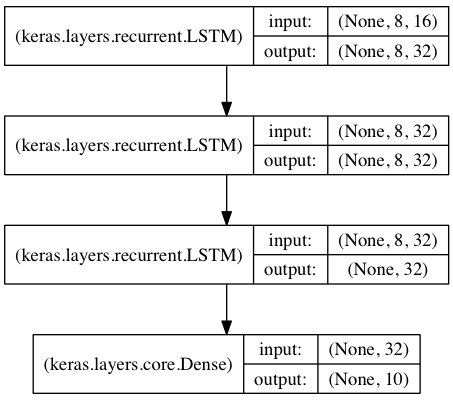
In this model, we stack 3 LSTM layers on top of each other,
making the model capable of learning higher-level temporal representations.
The first two LSTMs return their full output sequences, but the last one only returns
the last step in its output sequence, thus dropping the temporal dimension
(i.e. converting the input sequence into a single vector).
from keras.models import Sequential

from keras.layers import LSTM, Dense

import numpy as np

data_dim = 16

timesteps = 8

num_classes = 10

# expected input data shape: (batch_size, timesteps, data_dim)

model = Sequential()

model.add(LSTM(32, return_sequences=True,

               input_shape=(timesteps, data_dim)))  # returns a sequence of vectors of dimension 32

model.add(LSTM(32, return_sequences=True))  # returns a sequence of vectors of dimension 32

model.add(LSTM(32))  # return a single vector of dimension 32

model.add(Dense(10, activation='softmax'))

model.compile(loss='categorical_crossentropy',

              optimizer='rmsprop',

              metrics=['accuracy'])

# Generate dummy training data

x_train = np.random.random((1000, timesteps, data_dim))

y_train = np.random.random((1000, num_classes))

# Generate dummy validation data

x_val = np.random.random((100, timesteps, data_dim))

y_val = np.random.random((100, num_classes))

model.fit(x_train, y_train,

          batch_size=64, epochs=5,

          validation_data=(x_val, y_val))
Same stacked LSTM model, rendered “stateful”
A stateful recurrent model is one for which the internal states (memories) obtained after processing a batch
of samples are reused as initial states for the samples of the next batch. This allows to process longer sequences
while keeping computational complexity manageable.
You can read more about stateful RNNs in the FAQ.
from keras.models import Sequential

from keras.layers import LSTM, Dense

import numpy as np

data_dim = 16

timesteps = 8

num_classes = 10

batch_size = 32

# Expected input batch shape: (batch_size, timesteps, data_dim)

# Note that we have to provide the full batch_input_shape since the network is stateful.

# the sample of index i in batch k is the follow-up for the sample i in batch k-1.

model = Sequential()

model.add(LSTM(32, return_sequences=True, stateful=True,

               batch_input_shape=(batch_size, timesteps, data_dim)))

model.add(LSTM(32, return_sequences=True, stateful=True))

model.add(LSTM(32, stateful=True))

model.add(Dense(10, activation='softmax'))

model.compile(loss='categorical_crossentropy',

              optimizer='rmsprop',

              metrics=['accuracy'])

# Generate dummy training data

x_train = np.random.random((batch_size * 10, timesteps, data_dim))

y_train = np.random.random((batch_size * 10, num_classes))

# Generate dummy validation data

x_val = np.random.random((batch_size * 3, timesteps, data_dim))

y_val = np.random.random((batch_size * 3, num_classes))

model.fit(x_train, y_train,

          batch_size=batch_size, epochs=5, shuffle=False,

          validation_data=(x_val, y_val))
开始 Keras 序列模型(Sequential model)的更多相关文章
- Keras序列模型学习
转自:https://keras.io/zh/getting-started/sequential-model-guide/ 1.顺序模型是多个网络层的线性堆叠. 你可以通过将网络层实例的列表传递给 ...
- 【Keras学习】Sequential模型
序贯(Sequential)模型 序贯模型是多个网络层的线性堆叠,也就是“一条路走到黑”. 可以通过向Sequential模型传递一个layer的list来构造该模型: from keras.mode ...
- Keras 时序模型
版权声明:本文为博主原创文章,未经博主允许不得转载. https://blog.csdn.net/Thinking_boy1992/article/details/53207177 本文翻译自 时序模 ...
- keras 保存模型
转自:https://blog.csdn.net/u010159842/article/details/54407745,感谢分享! 我们不推荐使用pickle或cPickle来保存Keras模型 你 ...
- keras 入门模型训练
# -*- coding: utf-8 -*- from keras.models import Sequential from keras.layers import Dense from kera ...
- Keras保存模型并载入模型继续训练
我们以MNIST手写数字识别为例 import numpy as np from keras.datasets import mnist from keras.utils import np_util ...
- keras模块学习之model层【重点学习】
本笔记由博客园-圆柱模板 博主整理笔记发布,转载需注明,谢谢合作! model层是keras模块最重要的一个层,所以单独做下笔记,这块比较难理解,本博主自己还在学习这块,还在迷糊中. model的方法 ...
- keras 保存模型和加载模型
import numpy as npnp.random.seed(1337) # for reproducibility from keras.models import Sequentialfrom ...
- Deep Learning.ai学习笔记_第五门课_序列模型
目录 第一周 循环序列模型 第二周 自然语言处理与词嵌入 第三周 序列模型和注意力机制 第一周 循环序列模型 在进行语音识别时,给定一个输入音频片段X,并要求输出对应的文字记录Y,这个例子中输入和输出 ...
随机推荐
- 硬件小白学习之路(1)稳压芯片LM431
图稳压芯片LM431简介 偶然的机会接触到LM431这个芯片,周末晚上打发无聊的时光,查资料进行剖析. LM431的Symbol Diagram和Functional Diagram如图1所示,下面分 ...
- CSS盒子模型以及外边框合并的问题
盒子模型 我们把布局里面的所有东西都可以想象成一个盒子,盒子里面又装着小盒子,小盒子里面又装着小小盒子......所以布局的万物基于盒子.即使一个小小的元素p,也可以把它抽象成为一个盒子.你现在心里有 ...
- python学习(二)之turtle库绘图
今天是三月七号,也就是女生节,或者女神节.不知道你是不是有自己喜欢的女孩子,在这里你可以用turtle库绘制一朵玫瑰花,送给你喜欢的姑娘.(拉到最后有惊喜哦)但在画这朵玫瑰花之前,先来一个基础的图形, ...
- Java基础篇(02):特殊的String类,和相关扩展API
本文源码:GitHub·点这里 || GitEE·点这里 一.String类简介 1.基础简介 字符串是一个特殊的数据类型,属于引用类型.String类在Java中使用关键字final修饰,所以这个类 ...
- Elasticsearch构建全文搜索系统
目录 前言 一.安装 1.安装elasticsearch 2.启动集群cluster 3.安装管理界面elasticsearch-head 4.安装分词插件elasticsearch-analysis ...
- Linux定制化RPM包
定制化RPM包 1.Linux安装软件方法 1- rpm/yum安装 简单.速度快,但是不能定制安装 RPM RedHat Package Manager(RPM软件包管理器) 2- 二进制安装 解压 ...
- vue-cli2.0项目 添加骨架屏
1.创建项目 npm init webpack project 3.下载 vue-skeleton-webpack-plugin 插件 npm install vue-skeleton-webpa ...
- Yaml文件,超详细讲解
YAML文件简单介绍 YAML 是一种可读性非常高,与程序语言数据结构非常接近.同时具备丰富的表达能力和可扩展性,并且易于使用的数据标记语言. YAML全称其实是"YAML Ain't a ...
- 解决unrecognized import path "xxx"
$ export GOPROXY=https://goproxy.io 环境变量配置上面这句即可 https://goproxy.io 是一个goproxy.io这个开源项目提供的公开代理服务. 使用 ...
- 如何使用域名访问自己的Windows服务器(Java web 项目)
如何使用域名访问自己的Windows服务器(Java web 项目) 写在前面 前段时间在阿里云弄了个学生服务器,就想着自己搭建一个网站试一试,在网上查阅相关资料时发现大部分都是基于服务器是Linux ...