
Seaborn分布数据可视化---直方图/密度图
直方图\密度图
直方图和密度图一般用于分布数据的可视化。
distplot
用于绘制单变量的分布图,包括直方图和密度图。
sns.distplot(

    a,

    bins=None,

    hist=True,

    kde=True,

    rug=False,

    fit=None,

    hist_kws=None,

    kde_kws=None,

    rug_kws=None,

    fit_kws=None,

    color=None,

    vertical=False,

    norm_hist=False,

    axlabel=None,

    label=None,

    ax=None,

)

Docstring:

Flexibly plot a univariate distribution of observations.

This function combines the matplotlib ``hist`` function (with automatic

calculation of a good default bin size) with the seaborn :func:`kdeplot`

and :func:`rugplot` functions. It can also fit ``scipy.stats``

distributions and plot the estimated PDF over the data.

Parameters

----------

a : Series, 1d-array, or list.

    Observed data. If this is a Series object with a ``name`` attribute,

    the name will be used to label the data axis.

bins : argument for matplotlib hist(), or None, optional

    Specification of hist bins, or None to use Freedman-Diaconis rule.

hist : bool, optional

    Whether to plot a (normed) histogram.

kde : bool, optional

    Whether to plot a gaussian kernel density estimate.

rug : bool, optional

    Whether to draw a rugplot on the support axis.

fit : random variable object, optional

    An object with `fit` method, returning a tuple that can be passed to a

    `pdf` method a positional arguments following an grid of values to

    evaluate the pdf on.

{hist, kde, rug, fit}_kws : dictionaries, optional

    Keyword arguments for underlying plotting functions.

color : matplotlib color, optional

    Color to plot everything but the fitted curve in.

vertical : bool, optional

    If True, observed values are on y-axis.

norm_hist : bool, optional

    If True, the histogram height shows a density rather than a count.

    This is implied if a KDE or fitted density is plotted.

axlabel : string, False, or None, optional

    Name for the support axis label. If None, will try to get it

    from a.namel if False, do not set a label.

label : string, optional

    Legend label for the relevent component of the plot

ax : matplotlib axis, optional

    if provided, plot on this axis

Returns

-------

ax : matplotlib Axes

    Returns the Axes object with the plot for further tweaking.

See Also

--------

kdeplot : Show a univariate or bivariate distribution with a kernel

          density estimate.

rugplot : Draw small vertical lines to show each observation in a

          distribution.
kdeplot
用于绘制单变量或双变量的核密度图。
sns.kdeplot(

    data,

    data2=None,

    shade=False,

    vertical=False,

    kernel='gau',

    bw='scott',

    gridsize=100,

    cut=3,

    clip=None,

    legend=True,

    cumulative=False,

    shade_lowest=True,

    cbar=False,

    cbar_ax=None,

    cbar_kws=None,

    ax=None,

    **kwargs,

)

Docstring:

Fit and plot a univariate or bivariate kernel density estimate.

Parameters

----------

data : 1d array-like

    Input data.

data2: 1d array-like, optional

    Second input data. If present, a bivariate KDE will be estimated.

shade : bool, optional

    If True, shade in the area under the KDE curve (or draw with filled

    contours when data is bivariate).

vertical : bool, optional

    If True, density is on x-axis.

kernel : {'gau' | 'cos' | 'biw' | 'epa' | 'tri' | 'triw' }, optional

    Code for shape of kernel to fit with. Bivariate KDE can only use

    gaussian kernel.

bw : {'scott' | 'silverman' | scalar | pair of scalars }, optional

    Name of reference method to determine kernel size, scalar factor,

    or scalar for each dimension of the bivariate plot. Note that the

    underlying computational libraries have different interperetations

    for this parameter: ``statsmodels`` uses it directly, but ``scipy``

    treats it as a scaling factor for the standard deviation of the

    data.

gridsize : int, optional

    Number of discrete points in the evaluation grid.

cut : scalar, optional

    Draw the estimate to cut * bw from the extreme data points.

clip : pair of scalars, or pair of pair of scalars, optional

    Lower and upper bounds for datapoints used to fit KDE. Can provide

    a pair of (low, high) bounds for bivariate plots.

legend : bool, optional

    If True, add a legend or label the axes when possible.

cumulative : bool, optional

    If True, draw the cumulative distribution estimated by the kde.

shade_lowest : bool, optional

    If True, shade the lowest contour of a bivariate KDE plot. Not

    relevant when drawing a univariate plot or when ``shade=False``.

    Setting this to ``False`` can be useful when you want multiple

    densities on the same Axes.

cbar : bool, optional

    If True and drawing a bivariate KDE plot, add a colorbar.

cbar_ax : matplotlib axes, optional

    Existing axes to draw the colorbar onto, otherwise space is taken

    from the main axes.

cbar_kws : dict, optional

    Keyword arguments for ``fig.colorbar()``.

ax : matplotlib axes, optional

    Axes to plot on, otherwise uses current axes.

kwargs : key, value pairings

    Other keyword arguments are passed to ``plt.plot()`` or

    ``plt.contour{f}`` depending on whether a univariate or bivariate

    plot is being drawn.

Returns

-------

ax : matplotlib Axes

    Axes with plot.

See Also

--------

distplot: Flexibly plot a univariate distribution of observations.

jointplot: Plot a joint dataset with bivariate and marginal distributions.
rugplot
用于在坐标轴上绘制数据点,显示数据分布情况,一般结合distplot和kdeplot一起使用。
sns.rugplot(a, height=0.05, axis='x', ax=None, **kwargs)

Docstring:

Plot datapoints in an array as sticks on an axis.

Parameters

----------

a : vector

    1D array of observations.

height : scalar, optional

    Height of ticks as proportion of the axis.

axis : {'x' | 'y'}, optional

    Axis to draw rugplot on.

ax : matplotlib axes, optional

    Axes to draw plot into; otherwise grabs current axes.

kwargs : key, value pairings

    Other keyword arguments are passed to ``LineCollection``.

Returns

-------

ax : matplotlib axes

    The Axes object with the plot on it.
一维数据可视化
distplot()
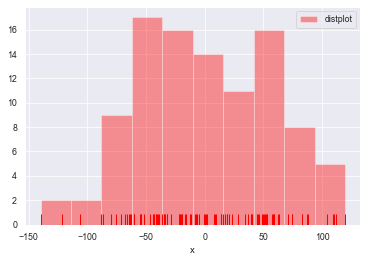
#直方图distplot()

#参数:bins->箱数, hist->是否显示箱曲线, kde->是否显示密度曲线, norm_hist->直方图是否按照密度来表示

#rug->是否显示数据分布情况, vertical->是否水平显示,label->设置图例, axlabel->设置x轴标注

rs = np.random.RandomState(123)             #设定随机种子

datas = pd.Series(rs.randn(100))            #创建包含100个随机数据的Series

sns.distplot(a=datas, bins=10, hist=True, kde=False, norm_hist=False,

             rug=True, vertical=False, color='r', label='distplot', axlabel='x')

plt.legend()
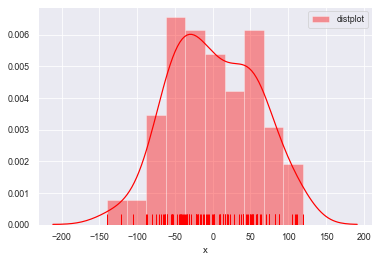
#kde=True设置密度曲线

sns.distplot(a=datas, bins=10, hist=True, kde=True, norm_hist=False,

             rug=True, vertical=False, color='r', label='distplot', axlabel='x')

plt.legend()
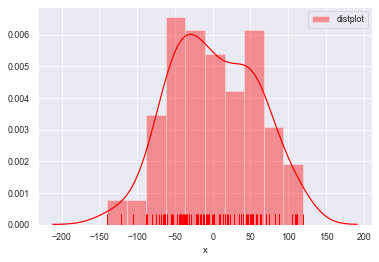
#norm_hist设置直方图按照密度曲线显示,实现hist=True 加 kde=True 共同的效果

sns.distplot(a=datas, bins=10, norm_hist=True,

             rug=True, vertical=False, color='r', label='distplot', axlabel='x')

plt.legend()
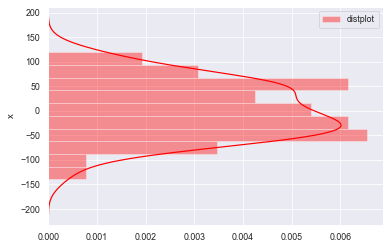
#rug=False不显示频率分布,vertical=False横向放置图形

sns.distplot(a=datas, bins=10, norm_hist=True,

             rug=False, vertical=False, color='r', label='distplot', axlabel='x')

plt.legend()
#总体参数设置

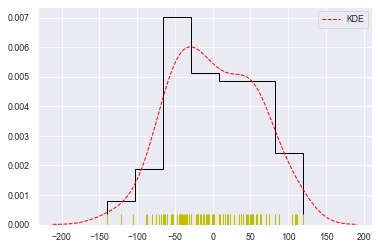
sns.distplot(datas, rug=True,

             #rug_kws设置数据频率分布颜色

             rug_kws={'color':'y'},

             #kde_kws设置密度曲线颜色、线宽、标注、线型

             kde_kws={'color':'r', 'lw':1, 'label':'KDE', 'linestyle':'--'},

             #hist_kws设置箱子的风格、线宽、透明度、颜色

             #histtype包括’bar'、‘barstacked’,'step','stepfilled'

             hist_kws={'histtype':'step', 'linewidth':1, 'alpha':1, 'color':'k'})
kdeplot()
#密度图 -- kdeplot()

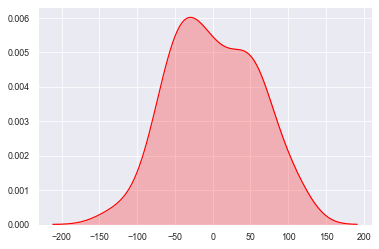
#shade--> 填充设置

sns.kdeplot(datas, shade=True, color='r', vertical=False)
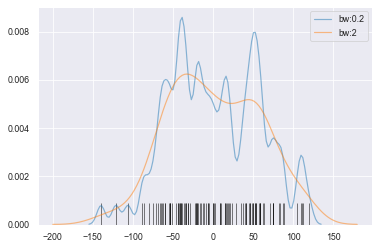
#bw --> 拟合参数

sns.kdeplot(datas, bw=5, label='bw:0.2',

            linestyle='-', linewidth=1.2, alpha=0.5)

sns.kdeplot(datas, bw=20, label='bw:2',

            linestyle='-', linewidth=1.2, alpha=0.5)

#rugplot()设置频率分布图

sns.rugplot(datas, height=0.1, color='k', alpha=0.5)
二维数据可视化
kdeplot()
#二维数据密度图

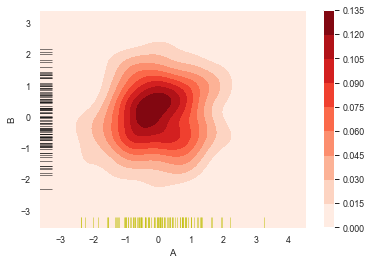
rs = np.random.RandomState(12345)

df = pd.DataFrame(rs.randn(100,2),

                  columns=['A','B'])

sns.kdeplot(df['A'],df['B'],

            cbar = True,             #设置显示颜色图例条

            shade = True,            #是否填充

            cmap = 'Reds',           #设置调色盘

            shade_lowest = 'False',  #设置最外围颜色是否显示

            n_levels = 10)           #设置曲线个数(越多越平滑)

#分别设置x,y轴的频率分布图

sns.rugplot(df['A'], color='y', axis='x', alpha=0.5)

sns.rugplot(df['B'], color='k', axis='y', alpha=0.5)
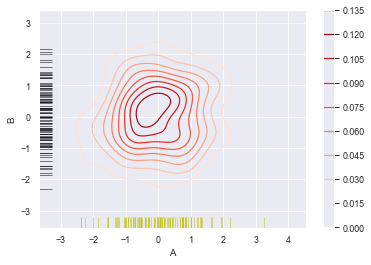
sns.kdeplot(df['A'],df['B'],

            cbar = True,

            shade = False,            #不填充

            cmap = 'Reds',

            shade_lowest = 'False',

            n_levels = 10)

#分别设置x,y轴的频率分布图

sns.rugplot(df['A'], color='y', axis='x', alpha=0.5)

sns.rugplot(df['B'], color='k', axis='y', alpha=0.5)
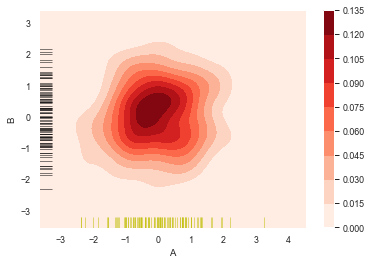
sns.kdeplot(df['A'],df['B'],

            cbar = True,

            shade = True,

            cmap = 'Reds',

#             shade_lowest = 'False',  #设置最外围颜色是否显示,与shade配合使用

            n_levels = 10)           #设置曲线个数(越多越平滑)

#分别设置x,y轴的频率分布图

sns.rugplot(df['A'], color='y', axis='x', alpha=0.5)

sns.rugplot(df['B'], color='k', axis='y', alpha=0.5)
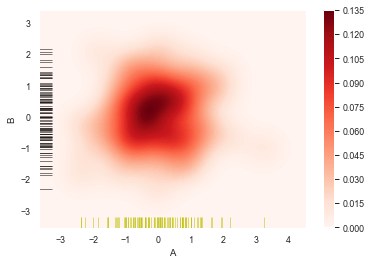
sns.kdeplot(df['A'],df['B'],

            cbar = True,

            shade = True,

            cmap = 'Reds',

#             shade_lowest = 'False',  #设置最外围颜色是否显示,与shade配合使用

            n_levels = 100)           #设置曲线个数(越多则边界渐变越平滑)

#分别设置x,y轴的频率分布图

sns.rugplot(df['A'], color='y', axis='x', alpha=0.5)

sns.rugplot(df['B'], color='k', axis='y', alpha=0.5)
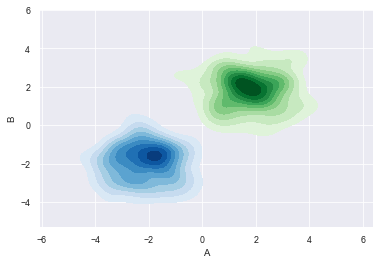
#多个密度图

#创建两个DataFrame数组

rs1 = np.random.RandomState(12)

rs2 = np.random.RandomState(21)

df1 = pd.DataFrame(rs1.randn(100,2)+2, columns=['A','B'])

df2 = pd.DataFrame(rs2.randn(100,2)-2, columns=['A','B'])

#创建密度图

sns.kdeplot(df1['A'], df1['B'], cmap='Greens',

            shade=True, shade_lowest=False)

sns.kdeplot(df2['A'], df2['B'], cmap='Blues',

            shade=True, shade_lowest=False)
Seaborn分布数据可视化---直方图/密度图的更多相关文章
- Python图表数据可视化Seaborn:1. 风格| 分布数据可视化-直方图| 密度图| 散点图
conda install seaborn 是安装到jupyter那个环境的 1. 整体风格设置 对图表整体颜色.比例等进行风格设置,包括颜色色板等调用系统风格进行数据可视化 set() / se ...
- seaborn分布数据可视化:直方图|密度图|散点图
系统自带的数据表格(存放在github上https://github.com/mwaskom/seaborn-data),使用时通过sns.load_dataset('表名称')即可,结果为一个Dat ...
- Echarts数据可视化series-radar雷达图,开发全解+完美注释
全栈工程师开发手册 (作者:栾鹏) Echarts数据可视化开发代码注释全解 Echarts数据可视化开发参数配置全解 6大公共组件详解(点击进入): title详解. tooltip详解.toolb ...
- Echarts数据可视化series-line线图,开发全解+完美注释
全栈工程师开发手册 (作者:栾鹏) Echarts数据可视化开发代码注释全解 Echarts数据可视化开发参数配置全解 6大公共组件详解(点击进入): title详解. tooltip详解.toolb ...
- Echarts数据可视化series-graph关系图,开发全解+完美注释
全栈工程师开发手册 (作者:栾鹏) Echarts数据可视化开发代码注释全解 Echarts数据可视化开发参数配置全解 6大公共组件详解(点击进入): title详解. tooltip详解.toolb ...
- seaborn线性关系数据可视化:时间线图|热图|结构化图表可视化
一.线性关系数据可视化lmplot( ) 表示对所统计的数据做散点图,并拟合一个一元线性回归关系. lmplot(x, y, data, hue=None, col=None, row=None, p ...
- Matplotlib学习---用matplotlib画直方图/密度图(histogram, density plot)
直方图用于展示数据的分布情况,x轴是一个连续变量,y轴是该变量的频次. 下面利用Nathan Yau所著的<鲜活的数据:数据可视化指南>一书中的数据,学习画图. 数据地址:http://d ...
- 用Python的Plotly画出炫酷的数据可视化(含各类图介绍,附代码)
前言 本文的文字及图片来源于网络,仅供学习.交流使用,不具有任何商业用途,版权归原作者所有,如有问题请及时联系我们以作处理. 作者: 我被狗咬了 在谈及数据可视化的时候,我们通常都会使用到matplo ...
- R绘图(1): 在散点图边缘加上直方图/密度图/箱型图
当我们在绘制散点图的时候,可能会遇到点特别多的情况,这时点与点之间过度重合,影响我们对图的认知.为了更好地反映特征,我们可以加上点的密度信息,比如在原来散点所在的位置将密度用热图的形式呈现出来,再比如 ...
- python-两个筛子数据可视化(直方图)
""" 作者:zxj 功能:模拟掷骰子,两个筛子数据可视化 版本:3.0 日期:19/3/24 """ import random impo ...
随机推荐
- GPS坐标系转换 go golang 版本
GPS坐标系转换 坐标系 解释 WGS84坐标系 地球坐标系,国际通用坐标系 GCJ02坐标系 火星坐标系,WGS84坐标系加密后的坐标系:Google国内地图.高德.腾讯地图 使用 BD09坐标系 ...
- 【LeetCode二叉树#15】二叉搜索树的最小绝对差(巩固迭代中序遍历#2)
二叉搜索树的最小绝对差(迭代法中序遍历巩固) 力扣题目链接(opens new window) 给你一棵所有节点为非负值的二叉搜索树,请你计算树中任意两节点的差的绝对值的最小值. 示例: 提示:树中至 ...
- 云原生:使用HPA和VPA实现集群扩缩容
1 背景 我们之前介绍过,随着业务流量上涨之后,我们的系统需要适时的进行扩容. 数据存储层我们也介绍过MySQL的扩容 Scale UP(纵向扩展) 和 Scale Out(横向扩展) 垂直拆分(Sc ...
- TensorFlow 回归模型
TensorFlow 回归模型 首先,导入所需的库和模块.代码中使用了numpy进行数值计算,matplotlib进行数据可视化,tensorflow进行机器学习模型的构建和训练,sklearn进行多 ...
- Redisson 框架中的分布式锁
实现分布式锁通常有三种方式:数据库.Redis 和 Zookeeper.我们比较常用的是通过 Redis 和 Zookeeper 实现分布式锁.Redisson 框架中封装了通过 Redis 实现的分 ...
- Lua学习笔记3
Lua学习笔记3 IO读写 Lua中读写使用自带的I/O库处理文件. 分为简单模式和完全模式. 简单模式(simple model)拥有一个当前输入文件和一个当前输出文件,并且提供针对这些文件相关的操 ...
- 因IPv4和IPv6协议不同而引发的第三方接口调用失效的问题
记录一次因IPv4和IPv6协议不同而引发的第三方接口调用失效的问题,仅供大家参考!!! 背景介绍 公司有一个微信小程序,我做后端的,负责给小程序提供数据接口.后来因为一系列原因小程序要对接一个中控( ...
- Landsat 7的热红外波段有2个该如何选择?
本文介绍Landsat 7遥感影像数据中B61.B62两个热红外波段的区别,以及研究应用时二者选择的依据. Landsat 7遥感影像数据具有2个热红外波段,分别是Band 61与Band 6 ...
- Editor - Goto Location: Multiple Definitions - vscode 多个定义,直接跳转到主定义 不进行选择
Editor - Goto Location: Multiple Definitions - vscode 多个定义,直接跳转到主定义 不进行选择 配置里面 搜 多
- windows10 中为文件添加让自己可以使用查看、修改、运行的权限
在Win10中添加权限的方法 前一段时间重装了系统,然后,突然间就因为权限原因没法查看一些文件了.所以就想办法添加权限.尝试很多次后终于成功了,这篇文章记录一下如何为自己添加权限. 选中需要添加权限的 ...