
POJ - 1113 Wall (凸包模板) Graham Scan 算法实现
Description
Once upon a time there was a greedy King who ordered his chief Architect to build a wall around the King's castle. The King was so greedy, that he would not listen to his Architect's proposals to build a beautiful brick wall with a perfect shape and nice tall towers. Instead, he ordered to build the wall around the whole castle using the least amount of stone and labor, but demanded that the wall should not come closer to the castle than a certain distance. If the King finds that the Architect has used more resources to build the wall than it was absolutely necessary to satisfy those requirements, then the Architect will loose his head. Moreover, he demanded Architect to introduce at once a plan of the wall listing the exact amount of resources that are needed to build the wall.
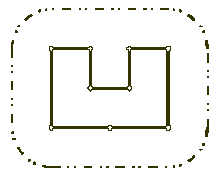
Your task is to help poor Architect to save his head, by writing a program that will find the minimum possible length of the wall that he could build around the castle to satisfy King's requirements.
The task is somewhat simplified by the fact, that the King's castle has a polygonal shape and is situated on a flat ground. The Architect has already established a Cartesian coordinate system and has precisely measured the coordinates of all castle's vertices in feet.
Input
The first line of the input file contains two integer numbers N and L separated by a space. N (3 <= N <= 1000) is the number of vertices in the King's castle, and L (1 <= L <= 1000) is the minimal number of feet that King allows for the wall to come close to the castle.
Next N lines describe coordinates of castle's vertices in a clockwise order. Each line contains two integer numbers Xi and Yi separated by a space (-10000 <= Xi, Yi <= 10000) that represent the coordinates of ith vertex. All vertices are different and the sides of the castle do not intersect anywhere except for vertices.
Output
Write to the output file the single number that represents the minimal possible length of the wall in feet that could be built around the castle to satisfy King's requirements. You must present the integer number of feet to the King, because the floating numbers are not invented yet. However, you must round the result in such a way, that it is accurate to 8 inches (1 foot is equal to 12 inches), since the King will not tolerate larger error in the estimates.
Sample Input
9 100

200 400

300 400

300 300

400 300

400 400

500 400

500 200

350 200

200 200
Sample Output
1628
Hint
结果四舍五入就可以了
Source
简化下题意即求凸包的周长+2×PI×r。
这道题的答案是凸包周长加上一个圆周长,即包围凸包的一个圆角多边形,但是没弄明白那些圆角加起来为什么恰好是一个圆。每个圆角是以凸包对应的顶点为圆心,给定的L为半径,与相邻两条边的切点之间的一段圆弧。每个圆弧的两条半径夹角与对应的凸包的内角互补。假设凸包有n条边,则所有圆弧角之和为180°n-180°(n-2)=360°。故,围墙周长为=n条平行于凸包的线段+n条圆弧的长度=凸包周长+围墙离城堡距离L为半径的圆周长。
AC代码:学习自KB大佬的模板加以修改
// Author : RioTian

// Time : 20/10/21

#include <algorithm>

#include <cmath>

#include <cstdio>

#include <cstdlib>

#include <cstring>

#include <iostream>

using namespace std;

const int N = 1000;

const double Pi = acos(-1.0);

struct point {

    int x, y;

    point() : x(), y() {}

    point(int x, int y) : x(x), y(y) {}

} list[N];

typedef point P;

int stack[N], top;

//计算叉积: p0p1 X p0p2

int cross(P p0, P p1, P p2) {

    return (p1.x - p0.x) * (p2.y - p0.y) - (p2.x - p0.x) * (p1.y - p0.y);

}

//计算 p1p2的 距离

double dis(P p1, P p2) {

    return sqrt((double)(p2.x - p1.x) * (p2.x - p1.x) +

                (p2.y - p1.y) * (p2.y - p1.y));

}

//利用极角排序,角度相同则距离小排前面

bool cmp(P p1, P p2) {

    int tmp = cross(list[0], p1, p2);

    if (tmp > 0)

        return true;

    else if (tmp == 0 && dis(list[0], p1) < dis(list[0], p2))

        return true;

    else

        return false;

}

//输入,并把  最左下方的点放在 list[0]  。并且进行极角排序

void init(int n) {

    int i, k = 0;

    cin >> list[0].x >> list[0].y;

    P p0 = list[0];  // p0 等价于 tmp 去寻找最左下方的点

    for (int i = 1; i < n; ++i) {

        cin >> list[i].x >> list[i].y;

        if (p0.y > list[i].y || (p0.y == list[i].y && p0.x > list[i].x))

            p0 = list[i], k = i;

    }

    list[k] = list[0];

    list[0] = p0;

    sort(list + 1, list + n, cmp);

}

//graham扫描法求凸包,凸包顶点存在stack栈中

//从栈底到栈顶一次是逆时针方向排列的

//如果要求凸包的一条边有2个以上的点

//那么要将while中的<=改成<

//但这不能将最后一条边上的多个点保留

//因为排序时将距离近的点排在前面

//那么最后一条边上的点仅有距离最远的会被保留,其余的会被出栈

//所以最后一条边需要特判

//如果要求逆凸包的话需要改cmp,graham中的符号即可

void Graham(int n) {

    int i;

    if (n == 1) top = 0, stack[0] = 0;

    if (n == 2) top = 1, stack[0] = 0, stack[1] = 1;

    if (n > 2) {

        for (i = 0; i <= 1; i++) stack[i] = i;

        top = 1;

        for (i = 2; i < n; i++) {

            while (top > 0 &&

                   cross(list[stack[top - 1]], list[stack[top]], list[i]) <= 0)

                top--;

            top++;

            stack[top] = i;

        }

    }

}

int main() {

    // freopen("in.txt", "r", stdin);

    // ios::sync_with_stdio(false), cin.tie(0), cout.tie(0);

    int N, L;

    while (scanf("%d%d", &N, &L) != EOF) {

        init(N);

        Graham(N);

        //叉积求凸包面积

        double res = 0;

        for (int i = 0; i < top; i++)

            res += dis(list[stack[i]], list[stack[i + 1]]);

        res += dis(list[stack[0]], list[stack[top]]);

        res += 2 * Pi * L;

        printf("%d\n", (int)(res + 0.5));

    }

}
POJ - 1113 Wall (凸包模板) Graham Scan 算法实现的更多相关文章
- POJ 1113 Wall 凸包 裸
LINK 题意:给出一个简单几何,问与其边距离长为L的几何图形的周长. 思路:求一个几何图形的最小外接几何,就是求凸包,距离为L相当于再多增加上一个圆的周长(因为只有四个角).看了黑书使用graham ...
- poj 1113 Wall 凸包的应用
题目链接:poj 1113 单调链凸包小结 题解:本题用到的依然是凸包来求,最短的周长,只是多加了一个圆的长度而已,套用模板,就能搞定: AC代码: #include<iostream> ...
- POJ 1113 - Wall 凸包
此题为凸包问题模板题,题目中所给点均为整点,考虑到数据范围问题求norm()时先转换成double了,把norm()那句改成<vector>压栈即可求得凸包. 初次提交被坑得很惨,在GDB ...
- POJ 1113 Wall 凸包求周长
Wall Time Limit: 1000MS Memory Limit: 10000K Total Submissions: 26286 Accepted: 8760 Description ...
- poj 1113 wall(凸包裸题)(记住求线段距离的时候是点积,点积是cos)
Wall Time Limit: 1000MS Memory Limit: 10000K Total Submissions: 43274 Accepted: 14716 Descriptio ...
- 凸包Graham Scan算法实现
凸包算法实现点集合中搜索凸包顶点的功能,可以处理共线情况,可以输出共线点也可以不输出而只输出凸包顶点.经典的Graham Scan算法,点排序使用极角排序方式,并对共线情况做特殊处理.一般算法是将共线 ...
- 凸包问题 Graham Scan
2020-01-09 15:14:21 凸包问题是计算几何的核心问题,并且凸包问题的研究已经持续了好多年,这中间涌现出了一大批优秀的算法. 凸包问题的最优解法是Graham Scan算法,该算法可以保 ...
- 凸包模板——Graham扫描法
凸包模板--Graham扫描法 First 标签: 数学方法--计算几何 题目:洛谷P2742[模板]二维凸包/[USACO5.1]圈奶牛Fencing the Cows yyb的讲解:https:/ ...
- 计算几何--求凸包模板--Graham算法--poj 1113
Wall Time Limit: 1000MS Memory Limit: 10000K Total Submissions: 28157 Accepted: 9401 Description ...
- POJ 1113 Wall 求凸包的两种方法
Wall Time Limit: 1000MS Memory Limit: 10000K Total Submissions: 31199 Accepted: 10521 Descriptio ...
随机推荐
- 阿里云轻量服务器上编译安装docker trojan时报错 fatal error: Killed signal terminated program cc1plus compilation
轻量服务器编译安装docker trojan时报错 72%时 通过以下操作解决,和编译其他软件类似,是内存不足引起的 编译安装swoole的时候报错 fatal error: Killed sig ...
- jmeter二次开发自定义函数助手
需求:在工作中,需要使用唯一的字符串来作为订单ID,于是想到了UUID,要求uuid中不能有特殊字符包括横线,所以就有了重新写一个uuid进行使用: 准备:idea 依赖包: 注意事项:必须有包且包的 ...
- DataGridView合并单元格,重绘后选中内容被覆盖的解决办法
DataGridView合并单元格只能进行重绘,网上基本上使用的是下面的方法: 1 /// <summary> 2 /// 说明:纵向合并单元格 3 /// 参数:dgv DataGrid ...
- StingBuilder与StringBuffer包含的常见方法(图示)
StingBuilder与StringBuffer包含的常见方法
- ASR项目实战-语音识别
本文深入探讨语音识别处理环节. 本阶段的重点特性为语音识别.VAD.热词.文本的时间偏移.讲话人的识别等. 语音识别 业界流派众多,比如Kaldi.端到端等,具体选择哪一种,需要综合考虑人员能力.训练 ...
- 【scikit-learn基础】--『监督学习』之 支持向量机回归
在机器学习中,支持向量机(Support Vector Machine)算法既可以用于回归问题,也可以用于分类问题. 支持向量机(SVM)算法的历史可以追溯到1963年,当时前苏联统计学家弗拉基米尔· ...
- 在Linux上部署.net Core 步骤以及遇到的一些问题
Linux安装部署手册 一.安装.NET Core SDK centos 7 系统命令为: sudo rpm -Uvh https://packages.microsoft.com/config/ce ...
- Pikachu漏洞靶场 (SSRF服务端请求伪造)
SSRF(Server-Side Request Forgery:服务器端请求伪造) curl 点击 累了吧,来读一首诗吧 url是这样的: http://192.168.171.30/pikachu ...
- HDU 4705 立方和拆解
HDU 4705 立方和拆解 题意 给一棵树,找出所有的(A,B,C)三元组的数量,满足ABC不能同时被一条路径覆盖 思路 首先可以明确的是,对于每个入度大于等于3的点(也就是有两个或以上儿子的节点) ...
- 在线录屏-通过Web API接口轻松实现录屏
在线录屏是指在互联网上进行屏幕录制的过程.它允许用户通过网络连接,将自己的屏幕活动记录下来,并可以在需要时进行播放.共享或存档.在线录屏常用于教育.培训.演示.游戏等场景,可以帮助用户展示操作步骤.解 ...