
Map Reduce Application(Join)
We are going to explain how join works in MR , we will focus on reduce side join and map side join.
Reduce Side Join
Assuming we have 2 datasets , one is user information(id, name...) , the other is comments made by users(user id, content, date...). We want to join the 2 datasets to select the username and comment they posted. So, this is a typical join example. You can implement all types of join including innter join/outer join/full outer join... As the name indicates, the join is done in reducer.
- We use 2/n mappers for each dataset(table in RDBMS). So, we set this with code below.
 MultipleInputs.addInputPath(job,filePath,TextInputFormat.class,UserMapper.class)

 MultipleInputs.addInputPath(job,filePath,TextInputFormat.class,CommentsMapper.class)
3 ....
4 MultipleInputs.addInputPath(job,filePath,TextInputFormat.class,OtherMapper.class)
.... - In each mapper, we just need to output the key/value pairs as the job is most done in reducer. In reduce function, when it iterators the values for a given key, reduce function needs to know the value is from which dataset to perform the join. Reducer itself may not be able to distinguish which value is from which mapper(UserMapper or CommentsMapper) for a given key. So, in the map function, we have a chance to mark the value like prefix the value with the mapper name something like that.
 outkey.set(userId);

 //mark this value so reduce function knows

 outvalue.set("UserMapper"+value.toString);

context.write(outkey,outvalue) - In reducer, we get the join type from configuration, perform the join. there can be multiple reducers and with multiple threads.
 public void setup(Context context){

     joinType = context.getConfiguration().get("joinType");

 }

 public void reduce(Text text, Iterable<Text> values, Context context)

         throws Exception {

         listUser.clear();

         listComments.clear();

         for (Text t: values){

             if(isFromUserMapper(t)){

                 listUser.add(realContent(t));

             }else if (isFromCommentsMapper(t)){

                 listUser.add(realContent(t));

             }

         }

         doJoin(context);

 }

 private void doJoin(Context context) throws Exception{

     if (joinType.equals("inner")){

         if(both are not empty){

             for (Text user:listUser){

                 for (Text comm: listComments){

                     context.write(user,comm);

                 }

             }

         }

     }else if (){

     }.....

 }
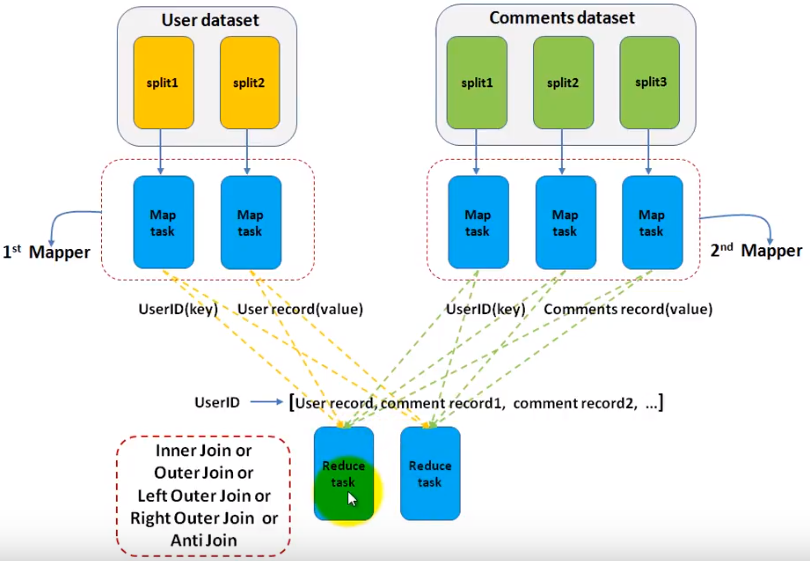
In reducer side join, all data will be sent to reducer side, so, the overall network bandwith is required.
Map Side Join/Replicated Join
As the name indicates , the join operation is done in map side . So, there is no reducer. It is very suitable for join datasets which has only 1 large dataset and others are small dataset and can be read into small memory in a single machine. It is faster than reduce side join (as no reduce phase, no intermediate output, no network transfer)
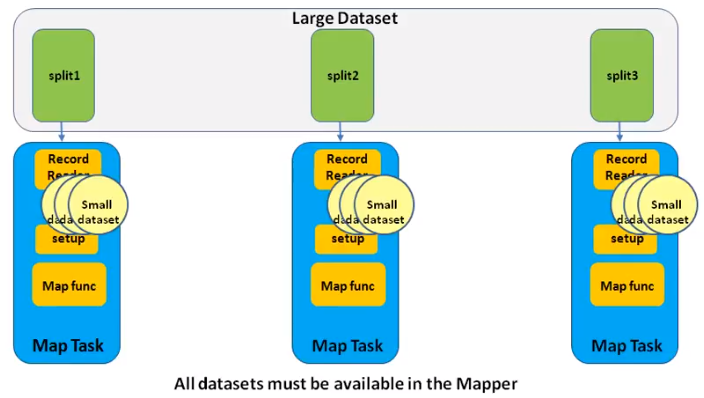
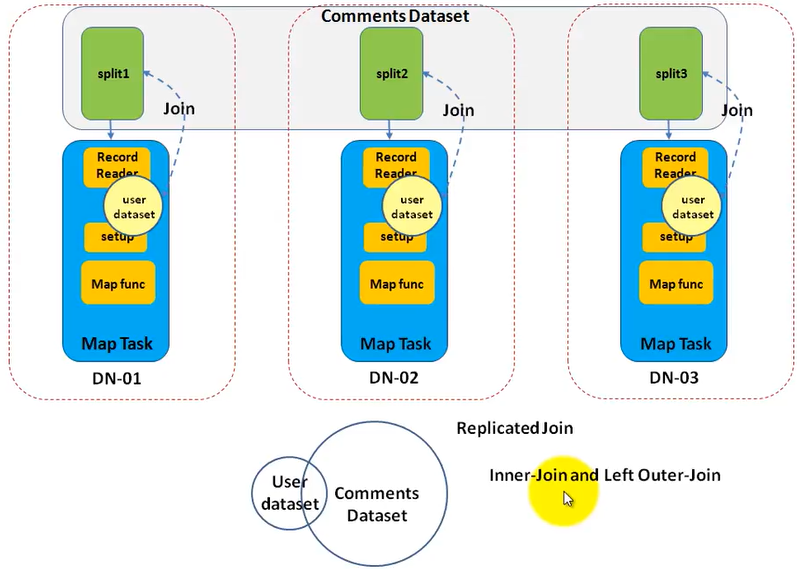
We still use the sample example that is to join user(small) and comments(large) datasets. How to implement it?
- Set the number of reduce to 0.
job.setNumReduceTasks(0);
- Add the small datasets to hadoop distribute cache.The first one is deprecated.
 DistributedCache.addCacheFile(new Path(args[]).toUri(),job.getConfiguration)

 job.addCacheFile(new Path(filename).toUri());
- In mapper setup function, get the cache by code below. The first one is deprecated. Read the file and put the the key / value in an instance variable like HashMap. This is single thread, so it is safe.
Path[] localPaths = context.getLocalCacheFiles();
URI[] uris = context.getCacheFiles()
- In the mapper function, since, you have the entire user data set in the HashMap, you can try to get the key(comes from the split of comment dataset) from the HashMap. If it exists, you get a match. Because only one split of comments dataset goes into each mapper task, you can only perform an inner join or a left outer join.
What is Hadoop Distributed Cache?
"DistributedCache is a facility provided by the Map-Reduce framework to cache files needed by applications. Once you cache a file for your job, hadoop framework will make it available on(or broadcast to) each and every data nodes (in file system, not in memory) where you map/reduce tasks are running. Then you can access the cache file as local file in your Mapper Or Reducer job. Now you can easily read the cache file and populate some collection (e.g Array, Hashmap etc.) in your code" The cache will be removed once the job is done as they are temporary files.
The size of the cache can be configured in mapred-site.xml.
How to use Distributed Cache(the API has changed)?
- Add cache in driver.
Note the # sign in the URI. Before it, you specify the absolute data path in HDFS. After it, you set a name(symlink) to specify the local file path in your mapper/reducer.
     job.addCacheFile(new URI("/user/ricky/user.txt#user"));

     job.addCacheFile(new URI("/user/ricky/org.txt#org"));

     return job.waitForCompletion(true) ? 0 : 1;
- Read cache in your task(mapper/reduce), probably in setup function.
 @Override

 protected void setup(

         Mapper<LongWritable, Text, Text, Text>.Context context)

         throws IOException, InterruptedException {

     if (context.getCacheFiles() != null

             && context.getCacheFiles().length > 0) {

         File some_file = new File("user");

         File other_file = new File("org");

     }

     super.setup(context);

 }
Reference:
https://www.youtube.com/user/pramodnarayana/videos
https://stackoverflow.com/questions/19678412/number-of-mappers-and-reducers-what-it-means
Map Reduce Application(Join)的更多相关文章
- Map Reduce Application(Partitioninig/Binning)
Map Reduce Application(Partitioninig/Group data by a defined key) Assuming we want to group data by ...
- Map Reduce Application(Top 10 IDs base on their value)
Top 10 IDs base on their value First , we need to set the reduce to 1. For each map task, it is not ...
- Map/Reduce中Join查询实现
张表,分别较data.txt和info.txt,字段之间以/t划分. data.txt内容如下: 201001 1003 abc 201002 1005 def 201003 ...
- hadoop 多表join:Map side join及Reduce side join范例
最近在准备抽取数据的工作.有一个id集合200多M,要从另一个500GB的数据集合中抽取出所有id集合中包含的数据集.id数据集合中每一个行就是一个id的字符串(Reduce side join要在每 ...
- hadoop的压缩解压缩,reduce端join,map端join
hadoop的压缩解压缩 hadoop对于常见的几种压缩算法对于我们的mapreduce都是内置支持,不需要我们关心.经过map之后,数据会产生输出经过shuffle,这个时候的shuffle过程特别 ...
- HIVE 的MAP/REDUCE
对于 JOIN 操作: Map: 以 JOIN ON 条件中的列作为 Key,如果有多个列,则 Key 是这些列的组合 以 JOIN 之后所关心的列作为 Value,当有多个列时,Value 是这些列 ...
- mapreduce: 揭秘InputFormat--掌控Map Reduce任务执行的利器
随着越来越多的公司采用Hadoop,它所处理的问题类型也变得愈发多元化.随着Hadoop适用场景数量的不断膨胀,控制好怎样执行以及何处执行map任务显得至关重要.实现这种控制的方法之一就是自定义Inp ...
- 基于python的《Hadoop权威指南》一书中气象数据下载和map reduce化数据处理及其可视化
文档内容: 1:下载<hadoop权威指南>中的气象数据 2:对下载的气象数据归档整理并读取数据 3:对气象数据进行map reduce进行处理 关键词:<Hadoop权威指南> ...
- Reduce Side Join实现
关于reduce边join,其最重要的是使用MultipleInputs.addInputPath这个api对不同的表使用不同的Map,然后在每个Map里做一下该表的标识,最后到了Reduce端再根据 ...
随机推荐
- 【最新】LuaJIT 32/64 位字节码,从编译到使用全纪录
网上关于 LuaJIT 的讨论,已经显得有些陈旧.如果你对 LuaJIT 编译 Lua 源文件为具体的 32位或64位字节码,极其具体使用感兴趣的话,不妨快速读一下这篇文章.此文章针对尝试在 iOS ...
- 使用第三方库iOS-ECharts做柱状图的心得
最近的项目里面用到了饼图和条形统计图,饼图用的是PNChart来做的,这个库感觉用起来也简单,但是做条形统计图的时候就特别蛋疼(不知道是不是我姿势没对),反正就是各种问题,然后就想到换一种框架,最后选 ...
- windows用交互式命令执行python程序
1.进入cmd命令 windows+r2.进入盘符,eg:E:3.使用dir命令查看当前文件夹下的所有目录4.使用绝对路径或者相对路径和cd命令直接进入想要到达的文件夹目录(或者使用cd命令一步一步达 ...
- ubnutu 安装protocol buffer
工作中需要使用protocol buffer,需要编译出protocol buffer的动态链接库,然后在别的makefile中链接它, 我的环境是ubnutu16.04,64bit,使用的proto ...
- SpringBoot整合Swagger2以及生产环境的安全问题处理
1.创建springboot项目 https://www.cnblogs.com/i-tao/p/8878562.html 这里我们使用多环境配置: application-dev.yml(开发环境) ...
- 安装mysql8.13用Navicat Premium链接本地数据库报2059
推荐使用已下命令: ALTER USER 'root'@'localhost' IDENTIFIED BY 'password' PASSWORD EXPIRE NEVER; #修改加密规则 ALTE ...
- MySQL---下载安装、数据库基本操作
1.下载安装 1.1 下载: http://dev.mysql.com/downloads/mysql/ 1.2 解压 1.3 初始化 cd c:\mysql-5.7.16-winx64\bin ( ...
- 创建jq插件步骤
无意看了这篇<jQuery插件开发精品教程,让你的jQuery提升一个台阶>文章,现在做一下总结. 一.jQuery插件的创建可以有三种方法 1.通过$.extend()来扩展jQuery ...
- Java代码注释
单行注释: 选中代码,按下ctrl+/ 一条代码单行注释:选中一条代码按下ctrl+/,则为一条代码单行注释: 多条代码单行注释:选中多条代码按下ctrl+/,则为多条代码单行注释: 取消注释:对已经 ...
- python反射怎么用
反射: 通过字符串的形式对 对象 进行增删改查 setattr 设置某个属性的值 class A(object): def __init__(self): self.name = "sath ...