
Executors、ThreadPoolExecutor线程池讲解
官方+白话讲解Executors、ThreadPoolExecutor线程池使用
Executors:JDK给提供的线程工具类,静态方法构建线程池服务ExecutorService,也就是ThreadPoolExecutor,使用默认线程池配置参数。
建议:对于大用户,高并发,不易掌控的项目,不建议使用Executors来创建线程池对象。
对于易于掌控且并发数不高的项目,可以考虑Executors。
ThreadPoolExecutor:线程池对象,实现ExecutorService接口,可以自定义线程池核心线程数、最大线程数、空闲时间、缓冲队列等。
建议:大用户,高并发,不易于掌控的项目,建议根据物理服务器配置,任务需求耗时,可能存在的并发量,自定义配置ThreadPoolExecutor线程信息。
一般项目会封装ThreadPoolExecutor工具类,因为需要考虑新手有时会乱用,也方便于统一灵活管理。
一、先说下Executors 创建线程池的三种策略
1.创建无边界缓存线程池:Executors.newCachedThreadPool()
无边界缓存界线程池:不限制最大线程数的线程池,且线程有空闲存活时长。
接着看下JDK Executors.newCachedThreadPool()源码:

源码可以可以看到,该方法创建了一个线程池为:核心线程数0,最大线程数Integer.MAX_VALUE(可以理解为无上限),线程空闲存活时长60,单位TimeUnit.SECONDS秒,缓冲队列是SynchronousQueue的线程池。
因为最大线程数没有上限,所以,大用户,高并发项目使用时一定要严谨配置。
关于SynchronousQueue缓冲队列的缓冲数是1,不过每次都被线程池创建取走,所以该缓冲对联永远isEmpty=true。具体细节先百度,后续有时间我再讲解。
2.创建有边界线程池:Executors.newFixedThreadPool(200)
有边界线程池:有最大线程数限制的线程池。
接着看下JDK Executors.newFixedThreadPool(200)源码:

源码可以可以看到,该方法创建了一个线程池为:核心线程数nThreads(200),最大线程数nThreads (200),线程空闲存活时长0,单位TimeUnit.SECONDS秒,缓冲队列是LinkedBlockingQueue的线程池。
LinkedBlockingQueue这里没有定义长度,也就是说这个缓冲队列的容量没有上限,大用户,高并发项目使用时一定要严谨配置。
3.创建单线程线程池:Executors.newSingleThreadExecutor()
单线程线程池:线程池里只有一个线程数,其他都存在缓冲队列里,
接着看下JDK Executors.newSingleThreadExecutor()源码:
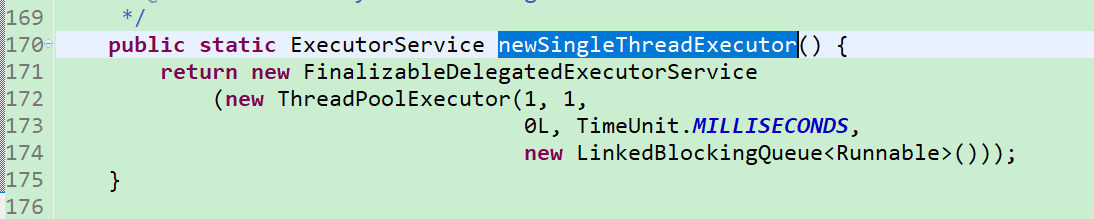
源码可以可以看到,该方法创建了一个线程池为:核心线程数1,最大线程数1,线程空闲存活时长0,单位TimeUnit.MILLISECONDS毫秒,缓冲队列是LinkedBlockingQueue的线程池。
LinkedBlockingQueue这里没有定义长度,也就是说这个缓冲队列的容量没有上限,大用户,高并发项目使用时一定要严谨配置。
使用场景:任务需要逐一调度执行。
二、ThreadPoolExecutor自定义配置线程池对象
通过上面的Executors,我们对创建线程池已经有了点了解。
下面直接看构造函数的源码,我把参数解释为白话文
   /**

     * @param corePoolSize the number of threads to keep in the pool, even

     *        if they are idle, unless {@code allowCoreThreadTimeOut} is set
         核心线程数,核心线程数永远小于等于最大线程数。
         缓冲队列不满时,线程池的线程数用远小于等于核心线程数。
         缓冲队列满时,线程池会在核心线程数的基础上再创建线程,但小于最大线程数

     * @param maximumPoolSize the maximum number of threads to allow in the

     *        pool
         线程池最大线程数

     * @param keepAliveTime when the number of threads is greater than

     *        the core, this is the maximum time that excess idle threads

     *        will wait for new tasks before terminating.
         线程空闲存活时长

     * @param unit the time unit for the {@code keepAliveTime} argument
         线程存活时长单位

     * @param workQueue the queue to use for holding tasks before they are

     *        executed.  This queue will hold only the {@code Runnable}

     *        tasks submitted by the {@code execute} method.
              缓冲队列,BlockingQueue接口的实现类,根据需求选择他的实现类即可,细节有必要去找度娘。
         常用BlockingQueue有LinkedBlockingQueue和SynchronousQueue

     * @param threadFactory the factory to use when the executor

     *        creates a new thread
         线程工厂,用来创建线程的,使用默认的就好

     * @param handler the handler to use when execution is blocked

     *        because the thread bounds and queue capacities are reached
         缓冲队列已满且已经最大线程数,这时的处理策略
         RejectedExecutionHandler下有多个实现类,根据所需决定
   */

    public ThreadPoolExecutor(int corePoolSize,

                              int maximumPoolSize,

                              long keepAliveTime,

                              TimeUnit unit,

                              BlockingQueue<Runnable> workQueue,

                              ThreadFactory threadFactory,

                              RejectedExecutionHandler handler) {

        if (corePoolSize < 0 ||

            maximumPoolSize <= 0 ||

            maximumPoolSize < corePoolSize ||

            keepAliveTime < 0)

            throw new IllegalArgumentException();

        if (workQueue == null || threadFactory == null || handler == null)

            throw new NullPointerException();

        this.acc = System.getSecurityManager() == null ?

                null :

                AccessController.getContext();

        this.corePoolSize = corePoolSize;

        this.maximumPoolSize = maximumPoolSize;

        this.workQueue = workQueue;

        this.keepAliveTime = unit.toNanos(keepAliveTime);

        this.threadFactory = threadFactory;

        this.handler = handler;

    }
在开发实战中,对于多线程颇为了解的,我建议根据硬件和软件需求结合,自定义创建ThreadPoolExecutor线程池。
Executors、ThreadPoolExecutor线程池讲解的更多相关文章
- ThreadPoolExecutor 线程池的源码解析
1.背景介绍 上一篇从整体上介绍了Executor接口,从上一篇我们知道了Executor框架的最顶层实现是ThreadPoolExecutor类,Executors工厂类中提供的newSchedul ...
- j.u.c系列(01) ---初探ThreadPoolExecutor线程池
写在前面 之前探索tomcat7启动的过程中,使用了线程池(ThreadPoolExecutor)的技术 public void createExecutor() { internalExecutor ...
- 手写线程池,对照学习ThreadPoolExecutor线程池实现原理!
作者:小傅哥 博客:https://bugstack.cn Github:https://github.com/fuzhengwei/CodeGuide/wiki 沉淀.分享.成长,让自己和他人都能有 ...
- 源码剖析ThreadPoolExecutor线程池及阻塞队列
本文章对ThreadPoolExecutor线程池的底层源码进行分析,线程池如何起到了线程复用.又是如何进行维护我们的线程任务的呢?我们直接进入正题: 首先我们看一下ThreadPoolExecuto ...
- 手写一个线程池,带你学习ThreadPoolExecutor线程池实现原理
摘要:从手写线程池开始,逐步的分析这些代码在Java的线程池中是如何实现的. 本文分享自华为云社区<手写线程池,对照学习ThreadPoolExecutor线程池实现原理!>,作者:小傅哥 ...
- ThreadPoolExecutor 线程池的实现
ThreadPoolExecutor继承自 AbstractExecutorService.AbstractExecutorService实现了 ExecutorService 接口. 顾名思义,线程 ...
- 13.ThreadPoolExecutor线程池之submit方法
jdk1.7.0_79 在上一篇<ThreadPoolExecutor线程池原理及其execute方法>中提到了线程池ThreadPoolExecutor的原理以及它的execute方法 ...
- javade多任务处理之Executors框架(线程池)实现的内置几种方式与两种基本自定义方式
一 Executors框架(线程池) 主要是解决开发人员进行线程的有效控制,原理可以看jdk源码,主要是由java.uitl.concurrent.ThreadPoolExecutor类实现的,这里只 ...
- Java并发——ThreadPoolExecutor线程池解析及Executor创建线程常见四种方式
前言: 在刚学Java并发的时候基本上第一个demo都会写new Thread来创建线程.但是随着学的深入之后发现基本上都是使用线程池来直接获取线程.那么为什么会有这样的情况发生呢? new Thre ...
随机推荐
- 字符串的方法slice、substr、substring对比
三个方法的参数1都代表子串开始位置,参数2在slice和substring中表示结束位置,而在substr中代表的则是子串长度: 对于负数态度,当出现在参数1的位置时,slice和substr从末尾开 ...
- pytest--常用插件
前戏 虽然pytest给我们提供了很多的功能,但是有些功能还是没有,而pytest的插件可以满足我们的需求,比如用例失败重跑,统计代码覆盖率等等功能. pytest-sugar pytest-suga ...
- 我是sb
哪能倒在这? 细节很多的题怎么写????sb 考完再也不学了,太jb痛苦了. 总因为一些奇奇怪怪的原因导致我
- 认识随机函数rand()和srand(unsigned int )
rand函数 int rand( void ); 函数名: rand 功 能: 随机数发生器 用 法: int rand(void); 所在头文件: stdlib.h 函数说明 : ...
- Django RestFramework中UpdateAPIView类使用
修改数据 from django.conf.urls import url from .api import workflow,workflowline urlpatterns = [ url(r'^ ...
- BBC micro:bit引脚介绍
另外两个大引脚(3V和GND)是非常不同的! 注意 标记为3V和GND的引脚与电路板的电源相关,千万不要连接在一起. 电源输入:如果BBC micro:bit由USB或电池供电,则可以使用3V引脚作为 ...
- SQLServer字符串与数字拼接
1.使用cast‘’+cast(@ID as varchar) 2.使用LTrim‘’+LTrim(@ID) 感觉第二种方式代码简单,但是可读性不好.
- Sitecore安全:访问权限
由于Sitecore使用Core数据库中的项来定义其用户界面,因此您可以对该数据库中的项应用访问权限,以控制对CMS功能的访问.最常见的是,将用户置于预定义的Sitecore客户端角色中 Siteco ...
- 如何用Python制作优美且功能强大的数据可视化图像
第一个案例 首先开始来绘制你的第一个图表 from pyecharts import Bar '''遇到不懂的问题?Python学习交流群:1004391443满足你的需求,资料都已经上传群文件,可以 ...
- 通过Queue控制线程并发,并监控队列执行进度
# -*- coding:utf-8 -*- import Queue import time import threading # 需要执行的业务主体 def domain(id): time.sl ...