
当我们谈论Erlang Maps时,我们谈论什么 Part 1

Record的痛点
这些痛点在Maps出现之后有所改善吗?
我们先从细数痛点開始:
|
1
2
3
4
5
6
7
8
9
10
|
7> rd(person,{name,id}).person8> #person{}.#person{name = undefined,id = undefined}9> P=person.person10> #P{}.* 1: syntax error before: P10> |
http://stackoverflow.com/questions/4103731/is-it-possible-to-use-record-name-as-a-parameter-in-erlang
|
1
2
3
4
5
|
10> N=name.name11> #person{N="zen"}.* 1: field 'N' is not an atom or _ in record person12> |
|
1
2
3
4
5
6
7
8
9
10
11
12
13
14
15
|
Eshell V6.0 (abort with ^G)1> rd(foo,{a,b,c}).foo2> rd(a,{f,m}).a3> rd(f,{id,name}).f4> #foo{a=#a{f=#f{id=2002,name="zen"},m=1984},b=1234,c=2465}.#foo{a = #a{f = #f{id = 2002,name = "zen"},m = 1984}, b = 1234,c = 2465}5> D=v(4).#foo{a = #a{f = #f{id = 2002,name = "zen"},m = 1984}, b = 1234,c = 2465}6> D#foo.a#a.f#f.name."zen" |
原因何在?
This parse transform can be used to reduce compile-time dependencies in large systems.In the old days, before records, Erlang programmers often wrote access functions for tuple data. This was tedious and error-prone. The record syntax made this easier, but since records were implemented fully in the pre-processor, a nasty compile-time dependency was introduced.
This module automates the generation of access functions for records. While this method cannot fully replace the utility of pattern matching, it does allow a fair bit of functionality on records without the need for compile-time dependencies.
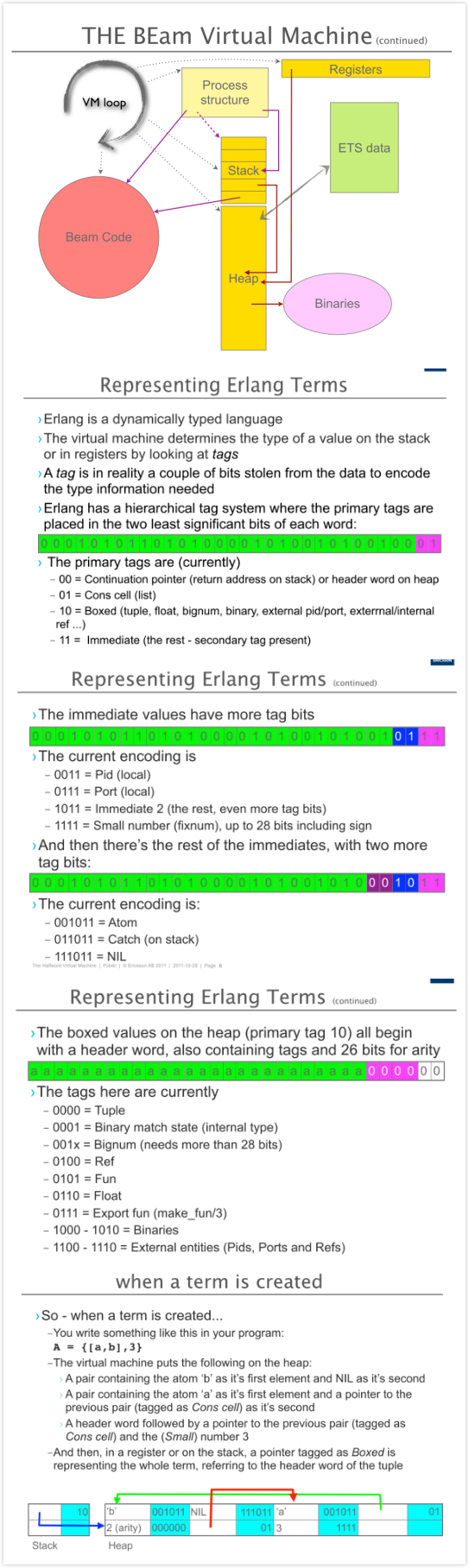
01 = Cons cell (list)
10 = Boxed (tuple, float, bignum, binary, external pid/port, exterrnal/internal ref ...)
11 = Immediate (the rest - secondary tag present)
– 0001 = Binary match state (internal type)
– 001x = Bignum (needs more than 28 bits)
– 0100 = Ref
– 0101 = Fun
– 0110 = Float
– 0111 = Export fun (make_fun/3)
– 1000 - 1010 = Binaries
– 1100 - 1110 = External entities (Pids, Ports and Refs)
#define BIN_MATCHSTATE_SUBTAG (0x1 << _TAG_PRIMARY_SIZE)
#define POS_BIG_SUBTAG (0x2 << _TAG_PRIMARY_SIZE) /* BIG: tags 2&3 */
#define NEG_BIG_SUBTAG (0x3 << _TAG_PRIMARY_SIZE) /* BIG: tags 2&3 */
#define _BIG_SIGN_BIT (0x1 << _TAG_PRIMARY_SIZE)
#define REF_SUBTAG (0x4 << _TAG_PRIMARY_SIZE) /* REF */
#define FUN_SUBTAG (0x5 << _TAG_PRIMARY_SIZE) /* FUN */
#define FLOAT_SUBTAG (0x6 << _TAG_PRIMARY_SIZE) /* FLOAT */
#define EXPORT_SUBTAG (0x7 << _TAG_PRIMARY_SIZE) /* FLOAT */
#define _BINARY_XXX_MASK (0x3 << _TAG_PRIMARY_SIZE)
#define REFC_BINARY_SUBTAG (0x8 << _TAG_PRIMARY_SIZE) /* BINARY */
#define HEAP_BINARY_SUBTAG (0x9 << _TAG_PRIMARY_SIZE) /* BINARY */
#define SUB_BINARY_SUBTAG (0xA << _TAG_PRIMARY_SIZE) /* BINARY */
#define MAP_SUBTAG (0xB << _TAG_PRIMARY_SIZE) /* MAP */
#define EXTERNAL_PID_SUBTAG (0xC << _TAG_PRIMARY_SIZE) /* EXTERNAL_PID */
#define EXTERNAL_PORT_SUBTAG (0xD << _TAG_PRIMARY_SIZE) /* EXTERNAL_PORT */
#define EXTERNAL_REF_SUBTAG (0xE << _TAG_PRIMARY_SIZE) /* EXTERNAL_REF */
Types:
ETERM **array;
int arrsize;
Creates an Erlang tuple from an array of Erlang terms.
array is an array of Erlang terms.
arrsize is the number of elements in array.
- 高速查询 O(1), 编译期间完毕了对key的索引,对于小数据量存取相当快 (~50 values),
- 没有过多额外的内存消耗,仅仅有Value和name 2+ N个字 (name + size+ N)
- 函数头完毕匹配
Maps与Record是一场你死我活的PK么?我们明天再说,敬请关注.
http://www.cnblogs.com/me-sa/archive/2012/03/24/you-win-yourself-zen-this-is-the-50-erlang-article-go-on.html
http://www.cnblogs.com/me-sa/archive/2012/04/28/2474892.html
http://www.cnblogs.com/me-sa/archive/2012/06/06/2538941.html

当我们谈论Erlang Maps时,我们谈论什么 Part 1的更多相关文章
- [Erlang 0117] 当我们谈论Erlang Maps时,我们谈论什么 Part 2
声明:本文讨论的Erlang Maps是基于17.0-rc2,时间2014-3-4.后续Maps可能会出现语法或函数API上的有所调整,特此说明. 前情提要: [Erlang 0116] 当我们谈论E ...
- 当我们谈论Erlang Maps时,我们谈论什么 Part 2
声明:本文讨论的Erlang Maps是基于17.0-rc2,时间2014-3-4.兴许Maps可能会出现语法或函数API上的有所调整,特此说明. 前情提要: [Erlang 0116] 当我们谈论E ...
- [Erlang 0116] 当我们谈论Erlang Maps时,我们谈论什么 Part 1
Erlang 增加 Maps数据类型并不是很突然,因为这个提议已经进行了2~3年之久,只不过Joe Armstrong老爷子最近一篇文章Big changes to Erlang掀起不小了风 ...
- [Erlang 0121] 当我们谈论Erlang Maps时,我们谈论什么 Part 3
Erlang/OTP 17.0 has been released http://www.erlang.org/download/otp_src_17.0.readme Erlang/OTP ...
- 话题讨论&征文--谈论大数据时我们在谈什么 获奖名单发布
从社会发展趋势的角度,非常明显大数据会是眼下肉眼可及的视野范围里能看到的最大趋势之中的一个.从传统IT 业到互联网.互联网到移动互联网,从以智能手机和Pad 为主要终端载体的移动互联网到可穿戴设备的移 ...
- Erlang运行时的错误
Erlang运行时发生错误时,会返回一些错误信息,理解这些信息,对于学好.用好Erlang来说是必要. Erlang中的运行错误包括:badarg, badarith, badmatch, funct ...
- 当我们看到phpinfo时在谈论什么
我们在渗透测试的过程中,如果存在phpinfo界面,我们会想到什么? 大部分内容摘抄自:https://www.k0rz3n.com/2019/02/12/PHPINFO 中的重要信息/ 关于phpi ...
- 当我们在谈论 DevOps,我们在谈论什么?
Cloud Insight 携手 BearyChat:打造适合运维人员的团队协作工具 走过 C 轮的 OneAPM,旗下的产品已经日渐丰满,从应用性能监控的 Application Insight 到 ...
- 项目 erlang启动时死循环
机子里的otp是新装的 看了一下main 是在util:ensure_started一堆app的时候死讯了, 按照顺序是sasl crypto asn1 public_key ssl 发现是publi ...
随机推荐
- 路飞学城Python-Day11
[44.函数-生成器] 需求:有一个列表 [0,1,2,3,4,5,6,7,8,9],对这个列表循环+1 li = [0,1,2,3,4,5,6,7,8,9] li = map(lambda x:x+ ...
- mysql 将时间转换成时间戳
select UNIX_TIMESTAMP(addtime/*date_column*/) from tablename 输出:1548658912 数据库原格式:2019-01-28 15:01:2 ...
- python编写登录与注册
#编写简单的注册与登陆模块 #使用死循环来检测 while True: #如果条件为真,则一直循环 sum=3 #定义密码输入的次数 username = input("请输入用户名:&qu ...
- state.sls web.apache
[root@master01 web]# salt 'node02' state.sls web.apache node02: ---------- ID: apache-inst ...
- Linux 文件系统的层次化结构
FHS,Filesystem Hierarchy Standard,文件系统层次化标准.这是一个推荐标准,可以从 http://www.pathname.com/fhs/ 获取. 本文不讨论 FHS, ...
- Redis学习总结(3)——Redis整合Spring结合使用缓存实例
摘要:本文介绍了如何在Spring中配置redis,并通过Spring中AOP的思想,将缓存的方法切入到有需要进入缓存的类或方法前面. 一.Redis介绍 什么是Redis? redis是一个key- ...
- 不安全的直接对象引用:你的 ASP.NET 应用数据是否安全?
介绍 作为一个在X94的航空工程师,你的老板要求你从2号楼的工程图中检索出一个特定的专利.不幸的是,进入大楼需要你出示你具有进入大楼的资格的证明,然后你迅速地以徽章的形式出示给了保安.到了十三楼,进入 ...
- 【甘道夫】Sqoop1.99.3基础操作--导入Oracle的数据到HDFS
第一步:进入clientShell fulong@FBI008:~$ sqoop.sh client Sqoop home directory: /home/fulong/Sqoop/sqoop-1. ...
- MAVEN自己主动部署到tomcat
前面几篇文章maven生成的war包都是手动部署到tomcat,显然这样是非常麻烦的.那么这一篇文章就来介绍一个怎样使用maven高速自己主动的部署项目到tomcat容器中. 1.首先我们须要配置to ...
- nj03---阻塞和线程
Node.js最大的特性就是"异步式I/O"与事件紧密结合的编程模式.这种模式与传统的同步式IO线性的编程思路有很大的不同,因为控制流很大程度上要靠"事件"和& ...