
Vue源码解析,keep-alive是如何实现缓存的?
前言
在性能优化上,最常见的手段就是缓存。对需要经常访问的资源进行缓存,减少请求或者是初始化的过程,从而降低时间或内存的消耗。Vue 为我们提供了缓存组件 keep-alive,它可用于路由级别或组件级别的缓存。
但其中的缓存原理你是否了解,组件缓存渲染又是如何工作。那么本文就来解析 keep-alive 的原理。
LRU策略
在使用 keep-alive 时,可以添加 prop 属性 include、exclude、max 允许组件有条件的缓存。既然有限制条件,旧的组件需要删除缓存,新的组件就需要加入到最新缓存,那么要如何制定对应的策略?
LRU(Least recently used,最近最少使用)策略根据数据的历史访问记录来进行淘汰数据。LRU 策略的设计原则是,如果一个数据在最近一段时间没有被访问到,那么在将来它被访问的可能性也很小。也就是说,当限定的空间已存满数据时,应当把最久没有被访问到的数据淘汰。

- 现在缓存最大只允许存3个组件,ABC三个组件依次进入缓存,没有任何问题
- 当D组件被访问时,内存空间不足,A是最早进入也是最旧的组件,所以A组件从缓存中删除,D组件加入到最新的位置
- 当B组件被再次访问时,由于B还在缓存中,B移动到最新的位置,其他组件相应的往后一位
- 当E组件被访问时,内存空间不足,C变成最久未使用的组件,C组件从缓存中删除,E组件加入到最新的位置
keep-alive 缓存机制便是根据LRU策略来设置缓存组件新鲜度,将很久未访问的组件从缓存中删除。了解完缓存机制,接下来进入源码,看看keep-alive组件是如何实现的。
组件实现原理
// 源码位置:src/core/components/keep-alive.js

export default {

  name: 'keep-alive',

  abstract: true,

  props: {

    include: patternTypes,

    exclude: patternTypes,

    max: [String, Number]

  },

  created () {

    this.cache = Object.create(null)

    this.keys = []

  },

  destroyed () {

    for (const key in this.cache) {

      pruneCacheEntry(this.cache, key, this.keys)

    }

  },

  mounted () {

    this.$watch('include', val => {

      pruneCache(this, name => matches(val, name))

    })

    this.$watch('exclude', val => {

      pruneCache(this, name => !matches(val, name))

    })

  },

  render () {

    const slot = this.$slots.default

    const vnode: VNode = getFirstComponentChild(slot)

    const componentOptions: ?VNodeComponentOptions = vnode && vnode.componentOptions

    if (componentOptions) {

      // check pattern

      const name: ?string = getComponentName(componentOptions)

      const { include, exclude } = this

      if (

        // not included

        (include && (!name || !matches(include, name))) ||

        // excluded

        (exclude && name && matches(exclude, name))

      ) {

        return vnode

      }

      const { cache, keys } = this

      const key: ?string = vnode.key == null

        // same constructor may get registered as different local components

        // so cid alone is not enough (#3269)

        ? componentOptions.Ctor.cid + (componentOptions.tag ? `::${componentOptions.tag}` : '')

        : vnode.key

      if (cache[key]) {

        vnode.componentInstance = cache[key].componentInstance

        // make current key freshest

        remove(keys, key)

        keys.push(key)

      } else {

        cache[key] = vnode

        keys.push(key)

        // prune oldest entry

        if (this.max && keys.length > parseInt(this.max)) {

          pruneCacheEntry(cache, keys[0], keys, this._vnode)

        }

      }

      vnode.data.keepAlive = true

    }

    return vnode || (slot && slot[0])

  }

}
kepp-alive 实际是一个抽象组件,只对包裹的子组件做处理,并不会和子组件建立父子关系,也不会作为节点渲染到页面上。在组件开头就设置 abstract 为 true,代表该组件是一个抽象组件。
// 源码位置: src/core/instance/lifecycle.js

export function initLifecycle (vm: Component) {

  const options = vm.$options

  // locate first non-abstract parent

  let parent = options.parent

  if (parent && !options.abstract) {

    while (parent.$options.abstract && parent.$parent) {

      parent = parent.$parent

    }

    parent.$children.push(vm)

  }

  vm.$parent = parent

  // ...

}
那么抽象组件是如何忽略这层关系的呢?在初始化阶段会调用 initLifecycle,里面判断父级是否为抽象组件,如果是抽象组件,就选取抽象组件的上一级作为父级,忽略与抽象组件和子组件之间的层级关系。
回到 keep-alive 组件,组件是没有编写
template 模板,而是由 render 函数决定渲染结果。
const slot = this.$slots.default

const vnode: VNode = getFirstComponentChild(slot)
如果 keep-alive 存在多个子元素,keep-alive 要求同时只有一个子元素被渲染。所以在开头会获取插槽内的子元素,调用 getFirstComponentChild 获取到第一个子元素的 VNode。
// check pattern

const name: ?string = getComponentName(componentOptions)

const { include, exclude } = this

if (

  // not included

  (include && (!name || !matches(include, name))) ||

  // excluded

  (exclude && name && matches(exclude, name))

) {

  return vnode

}

function matches (pattern: string | RegExp | Array<string>, name: string): boolean {

  if (Array.isArray(pattern)) {

    return pattern.indexOf(name) > -1

  } else if (typeof pattern === 'string') {

    return pattern.split(',').indexOf(name) > -1

  } else if (isRegExp(pattern)) {

    return pattern.test(name)

  }

  return false

}
接着判断当前组件是否符合缓存条件,组件名与include不匹配或与exclude匹配都会直接退出并返回 VNode,不走缓存机制。
const { cache, keys } = this

const key: ?string = vnode.key == null

  // same constructor may get registered as different local components

  // so cid alone is not enough (#3269)

  ? componentOptions.Ctor.cid + (componentOptions.tag ? `::${componentOptions.tag}` : '')

  : vnode.key

if (cache[key]) {

  vnode.componentInstance = cache[key].componentInstance

  // make current key freshest

  remove(keys, key)

  keys.push(key)

} else {

  cache[key] = vnode

  keys.push(key)

  // prune oldest entry

  if (this.max && keys.length > parseInt(this.max)) {

    pruneCacheEntry(cache, keys[0], keys, this._vnode)

  }

}

vnode.data.keepAlive = true
匹配条件通过会进入缓存机制的逻辑,如果命中缓存,从 cache 中获取缓存的实例设置到当前的组件上,并调整 key 的位置将其放到最后。如果没命中缓存,将当前 VNode 缓存起来,并加入当前组件的 key。如果缓存组件的数量超出 max 的值,即缓存空间不足,则调用 pruneCacheEntry 将最旧的组件从缓存中删除,即 keys[0] 的组件。之后将组件的 keepAlive 标记为 true,表示它是被缓存的组件。
function pruneCacheEntry (

  cache: VNodeCache,

  key: string,

  keys: Array<string>,

  current?: VNode

) {

  const cached = cache[key]

  if (cached && (!current || cached.tag !== current.tag)) {

    cached.componentInstance.$destroy()

  }

  cache[key] = null

  remove(keys, key)

}
pruneCacheEntry 负责将组件从缓存中删除,它会调用组件 $destroy 方法销毁组件实例,缓存组件置空,并移除对应的 key。
mounted () {

  this.$watch('include', val => {

    pruneCache(this, name => matches(val, name))

  })

  this.$watch('exclude', val => {

    pruneCache(this, name => !matches(val, name))

  })

}

function pruneCache (keepAliveInstance: any, filter: Function) {

  const { cache, keys, _vnode } = keepAliveInstance

  for (const key in cache) {

    const cachedNode: ?VNode = cache[key]

    if (cachedNode) {

      const name: ?string = getComponentName(cachedNode.componentOptions)

      if (name && !filter(name)) {

        pruneCacheEntry(cache, key, keys, _vnode)

      }

    }

  }

}
keep-alive 在 mounted 会监听 include 和 exclude 的变化,属性发生改变时调整缓存和 keys 的顺序,最终调用的也是 pruneCacheEntry。
小结:cache 用于缓存组件,keys 存储组件的 key,根据LRU策略来调整缓存组件。keep-alive 的 render 中最后会返回组件的 VNode,因此我们也可以得出一个结论,keep-alive 并非真的不会渲染,而是渲染的对象是包裹的子组件。
组件渲染流程
温馨提示:这部分内容需要对
render和patch过程有了解
渲染过程最主要的两个过程就是 render 和 patch,在 render 之前还会有模板编译,render 函数就是模板编译后的产物,它负责构建 VNode 树,构建好的 VNode 会传递给 patch,patch 根据 VNode 的关系生成真实dom节点树。
这张图描述了 Vue 视图渲染的流程:
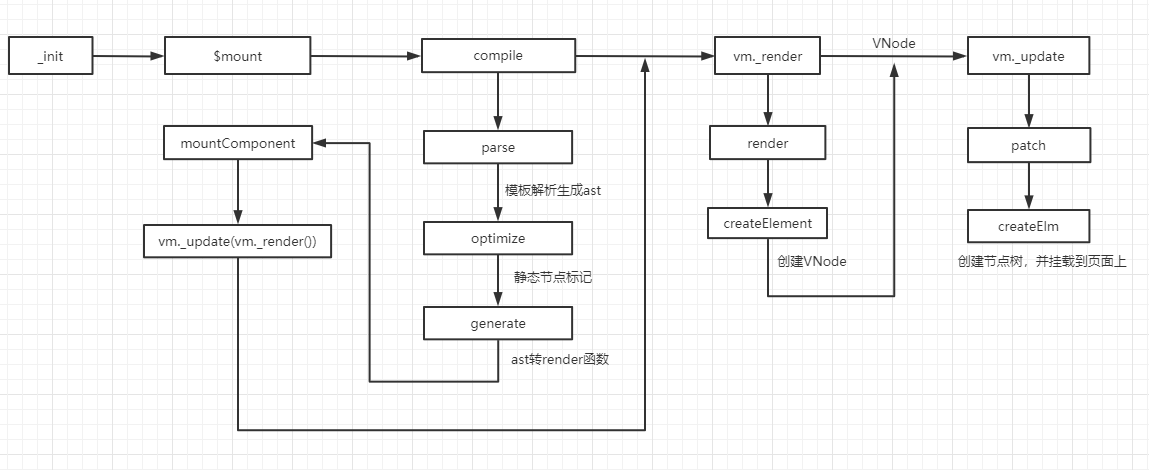
VNode构建完成后,最终会被转换成真实dom,而 patch 是必经的过程。为了更好的理解组件渲染的过程,假设 keep-alive 包括的组件有A和B两个组件,默认展示A组件。
初始化渲染
组件在 patch 过程是会执行 createComponent 来挂载组件的,A组件也不例外。
// 源码位置:src/core/vdom/patch.js

function createComponent (vnode, insertedVnodeQueue, parentElm, refElm) {

  let i = vnode.data

  if (isDef(i)) {

    const isReactivated = isDef(vnode.componentInstance) && i.keepAlive

    if (isDef(i = i.hook) && isDef(i = i.init)) {

      i(vnode, false /* hydrating */)

    }

    // after calling the init hook, if the vnode is a child component

    // it should've created a child instance and mounted it. the child

    // component also has set the placeholder vnode's elm.

    // in that case we can just return the element and be done.

    if (isDef(vnode.componentInstance)) {

      initComponent(vnode, insertedVnodeQueue)

      insert(parentElm, vnode.elm, refElm)

      if (isTrue(isReactivated)) {

        reactivateComponent(vnode, insertedVnodeQueue, parentElm, refElm)

      }

      return true

    }

  }

}
isReactivated 标识组件是否重新激活。在初始化渲染时,A组件还没有初始化构造完成,componentInstance 还是 undefined。而A组件的 keepAlive 是 true,因为 keep-alive 作为父级包裹组件,会先于A组件挂载,也就是 kepp-alive 会先执行 render 的过程,A组件被缓存起来,之后对插槽内第一个组件(A组件)的 keepAlive 赋值为 true,不记得这个过程请看上面组件实现的代码。所以此时的 isReactivated 是 false。
接着会调用 init 函数进行组件初始化,它是组件的一个钩子函数:
// 源码位置:src/core/vdom/create-component.js

const componentVNodeHooks = {

  init (vnode: VNodeWithData, hydrating: boolean): ?boolean {

    if (

      vnode.componentInstance &&

      !vnode.componentInstance._isDestroyed &&

      vnode.data.keepAlive

    ) {

      // kept-alive components, treat as a patch

      const mountedNode: any = vnode // work around flow

      componentVNodeHooks.prepatch(mountedNode, mountedNode)

    } else {

      const child = vnode.componentInstance = createComponentInstanceForVnode(

        vnode,

        activeInstance

      )

      child.$mount(hydrating ? vnode.elm : undefined, hydrating)

    }

  },

  // ...

}
createComponentInstanceForVnode 内会 new Vue 构造组件实例并赋值到 componentInstance,随后调用 $mount 挂载组件。
回 createComponent,继续走下面的逻辑:
if (isDef(vnode.componentInstance)) {

  initComponent(vnode, insertedVnodeQueue)

  insert(parentElm, vnode.elm, refElm)

  if (isTrue(isReactivated)) {

    reactivateComponent(vnode, insertedVnodeQueue, parentElm, refElm)

  }

  return true

}
调用 initComponent 将 vnode.elm 赋值为真实dom,然后调用 insert 将组件的真实dom插入到父元素中。
所以在初始化渲染中,keep-alive 将A组件缓存起来,然后正常的渲染A组件。
缓存渲染
当切换到B组件,再切换回A组件时,A组件命中缓存被重新激活。
再次经历 patch 过程,keep-alive 是根据插槽获取当前的组件,那么插槽的内容又是如何更新实现缓存?
const isRealElement = isDef(oldVnode.nodeType)

if (!isRealElement && sameVnode(oldVnode, vnode)) {

  // patch existing root node

  patchVnode(oldVnode, vnode, insertedVnodeQueue, null, null, removeOnly)

}
非初始化渲染时,patch 会调用 patchVnode 对比新旧节点。
// 源码位置:src/core/vdom/patch.js

function patchVnode (

  oldVnode,

  vnode,

  insertedVnodeQueue,

  ownerArray,

  index,

  removeOnly

) {

  // ...

  let i

  const data = vnode.data

  if (isDef(data) && isDef(i = data.hook) && isDef(i = i.prepatch)) {

    i(oldVnode, vnode)

  }

  // ...

}
patchVnode 内会调用钩子函数 prepatch。
// 源码位置: src/core/vdom/create-component.js

prepatch (oldVnode: MountedComponentVNode, vnode: MountedComponentVNode) {

  const options = vnode.componentOptions

  const child = vnode.componentInstance = oldVnode.componentInstance

  updateChildComponent(

    child,

    options.propsData, // updated props

    options.listeners, // updated listeners

    vnode, // new parent vnode

    options.children // new children

  )

},
updateChildComponent 就是更新的关键方法,它里面主要是更新实例的一些属性:
// 源码位置:src/core/instance/lifecycle.js

export function updateChildComponent (

  vm: Component,

  propsData: ?Object,

  listeners: ?Object,

  parentVnode: MountedComponentVNode,

  renderChildren: ?Array<VNode>

) {

  // ...

  // Any static slot children from the parent may have changed during parent's

  // update. Dynamic scoped slots may also have changed. In such cases, a forced

  // update is necessary to ensure correctness.

  const needsForceUpdate = !!(

    renderChildren ||               // has new static slots

    vm.$options._renderChildren ||  // has old static slots

    hasDynamicScopedSlot

  )

  // ...

  // resolve slots + force update if has children

  if (needsForceUpdate) {

    vm.$slots = resolveSlots(renderChildren, parentVnode.context)

    vm.$forceUpdate()

  }

}

Vue.prototype.$forceUpdate = function () {

  const vm: Component = this

  if (vm._watcher) {

    // 这里最终会执行 vm._update(vm._render)

    vm._watcher.update()

  }

}
从注释中可以看到 needsForceUpdate 是有插槽才会为 true,keep-alive 符合条件。首先调用 resolveSlots 更新 keep-alive 的插槽,然后调用 $forceUpdate 让 keep-alive 重新渲染,再走一遍 render。因为A组件在初始化已经缓存了,keep-alive 直接返回缓存好的A组件 VNode。VNode 准备好后,又来到了 patch 阶段。
function createComponent (vnode, insertedVnodeQueue, parentElm, refElm) {

  let i = vnode.data

  if (isDef(i)) {

    const isReactivated = isDef(vnode.componentInstance) && i.keepAlive

    if (isDef(i = i.hook) && isDef(i = i.init)) {

      i(vnode, false /* hydrating */)

    }

    // after calling the init hook, if the vnode is a child component

    // it should've created a child instance and mounted it. the child

    // component also has set the placeholder vnode's elm.

    // in that case we can just return the element and be done.

    if (isDef(vnode.componentInstance)) {

      initComponent(vnode, insertedVnodeQueue)

      insert(parentElm, vnode.elm, refElm)

      if (isTrue(isReactivated)) {

        reactivateComponent(vnode, insertedVnodeQueue, parentElm, refElm)

      }

      return true

    }

  }

}
A组件再次经历 createComponent 的过程,调用 init。
const componentVNodeHooks = {

  init (vnode: VNodeWithData, hydrating: boolean): ?boolean {

    if (

      vnode.componentInstance &&

      !vnode.componentInstance._isDestroyed &&

      vnode.data.keepAlive

    ) {

      // kept-alive components, treat as a patch

      const mountedNode: any = vnode // work around flow

      componentVNodeHooks.prepatch(mountedNode, mountedNode)

    } else {

      const child = vnode.componentInstance = createComponentInstanceForVnode(

        vnode,

        activeInstance

      )

      child.$mount(hydrating ? vnode.elm : undefined, hydrating)

    }

  },

}
这时将不再走 $mount 的逻辑,只调用 prepatch 更新实例属性。所以在缓存组件被激活时,不会执行 created 和 mounted 的生命周期函数。
回到 createComponent,此时的 isReactivated 为 true,调用 reactivateComponent:
function reactivateComponent (vnode, insertedVnodeQueue, parentElm, refElm) {

  let i

  // hack for #4339: a reactivated component with inner transition

  // does not trigger because the inner node's created hooks are not called

  // again. It's not ideal to involve module-specific logic in here but

  // there doesn't seem to be a better way to do it.

  let innerNode = vnode

  while (innerNode.componentInstance) {

    innerNode = innerNode.componentInstance._vnode

    if (isDef(i = innerNode.data) && isDef(i = i.transition)) {

      for (i = 0; i < cbs.activate.length; ++i) {

        cbs.activate[i](emptyNode, innerNode)

      }

      insertedVnodeQueue.push(innerNode)

      break

    }

  }

  // unlike a newly created component,

  // a reactivated keep-alive component doesn't insert itself

  insert(parentElm, vnode.elm, refElm)

}
最后调用 insert 插入组件的dom节点,至此缓存渲染流程完成。
小结:组件首次渲染时,keep-alive 会将组件缓存起来。等到缓存渲染时,keep-alive 会更新插槽内容,之后 $forceUpdate 重新渲染。这样在 render 时就获取到最新的组件,如果命中缓存则从缓存中返回 VNode。
总结
keep-alive 组件是抽象组件,在对应父子关系时会跳过抽象组件,它只对包裹的子组件做处理,主要是根据LRU策略缓存组件 VNode,最后在 render 时返回子组件的 VNode。缓存渲染过程会更新 keep-alive 插槽,重新再 render 一次,从缓存中读取之前的组件 VNode 实现状态缓存。
往期相关文章:
Vue源码解析,keep-alive是如何实现缓存的?的更多相关文章
- 【vuejs深入二】vue源码解析之一,基础源码结构和htmlParse解析器
写在前面 一个好的架构需要经过血与火的历练,一个好的工程师需要经过无数项目的摧残. vuejs是一个优秀的前端mvvm框架,它的易用性和渐进式的理念可以使每一个前端开发人员感到舒服,感到easy.它内 ...
- 【vuejs深入三】vue源码解析之二 htmlParse解析器的实现
写在前面 一个好的架构需要经过血与火的历练,一个好的工程师需要经过无数项目的摧残. 昨天博主分析了一下在vue中,最为基础核心的api,parse函数,它的作用是将vue的模板字符串转换成ast,从而 ...
- Vue源码解析---数据的双向绑定
本文主要抽离Vue源码中数据双向绑定的核心代码,解析Vue是如何实现数据的双向绑定 核心思想是ES5的Object.defineProperty()和发布-订阅模式 整体结构 改造Vue实例中的dat ...
- Vue源码解析之nextTick
Vue源码解析之nextTick 前言 nextTick是Vue的一个核心功能,在Vue内部实现中也经常用到nextTick.但是,很多新手不理解nextTick的原理,甚至不清楚nextTick的作 ...
- 【VUE】Vue 源码解析
Vue 源码解析 Vue 的工作机制 在 new vue() 之后,Vue 会调用进行初始化,会初始化生命周期.事件.props.methods.data.computed和watch等.其中最重要的 ...
- Vue源码解析(一):入口文件
在学习Vue源码之前,首先要做的一件事情,就是去GitHub上将Vue源码clone下来,目前我这里分析的Vue版本是V2.5.21,下面开始分析: 一.源码的目录结构: Vue的源码都在src目录下 ...
- Vue源码解析之数组变异
力有不逮的对象 众所周知,在 Vue 中,直接修改对象属性的值无法触发响应式.当你直接修改了对象属性的值,你会发现,只有数据改了,但是页面内容并没有改变. 这是什么原因? 原因在于: Vue 的响应式 ...
- Vue源码解析:AST语法树转render函数
开始 今天要说的代码全在codegen文件夹中,在说实现原理前,还是先看个简单的例子! <div class="container"> <span>{{ms ...
- VUE源码解析心得
解读vue源码比较好奇的几个点: VUE MVVM 原理 http://www.cnblogs.com/guwei4037/p/5591183.html https://cn.vuejs.org/v2 ...
随机推荐
- 回文树(回文自动机)(PAM)
第一个能看懂的论文:国家集训队2017论文集 这是我第一个自己理解的自动机(AC自动机不懂KMP硬背,SAM看不懂一堆引理定理硬背) 参考文献:2017国家集训队论文集 回文树及其应用 翁文涛 参考博 ...
- XML转Bean
XML转Bean有很多方式,我使用的是xtream方式实现xml与bean的互转. 下面是简单的xml转bean /** * XML转换成bean * @param obj * @return yuy ...
- web自动化 -- HTMLreport(二)测试报告输出内容居左对齐
一.需求痛点 1.报告输出内容是居中对齐,很难看 2.我们希望输出内容是居左对齐 3.痛点截图 二.解决办法 1.原因分析 HTMLreport的内容对齐方式,自然是修改HTMLreport的内容了 ...
- yum下载软件包
方法一: downloadonly插件有一个yum的插件叫做downloadonly,就是只下载不安装的意思.1. 安装插件yum install yum-download2. 下载yum updat ...
- SpringBoot整合Mail发送邮件&发送模板邮件
整合mail发送邮件,其实就是通过代码来操作发送邮件的步骤,编辑收件人.邮件内容.邮件附件等等.通过邮件可以拓展出短信验证码.消息通知等业务. 一.pom文件引入依赖 <dependency&g ...
- ASP.NET Core 监听SQL Server数据库的实时信息
1.开发环境: 开发工具:Visual Studio 2019 数据库:SQL Server2012 开发环境:.Net Core 3.1 2.使用技术: Signalr:实现消息推送 SqlDepe ...
- luogu P2525 Uim的情人节礼物 其之壱
LINK:Uim的情人节礼物·其之壱 壱 古代通壹 常在日文中出现. 完全可以使用STL -->prev_permutation来解决. 不过我简单了解了一下康托展开. 这是一个一个排列对应一个 ...
- 实践录丨如何在鲲鹏服务器OpenEuler操作系统中快速部署OpenGauss数据库
本文适合需要快速了解OpenGauss基本使用和操作的单机用户,可以短时间内完成安装体验.对于企业级生产使用或者需要部署多台服务器的,不适合本文. 因为业务需要,要在鲲鹏架构里安装单机版的OpenGa ...
- day2. 六大基本数据类型简介
一.基本数据类型 Number 数字类型 (int float bool complex) str 字符串类型 list 列表类型 tuple 元组类型 set 集合类型 dict 字典类型 二.Nu ...
- 【USACO02FEB】Rebuilding Roads 重建道路 题解(树形DP)
题目链接 题目大意:问使含有$p$个节点的子树分离至少需要去掉几条边. ------------------ 设$f[i][j]$表示以$i$为根的子树保留$j$个节点所去掉的最少边数. 初始化$f[ ...