
netty4 Handler的执行顺序
转载:https://my.oschina.net/jamaly/blog/272385
Handler在netty中,无疑占据着非常重要的地位。Handler与Servlet中的filter很像,通过Handler可以完成通讯报文的解码编码、拦截指定的报文、统一对日志错误进行处理、统一对请求进行计数、控制Handler执行与否。一句话,没有它做不到的只有你想不到的。
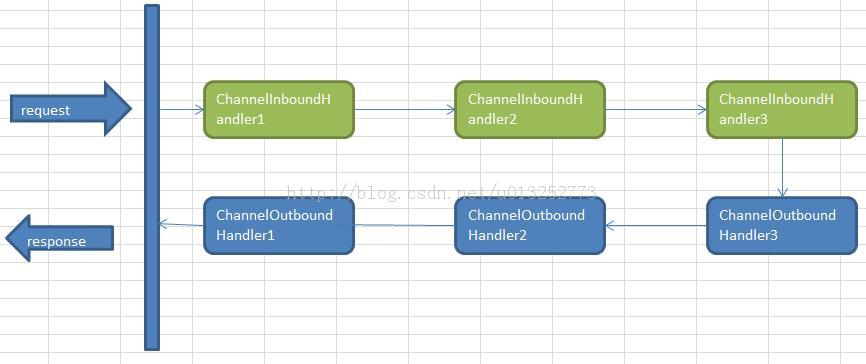
Netty中的所有handler都实现自ChannelHandler接口。按照输出输出来分,分为ChannelInboundHandler、ChannelOutboundHandler两大类。ChannelInboundHandler对从客户端发往服务器的报文进行处理,一般用来执行解码、读取客户端数据、进行业务处理等;ChannelOutboundHandler对从服务器发往客户端的报文进行处理,一般用来进行编码、发送报文到客户端。
Netty中,可以注册多个handler。ChannelInboundHandler按照注册的先后顺序执行;ChannelOutboundHandler按照注册的先后顺序逆序执行,如下图所示,按照注册的先后顺序对Handler进行排序,request进入Netty后的执行顺序为:
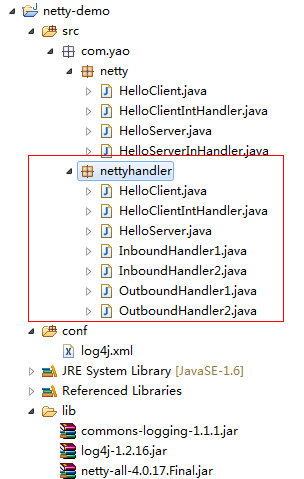
下面例子涉及的类包括:
一、HelloServer:
package com.yao.nettyhandler;

import io.netty.bootstrap.ServerBootstrap;

import io.netty.channel.ChannelFuture;

import io.netty.channel.ChannelInitializer;

import io.netty.channel.ChannelOption;

import io.netty.channel.EventLoopGroup;

import io.netty.channel.nio.NioEventLoopGroup;

import io.netty.channel.socket.SocketChannel;

import io.netty.channel.socket.nio.NioServerSocketChannel;

public class HelloServer {

	public void start(int port) throws Exception {

		EventLoopGroup bossGroup = new NioEventLoopGroup();

		EventLoopGroup workerGroup = new NioEventLoopGroup();

		try {

			ServerBootstrap b = new ServerBootstrap();

			b.group(bossGroup, workerGroup).channel(NioServerSocketChannel.class)

					.childHandler(new ChannelInitializer<SocketChannel>() {

								@Override

								public void initChannel(SocketChannel ch) throws Exception {

									// 注册两个OutboundHandler,执行顺序为注册顺序的逆序,所以应该是OutboundHandler2 OutboundHandler1

									ch.pipeline().addLast(new OutboundHandler1());

									ch.pipeline().addLast(new OutboundHandler2());

									// 注册两个InboundHandler,执行顺序为注册顺序,所以应该是InboundHandler1 InboundHandler2

									ch.pipeline().addLast(new InboundHandler1());

									ch.pipeline().addLast(new InboundHandler2());

								}

							}).option(ChannelOption.SO_BACKLOG, 128)

					.childOption(ChannelOption.SO_KEEPALIVE, true);

			ChannelFuture f = b.bind(port).sync();

			f.channel().closeFuture().sync();

		} finally {

			workerGroup.shutdownGracefully();

			bossGroup.shutdownGracefully();

		}

	}

	public static void main(String[] args) throws Exception {

		HelloServer server = new HelloServer();

		server.start(8000);

	}

}
二、InboundHandler1:
package com.yao.nettyhandler;

import io.netty.channel.ChannelHandlerContext;

import io.netty.channel.ChannelInboundHandlerAdapter;

import org.apache.commons.logging.Log;

import org.apache.commons.logging.LogFactory;

public class InboundHandler1 extends ChannelInboundHandlerAdapter {

	private static Log logger = LogFactory.getLog(InboundHandler1.class);

	@Override

	public void channelRead(ChannelHandlerContext ctx, Object msg) throws Exception {

		logger.info("InboundHandler1.channelRead: ctx :" + ctx);

		// 通知执行下一个InboundHandler

		//ctx.fireChannelRead(msg);

	}

	@Override

	public void channelReadComplete(ChannelHandlerContext ctx) throws Exception {

		logger.info("InboundHandler1.channelReadComplete");

		ctx.flush();

	}

}
三、InboundHandler2:
package com.yao.nettyhandler;

import io.netty.buffer.ByteBuf;

import io.netty.channel.ChannelHandlerContext;

import io.netty.channel.ChannelInboundHandlerAdapter;

import org.apache.commons.logging.Log;

import org.apache.commons.logging.LogFactory;

public class InboundHandler2 extends ChannelInboundHandlerAdapter {

	private static Log	logger	= LogFactory.getLog(InboundHandler2.class);

	@Override

	// 读取Client发送的信息,并打印出来

	public void channelRead(ChannelHandlerContext ctx, Object msg) throws Exception {

		logger.info("InboundHandler2.channelRead: ctx :" + ctx);

		ByteBuf result = (ByteBuf) msg;

		byte[] result1 = new byte[result.readableBytes()];

		result.readBytes(result1);

		String resultStr = new String(result1);

		System.out.println("Client said:" + resultStr);

		result.release();

		ctx.write(msg);

	}

	@Override

	public void channelReadComplete(ChannelHandlerContext ctx) throws Exception {

		logger.info("InboundHandler2.channelReadComplete");

		ctx.flush();

	}

}
四、OutboundHandler1 :
package com.yao.nettyhandler;

import io.netty.buffer.ByteBuf;

import io.netty.channel.ChannelHandlerContext;

import io.netty.channel.ChannelOutboundHandlerAdapter;

import io.netty.channel.ChannelPromise;

import org.apache.commons.logging.Log;

import org.apache.commons.logging.LogFactory;

public class OutboundHandler1 extends ChannelOutboundHandlerAdapter {

	private static Log	logger	= LogFactory.getLog(OutboundHandler1.class);

	@Override

	// 向client发送消息

	public void write(ChannelHandlerContext ctx, Object msg, ChannelPromise promise) throws Exception {

		logger.info("OutboundHandler1.write");

		String response = "I am ok!";

		ByteBuf encoded = ctx.alloc().buffer(4 * response.length());

		encoded.writeBytes(response.getBytes());

		ctx.write(encoded);

		ctx.flush();

	}

}
五、OutboundHandler2:
package com.yao.nettyhandler;

import io.netty.channel.ChannelHandlerContext;

import io.netty.channel.ChannelOutboundHandlerAdapter;

import io.netty.channel.ChannelPromise;

import org.apache.commons.logging.Log;

import org.apache.commons.logging.LogFactory;

public class OutboundHandler2 extends ChannelOutboundHandlerAdapter {

	private static Log	logger	= LogFactory.getLog(OutboundHandler2.class);

	@Override

	public void write(ChannelHandlerContext ctx, Object msg, ChannelPromise promise) throws Exception {

		logger.info("OutboundHandler2.write");

		// 执行下一个OutboundHandler

		super.write(ctx, msg, promise);

	}

}
下面是客户端
六、HelloClient:
package com.yao.nettyhandler;

import io.netty.bootstrap.Bootstrap;

import io.netty.channel.ChannelFuture;

import io.netty.channel.ChannelInitializer;

import io.netty.channel.ChannelOption;

import io.netty.channel.EventLoopGroup;

import io.netty.channel.nio.NioEventLoopGroup;

import io.netty.channel.socket.SocketChannel;

import io.netty.channel.socket.nio.NioSocketChannel;

public class HelloClient {

	public void connect(String host, int port) throws Exception {

		EventLoopGroup workerGroup = new NioEventLoopGroup();

		try {

			Bootstrap b = new Bootstrap();

			b.group(workerGroup);

			b.channel(NioSocketChannel.class);

			b.option(ChannelOption.SO_KEEPALIVE, true);

			b.handler(new ChannelInitializer<SocketChannel>() {

				@Override

				public void initChannel(SocketChannel ch) throws Exception {

					ch.pipeline().addLast(new HelloClientIntHandler());

				}

			});

			// Start the client.

			ChannelFuture f = b.connect(host, port).sync();

			f.channel().closeFuture().sync();

		} finally {

			workerGroup.shutdownGracefully();

		}

	}

	public static void main(String[] args) throws Exception {

		HelloClient client = new HelloClient();

		client.connect("127.0.0.1", 8000);

	}

}
七、HelloClientIntHandler:
package com.yao.nettyhandler;

import io.netty.buffer.ByteBuf;

import io.netty.channel.ChannelHandlerContext;

import io.netty.channel.ChannelInboundHandlerAdapter;

import org.apache.commons.logging.Log;

import org.apache.commons.logging.LogFactory;

public class HelloClientIntHandler extends ChannelInboundHandlerAdapter {

	private static Log	logger	= LogFactory.getLog(HelloClientIntHandler.class);

	@Override

	// 读取服务端的信息

	public void channelRead(ChannelHandlerContext ctx, Object msg) throws Exception {

		logger.info("HelloClientIntHandler.channelRead");

		ByteBuf result = (ByteBuf) msg;

		byte[] result1 = new byte[result.readableBytes()];

		result.readBytes(result1);

		result.release();

		ctx.close();

		System.out.println("Server said:" + new String(result1));

	}

	@Override

	// 当连接建立的时候向服务端发送消息 ,channelActive 事件当连接建立的时候会触发

	public void channelActive(ChannelHandlerContext ctx) throws Exception {

		logger.info("HelloClientIntHandler.channelActive");

		String msg = "Are you ok?";

		ByteBuf encoded = ctx.alloc().buffer(4 * msg.length());

		encoded.writeBytes(msg.getBytes());

		ctx.write(encoded);

		ctx.flush();

	}

}
八、总结:
在使用Handler的过程中,需要注意:
1、ChannelInboundHandler之间的传递,通过调用 ctx.fireChannelRead(msg) 实现;调用ctx.write(msg) 将传递到ChannelOutboundHandler。
2、ChannelOutboundHandler中,ctx.write()方法执行后,需要调用flush()方法才能令它立即执行。
3、ChannelOutboundHandler 在注册的时候需要放在最后一个ChannelInboundHandler之前,否则将无法传递到ChannelOutboundHandler。
4、Handler的消费处理放在最后一个处理。
netty4 Handler的执行顺序的更多相关文章
- hadoop27---netty中handler的执行顺序
Netty是基于Java NIO的网络应用框架. Netty是一个NIO client-server(客户端服务器)框架,使用Netty可以快速开发网络应用,例如服务器和客户端协议.Netty提供了一 ...
- 7.Netty中 handler 的执行顺序
1.Netty中handler的执行顺序 Handler在Netty中,无疑占据着非常重要的地位.Handler与Servlet中的filter很像,通过Handler可以完成通讯报文的解码编码.拦截 ...
- Netty4.0学习笔记系列之二:Handler的执行顺序(转)
http://blog.csdn.net/u013252773/article/details/21195593 Handler在netty中,无疑占据着非常重要的地位.Handler与Servlet ...
- Netty4.0学习笔记系列之二:Handler的执行顺序
Handler在netty中,无疑占据着非常重要的地位.Handler与Servlet中的filter很像,通过Handler可以完成通讯报文的解码编码.拦截指定的报文.统一对日志错误进行处理.统一对 ...
- netty(七) Handler的执行顺序
Handler在netty中,无疑占据着非常重要的地位.Handler与Servlet中的filter很像,通过Handler可以完成通讯报文的解码编码.拦截指定的报文.统一对日志错误进行处理.统一对 ...
- 关于Netty Pipeline中Handler的执行顺序问题
原文地址:http://blog.csdn.net/wgyvip/article/details/25637651 最近在学习Netty框架,根据官网的教程学着做了几个小测试,都成功了,后面开始试着写 ...
- netty4.1.32 pipeline的添加顺序和执行顺序
本文只想讨论一下pipeline的执行顺序问题,因为这个搞不明白就不知道先添加编码还是解码,是不是可以混淆添加等等一系列事情 pipeline.addLast(new outboundsHandler ...
- 【转】netty4.1.32 pipeline的添加顺序和执行顺序
原文:https://www.cnblogs.com/ruber/p/10186571.html 本文只想讨论一下pipeline的执行顺序问题,因为这个搞不明白就不知道先添加编码还是解码,是不是可以 ...
- javascript中的事件冒泡、事件捕获和事件执行顺序
谈起JavaScript的 事件,事件冒泡.事件捕获.阻止默认事件这三个话题,无论是面试还是在平时的工作中,都很难避免. DOM事件标准定义了两种事件流,这两种事件流有着显著的不同并且可能对你的应用有 ...
随机推荐
- Python-爬虫初学
#爬取网站中的图片 1 import re #正则表达式库 import urllib #url链接库 def getHtml(url): page = urllib.urlopen(url) #打开 ...
- vim功能使用
转自:http://blog.csdn.net/xiajun07061225/article/details/7039413 vi与vim vi编辑器是所有Unix及Linux系统下标准的编辑器,他就 ...
- 在SQL Server中 获取日期、日期格式转换
--常用日期转换参数: PRINT CONVERT(varchar, getdate(), 120 ) 2016-07-20 16:09:01 PRINT replace(replace(replac ...
- Codeforces Round #375 (Div. 2) C. Polycarp at the Radio 贪心
C. Polycarp at the Radio time limit per test 2 seconds memory limit per test 256 megabytes input sta ...
- 强制性签出被人没有签入的文件(在.net开发vs中)
灵感,是天才的女神.她并不步履蹒跚地走过,而是在空中像乌鸦那么警觉地飞过的,她没有什么剽带给诗人抓握,她的头是一团烈火,她溜得快,像那些白里带红的鹤,教猎人见了无可奈何.——巴尔扎克(上海网站建设) ...
- Scrum Meeting---Four(2015-10-28)
今日已完成任务和明日要做的任务 姓名 今日已完成任务 今日时间 明日计划完成任务 估计用时 董元财 今日我完成了数据库表的设计以及创建 3h 进行Java Web工程的编写 4h 胡亚坤 用户之间的通 ...
- 2013 Multi-University Training Contest 9
HDU-4687 Boke and Tsukkomi 题意:给定一个简单图,询问哪些边如果选择的话会使得最大的连边数减少. 解法:套用一般图的最大匹配算法(带花树)先算出最大匹配数,然后枚举一条边被选 ...
- (四)linux网络编程
一.CS架构,BS架构 (1)CS架构介绍(client server,客户端服务器架构),例如:qq.360网盘(2)BS架构介绍(broswer server,浏览器服务器架构)例如:浏览器 二. ...
- C语言语法之占用字节
指针占用字节 指针即为地址,存的是变量的地址,在同一架构下地址长度都是相同的(cpu的最大寻址内存空间),所以不同类型的指针长度都一样. 指针占用几个字节跟语言无关,而是跟系统的寻址能力有关,16为地 ...
- 使用js加载器动态加载外部Javascript文件
原文:http://www.cnblogs.com/xdp-gacl/p/3927417.html 今天在网上找到了一个可以动态加载js文件的js加载器,具体代码如下: JsLoader.js var ...