
Selenium2+python自动化56-unittest之断言(assert)
前言
在测试用例中,执行完测试用例后,最后一步是判断测试结果是pass还是fail,自动化测试脚本里面一般把这种生成测试结果的方法称为断言(assert)。
用unittest组件测试用例的时候,断言的方法还是很多的,下面介绍几种常用的断言方法:assertEqual、assertIn、assertTrue
selenium+python高级教程》已出书:selenium webdriver基于Python源码案例
(购买此书送对应PDF版本)

一、简单案例
1.下面写了4个case,其中第四个是执行失败的
# coding:utf-8
import unittest
class Test(unittest.TestCase):
def test01(self):
'''判断 a == b '''
a = 1
b = 1
self.assertEqual(a, b)
def test02(self):
'''判断 a in b '''
a = "hello"
b = "hello world!"
self.assertIn(a, b)
def test03(self):
'''判断 a is True '''
a = True
self.assertTrue(a)
def test04(self):
'''失败案例'''
a = "上海-悠悠"
b = "yoyo"
self.assertEqual(a, b)
if __name__ == "__main__":
unittest.main()
2.执行结果如下
Failure
Expected :'\xe4\xb8\x8a\xe6\xb5\xb7-\xe6\x82\xa0\xe6\x82\xa0'
Actual :'yoyo'
<Click to see difference>
Traceback (most recent call last):
File "D:\test\yoyotest\kecheng\test12.py", line 27, in test04
self.assertEqual(a, b)
AssertionError: '\xe4\xb8\x8a\xe6\xb5\xb7-\xe6\x82\xa0\xe6\x82\xa0' != 'yoyo'
3.执行的结果,中文编码不对,没正常显示中文,遇到这种情况,可以自定义异常输出
二、自定义异常
1.以assertEqual为例分析:
assertEqual(self, first, second, msg=None)
Fail if the two objects are unequal as determined by the '=='
operator.
2.翻译:如果两个对象不能相等,就返回失败,相当于return: first==second
3.这里除了相比较的两个参数first和second,还有第三个参数msg=None,这个msg参数就是遇到异常后自定义输出信息
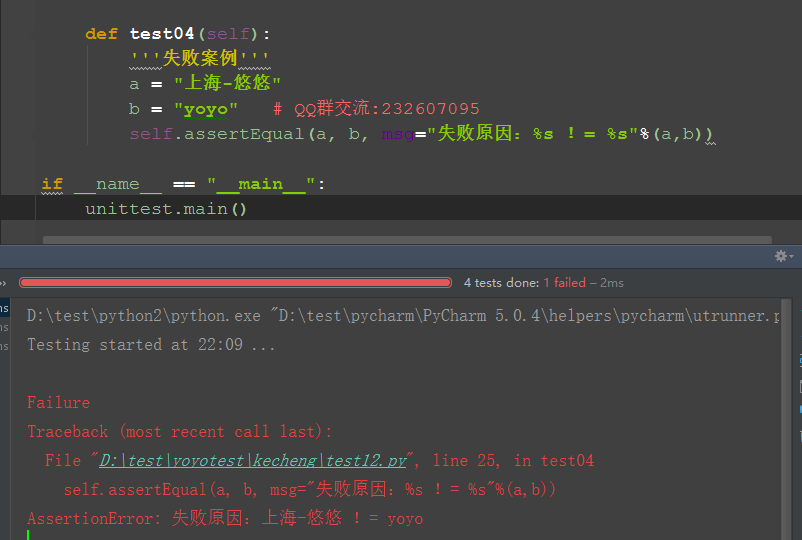
三、unittest常用的断言方法
1.assertEqual(self, first, second, msg=None)
--判断两个参数相等:first == second
2.assertNotEqual(self, first, second, msg=None)
--判断两个参数不相等:first != second
3.assertIn(self, member, container, msg=None)
--判断是字符串是否包含:member in container
4.assertNotIn(self, member, container, msg=None)
--判断是字符串是否不包含:member not in container
5.assertTrue(self, expr, msg=None)
--判断是否为真:expr is True
6.assertFalse(self, expr, msg=None)
--判断是否为假:expr is False
7.assertIsNone(self, obj, msg=None)
--判断是否为None:obj is None
8.assertIsNotNone(self, obj, msg=None)
--判断是否不为None:obj is not None
四、unittest所有断言方法
1.下面是unittest框架支持的所有断言方法,有兴趣的同学可以慢慢看。
| assertAlmostEqual(self, first, second, places=None, msg=None, delta=None)
| Fail if the two objects are unequal as determined by their
| difference rounded to the given number of decimal places
| (default 7) and comparing to zero, or by comparing that the
| between the two objects is more than the given delta.
|
| Note that decimal places (from zero) are usually not the same
| as significant digits (measured from the most signficant digit).
|
| If the two objects compare equal then they will automatically
| compare almost equal.
|
| assertAlmostEquals = assertAlmostEqual(self, first, second, places=None, msg=None, delta=None)
|
| assertDictContainsSubset(self, expected, actual, msg=None)
| Checks whether actual is a superset of expected.
|
| assertDictEqual(self, d1, d2, msg=None)
|
| assertEqual(self, first, second, msg=None)
| Fail if the two objects are unequal as determined by the '=='
| operator.
|
| assertEquals = assertEqual(self, first, second, msg=None)
|
| assertFalse(self, expr, msg=None)
| Check that the expression is false.
|
| assertGreater(self, a, b, msg=None)
| Just like self.assertTrue(a > b), but with a nicer default message.
|
| assertGreaterEqual(self, a, b, msg=None)
| Just like self.assertTrue(a >= b), but with a nicer default message.
|
| assertIn(self, member, container, msg=None)
| Just like self.assertTrue(a in b), but with a nicer default message.
|
| assertIs(self, expr1, expr2, msg=None)
| Just like self.assertTrue(a is b), but with a nicer default message.
|
| assertIsInstance(self, obj, cls, msg=None)
| Same as self.assertTrue(isinstance(obj, cls)), with a nicer
| default message.
|
| assertIsNone(self, obj, msg=None)
| Same as self.assertTrue(obj is None), with a nicer default message.
|
| assertIsNot(self, expr1, expr2, msg=None)
| Just like self.assertTrue(a is not b), but with a nicer default message.
|
| assertIsNotNone(self, obj, msg=None)
| Included for symmetry with assertIsNone.
|
| assertItemsEqual(self, expected_seq, actual_seq, msg=None)
| An unordered sequence specific comparison. It asserts that
| actual_seq and expected_seq have the same element counts.
| Equivalent to::
|
| self.assertEqual(Counter(iter(actual_seq)),
| Counter(iter(expected_seq)))
|
| Asserts that each element has the same count in both sequences.
| Example:
| - [0, 1, 1] and [1, 0, 1] compare equal.
| - [0, 0, 1] and [0, 1] compare unequal.
|
| assertLess(self, a, b, msg=None)
| Just like self.assertTrue(a < b), but with a nicer default message.
|
| assertLessEqual(self, a, b, msg=None)
| Just like self.assertTrue(a <= b), but with a nicer default message.
|
| assertListEqual(self, list1, list2, msg=None)
| A list-specific equality assertion.
|
| Args:
| list1: The first list to compare.
| list2: The second list to compare.
| msg: Optional message to use on failure instead of a list of
| differences.
|
| assertMultiLineEqual(self, first, second, msg=None)
| Assert that two multi-line strings are equal.
|
| assertNotAlmostEqual(self, first, second, places=None, msg=None, delta=None)
| Fail if the two objects are equal as determined by their
| difference rounded to the given number of decimal places
| (default 7) and comparing to zero, or by comparing that the
| between the two objects is less than the given delta.
|
| Note that decimal places (from zero) are usually not the same
| as significant digits (measured from the most signficant digit).
|
| Objects that are equal automatically fail.
|
| assertNotAlmostEquals = assertNotAlmostEqual(self, first, second, places=None, msg=None, delta=None)
|
| assertNotEqual(self, first, second, msg=None)
| Fail if the two objects are equal as determined by the '!='
| operator.
|
| assertNotEquals = assertNotEqual(self, first, second, msg=None)
|
| assertNotIn(self, member, container, msg=None)
| Just like self.assertTrue(a not in b), but with a nicer default message.
|
| assertNotIsInstance(self, obj, cls, msg=None)
| Included for symmetry with assertIsInstance.
|
| assertNotRegexpMatches(self, text, unexpected_regexp, msg=None)
| Fail the test if the text matches the regular expression.
|
| assertRaises(self, excClass, callableObj=None, *args, **kwargs)
| Fail unless an exception of class excClass is raised
| by callableObj when invoked with arguments args and keyword
| arguments kwargs. If a different type of exception is
| raised, it will not be caught, and the test case will be
| deemed to have suffered an error, exactly as for an
| unexpected exception.
|
| If called with callableObj omitted or None, will return a
| context object used like this::
|
| with self.assertRaises(SomeException):
| do_something()
|
| The context manager keeps a reference to the exception as
| the 'exception' attribute. This allows you to inspect the
| exception after the assertion::
|
| with self.assertRaises(SomeException) as cm:
| do_something()
| the_exception = cm.exception
| self.assertEqual(the_exception.error_code, 3)
|
| assertRaisesRegexp(self, expected_exception, expected_regexp, callable_obj=None, *args, **kwargs)
| Asserts that the message in a raised exception matches a regexp.
|
| Args:
| expected_exception: Exception class expected to be raised.
| expected_regexp: Regexp (re pattern object or string) expected
| to be found in error message.
| callable_obj: Function to be called.
| args: Extra args.
| kwargs: Extra kwargs.
|
| assertRegexpMatches(self, text, expected_regexp, msg=None)
| Fail the test unless the text matches the regular expression.
|
| assertSequenceEqual(self, seq1, seq2, msg=None, seq_type=None)
| An equality assertion for ordered sequences (like lists and tuples).
|
| For the purposes of this function, a valid ordered sequence type is one
| which can be indexed, has a length, and has an equality operator.
|
| Args:
| seq1: The first sequence to compare.
| seq2: The second sequence to compare.
| seq_type: The expected datatype of the sequences, or None if no
| datatype should be enforced.
| msg: Optional message to use on failure instead of a list of
| differences.
|
| assertSetEqual(self, set1, set2, msg=None)
| A set-specific equality assertion.
|
| Args:
| set1: The first set to compare.
| set2: The second set to compare.
| msg: Optional message to use on failure instead of a list of
| differences.
|
| assertSetEqual uses ducktyping to support different types of sets, and
| is optimized for sets specifically (parameters must support a
| difference method).
|
| assertTrue(self, expr, msg=None)
| Check that the expression is true.
|
| assertTupleEqual(self, tuple1, tuple2, msg=None)
| A tuple-specific equality assertion.
|
| Args:
| tuple1: The first tuple to compare.
| tuple2: The second tuple to compare.
| msg: Optional message to use on failure instead of a list of
| differences.
学习过程中有遇到疑问的,可以加selenium(python+java) QQ群交流:646645429
觉得对你有帮助,就在右下角点个赞吧,感谢支持!
al_seq and expected_seq have the same element counts.| Equivalent to::| | self.assertEqual(Counter(iter(actual_seq)),| Counter(iter(expected_seq)))| | Asserts that each element has the same count in both sequences.| Example:| - [0, 1, 1] and [1, 0, 1] compare equal.| - [0, 0, 1] and [0, 1] compare unequal.| | assertLess(self, a, b, msg=None)| Just like self.assertTrue(a < b), but with a nicer default message.| | assertLessEqual(self, a, b, msg=None)| Just like self.assertTrue(a <= b), but with a nicer default message.| | assertListEqual(self, list1, list2, msg=None)| A list-specific equality assertion.| | Args:| list1: The first list to compare.| list2: The second list to compare.| msg: Optional message to use on failure instead of a list of| differences.| | assertMultiLineEqual(self, first, second, msg=None)| Assert that two multi-line strings are equal.| | assertNotAlmostEqual(self, first, second, places=None, msg=None, delta=None)| Fail if the two objects are equal as determined by their| difference rounded to the given number of decimal places| (default 7) and comparing to zero, or by comparing that the| between the two objects is less than the given delta.| | Note that decimal places (from zero) are usually not the same| as significant digits (measured from the most signficant digit).| | Objects that are equal automatically fail.| | assertNotAlmostEquals = assertNotAlmostEqual(self, first, second, places=None, msg=None, delta=None)| | assertNotEqual(self, first, second, msg=None)| Fail if the two objects are equal as determined by the '!='| operator.| | assertNotEquals = assertNotEqual(self, first, second, msg=None)| | assertNotIn(self, member, container, msg=None)| Just like self.assertTrue(a not in b), but with a nicer default message.| | assertNotIsInstance(self, obj, cls, msg=None)| Included for symmetry with assertIsInstance.| | assertNotRegexpMatches(self, text, unexpected_regexp, msg=None)| Fail the test if the text matches the regular expression.| | assertRaises(self, excClass, callableObj=None, *args, **kwargs)| Fail unless an exception of class excClass is raised| by callableObj when invoked with arguments args and keyword| arguments kwargs. If a different type of exception is| raised, it will not be caught, and the test case will be| deemed to have suffered an error, exactly as for an| unexpected exception.| | If called with callableObj omitted or None, will return a| context object used like this::| | with self.assertRaises(SomeException):| do_something()| | The context manager keeps a reference to the exception as| the 'exception' attribute. This allows you to inspect the| exception after the assertion::| | with self.assertRaises(SomeException) as cm:| do_something()| the_exception = cm.exception| self.assertEqual(the_exception.error_code, 3)| | assertRaisesRegexp(self, expected_exception, expected_regexp, callable_obj=None, *args, **kwargs)| Asserts that the message in a raised exception matches a regexp.| | Args:| expected_exception: Exception class expected to be raised.| expected_regexp: Regexp (re pattern object or string) expected| to be found in error message.| callable_obj: Function to be called.| args: Extra args.| kwargs: Extra kwargs.| | assertRegexpMatches(self, text, expected_regexp, msg=None)| Fail the test unless the text matches the regular expression.| | assertSequenceEqual(self, seq1, seq2, msg=None, seq_type=None)| An equality assertion for ordered sequences (like lists and tuples).| | For the purposes of this function, a valid ordered sequence type is one| which can be indexed, has a length, and has an equality operator.| | Args:| seq1: The first sequence to compare.| seq2: The second sequence to compare.| seq_type: The expected datatype of the sequences, or None if no| datatype should be enforced.| msg: Optional message to use on failure instead of a list of| differences.| | assertSetEqual(self, set1, set2, msg=None)| A set-specific equality assertion.| | Args:| set1: The first set to compare.| set2: The second set to compare.| msg: Optional message to use on failure instead of a list of| differences.| | assertSetEqual uses ducktyping to support different types of sets, and| is optimized for sets specifically (parameters must support a| difference method).| | assertTrue(self, expr, msg=None)| Check that the expression is true.| | assertTupleEqual(self, tuple1, tuple2, msg=None)| A tuple-specific equality assertion.| | Args:| tuple1: The first tuple to compare.| tuple2: The second tuple to compare.| msg: Optional message to use on failure instead of a list of| differences.
Selenium2+python自动化56-unittest之断言(assert)的更多相关文章
- Python单元测试框架unittest之断言(assert)
unittest中断言主要有三种类型: 1.基本的布尔断言,即:要么正确,要么错误的验证 2.比较断言,如比较两个变量的值(跟上面的布尔断言区别不大,主要是通过比较两个变量的值得出布尔值) 3.复杂断 ...
- Selenium2+python自动化(unittest)
# coding:utf-8from selenium import webdriverimport unittestimport timeclass Bolg(unittest.TestCase): ...
- Selenium2+python自动化54-unittest生成测试报告(HTMLTestRunner)
前言 批量执行完用例后,生成的测试报告是文本形式的,不够直观,为了更好的展示测试报告,最好是生成HTML格式的. unittest里面是不能生成html格式报告的,需要导入一个第三方的模块:HTMLT ...
- Selenium2+python自动化39-关于面试的题
前言 最近看到群里有小伙伴贴出一组面试题,最近又是跳槽黄金季节,小编忍不住抽出一点时间总结了下, 回答不妥的地方欢迎各位高手拍砖指点. 一.selenium中如何判断元素是否存在? 首先selen ...
- Selenium2+python自动化20-Excel数据参数化【转载】
前言 问: Python 获取到Excel一列值后怎么用selenium录制的脚本中参数化,比如对登录用户名和密码如何做参数化? 答:可以使用xlrd读取Excel的内容进行参数化.当然为了便于各位小 ...
- Selenium2+python自动化43-判断title(title_is)
From: https://www.cnblogs.com/yoyoketang/p/6539117.html 前言 获取页面title的方法可以直接用driver.title获取到,然后也可以把获取 ...
- Selenium2+python自动化59-数据驱动(ddt)
前言 在设计用例的时候,有些用例只是参数数据的输入不一样,比如登录这个功能,操作过程但是一样的.如果用例重复去写操作过程会增加代码量,对应这种多组数据的测试用例,可以用数据驱动设计模式,一组数据对应一 ...
- Selenium2+python自动化55-unittest之装饰器(@classmethod)
前言 前面讲到unittest里面setUp可以在每次执行用例前执行,这样有效的减少了代码量,但是有个弊端,比如打开浏览器操作,每次执行用例时候都会重新打开,这样就会浪费很多时间. 于是就想是不是可以 ...
- Selenium2+python自动化52-unittest执行顺序
前言 很多初学者在使用unittest框架时候,不清楚用例的执行顺序到底是怎样的.对测试类里面的类和方法分不清楚,不知道什么时候执行,什么时候不执行. 本篇通过最简单案例详细讲解unittest执行顺 ...
- Selenium2+python自动化59-数据驱动(ddt)【转载】
前言 在设计用例的时候,有些用例只是参数数据的输入不一样,比如登录这个功能,操作过程但是一样的.如果用例重复去写操作过程会增加代码量,对应这种多组数据的测试用例,可以用数据驱动设计模式,一组数据对应一 ...
随机推荐
- 题解-python-CodeForces 227A
codeforces题目,用python写 本题输入三个点坐标,考察叉积,若大于0则right,小于0则left,等于0则towards 代码: a = raw_input().split() b = ...
- sp_executesql动态执行sql语句并将结果赋值给一变量
需求场景: 需动态拼接sql语句进行执行,并将执行的结果赋值给一指定变量. 样例代码如下: SELECT @tableName = TAB_NAME FROM dbo.NMR_BLYWBDY WHER ...
- 《精通Python设计模式》学习之原型模式
暂时在工作中,还没有用到呢~~~ 以后要留意一下,主要用于复制对象副本, 然后又有自定义属性的地方. import copy from collections import OrderedDict c ...
- .size和.empty
坑爹的list容器size方法--为了splice居然把复杂度设计为O(N)? 能用empty的时候,不要用size empty可以保证常量复杂度,但list的size不保证 链表长度必须要遍历全部的 ...
- Signalr信息推送
前序 距离上次写文章,差不多已经大半年了.感觉自己越来越懒了,即使有时候空闲下来了,也不想动.前面买了一系列的Python的书,基础的看了大概有四分之一,剩下的基本上还未动,晚上回去也只是吃饭看电影. ...
- TradingView 自定义指标
TradingView 支持自定义指标,不过是把你要定义的指标写成一个 JS 源文件(customIndex.js),放在图表库 static 文件夹下.自定义指标 JS 源代码模板如下: __cus ...
- UWP入门——应用数据和设置
数据有两个基本的分类,应用数据和用户数据,而用户数据则为由用户拥有的数据,如文档,音乐或电子邮件等,下面将大致的介绍一下应用数据的基本操作. 应用数据:应用数据包含APP的状态信息(如运行时状态,用户 ...
- JAVAEE——SSH项目实战04:联系人添加、列表显示和修改
作者: kent鹏 转载请注明出处: http://www.cnblogs.com/xieyupeng/p/7159337.html 一.联系人添加 1.添加页面设计 linkman/list. ...
- js中对同步和异步的理解
你应该知道,javascript语言是一门“单线程”的语言,不像java语言,类继承Thread再来个thread.start就可以开辟一个线程,所以,javascript就像一条流水线,仅仅是一条流 ...
- 深入理解ajax系列第二篇
前面的话 在上一篇中,概要地介绍了XHR对象的使用.本文将详细介绍使用XHR对象发送请求的两种方式——GET和POST.下面将以实例的形式来详细说明 GET GET是最常见的请求类型,最常用于向服务器 ...