
[Model] AlexNet
CaffeNet - a variant of AlexNet
Ref: Classification: Instant Recognition with Caffe
This is caffeNet
区别:https://github.com/BVLC/caffe/issues/4202
This is AlexNet.
单机版:http://www.cs.toronto.edu/~guerzhoy/tf_alexnet/myalexnet_forward_newtf.py
################################################################################

#Michael Guerzhoy and Davi Frossard, 2016

#AlexNet implementation in TensorFlow, with weights

#Details:

#http://www.cs.toronto.edu/~guerzhoy/tf_alexnet/

#

#With code from https://github.com/ethereon/caffe-tensorflow

#Model from  https://github.com/BVLC/caffe/tree/master/models/bvlc_alexnet

#Weights from Caffe converted using https://github.com/ethereon/caffe-tensorflow

#

#

################################################################################

from numpy import *

import os

#from pylab import *

import numpy as np

#import matplotlib.pyplot as plt

#import matplotlib.cbook as cbook

import time

from scipy.misc import imread

from scipy.misc import imresize

import matplotlib.image as mpimg

from scipy.ndimage import filters

import urllib

from numpy import random

import tensorflow as tf

from caffe_classes import class_names

train_x = zeros((1, 227,227,3)).astype(float32)

train_y = zeros((1, 1000))

xdim = train_x.shape[1:]

ydim = train_y.shape[1]

################################################################################

#Read Image, and change to BGR

im1 = (imread("laska.png")[:,:,:3]).astype(float32)

im1 = im1 - mean(im1)

im1[:, :, 0], im1[:, :, 2] = im1[:, :, 2], im1[:, :, 0]

im2 = (imread("poodle.png")[:,:,:3]).astype(float32)

im2[:, :, 0], im2[:, :, 2] = im2[:, :, 2], im2[:, :, 0]

################################################################################

# (self.feed('data')

#         .conv(11, 11, 96, 4, 4, padding='VALID', name='conv1')

#         .lrn(2, 2e-05, 0.75, name='norm1')

#         .max_pool(3, 3, 2, 2, padding='VALID', name='pool1')

#         .conv(5, 5, 256, 1, 1, group=2, name='conv2')

#         .lrn(2, 2e-05, 0.75, name='norm2')

#         .max_pool(3, 3, 2, 2, padding='VALID', name='pool2')

#         .conv(3, 3, 384, 1, 1, name='conv3')

#         .conv(3, 3, 384, 1, 1, group=2, name='conv4')

#         .conv(3, 3, 256, 1, 1, group=2, name='conv5')

#         .fc(4096, name='fc6')

#         .fc(4096, name='fc7')

#         .fc(1000, relu=False, name='fc8')

#         .softmax(name='prob'))

#In Python 3.5, change this to:

net_data = load(open("bvlc_alexnet.npy", "rb"), encoding="latin1").item()

#net_data = load("bvlc_alexnet.npy").item()

def conv(input, kernel, biases, k_h, k_w, c_o, s_h, s_w,  padding="VALID", group=1):

    '''From https://github.com/ethereon/caffe-tensorflow

    '''

    c_i = input.get_shape()[-1]

    assert c_i%group==0

    assert c_o%group==0

    convolve = lambda i, k: tf.nn.conv2d(i, k, [1, s_h, s_w, 1], padding=padding)

    if group==1:

        conv = convolve(input, kernel)

    else:

        input_groups =  tf.split(input, group, 3)   #tf.split(3, group, input)

        kernel_groups = tf.split(kernel, group, 3)  #tf.split(3, group, kernel)

        output_groups = [convolve(i, k) for i,k in zip(input_groups, kernel_groups)]

        conv = tf.concat(output_groups, 3)          #tf.concat(3, output_groups)

    return  tf.reshape(tf.nn.bias_add(conv, biases), [-1]+conv.get_shape().as_list()[1:])

x = tf.placeholder(tf.float32, (None,) + xdim)

#conv1

#conv(11, 11, 96, 4, 4, padding='VALID', name='conv1')

k_h = 11; k_w = 11; c_o = 96; s_h = 4; s_w = 4

conv1W = tf.Variable(net_data["conv1"][0])

conv1b = tf.Variable(net_data["conv1"][1])

conv1_in = conv(x, conv1W, conv1b, k_h, k_w, c_o, s_h, s_w, padding="SAME", group=1)

conv1 = tf.nn.relu(conv1_in)

#lrn1

#lrn(2, 2e-05, 0.75, name='norm1')

radius = 2; alpha = 2e-05; beta = 0.75; bias = 1.0

lrn1 = tf.nn.local_response_normalization(conv1,

                                                  depth_radius=radius,

                                                  alpha=alpha,

                                                  beta=beta,

                                                  bias=bias)

#maxpool1

#max_pool(3, 3, 2, 2, padding='VALID', name='pool1')

k_h = 3; k_w = 3; s_h = 2; s_w = 2; padding = 'VALID'

maxpool1 = tf.nn.max_pool(lrn1, ksize=[1, k_h, k_w, 1], strides=[1, s_h, s_w, 1], padding=padding)

#conv2

#conv(5, 5, 256, 1, 1, group=2, name='conv2')

k_h = 5; k_w = 5; c_o = 256; s_h = 1; s_w = 1; group = 2

conv2W = tf.Variable(net_data["conv2"][0])

conv2b = tf.Variable(net_data["conv2"][1])

conv2_in = conv(maxpool1, conv2W, conv2b, k_h, k_w, c_o, s_h, s_w, padding="SAME", group=group)

conv2 = tf.nn.relu(conv2_in)

#lrn2

#lrn(2, 2e-05, 0.75, name='norm2')

radius = 2; alpha = 2e-05; beta = 0.75; bias = 1.0

lrn2 = tf.nn.local_response_normalization(conv2,

                                                  depth_radius=radius,

                                                  alpha=alpha,

                                                  beta=beta,

                                                  bias=bias)

#maxpool2

#max_pool(3, 3, 2, 2, padding='VALID', name='pool2')

k_h = 3; k_w = 3; s_h = 2; s_w = 2; padding = 'VALID'

maxpool2 = tf.nn.max_pool(lrn2, ksize=[1, k_h, k_w, 1], strides=[1, s_h, s_w, 1], padding=padding)

#conv3

#conv(3, 3, 384, 1, 1, name='conv3')

k_h = 3; k_w = 3; c_o = 384; s_h = 1; s_w = 1; group = 1

conv3W = tf.Variable(net_data["conv3"][0])

conv3b = tf.Variable(net_data["conv3"][1])

conv3_in = conv(maxpool2, conv3W, conv3b, k_h, k_w, c_o, s_h, s_w, padding="SAME", group=group)

conv3 = tf.nn.relu(conv3_in)

#conv4

#conv(3, 3, 384, 1, 1, group=2, name='conv4')

k_h = 3; k_w = 3; c_o = 384; s_h = 1; s_w = 1; group = 2

conv4W = tf.Variable(net_data["conv4"][0])

conv4b = tf.Variable(net_data["conv4"][1])

conv4_in = conv(conv3, conv4W, conv4b, k_h, k_w, c_o, s_h, s_w, padding="SAME", group=group)

conv4 = tf.nn.relu(conv4_in)

#conv5

#conv(3, 3, 256, 1, 1, group=2, name='conv5')

k_h = 3; k_w = 3; c_o = 256; s_h = 1; s_w = 1; group = 2

conv5W = tf.Variable(net_data["conv5"][0])

conv5b = tf.Variable(net_data["conv5"][1])

conv5_in = conv(conv4, conv5W, conv5b, k_h, k_w, c_o, s_h, s_w, padding="SAME", group=group)

conv5 = tf.nn.relu(conv5_in)

#maxpool5

#max_pool(3, 3, 2, 2, padding='VALID', name='pool5')

k_h = 3; k_w = 3; s_h = 2; s_w = 2; padding = 'VALID'

maxpool5 = tf.nn.max_pool(conv5, ksize=[1, k_h, k_w, 1], strides=[1, s_h, s_w, 1], padding=padding)

#fc6

#fc(4096, name='fc6')

fc6W = tf.Variable(net_data["fc6"][0])

fc6b = tf.Variable(net_data["fc6"][1])

fc6 = tf.nn.relu_layer(tf.reshape(maxpool5, [-1, int(prod(maxpool5.get_shape()[1:]))]), fc6W, fc6b)

#fc7

#fc(4096, name='fc7')

fc7W = tf.Variable(net_data["fc7"][0])

fc7b = tf.Variable(net_data["fc7"][1])

fc7 = tf.nn.relu_layer(fc6, fc7W, fc7b)

#fc8

#fc(1000, relu=False, name='fc8')

fc8W = tf.Variable(net_data["fc8"][0])

fc8b = tf.Variable(net_data["fc8"][1])

fc8 = tf.nn.xw_plus_b(fc7, fc8W, fc8b)

#prob

#softmax(name='prob'))

prob = tf.nn.softmax(fc8)

init = tf.initialize_all_variables()

sess = tf.Session()

sess.run(init)

t = time.time()

output = sess.run(prob, feed_dict = {x:[im1,im2]})

################################################################################

#Output:

for input_im_ind in range(output.shape[0]):

    inds = argsort(output)[input_im_ind,:]

    print("Image", input_im_ind)

    for i in range(5):

        print(class_names[inds[-1-i]], output[input_im_ind, inds[-1-i]])

print(time.time()-t)
################################################################################

#Michael Guerzhoy and Davi Frossard, 2016

#AlexNet implementation in TensorFlow, with weights

#Details:

#http://www.cs.toronto.edu/~guerzhoy/tf_alexnet/

#

#With code from https://github.com/ethereon/caffe-tensorflow

#Model from  https://github.com/BVLC/caffe/tree/master/models/bvlc_alexnet

#Weights from Caffe converted using https://github.com/ethereon/caffe-tensorflow

#

#

################################################################################
此处推荐了将caffe model自动转为tensorflow的。
模型:
From: https://github.com/BVLC/caffe/tree/master/models/bvlc_alexnet

1. train_val.prototxt首先,train_val.prototxt文件是network配置文件。该文件是在训练的时候用的。2.deploy.prototxt该文件是在测试时使用的文件。区别:首先deploy.prototxt文件都是在train_val.prototxt文件的基础上删除了一些东西,所形成的。由于两个文件的性质,train_val.prototxt文件里面训练的部分都会在deploy.prototxt文件中删除。
参数
- bvlc_alexnet.npy -- the weights; they need to be in the working directory [link]
Train: https://github.com/tensorflow/models/blob/master/research/slim/nets/alexnet.py
Test : https://github.com/tensorflow/models/blob/master/research/slim/nets/alexnet_test.py
# Copyright 2016 The TensorFlow Authors. All Rights Reserved.

#

# Licensed under the Apache License, Version 2.0 (the "License");

# you may not use this file except in compliance with the License.

# You may obtain a copy of the License at

#

# http://www.apache.org/licenses/LICENSE-2.0

#

# Unless required by applicable law or agreed to in writing, software

# distributed under the License is distributed on an "AS IS" BASIS,

# WITHOUT WARRANTIES OR CONDITIONS OF ANY KIND, either express or implied.

# See the License for the specific language governing permissions and

# limitations under the License.

# ==============================================================================

"""Contains a model definition for AlexNet.

This work was first described in:

  ImageNet Classification with Deep Convolutional Neural Networks

  Alex Krizhevsky, Ilya Sutskever and Geoffrey E. Hinton

and later refined in:

  One weird trick for parallelizing convolutional neural networks

  Alex Krizhevsky, 2014

Here we provide the implementation proposed in "One weird trick" and not

"ImageNet Classification", as per the paper, the LRN layers have been removed.

Usage:

  with slim.arg_scope(alexnet.alexnet_v2_arg_scope()):

    outputs, end_points = alexnet.alexnet_v2(inputs)

@@alexnet_v2

"""

from __future__ import absolute_import

from __future__ import division

from __future__ import print_function

import tensorflow as tf

slim = tf.contrib.slim

trunc_normal = lambda stddev: tf.truncated_normal_initializer(0.0, stddev)

def alexnet_v2_arg_scope(weight_decay=0.0005):

  with slim.arg_scope([slim.conv2d, slim.fully_connected],

                      activation_fn=tf.nn.relu,

                      biases_initializer=tf.constant_initializer(0.1),

                      weights_regularizer=slim.l2_regularizer(weight_decay)):

    with slim.arg_scope([slim.conv2d], padding='SAME'):

      with slim.arg_scope([slim.max_pool2d], padding='VALID') as arg_sc:

        return arg_sc

def alexnet_v2(inputs,

               num_classes=1000,

               is_training=True,

               dropout_keep_prob=0.5,

               spatial_squeeze=True,

               scope='alexnet_v2'):

  """AlexNet version 2.

  Described in: http://arxiv.org/pdf/1404.5997v2.pdf

  Parameters from:

  github.com/akrizhevsky/cuda-convnet2/blob/master/layers/

  layers-imagenet-1gpu.cfg

  Note: All the fully_connected layers have been transformed to conv2d layers.

        To use in classification mode, resize input to 224x224. To use in fully

        convolutional mode, set spatial_squeeze to false.

        The LRN layers have been removed and change the initializers from

        random_normal_initializer to xavier_initializer.

  Args:

    inputs: a tensor of size [batch_size, height, width, channels].

    num_classes: number of predicted classes.

    is_training: whether or not the model is being trained.

    dropout_keep_prob: the probability that activations are kept in the dropout

      layers during training.

    spatial_squeeze: whether or not should squeeze the spatial dimensions of the

      outputs. Useful to remove unnecessary dimensions for classification.

    scope: Optional scope for the variables.

  Returns:

    the last op containing the log predictions and end_points dict.

  """

  with tf.variable_scope(scope, 'alexnet_v2', [inputs]) as sc:

    end_points_collection = sc.name + '_end_points'

    # Collect outputs for conv2d, fully_connected and max_pool2d.

    with slim.arg_scope([slim.conv2d, slim.fully_connected, slim.max_pool2d],

                        outputs_collections=[end_points_collection]):

      net = slim.conv2d(inputs, 64, [11, 11], 4, padding='VALID',

                        scope='conv1')

      net = slim.max_pool2d(net, [3, 3], 2, scope='pool1')

      net = slim.conv2d(net, 192, [5, 5], scope='conv2')

      net = slim.max_pool2d(net, [3, 3], 2, scope='pool2')

      net = slim.conv2d(net, 384, [3, 3], scope='conv3')

      net = slim.conv2d(net, 384, [3, 3], scope='conv4')

      net = slim.conv2d(net, 256, [3, 3], scope='conv5')

      net = slim.max_pool2d(net, [3, 3], 2, scope='pool5')

      # Use conv2d instead of fully_connected layers.

      with slim.arg_scope([slim.conv2d],

                          weights_initializer=trunc_normal(0.005),

                          biases_initializer=tf.constant_initializer(0.1)):

        net = slim.conv2d(net, 4096, [5, 5], padding='VALID',

                          scope='fc6')

        net = slim.dropout(net, dropout_keep_prob, is_training=is_training,

                           scope='dropout6')

        net = slim.conv2d(net, 4096, [1, 1], scope='fc7')

        net = slim.dropout(net, dropout_keep_prob, is_training=is_training,

                           scope='dropout7')

        net = slim.conv2d(net, num_classes, [1, 1],

                          activation_fn=None,

                          normalizer_fn=None,

                          biases_initializer=tf.zeros_initializer(),

                          scope='fc8')

      # Convert end_points_collection into a end_point dict.

      end_points = slim.utils.convert_collection_to_dict(end_points_collection)

      if spatial_squeeze:

        net = tf.squeeze(net, [1, 2], name='fc8/squeezed')

        end_points[sc.name + '/fc8'] = net

      return net, end_points

alexnet_v2.default_image_size = 224
From: http://vision.stanford.edu/teaching/cs231b_spring1415/slides/alexnet_tugce_kyunghee.pdf

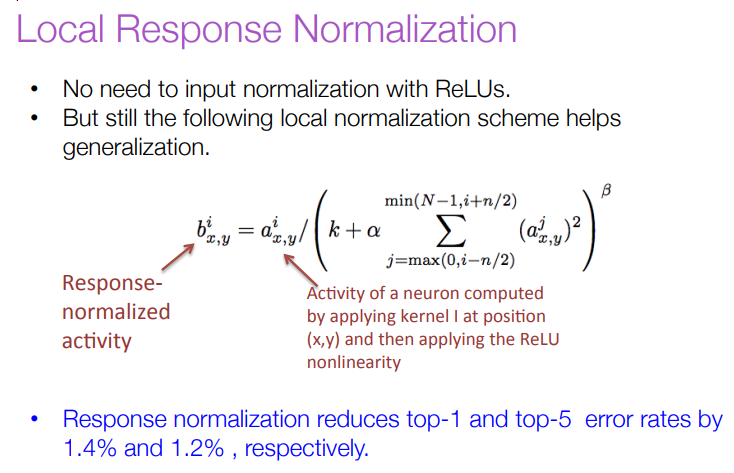
LCN: 使用价值不大的结构
其中这个LRN层真是让人百思不得其解,搜索了下,给出的介绍比较少。为什么会比较少呢,搜索到最后我得出的结论是,这货似乎没什么多少卵用。
但似乎,在后来的设计中,这一层已经被其它种的Regularization技术,如drop out, batch normalization取代了。知道了这些,似乎也可以不那么纠结这个LRN了。
Batch normalization参见:http://www.cnblogs.com/hansjorn/p/6298576.html
单独列出来学习:
SqueezeNet
http://www.jianshu.com/p/8e269451795d
http://blog.csdn.net/xbinworld/article/details/50897870
以上貌似是与AlexNet有关的两个网络设计,需要细看。
[Model] AlexNet的更多相关文章
- AlexNet 网络详解及Tensorflow实现源码
版权声明:本文为博主原创文章,未经博主允许不得转载. 1. 图片数据处理 2. 卷积神经网络 2.1. 卷积层 2.2. 池化层 2.3. 全链层 3. AlexNet 4. 用Tensorflow搭 ...
- 深度学习原理与框架-Alexnet(迁移学习代码) 1.sys.argv[1:](控制台输入的参数获取第二个参数开始) 2.tf.split(对数据进行切分操作) 3.tf.concat(对数据进行合并操作) 4.tf.variable_scope(指定w的使用范围) 5.tf.get_variable(构造和获得参数) 6.np.load(加载.npy文件)
1. sys.argv[1:] # 在控制台进行参数的输入时,只使用第二个参数以后的数据 参数说明:控制台的输入:python test.py what, 使用sys.argv[1:],那么将获得w ...
- AlexNet 2012
AlexNet Alexnet是一年一度的ImageNet大型视觉识别挑战赛(ILSVRC)2012年冠军,ILSVRC使用ImageNet的一个子集,分为1000种类别,每种 ...
- 深度学习方法(五):卷积神经网络CNN经典模型整理Lenet,Alexnet,Googlenet,VGG,Deep Residual Learning
欢迎转载,转载请注明:本文出自Bin的专栏blog.csdn.net/xbinworld. 技术交流QQ群:433250724,欢迎对算法.技术感兴趣的同学加入. 关于卷积神经网络CNN,网络和文献中 ...
- 【tf.keras】tf.keras加载AlexNet预训练模型
目录 从 PyTorch 中导出模型参数 第 0 步:配置环境 第 1 步:安装 MMdnn 第 2 步:得到 PyTorch 保存完整结构和参数的模型(pth 文件) 第 3 步:导出 PyTorc ...
- AlexNet网络的Pytorch实现
1.文章原文地址 ImageNet Classification with Deep Convolutional Neural Networks 2.文章摘要 我们训练了一个大型的深度卷积神经网络用于 ...
- AlexNet实现cifar10数据集分类
import tensorflow as tf import os from matplotlib import pyplot as plt import tensorflow.keras.datas ...
- 小白的经典CNN复现(三):AlexNet
小白的经典CNN复现(三):AlexNet 锵锵--本系列的第三弹AlexNet终于是来啦(≧∀≦),到了这里,我们的CNN的结构就基本上和现在我们经常使用或者接触的一些基本结构差不多了,并且从这一个 ...
- 【深度学习系列】用PaddlePaddle和Tensorflow实现经典CNN网络GoogLeNet
前面讲了LeNet.AlexNet和Vgg,这周来讲讲GoogLeNet.GoogLeNet是由google的Christian Szegedy等人在2014年的论文<Going Deeper ...
随机推荐
- java.lang.ClassCastException: cn.itcase.serviceImpl.servicestudentImpl cannot be cast to javax.servlet.Servlet
java.lang.ClassCastException: cn.itcase.serviceImpl.servicestudentImpl cannot be cast to javax.servl ...
- openvpn 的安装和使用方法
一.安装: 必备条件: 该计算机必须安装了网卡 1.像安装普通软件一样将 openvpn 这个软件安装好 2.到安装目录下/config 中,该目录下默认只有一个 README.txt,然后将企业给的 ...
- Eclipse 安装Maven以及Eclipse配置Maven
安装Maven 1 下载 Downloading Apache Maven 3.5.0 选择 2 解压 3 配置环境变量 新建变量名:MAVEN_HOME 变量值:D:\SoftwareInstal ...
- hadoop三种运行模式
1.单机模式:安装简单,几乎不用做任何配置,但仅限于调试用途 2.伪分布模式:在单节点上同时启动namenode.datanode.jobtracker.tasktracker.secondaryna ...
- Java 中的“implements Runnable” 和“extends Thread”(转)
知识点 “implements Runnable” 和“extends Thread”的不同 具体分析 最近在学习Android中的Handler消息传递机制时,创建新线程有两种方式:一种是实现Run ...
- POI HSSFCellStyle 设置 Excel 单元格样式
POI中可能会用到一些需要设置EXCEL单元格格式的操作小结: 先获取工作薄对象: HSSFWorkbook wb = new HSSFWorkbook(); HSSFSheet sheet = wb ...
- 递归与迭代的联系以及优缺点(以c++为例)
1.递归的定义: 程序直接或间接的调用自身的方法. 递归算法的特点:(1) 递归就是在过程或函数里调用自身.(2) 在使用递归策略时,必须有一个明确的递归结束条件,称为递归出口.(3) 递归算法解题通 ...
- 分布式文件系统---GlusterFS
1.1 分布式文件系统 1.1.1 什么是分布式文件系统 相对于本机端的文件系统而言,分布式文件系统(英语:Distributed file system, DFS),或是网络文件系统(英语:Netw ...
- 最佳实战Docker持续集成图文详解
最佳实战Docker持续集成图文详解 这是一种真正的容器级的实现,这个带来的好处,不仅仅是效率的提升,更是一种变革:开发人员第一次真正为自己的代码负责——终于可以跳过运维和测试部门,自主维护运行环境( ...
- Windows平台下tomcat 性能调优
Tomcat 线程查看工具: https://blog.csdn.net/jrainbow/article/details/49026365 16G内存 Tomcat并发优化.内存配置.垃圾回收.宕机 ...