
virtual table(有180个评论)
To implement virtual functions, C++ uses a special form of late binding known as the virtual table. The virtual table is a lookup table of functions used to resolve function calls in a dynamic/late binding manner. The virtual table sometimes goes by other names, such as “vtable”, “virtual function table”, “virtual method table”, or “dispatch table”.
Because knowing how the virtual table works is not necessary to use virtual functions, this section can be considered optional reading.
The virtual table is actually quite simple, though it’s a little complex to describe in words. First, every class that uses virtual functions (or is derived from a class that uses virtual functions) is given its own virtual table. This table is simply a static array that the compiler sets up at compile time. A virtual table contains one entry for each virtual function that can be called by objects of the class. Each entry in this table is simply a function pointer that points to the most-derived function accessible by that class.
Second, the compiler also adds a hidden pointer to the base class, which we will call *__vptr. *__vptr is set (automatically) when a class instance is created so that it points to the virtual table for that class. Unlike the *this pointer, which is actually a function parameter used by the compiler to resolve self-references, *__vptr is a real pointer. Consequently, it makes each class object allocated bigger by the size of one pointer. It also means that *__vptr is inherited by derived classes, which is important.
By now, you’re probably confused as to how these things all fit together, so let’s take a look at a simple example:
|
1
2
3
4
5
6
7
8
9
10
11
12
13
14
15
16
17
18
|
class Base
{
public:
virtual void function1() {};
virtual void function2() {};
};
class D1: public Base
{
public:
virtual void function1() {};
};
class D2: public Base
{
public:
virtual void function2() {};
};
|
Because there are 3 classes here, the compiler will set up 3 virtual tables: one for Base, one for D1, and one for D2.
The compiler also adds a hidden pointer to the most base class that uses virtual functions. Although the compiler does this automatically, we’ll put it in the next example just to show where it’s added:
|
1
2
3
4
5
6
7
8
9
10
11
12
13
14
15
16
17
18
19
|
class Base
{
public:
FunctionPointer *__vptr;
virtual void function1() {};
virtual void function2() {};
};
class D1: public Base
{
public:
virtual void function1() {};
};
class D2: public Base
{
public:
virtual void function2() {};
};
|
When a class object is created, *__vptr is set to point to the virtual table for that class. For example, when a object of type Base is created, *__vptr is set to point to the virtual table for Base. When objects of type D1 or D2 are constructed, *__vptr is set to point to the virtual table for D1 or D2 respectively.
Now, let’s talk about how these virtual tables are filled out. Because there are only two virtual functions here, each virtual table will have two entries (one for function1(), and one for function2()). Remember that when these virtual tables are filled out, each entry is filled out with the most-derived function an object of that class type can call.
The virtual table for Base objects is simple. An object of type Base can only access the members of Base. Base has no access to D1 or D2 functions. Consequently, the entry for function1 points to Base::function1(), and the entry for function2 points to Base::function2().
The virtual table for D1 is slightly more complex. An object of type D1 can access members of both D1 and Base. However, D1 has overridden function1(), making D1::function1() more derived than Base::function1(). Consequently, the entry for function1 points to D1::function1(). D1 hasn’t overridden function2(), so the entry for function2 will point to Base::function2().
The virtual table for D2 is similar to D1, except the entry for function1 points to Base::function1(), and the entry for function2 points to D2::function2().
Here’s a picture of this graphically:
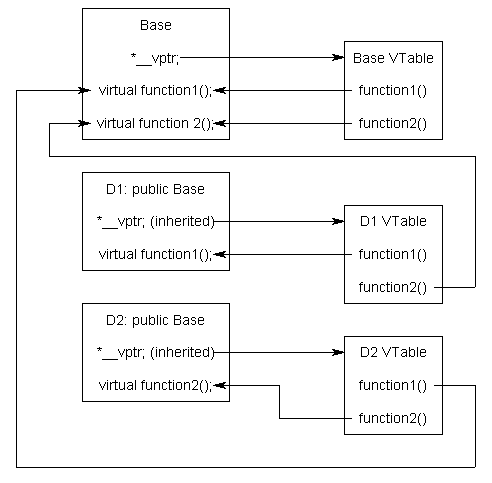
Although this diagram is kind of crazy looking, it’s really quite simple: the *__vptr in each class points to the virtual table for that class. The entries in the virtual table point to the most-derived version of the function objects of that class are allowed to call.
So consider what happens when we create an object of type D1:
|
1
2
3
4
|
int main()
{
D1 d1;
}
|
Because d1 is a D1 object, d1 has its *__vptr set to the D1 virtual table.
Now, let’s set a base pointer to D1:
|
1
2
3
4
5
|
int main()
{
D1 d1;
Base *dPtr = &d1;
}
|
Note that because dPtr is a base pointer, it only points to the Base portion of d1. However, also note that *__vptr is in the Base portion of the class, so dPtr has access to this pointer. Finally, note that dPtr->__vptr points to the D1 virtual table! Consequently, even though dPtr is of type Base, it still has access to D1’s virtual table (through __vptr).
So what happens when we try to call dPtr->function1()?
|
1
2
3
4
5
6
|
int main()
{
D1 d1;
Base *dPtr = &d1;
dPtr->function1();
}
|
First, the program recognizes that function1() is a virtual function. Second, the program uses dPtr->__vptr to get to D1’s virtual table. Third, it looks up which version of function1() to call in D1’s virtual table. This has been set to D1::function1(). Therefore, dPtr->function1() resolves to D1::function1()!
Now, you might be saying, “But what if Base really pointed to a Base object instead of a D1 object. Would it still call D1::function1()?”. The answer is no.
|
1
2
3
4
5
6
|
int main()
{
Base b;
Base *bPtr = &b;
bPtr->function1();
}
|
In this case, when b is created, __vptr points to Base’s virtual table, not D1’s virtual table. Consequently, bPtr->__vptr will also be pointing to Base’s virtual table. Base’s virtual table entry for function1() points to Base::function1(). Thus, bPtr->function1() resolves to Base::function1(), which is the most-derived version of function1() that a Base object should be able to call.
By using these tables, the compiler and program are able to ensure function calls resolve to the appropriate virtual function, even if you’re only using a pointer or reference to a base class!
Calling a virtual function is slower than calling a non-virtual function for a couple of reasons: First, we have to use the *__vptr to get to the appropriate virtual table. Second, we have to index the virtual table to find the correct function to call. Only then can we call the function. As a result, we have to do 3 operations to find the function to call, as opposed to 2 operations for a normal indirect function call, or one operation for a direct function call. However, with modern computers, this added time is usually fairly insignificant.
Also as a reminder, any class that uses virtual functions has a __vptr, and thus each object of that class will be bigger by one pointer. Virtual functions are powerful, but they do have a performance cost.
 12.6 -- Pure virtual functions, abstract base classes, and interface classes 12.6 -- Pure virtual functions, abstract base classes, and interface classes |
 Index Index |
 12.4 -- Early binding and late binding 12.4 -- Early binding and late binding |
Share this:
http://www.learncpp.com/cpp-tutorial/125-the-virtual-table/
virtual table(有180个评论)的更多相关文章
- C++: Virtual Table and Shared Memory
See at: 补充栏3: C++对象和共享内存 (叙述内容和Link1的内容基本一致) <C++网络编程 卷1:运用ACE和模式消除复杂性> <C++ Network Progra ...
- virtual table for class
虚函数表 说起虚函数,相信你我都可以自然而然的想到“多态”,因为多态的实现就依赖于虚函数的继承和重写(覆盖).那么,class又或者是object是如何来管理虚函数的呢?你我又会想到虚函数表. 虚函数 ...
- (C/C++学习)4.C++类中的虚函数表Virtual Table
说明:C++的多态是通过一张虚函数表(Virtual Table)来实现的,简称为V-Table.在这个表中,主要为一个类的虚函数的地址表,这张表解决了继承.覆写的问题,保证其真实反应实际的虚函数调用 ...
- Virtual Table
C++对象模型——吴泰 C/C++杂记 C++中的虚函数(表)实现机制以及用C语言对其进行的模拟实现 C++ 多继承和虚继承的内存布局 [已翻译100%] (虚继承参考,推荐) 图说C++对象模型:对 ...
- [转] When exactly does the virtual table pointer (in C++) gets set for an object?
PS: http://stackoverflow.com/questions/7934540/when-exactly-does-the-virtual-table-pointer-in-c-gets ...
- C++对象的virtual table在内存中的布局
(1)单一继承 (2)多重继承 (3)虚拟继承 参考:<深度探索C++对象模型>
- C++: virtual inheritance and Cross Delegation
Link1: Give an example Note: I think the Storable::Write method should also be pure virtual. http:// ...
- [CareerCup] 13.3 Virtual Functions 虚函数
13.3 How do virtual functions work in C++? 这道题问我们虚函数在C++中的工作原理.虚函数的工作机制主要依赖于虚表格vtable,即Virtual Table ...
- Standard C++ Programming: Virtual Functions and Inlining
原文链接:http://www.drdobbs.com/cpp/standard-c-programming-virtual-functions/184403747 By Josée Lajoie a ...
随机推荐
- Hadoop MapReduce编程 API入门系列之wordcount版本3(七)
这篇博客,给大家,体会不一样的版本编程. 代码 package zhouls.bigdata.myMapReduce.wordcount3; import java.io.IOException; i ...
- HTML5 audio 如何实现播放多个MP3音频
<audio>标签是HTML5中的新标签,定义声音用于嵌入音频内容,比如音乐或其他音频流.用的比较多音频格式是.mp3. <audio>标签常用属性如下表 属性 值 描述 au ...
- hdu2686/hdu3376 最小费用流最大流 拆点
虽然题目求的是最大费用,但是我们可以通过转换就变为最小费用.用一个比最大值更的数与每个数的差作为费用值.最后处理回来就i可以了.有些人用直接每个值都乘以-1,这样更简单. 做这题,我对为什么不拆点就会 ...
- hdu3572Task Schedule 最大流,判断满流 优化的SAP算法
PS:多校联赛的题目质量还是挺高的.建图不会啊,看了题解才会的. 参考博客:http://blog.csdn.net/luyuncheng/article/details/7944417 看了上面博客 ...
- MSSQL数据库设置单用户模式后无法连上解决办法
设置数据库单用户模式后, 发现用系统管理员账号无法连接数据库, 用sa账号也不行. 首先, 马上去查了一下有什么进程比这个连接给占用了 SELECT [Spid] = session_Id , eci ...
- OpenStack、KVM、Docker——Docker之后还需要OpenStack吗?
原文链接:http://news.csdn.net/article_preview.html?preview=1&reload=1&arcid=2823129 Docker从一个新兴的 ...
- sqlserver 分组 group by
select 名称, COUNT(名称) as 数量之和from 信息group by all 名称
- 模拟一个简单的基于tcp的远程关机程序(转)
最近在学习unix网络编程,现在正在学习tcp的通信.其实,只要建立起了tcp通信,操作远端的计算机就不是什么问题了.正向telnet一样,也是基于tcp/IP协议的.所以这个实验,也算是对telne ...
- java调用第三方命令,process.waitfor()挂起(你不知道的坑)
我们常在java中运行第三方程序,如sh.python,java提供一个Runtime.exec()方法,生成一个Process对象.今天在使用这个方法的时候,发现接口半天没有返回数据.查了一下,原来 ...
- 洛谷P1540 机器翻译 水题 模拟
注意一下细节,尤其是更新minv时不要更新错. Code: #include<vector> #include<iostream> #include<cstdio> ...