
Call stack Structure
The stack frame at the top of the stack is for the currently executing routine. The stack frame usually includes at least the following items (in push order):
- the arguments (parameter values) passed to the routine (if any);
- the return address back to the routine's caller (e.g. in the
DrawLinestack frame, an address intoDrawSquare's code); and - space for the local variables of the routine (if any).
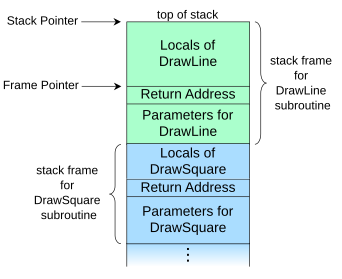
Call stack layout
Stack and frame pointers[edit]
When stack frame sizes can differ, such as between different functions or between invocations of a particular function, popping a frame off the stack does not constitute a fixed decrement of the stack pointer. At function return, the stack pointer is instead restored to the frame pointer, the value of the stack pointer just before the function was called. Each stack frame contains a stack pointer to the top of the frame immediately below. The stack pointer is a mutable register shared between all invocations. A frame pointer of a given invocation of a function is a copy of the stack pointer as it was before the function was invoked.[2]
The locations of all other fields in the frame can be defined relative either to the top of the frame, as negative offsets of the stack pointer, or relative to the top of the frame below, as positive offsets of the frame pointer. The location of the frame pointer itself must inherently be defined as a negative offset of the stack pointer.
Storing the address to the caller's frame[edit]
In most systems a stack frame has a field to contain the previous value of the frame pointer register, the value it had while the caller was executing. For example, the stack frame of DrawLine would have a memory location holding the frame pointer value that DrawSquare uses (not shown in the diagram above). The value is saved upon entry to the subroutine and restored upon return. Having such a field in a known location in the stack frame enables code to access each frame successively underneath the currently executing routine's frame, and also allows the routine to easily restore the frame pointer to the caller's frame, just before it returns.
Lexically nested routines[edit]
Programming languages that support nested subroutines also have a field in the call frame that points to the stack frame of the latest activation of the procedure that most closely encapsulates the callee, i.e. the immediate scope of the callee. This is called an access link or static link (as it keeps track of static nesting during dynamic and recursive calls) and provides the routine (as well as any other routines it may invoke) access to the local data of its encapsulating routines at every nesting level. Some architectures, compilers, or optimization cases store one link for each enclosing level (not just the immediately enclosing), so that deeply nested routines that access shallow data do not have to traverse several links; this strategy is often called a "display".[3]
Access links can be optimized away when an inner function does not access any (non-constant) local data in the encapsulation, as is the case with pure functions communicating only via arguments and return values, for example. Some historical computers, such as the Burroughs large systems, had special "display registers" to support nested functions, while compilers for most modern machines (such as the ubiquitous x86) simply reserve a few words on the stack for the pointers, as needed.
Overlap[edit]
For some purposes, the stack frame of a subroutine and that of its caller can be considered to overlap, the overlap consisting of the area where the parameters are passed from the caller to the callee. In some environments, the caller pushes each argument onto the stack, thus extending its stack frame, then invokes the callee. In other environments, the caller has a preallocated area at the top of its stack frame to hold the arguments it supplies to other subroutines it calls. This area is sometimes termed the outgoing arguments area or callout area. Under this approach, the size of the area is calculated by the compiler to be the largest needed by any called subroutine.
Call stack Structure的更多相关文章
- 线性数据结构之栈——Stack
Linear data structures linear structures can be thought of as having two ends, whose items are order ...
- 【LeetCode OJ】Evaluate Reverse Polish Notation
Problem link: http://oj.leetcode.com/problems/evaluate-reverse-polish-notation/ According to the wik ...
- MakeObjectInstance的前世今生(关键是ECX的何时入栈以及Self指针何时存储的)
高手们的文章有很大启发,但是总有些小错,也有没交代清楚的,以下是我的理解: 编译器编译MainWndProc的时候,它是一个正常Delphi普通函数,MakeObjectInstance对它做变换是运 ...
- java建立二叉树,递归/非递归先序遍历,递归/非递归中序遍历,层次遍历
import java.util.LinkedList; import java.util.Scanner; import java.util.Stack; //structure of binary ...
- [转] iOS ABI Function Call Guide
source: apple ARMv6 Function Calling Conventions When functions (routines) call other functions (sub ...
- iOS - Block底层解析
Block是iOS开发中一种比较特殊的数据结构,它可以保存一段代码,在合适的地方再调用,具有语法简介.回调方便.编程思路清晰.执行效率高等优点,受到众多猿猿的喜爱.但是Block在使用过程中,如果对B ...
- allego 输出报告说明
List of Available Reports Assigned Function Report Lists all assigned functions, sorted by function ...
- SECD machine
SECD machine 对程序语言理论的理解 程序语言理论主要研究语法.语义及语言的实现.编程语言有语法,各种数学逻辑.结构化数据都有语法.乔姆斯基的语言体系及巴科斯范式是语法分析的基础,语法分析将 ...
- 【deep learning精华部分】稀疏自编码提取高阶特征、多层微调完全解释及代码逐行详解
我们前面已经讲了如何训练稀疏自编码神经网络,当我们训练好这个神经网络后,当有新的样本输入到这个训练好的稀疏自编码器中后,那么隐藏层各单元的激活值组成的向量就可以代表(因为根据稀疏自编码,我们可以用来恢 ...
随机推荐
- 通过android XML 创建图形,降低对美工的依赖
在开发中总会须要自己定义各种View的样式,假设总是依赖美工作图弄出须要的UI样式图片(比方:一个button要选中和默认两张图片),不但时间上会浪费.往往也会有适配问题. 尽管能够通过.9图来解决一 ...
- MySQL系列:innodb源代码分析之内存管理
在innodb中实现了自己的内存池系统和内存堆分配系统,在innodb的内存管理系统中,大致分为三个部分:基础的内存块分配管理.内存伙伴分配器和内存堆分配器.innodb定义和实现内存池的主要目的是提 ...
- js 对有“命名空间”的表单做深度解析
问题描写叙述:一个大表单中,可能包括几十个字段.这些字段在数据库中的映射非常可能不在一张表中,为了降低后台操作的工作量,我们应该在前台提交的时候对数据做初步处理. 举例说明: watermark/2/ ...
- 【bzoj4542】[Hnoi2016]大数
#include<algorithm> #include<iostream> #include<cstdlib> #include<cstring> # ...
- Vijos 1523 贪吃的九头龙 【树形DP】
贪吃的九头龙 背景 安徽省芜湖市第二十七中学测试题 NOI 2002 贪吃的九头龙(dragon) Description:OfficialData:OfficialProgram:Converted ...
- ZOJ1450 Minimal Circle 最小圆覆盖
ZOJ1450 给定N个点(N<=100)求最小的圆把这些点全部覆盖 考虑对于三角形,可以唯一的找到外接圆,而多边形又可以分解为三角形,所以对于多边形也可以找到唯一的最小覆盖圆. #includ ...
- 【174】C#添加非默认字体
参考:C# WinForm程序安装字体或直接调用非注册字体 参考:百度知道 在Debug文件夹下面新建一个font的文件夹,然后将字体的文件复制到里面,使用的时候,直接调用字体文件! private ...
- Netty,Thrifty
小白科普:Netty有什么用? https://mp.weixin.qq.com/s/PTKnRQ_hLf8BBPYnywLenA Thrifty 是基于.net Attribute 实现了标准 Th ...
- bzoj 1668: [Usaco2006 Oct]Cow Pie Treasures 馅饼里的财富【记忆化搜索+剪枝】
c[x][y]为从(x,y)到(n,m)的最大值,记忆化一下 有个剪枝是因为y只能+1所以当n-x>m-y时就算x也一直+1也是走不到(n,m)的,直接返回0即可 #include<ios ...
- 第三章 K近邻法(k-nearest neighbor)
书中存在的一些疑问 kd树的实现过程中,为何选择的切分坐标轴要不断变换?公式如:x(l)=j(modk)+1.有什么好处呢?优点在哪?还有的实现是通过选取方差最大的维度作为划分坐标轴,有何区别? 第一 ...