
实例学习Bloom Filter
0. 科普
1. 为什么需要Bloom Filter
2. 基本原理
3. 如何设计Bloom Filter
4. 实例操作
5. 扩展
0. 科普
Bloom Filter是由Bloom在1970年提出的一种多哈希函数映射的快速查找算法。通常应用在一些需要快速判断某个元素是否属于集合,但是并不严格要求100%正确的场合。
1. 为什么需要Bloom Filter
举例说明:假设有2000万个url,现在判断一个新的url是否在这2000万个之中。可以有的思路:
- 将访问过的URL保存到数据库。
- 用HashSet将访问过的URL保存起来。那只需接近O(1)的代价就可以查到一个URL是否被访问过了。
- URL经过MD5等单向哈希后再保存到HashSet或数据库。
- Bit-Map方法。建立一个BitSet,将每个URL经过一个哈希函数映射到某一位。
分析
思路1:当数据量很大时,查询数据库变得效率底下
思路2:太消耗内存,还得把字符串全部储存起来
思路3:字符串经过MD5处理后有128个bit,比思路2省了很多空间
思路4:一个字符串仅用一位来表示,比思路3还节省空间
当然前提是会出现误判(哈希后表示相同),为了继承这么好的思路,同时减少误判的情况,可以来个折衷:一个哈希函数生成一个位,用多个哈希函数生成多个位来存储一个字符串。这样比Bit-Map多用了些空间,但是减少了误判率。
2. 基本原理
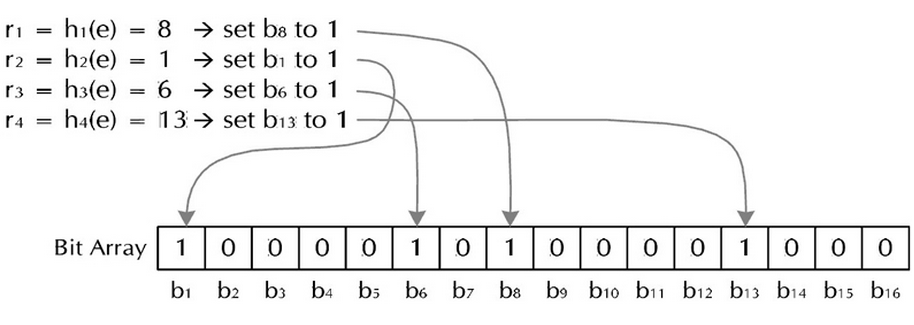
这样把大量的字符串存起来。查找时,用同样的哈希处理待查串,如果对应的各位上都为1,说明该字符串可能在这些字符串中,否则一定不在其中。
3. 如何设计Bloom Filter
如何降低误判率是关键,这需要
- 选取区分度高的哈希函数
- 根据存储数组、哈希函数个数、误判率之间的关系,分配空间、个数
直接利用前人的结论:
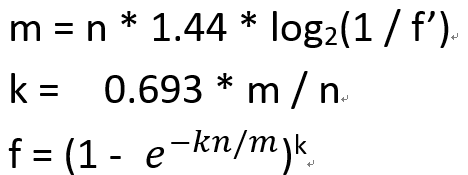
其中f'是自己期望的误判率,m是总共开辟的存储空间位数,n是待存储字符串的个数,k是哈希函数的个数,f是真正的误判率。
4. 实例操作
需求:2000万个已知url,100个待查url
设计:
1. 设定误判率为0.1, n=2000万,计算
m = n * 1.44 * math.log(/f)/math.log()=

k = 0.693 * m / n=

f = ( - math.exp(- * k * n / m)) ** k = 0.00101298781512
哈希函数的选取看这里
参考代码(c++)
makefile
objects = main.o hash.o bloomfilter.o

main : $(objects)

    g++ -o main $(objects)

main.o : hash.h bloomfilter.h

bloomfilter.o : bloomfilter.h

hash.o : hash.h

clean:

    rm *.o main
main.cc
#include <iostream>

#include <fstream>

#include <sstream>

#include <cstring>

#include <string>

#include "bloomfilter.h"

using namespace std;

const int MAXSIZE = ;

int main(int argc, char **argv)

{

    char *poolfile = argv[];

    char *testfile = argv[];

    cout << poolfile << endl;

    ifstream fpool(poolfile);

    ifstream ftest(testfile);

    if(!fpool)

    {

        cout << "cannot open the file:" << poolfile << endl;

        return ;

    }

    if(!ftest)

    {

        cout << "cannot open the file:" << testfile << endl;

        return ;

    }

    BloomFilter bf(MAXSIZE);

    bf.setBit(fpool);

    cout << "Store OK" << endl;

    bf.checkBit(ftest);

    cout << "Check OK" << endl;

    fpool.close();

    ftest.close();

}
bloomfilter.h
#include <iostream>

#include <string>

#include <fstream>

#include <vector>

#include "hash.h"

using namespace std;

class BloomFilter

{

    public:

        BloomFilter(int size) : SIZE(size) { vec.resize(size); };

        void setBit(ifstream &f);

        void setBit(const string &s);

        void setBit(unsigned int count);

        bool checkBit(ifstream &f);

        bool checkBit(const string &s);

        bool checkBit(unsigned int count);

    private:

        vector<char> vec;

        const unsigned int SIZE;

};
bloomfilter.cc
#include "bloomfilter.h"

void BloomFilter::setBit(ifstream &f)

{

    string line;

    while(f >> line)

    {

        setBit(line);

    }

}

bool BloomFilter::checkBit(ifstream &f)

{

    string line;

    while(f >> line)

    {

        if(!checkBit(line))

            cout << line << endl;

    }

}

void BloomFilter::setBit(const string &s)

{

    unsigned int bitpos = ;

    const char *str = s.c_str();

    int len = s.size();

    bitpos = RSHash(str, len);

    setBit(bitpos);

    bitpos = JSHash(str, len);

    setBit(bitpos);

    bitpos = PJWHash(str, len);

    setBit(bitpos);

    bitpos = ELFHash(str, len);

    setBit(bitpos);

    bitpos = BKDRHash(str, len);

    setBit(bitpos);

    bitpos = SDBMHash(str, len);

    setBit(bitpos);

    bitpos = DJBHash(str, len);

    setBit(bitpos);

    bitpos = DEKHash(str, len);

    setBit(bitpos);

    bitpos = BPHash(str, len);

    setBit(bitpos);

    bitpos = FNVHash(str, len);

    setBit(bitpos);

}

bool BloomFilter::checkBit(const string &s)

{

    unsigned int bitpos = ;

    const char *str = s.c_str();

    int len = s.size();

    bool rev = true;

    bitpos = RSHash(str, len);

    rev &= checkBit(bitpos);

    bitpos = JSHash(str, len);

    rev &= checkBit(bitpos);

    bitpos = PJWHash(str, len);

    rev &= checkBit(bitpos);

    bitpos = ELFHash(str, len);

    rev &= checkBit(bitpos);

    bitpos = BKDRHash(str, len);

    rev &= checkBit(bitpos);

    bitpos = SDBMHash(str, len);

    rev &= checkBit(bitpos);

    bitpos = DJBHash(str, len);

    rev &= checkBit(bitpos);

    bitpos = DEKHash(str, len);

    rev &= checkBit(bitpos);

    bitpos = BPHash(str, len);

    rev &= checkBit(bitpos);

    bitpos = FNVHash(str, len);

    rev &= checkBit(bitpos);

    return rev;

}

void BloomFilter::setBit(unsigned int count)

{

    count = count % (SIZE * );

    vec[count / ] |= ( << (count % ));

}

bool BloomFilter::checkBit(unsigned int count)

{

    count = count % (SIZE * );

    return vec[count / ] &= ( << (count % ));

}
hash.h
unsigned int RSHash(const char* str, unsigned int len);

unsigned int JSHash(const char* str, unsigned int len);

unsigned int PJWHash(const char* str, unsigned int len);

unsigned int ELFHash(const char* str, unsigned int len);

unsigned int BKDRHash(const char* str, unsigned int len);

unsigned int SDBMHash(const char* str, unsigned int len);

unsigned int DJBHash(const char* str, unsigned int len);

unsigned int DEKHash(const char* str, unsigned int len);

unsigned int BPHash(const char* str, unsigned int len);

unsigned int FNVHash(const char* str, unsigned int len);
hash.cc
#include "hash.h"

unsigned int RSHash(const char* str, unsigned int len)

{

   unsigned int b = ;

   unsigned int a = ;

   unsigned int hash = ;

   unsigned int i = ;

   for(i=; i<len; str++, i++)

   {

      hash = hash*a + (*str);

      a = a*b;

   }

   return hash;

}

/* End Of RS Hash Function */

unsigned int JSHash(const char* str, unsigned int len)

{

   unsigned int hash = ;

   unsigned int i    = ;

   for(i=; i<len; str++, i++)

   {

      hash ^= ((hash<<) + (*str) + (hash>>));

   }

   return hash;

}

/* End Of JS Hash Function */

unsigned int PJWHash(const char* str, unsigned int len)

{

   const unsigned int BitsInUnsignedInt = (unsigned int)(sizeof(unsigned int) * );

   const unsigned int ThreeQuarters = (unsigned int)((BitsInUnsignedInt  * ) / );

   const unsigned int OneEighth = (unsigned int)(BitsInUnsignedInt / );

   const unsigned int HighBits = (unsigned int)(0xFFFFFFFF) << (BitsInUnsignedInt - OneEighth);

   unsigned int hash = ;

   unsigned int test = ;

   unsigned int i = ;

   for(i=;i<len; str++, i++)

   {

      hash = (hash<<OneEighth) + (*str);

      if((test = hash & HighBits)  != )

      {

         hash = ((hash ^(test >> ThreeQuarters)) & (~HighBits));

      }

   }

   return hash;

}

/* End Of  P. J. Weinberger Hash Function */

unsigned int ELFHash(const char* str, unsigned int len)

{

   unsigned int hash = ;

   unsigned int x    = ;

   unsigned int i    = ;

   for(i = ; i < len; str++, i++)

   {

      hash = (hash << ) + (*str);

      if((x = hash & 0xF0000000L) != )

      {

         hash ^= (x >> );

      }

      hash &= ~x;

   }

   return hash;

}

/* End Of ELF Hash Function */

unsigned int BKDRHash(const char* str, unsigned int len)

{

   unsigned int seed = ; /* 31 131 1313 13131 131313 etc.. */

   unsigned int hash = ;

   unsigned int i    = ;

   for(i = ; i < len; str++, i++)

   {

      hash = (hash * seed) + (*str);

   }

   return hash;

}

/* End Of BKDR Hash Function */

unsigned int SDBMHash(const char* str, unsigned int len)

{

   unsigned int hash = ;

   unsigned int i    = ;

   for(i = ; i < len; str++, i++)

   {

      hash = (*str) + (hash << ) + (hash << ) - hash;

   }

   return hash;

}

/* End Of SDBM Hash Function */

unsigned int DJBHash(const char* str, unsigned int len)

{

   unsigned int hash = ;

   unsigned int i    = ;

   for(i = ; i < len; str++, i++)

   {

      hash = ((hash << ) + hash) + (*str);

   }

   return hash;

}

/* End Of DJB Hash Function */

unsigned int DEKHash(const char* str, unsigned int len)

{

   unsigned int hash = len;

   unsigned int i    = ;

   for(i = ; i < len; str++, i++)

   {

      hash = ((hash << ) ^ (hash >> )) ^ (*str);

   }

   return hash;

}

/* End Of DEK Hash Function */

unsigned int BPHash(const char* str, unsigned int len)

{

   unsigned int hash = ;

   unsigned int i    = ;

   for(i = ; i < len; str++, i++)

   {

      hash = hash <<  ^ (*str);

   }

   return hash;

}

/* End Of BP Hash Function */

unsigned int FNVHash(const char* str, unsigned int len)

{

   const unsigned int fnv_prime = 0x811C9DC5;

   unsigned int hash      = ;

   unsigned int i         = ;

   for(i = ; i < len; str++, i++)

   {

      hash *= fnv_prime;

      hash ^= (*str);

   }

   return hash;

}

/* End Of FNV Hash Function */
数据下载:http://pan.baidu.com/s/1hqBTks0
Github 地址:https://github.com/jihite/Bloom-Filter
5. 扩展
如何删除存储数组中的元素?
思路:把存储数组的每一个元素扩展一下(原来是1b)用来存储该位置被置1的次数。存储是,计数次数加一;删除的时候,计数次数减一。
实例学习Bloom Filter的更多相关文章
- Bloom Filter:海量数据的HashSet
Bloom Filter一般用于数据的去重计算,近似于HashSet的功能:但是不同于Bitmap(用于精确计算),其为一种估算的数据结构,存在误判(false positive)的情况. 1. 基本 ...
- 探索C#之布隆过滤器(Bloom filter)
阅读目录: 背景介绍 算法原理 误判率 BF改进 总结 背景介绍 Bloom filter(后面简称BF)是Bloom在1970年提出的二进制向量数据结构.通俗来说就是在大数据集合下高效判断某个成员是 ...
- Bloom Filter 布隆过滤器
Bloom Filter 是由伯顿.布隆(Burton Bloom)在1970年提出的一种多hash函数映射的快速查找算法.它实际上是一个很长的二进制向量和一些列随机映射函数.应用在数据量很大的情况下 ...
- Bloom Filter学习
参考文献: Bloom Filters - the math http://pages.cs.wisc.edu/~cao/papers/summary-cache/node8.html B ...
- 【转】探索C#之布隆过滤器(Bloom filter)
原文:蘑菇先生,http://www.cnblogs.com/mushroom/p/4556801.html 背景介绍 Bloom filter(后面简称BF)是Bloom在1970年提出的二进制向量 ...
- bloom filter
Bloom filter 是由 Howard Bloom 在 1970 年提出的二进制向量数据结构,它具有很好的空间和时间效率,被用来检测一个元素是不是集合中的一个成员. 结 构 二进制 召回率 ...
- Bloom Filter 概念和原理
Bloom filter 是由 Howard Bloom 在 1970 年提出的二进制向量数据结构,它具有很好的空间和时间效率,被用来检测一个元素是不是集合中的一个成员.如果检测结果为是,该元素不一定 ...
- 【转】Bloom Filter布隆过滤器的概念和原理
转自:http://blog.csdn.net/jiaomeng/article/details/1495500 之前看数学之美丽,里面有提到布隆过滤器的过滤垃圾邮件,感觉到何其的牛,竟然有这么高效的 ...
- [爬虫学习笔记]基于Bloom Filter的url去重模块UrlSeen
Url Seen用来做url去重.对于一个大的爬虫系统,它可能已经有百亿或者千亿的url,新来一个url如何能快速的判断url是否已经出现过非常关键.因为大的爬虫系统可能一秒钟就会下载 ...
随机推荐
- rtx信息泄漏利结合弱口令导致被批量社工思路
腾讯通RTX(Real Time eXchange)是腾讯公司推出的企业级实时通信平台. rtx server 存在暴露用户信息的漏洞,通过web访问 http://RtxServerIp:8012/ ...
- 数据分析≠Hadoop+NoSQL,不妨先看完善现有技术的10条捷径(分享)
Hadoop让大数据分析走向了大众化,然而它的部署仍需耗费大量的人力和物力.在直奔Hadoop之前,是否已经将现有技术推向极限?这里总结了对Hadoop投资前可以尝试的10个替代方案, ...
- stringlist
#ifndef _STRINGLIST_HPP_#define _STRINGLIST_HPP_ #include "../global.hpp"#include <type ...
- [ios]scrollView实现移动与缩放
实现滑动 1.在viewDidLoad中对scrollview的contentSize属性赋值 告诉他滑动范围. 实现缩放 1.在storyboard的scrollview的attribute标签中设 ...
- [转载]iOS面试题总
转载自:http://blog.sina.com.cn/s/blog_67eb608b0101r6xb.html (2014-06-13 20:23:33) 转载▼ 标签: 转载 crash 原文 ...
- IME日语输入法的快捷键
<1>小小技巧 alt+shift可以在中,英,日之间切换 ALT+~可以在假名和英文之间切换 ctrl+CAPSLOCK 和 alt+CAPSLOCK可以在平假名和片假名之间切换 敲完字 ...
- Another 20 Docs and Guides for Front-End Developers
http://www.sitepoint.com/another-20-docs-guides-front-end-developers/?utm_medium=email&utm_campa ...
- Excel取消保护密码
Excel表被保护了, 如果没有密码, 可通过以下宏代码查看 (Office 2013已测) Option Explicit Public Sub AllInternalPasswords()' Br ...
- OC 加密
//MD5加密的结果为128位的二进制数. //所以有128 / 8 = 16字节(8位一个字节). //每八位表示两个16进制数. //MD5 有32个16进制数. //语言层次的所有摘要算法步骤类 ...
- VMware ESXi虚拟机克隆及迁移
使用ESXi经常会遇到这样的问题,我需要建立多个虚拟机,都是linux操作系统,难道必须一个一个安装吗? VMware ESXi.VMware vCenter Server 和 vSphere Cli ...