
201771010118 马昕璐 《面向对象设计 java》第十七周实验总结
1、实验目的与要求
(1) 掌握线程同步的概念及实现技术;
(2) 线程综合编程练习
2、实验内容和步骤
实验1:测试程序并进行代码注释。
测试程序1:
l 在Elipse环境下调试教材651页程序14-7,结合程序运行结果理解程序;
l 掌握利用锁对象和条件对象实现的多线程同步技术。
package synch;

import java.util.*;
import java.util.concurrent.locks.*;

/**
 * A bank with a number of bank accounts that uses locks for serializing access.
 * @version 1.30 2004-08-01
 * @author Cay Horstmann
 */
public class Bank
{
   private final double[] accounts;
   private Lock bankLock;
   private Condition sufficientFunds;

   /**
    * Constructs the bank.
    * @param n the number of accounts
    * @param initialBalance the initial balance for each account
    */
   public Bank(int n, double initialBalance)
   {
      accounts = new double[n];
      Arrays.fill(accounts, initialBalance);
      bankLock = new ReentrantLock();
      sufficientFunds = bankLock.newCondition();
   }

   /**
    * Transfers money from one account to another.
    * @param from the account to transfer from
    * @param to the account to transfer to
    * @param amount the amount to transfer
    */
   public void transfer(int from, int to, double amount) throws InterruptedException
   //通过锁对象生成条件对象
   {
      bankLock.lock();//加锁
      try
      {
         while (accounts[from] < amount)
            sufficientFunds.await();//条件对象如果被注释会出现死锁现象不能实现线程的有效调用
         System.out.print(Thread.currentThread());
         accounts[from] -= amount;
         System.out.printf(" %10.2f from %d to %d", amount, from, to);
         accounts[to] += amount;
         System.out.printf(" Total Balance: %10.2f%n", getTotalBalance());
         sufficientFunds.signalAll();
      }
      finally
      {
         bankLock.unlock();
      }
   }

   /**
    * Gets the sum of all account balances.
    * @return the total balance
    */
   public double getTotalBalance()
   {
      bankLock.lock();
      try
      {
         double sum = 0;

         for (double a : accounts)
            sum += a;

         return sum;
      }
      finally
      {
         bankLock.unlock();
      }
   }

   /**
    * Gets the number of accounts in the bank.
    * @return the number of accounts
    */
   public int size()
   {
      return accounts.length;
   }
}
package synch;

/**
 * This program shows how multiple threads can safely access a data structure.
 * @version 1.31 2015-06-21
 * @author Cay Horstmann
 */
public class SynchBankTest
{
   public static final int NACCOUNTS = 100;
   public static final double INITIAL_BALANCE = 1000;
   public static final double MAX_AMOUNT = 1000;
   public static final int DELAY = 10;

   public static void main(String[] args)
   {
      Bank bank = new Bank(NACCOUNTS, INITIAL_BALANCE);
      for (int i = 0; i < NACCOUNTS; i++)
      {
         int fromAccount = i;
         Runnable r = () -> {
            try
            {
               while (true)
               {
                  int toAccount = (int) (bank.size() * Math.random());
                  double amount = MAX_AMOUNT * Math.random();
                  bank.transfer(fromAccount, toAccount, amount);
                  Thread.sleep((int) (DELAY * Math.random()));
               }
            }
            catch (InterruptedException e)
            {
            }
         };
         Thread t = new Thread(r);
         t.start();
      }
   }
}
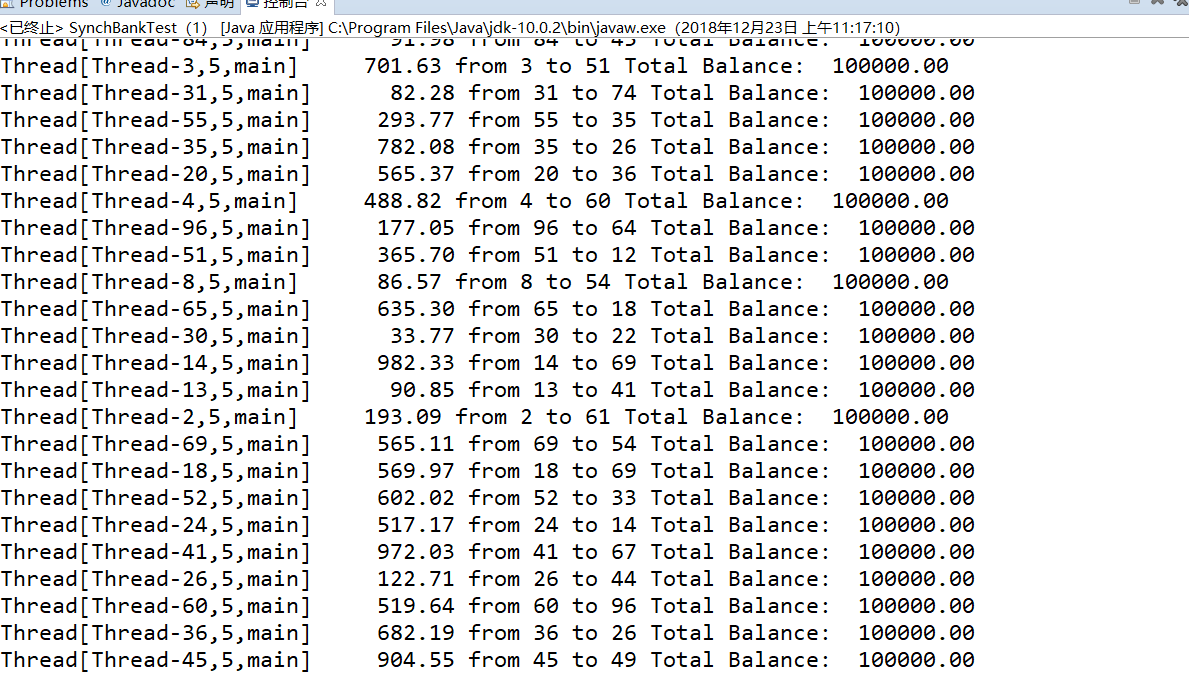
实验结果如下:
测试程序2:
l 在Elipse环境下调试教材655页程序14-8,结合程序运行结果理解程序;
l 掌握synchronized在多线程同步中的应用。
package synch2;

import java.util.*;

/**
 * A bank with a number of bank accounts that uses synchronization primitives.
 * @version 1.30 2004-08-01
 * @author Cay Horstmann
 */
public class Bank
{
   private final double[] accounts;

   /**
    * Constructs the bank.
    * @param n the number of accounts
    * @param initialBalance the initial balance for each account
    */
   public Bank(int n, double initialBalance)
   {
      accounts = new double[n];
      Arrays.fill(accounts, initialBalance);
   }

   /**
    * Transfers money from one account to another.
    * @param from the account to transfer from
    * @param to the account to transfer to
    * @param amount the amount to transfer
    */
   public synchronized void transfer(int from, int to, double amount) throws InterruptedException
   {
      while (accounts[from] < amount)
         wait();
    //在其他线程调用此对象的 notify() 方法或 notifyAll() 方法前,导致当前线程等待
      System.out.print(Thread.currentThread());
      accounts[from] -= amount;
      System.out.printf(" %10.2f from %d to %d", amount, from, to);
      accounts[to] += amount;
      System.out.printf(" Total Balance: %10.2f%n", getTotalBalance());
      notifyAll();//唤醒在此对象监视器上等待的所有线程
   }

   /**
    * Gets the sum of all account balances.
    * @return the total balance
    */
   public synchronized double getTotalBalance()
   {
      double sum = 0;

      for (double a : accounts)
         sum += a;

      return sum;
   }

   /**
    * Gets the number of accounts in the bank.
    * @return the number of accounts
    */
   public int size()
   {
      return accounts.length;
   }
}
package synch2;

/**
 * This program shows how multiple threads can safely access a data structure,
 * using synchronized methods.
 * @version 1.31 2015-06-21
 * @author Cay Horstmann
 */
public class SynchBankTest2
{
   public static final int NACCOUNTS = 100;
   public static final double INITIAL_BALANCE = 1000;
   public static final double MAX_AMOUNT = 1000;
   public static final int DELAY = 10;

   public static void main(String[] args)
   {
      Bank bank = new Bank(NACCOUNTS, INITIAL_BALANCE);
      for (int i = 0; i < NACCOUNTS; i++)
      {
         int fromAccount = i;
         Runnable r = () -> {
            try
            {
               while (true)
               {
                  int toAccount = (int) (bank.size() * Math.random());
                  double amount = MAX_AMOUNT * Math.random();
                  bank.transfer(fromAccount, toAccount, amount);
                  Thread.sleep((int) (DELAY * Math.random()));
               }
            }
            catch (InterruptedException e)
            {
            }
         };
         Thread t = new Thread(r);
         t.start();
      }
   }
}
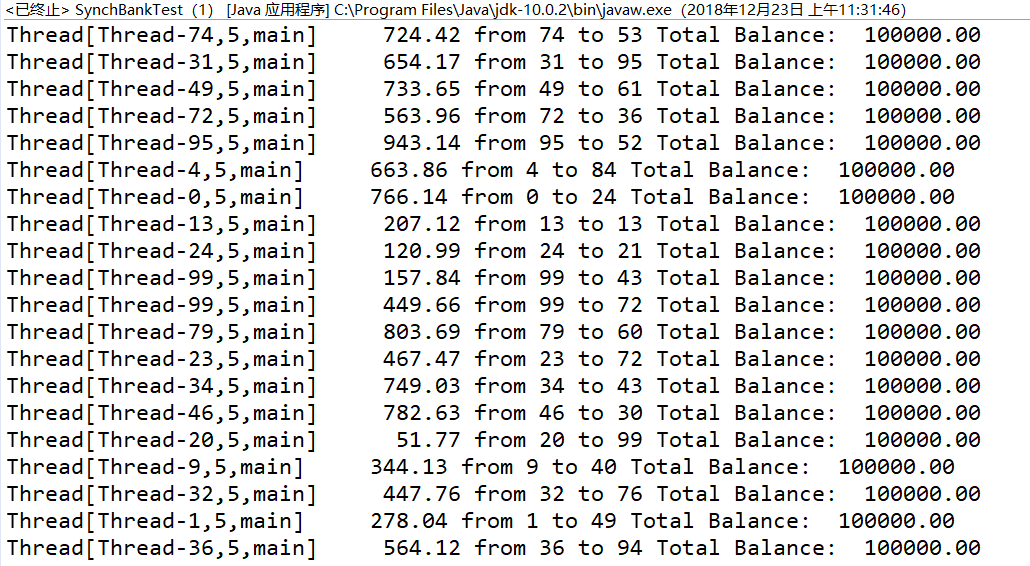
实验结果如图所示:
测试程序3:
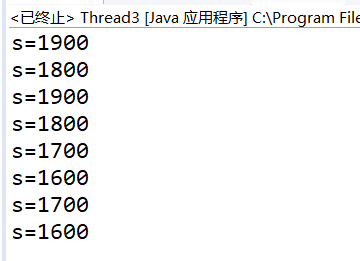
l 在Elipse环境下运行以下程序,结合程序运行结果分析程序存在问题;
l 尝试解决程序中存在问题。
|
class Cbank { private static int s=2000; public static void sub(int m) { int temp=s; temp=temp-m; try { Thread.sleep((int)(1000*Math.random())); } catch (InterruptedException e) { } s=temp; System.out.println("s="+s); } }
class Customer extends Thread { public void run() { for( int i=1; i<=4; i++) Cbank.sub(100); } } public class Thread3 { public static void main(String args[]) { Customer customer1 = new Customer(); Customer customer2 = new Customer(); customer1.start(); customer2.start(); } } |
class Cbank
{
private static int s=2000;
public static void sub(int m)
{
int temp=s;
temp=temp-m;
try {
Thread.sleep((int)(1000*Math.random()));
}
catch (InterruptedException e) { }
s=temp;
System.out.println("s="+s);
}
}
class Customer extends Thread
{
public void run()
{
for( int i=1; i<=4; i++)
Cbank.sub(100);
}
}
public class Thread3
{
public static void main(String args[])
{
Customer customer1 = new Customer();
Customer customer2 = new Customer();
customer1.start();
customer2.start();
}
}
实验结果如下:
实验2 编程练习
利用多线程及同步方法,编写一个程序模拟火车票售票系统,共3个窗口,卖10张票,程序输出结果类似(程序输出不唯一,可以是其他类似结果)。
Thread-0窗口售:第1张票
Thread-0窗口售:第2张票
Thread-1窗口售:第3张票
Thread-2窗口售:第4张票
Thread-2窗口售:第5张票
Thread-1窗口售:第6张票
Thread-0窗口售:第7张票
Thread-2窗口售:第8张票
Thread-1窗口售:第9张票
Thread-0窗口售:第10张票
public class Demo {
        public static void main(String[] args) {
            Mythread mythread = new Mythread();
            Thread t1 = new Thread(mythread);
            Thread t2 = new Thread(mythread);
            Thread t3= new Thread(mythread);
            t1.start();
            t2.start();
            t3.start();
        }
        }
        class Mythread implements Runnable{
            int t=1;
            boolean flag=true;
            @Override
            public void run() {
                while(flag) {
                        try {
                            Thread.sleep(500);
                        } catch (InterruptedException e) {
                            // TODO Auto-generated catch block
                            e.printStackTrace();
                        }
                        synchronized (this) {
                            if(t<=10) {
                            System.out.println(Thread.currentThread().getName()+"窗口售:第"+t+"张票");
                            t++;
                        }
                        if(t>10) {
                            flag=false;
                        }
                        }

                    }

                }

            }

实验总结:在这周的理论学习部分中,我们学习了关于解决线程并发执行中的问题,实验中掌握了利用锁对象和条件对象实现的多线程同步技术。在一学期的java学习中我收获了很多,对学长及老师的教导与帮助深表感谢。
201771010118 马昕璐 《面向对象设计 java》第十七周实验总结的更多相关文章
- 201771010118马昕璐《面向对象程序设计java》第八周学习总结
第一部分:理论知识学习部分 1.接口 在Java程序设计语言中,接口不是类,而是对类的一组需求描述,由常量和一组抽象方法组成.Java为了克服单继承的缺点,Java使用了接口,一个类可以实现一个或多个 ...
- 201771010123汪慧和《面向对象程序设计JAVA》第九周实验总结
一.理论部分 1.异常 (1)异常处理的任务就是将控制权从错误产生的地方转移给能够处理这种情况的错误处理器. (2)程序中可能出现的错误和问题:a.用户输入错误.b.设备错误.c.物理限制.d.代码错 ...
- 201771010118 马昕璐《面向对象程序设计java》第十二周学习总结
第一部分:理论知识学习部分 用户界面:用户与计算机系统(各种程序)交互的接口 图形用户界面:以图形方式呈现的用户界面 AET:Java 的抽象窗口工具箱包含在java.awt包中,它提供了许多用来设计 ...
- 201771010118 马昕璐 《面向对象程序设计(java)》第十三周学习总结
第一部分:理论知识学习部分 事件处理基础 1.事件源(event source):能够产生事件的对象都可以成为事件源.一个事件源是一个能够注册监听器并向监听器发送事件对象的对象. 2.事件监听器(ev ...
- 201771010118 马昕璐《面向对象程序设计java》第十周学习总结
第一部分:理论知识学习部分 泛型:也称参数化类型(parameterized type)就是在定义类.接口和方法时,通过类型参数 指示将要处理的对象类型. 泛型程序设计(Generic program ...
- 201871010115——马北《面向对象程序设计JAVA》第二周学习总结
项目 内容 这个作业属于哪个课程 https://www.cnblogs.com/nwnu-daizh/ 这个作业的要求在哪里 https://www.cnblogs.com/nwnu-daizh/p ...
- 201771010134杨其菊《面向对象程序设计java》第九周学习总结
第九周学习总结 第一部分:理论知识 异常.断言和调试.日志 1.捕获 ...
- 201871010124 王生涛《面向对象程序设计JAVA》第一周学习总结
项目 内容 这个作业属于哪个课程 https://www.cnblogs.com/nwnu-daizh/ 这个作业的要求在哪里 https://edu.cnblogs.com/campus/xbsf/ ...
- 马昕璐 201771010118《面向对象程序设计(java)》第十八周学习总结
实验十八 总复习 实验时间 2018-12-30 1.实验目的与要求 (1) 综合掌握java基本程序结构: (2) 综合掌握java面向对象程序设计特点: (3) 综合掌握java GUI 程序设 ...
随机推荐
- dubbo基本信息
1.Dubbo是什么? Dubbo是阿里巴巴开源的基于 Java 的高性能 RPC 分布式服务框架,现已成为 Apache 基金会孵化项目. 面试官问你如果这个都不清楚,那下面的就没必要问了. 官网: ...
- mac 安装和使用MongoDB
安装 尝试一:手动命令安装尝试二:采用Homebrew尝试三:下载安装包使用安装尝试一:手动命令安装按照官网https://docs.mongodb.com/manual/tutorial/insta ...
- stylus 实践
音乐分享: Broken Back - <Halcyon Birds> —————————————————————————————————————————————————————————— ...
- patch 28729262
打补丁最后出个error OPatch found the word "error" in the stderr of the make command.Please look a ...
- ThinkPHP 2053错误
这个报错是调用存储过程的时候产生的,用的是5.1的代码是根据官方文档写的,我怀疑5.0也有这个问题.去官方查了一下发现不少人有这个问题,但是官方都没有回应过,只能自己动手一步步调了. $center ...
- 动态的加载显示oracle警告日志文件内容
Last login: Fri Jan 25 00:37:47 2019 from oracle [root@oracle ~]# su - oracle [oracle@oracle ~]$ sql ...
- 【Git】Git提交代码的正确姿势
按此步骤基本没问题,中间有conflict,需要手动解决. 1.git stash 2.git pull 3.git stash pop 4.git add --xxx 5.git commit -m ...
- 2-3、配置Filebeat
配置Filebeat 提示:Filebeat modules为常见的日志格式提供了最快的入门操作. 如果要使用Filebeat模块,请跳过本节,包括剩余的入门步骤,并直接转到快速入门:Quick st ...
- 当运行docker run -i -t ubuntu /bin/bash时,提示报错Error response from daemon: EOF?
可能是下载过程中出现错误,重新执行docker pull ubuntu,在执行docker run -i -t ubuntu /bin/bash就OK了.
- [转] Ramda 函数库参考教程
学习函数式编程的过程中,我接触到了 Ramda.js. 我发现,这是一个很重要的库,提供了许多有用的方法,每个 JavaScript 程序员都应该掌握这个工具. 你可能会问,Underscore 和 ...