
James Munkres Topology: Sec 22 Exer 6
Exercise 22.6 Recall that \(\mathbb{R}_{K}\) denotes the real line in the \(K\)-topology. Let \(Y\) be the quotient space obtained from \(\mathbb{R}_K\) by collapsing the set \(K\) to a point; let \(p: \mathbb{R}_K \rightarrow Y\) be the quotient map.
(a) Show that \(Y\) satisfies the \(T_1\) axiom, but is not Hausdorff.
(b) Show that \(p \times p: \mathbb{R}_K \times \mathbb{R}_K \rightarrow Y \times Y\) is not a quotient map.
Comment This exercise shows that the product map of two quotient maps is not necessarily a quotient map.
Proof: (a) At first, we will clarify the forms of open sets in the quotient space \(Y\), which are defined as the images of saturated open sets in \(\mathbb{R}_K\) under the quotient map \(p\). Assume the set \(K\) coalesces to \(\alpha\), \(Y\) can be written as: \(Y = (\mathbb{R} - K) \cup \{\alpha\}\). For any \(x\) in \(\mathbb{R} - K\), \(p^{-1}(x) = x\) and \(p^{-1}(\alpha) = K\). Then the saturated open sets in \(\mathbb{R}_K\) have the following two forms:
- open set \(U\) of \(\mathbb{R}_K\) which contains \(K\);
- \(U - K\) with \(U\) being arbitrary open set in \(\mathbb{R}_K\).
Then their images under the quotient map \(p\) are
- \((U - K) \cup \{\alpha\}\) with \(K \subsetneq U\)
- \(U - K\)
which comprise the quotient topology on \(Y\). To prove \(Y\) satisfies the \(T_1\)-axiom, by referring to Theorem 17.8, we only need to show that one-point set \(\{x_0\}\) is closed. Then finite union of such closed singletons is also closed. To achieve this, there are two cases to be discussed.
If \(x_0 = \alpha\), for any point \(x \in Y\) and \(x \neq x_0\), i.e. \(x \in \mathbb{R} - K\), there exists an open set \(U - K\) in \(Y\) containing \(x\), which does not contain \(x_0\). Therefore, for all \(x \in \mathbb{R} - K\), it does not belong to the closure of \(\{\alpha\}\). Hence \(\{\alpha\}\) is closed.
If \(x_0 \in \mathbb{R} - K\), there are further two sub-cases:
For any \(x \in \mathbb{R} - K\) and \(x \neq x_0\), because \(\mathbb{R}_K\) is Hausdorff, there exists open sets \(U\) and \(V\) in \(\mathbb{R}_K\), such that \(x_0 \in U\), \(x \in V\) and \(U \cap V = \Phi\). Then \(x_0 \in (U - K)\), \(x \in (V - K)\) and \((U - K) \cap (V - K) = \Phi\), where both \(U - K\) and \(V - K\) are open in \(Y\). Hence \(\{x_0\} \cap (V - K) = \Phi\).
For \(x = \alpha\), the open set containing \(x\) has the form \((U - K) \cup \{\alpha\}\) where \(U\) is an open set in \(\mathbb{R}_K\) containing \(K\). Then,
- when \(x_0 \in (-\infty, 0]\), let \(U = (0, 2)\);
- when \(x_0 \in (0, 1]\), let \(U = (0,x_0) \cup (x_0, \frac{3}{2})\);
- when \(x_0 \in (1, +\infty)\), let \(U = (0,x_0)\),
such that \(K \subset U\) and \(\{x_0\} \cap ((U - K) \cup \{\alpha\}) = \Phi\).
Combining the above two sub-cases, we have for any \(x \neq x_0\) in \(Y\), it does not belong to the closure of \(\{x_0\}\). Hence \(\{x_0\}\) is closed.
Summarize the above cases, one-point set in \(Y\) is closed. Hence \(Y\) satisfies the \(T_1\)-axiom.
Next, we will show \(Y\) is not Hausdorff.
Let \(x_1, x_2 \in Y\), \(x_1 = \alpha\) and \(x_2 = 0\). For any open set in \(Y\) containing 0 but not \(\alpha\), it must have the form \(V - K\) with \(V\) being open in \(\mathbb{R}_K\). Then there exists an open interval \((a_2, b_2)\) with \(a_2 < 0\) and \(b_2 > 0\) such that \(0 \in (a_2, b_2)\) and \((a_2, b_2) \subset V\). We can find an \(n_0 \in \mathbb{Z}_+\) such that \(\frac{1}{n_0} < b_2\) and hence \(\frac{1}{n_0} \in (a_2, b_2)\). Meanwhile, any open set containing \(\alpha\) has the form \((U - K ) \cup \{\alpha\}\) with \(U\) being open in \(\mathbb{R}_K\) and \(K \subsetneq U\). Then there exists an open interval \((a_1,b_1)\) such that \(\frac{1}{n_0} \in (a_1, b_1)\) and \((a_1, b_1) \subset U\). Therefore, \((a_1,b_1) \cap (a_2,b_2) \neq \Phi\) and \(U \cap V \neq \Phi\), especially, \((U-K)\cap(V-K)\neq\Phi\). Hence, \(((U-K)\cup\{\alpha\}) \cap (V-K) \neq \Phi\). Therefore, for any open set containing 0, there is no open set containing \(\alpha\) which has no intersection with it. So \(Y\) is not Hausdorff.
(b) To prove this part, Exercise 13 in Section 17 should be adopted, which is presented below:
\(X\) is Hausdorff if and only if the diagonal \(\Delta = \{x \times x \vert x \in X \}\) is closed in \(X \times X\).
- If \(X\) is Hausdorff, for any \(x_1, x_2 \in X\) and \(x_1 \neq x_2\), there exist \(U\) and \(V\) open in \(X\) such that \(x_1 \in U\), \(x_2 \in V\) and \(U \cap V = \Phi\). Because \(U\) and \(V\) have no common points, \((U \times V) \cap \Delta = \Phi\). Then according to Theorem 17.5, \((x_1, x_2)\) does not belong to the closure of \(\Delta\). Because \(x_1\) and \(x_2\) are arbitrary two different points in \(X\), \(\Delta\) is closed.
- On the contrary, if \(\Delta\) is closed, for all \(x_1, x_2 \in X\) and \(x_1 \neq x_2\), there exists an open set \(W\) in \(X \times X\) containing \((x_1,x_2)\) such that \(W \cap \Delta = \Phi\). Then there exists a basis element \(U \times V\) in \(X \times X\) such that \((x_1, x_2) \subset U \times V \subset W\). Hence \(x_1 \in U\) and \(x_2 \in V\). Because \((U \times V) \cap \Delta = \Phi\), \(U \cap V = \Phi\). Because \(x_1\) and \(x_2\) are arbitrary two different points in \(X\), \(X\) is Hausdorff.
With the proved S17E13 and the obtained conclusion in part (a) that \(Y\) is no Hausdorff, we know that the diagonal set \(\Delta\) is not closed in \(Y \times Y\). Meanwhile, because its preimage \((p \times p)^{-1}(\Delta) = \{x \times x \vert x \in \mathbb{R}\}\) is closed in \(\mathbb{R}_K \times \mathbb{R}_K\), the product map \(p \times p\) is not a quotient map.
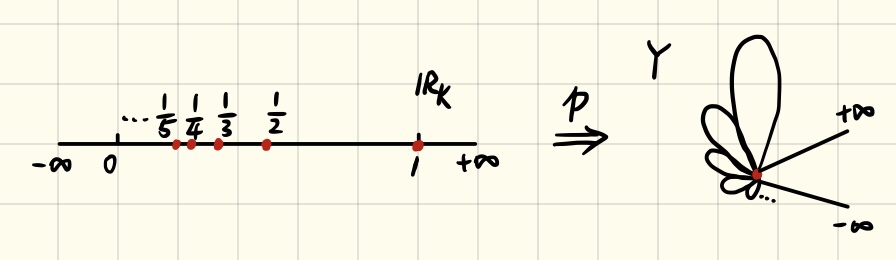
Finally, the following figure illustrates the original space \(\mathbb{R}_K\) and the quotient space \(Y\). The transformation from \(\mathbb{R}_K\) to \(Y\) can be considered as merging a countable number of knots on a rope.
PS: Because the world we are living in is Hausdorff, Diagon Alley is always closed.
James Munkres Topology: Sec 22 Exer 6的更多相关文章
- James Munkres Topology: Sec 22 Exer 3
Exercise 22.3 Let \(\pi_1: \mathbb{R} \times \mathbb{R} \rightarrow \mathbb{R}\) be projection on th ...
- James Munkres Topology: Sec 18 Exer 12
Theorem 18.4 in James Munkres “Topology” states that if a function \(f : A \rightarrow X \times Y\) ...
- James Munkres Topology: Sec 37 Exer 1
Exercise 1. Let \(X\) be a space. Let \(\mathcal{D}\) be a collection of subsets of \(X\) that is ma ...
- James Munkres Topology: Sec 22 Example 1
Example 1 Let \(X\) be the subspace \([0,1]\cup[2,3]\) of \(\mathbb{R}\), and let \(Y\) be the subsp ...
- James Munkres Topology: Lemma 21.2 The sequence lemma
Lemma 21.2 (The sequence lemma) Let \(X\) be a topological space; let \(A \subset X\). If there is a ...
- James Munkres Topology: Theorem 20.3 and metric equivalence
Proof of Theorem 20.3 Theorem 20.3 The topologies on \(\mathbb{R}^n\) induced by the euclidean metri ...
- James Munkres Topology: Theorem 20.4
Theorem 20.4 The uniform topology on \(\mathbb{R}^J\) is finer than the product topology and coarser ...
- James Munkres Topology: Theorem 19.6
Theorem 19.6 Let \(f: A \rightarrow \prod_{\alpha \in J} X_{\alpha}\) be given by the equation \[ f( ...
- James Munkres Topology: Theorem 16.3
Theorem 16.3 If \(A\) is a subspace of \(X\) and \(B\) is a subspace of \(Y\), then the product topo ...
随机推荐
- nuxt npm run dev 报错Solution to the "Error: listen EADDRINUSE 127.0.0.1:8080"
Solution to the "Error: listen EADDRINUSE 127.0.0.1:8080" Hello, Just sharing a solution t ...
- Rest Framework
目录导航 一.RESTful 规范 二.APIView 组件 三.序列化组件 四.认证组件 五.权限组件 六.频率组件 七.分页器组件 一.RESTful 规范 什么是RESTful规范: REST与 ...
- Redis的删除机制、持久化 主从
转: Redis的删除机制.持久化 主从 Redis的使用分两点: 性能如下图所示,我们在碰到需要执行耗时特别久,且结果不频繁变动的SQL,就特别适合将运行结果放入缓存.这样,后面的请求就去缓存中读取 ...
- lumen 支持多文件上传
1.webform (注意:name后面一定要加[]号) <form method="post" enctype="multipart/form-data" ...
- 暑假闲着没事第一弹:基于Django的长江大学教务处成绩查询系统
本篇文章涉及到的知识点有:Python爬虫,MySQL数据库,html/css/js基础,selenium和phantomjs基础,MVC设计模式,ORM(对象关系映射)框架,django框架(Pyt ...
- 蓝桥杯入门训练-Fibonacci数列
刚刚开始刷题的时候就栽了个大跟头,稍微记一下...... 一开始不是很理解:“我们只要能算出这个余数即可,而不需要先计算出Fn的准确值,再将计算的结果除以10007取余数,直接计算余数往往比先算出原数 ...
- Python的安装及小程序练习
Python 1.Python的安装教程 (1)进入Python官网 (2)双击Python-3.6.4.exe安装程序,勾选Add Python 3.6 to PATH (3)选择自定义安装. (4 ...
- 简单的Web日志处理细节
- selenium + python自动化测试(一)
本篇随笔为散集.不多逼逼直接干 step 1:使用webdriver调用浏览器,webdriver支持的浏览器为Firefox(),IE(),Chrome(),不同的浏览器需要安装不同的驱动. 本文使 ...
- 转:jsp与servlet的区别与联系
jsp与servlet的区别与联系 - gsyabc - 博客园https://www.cnblogs.com/sanyouge/p/7325656.html jsp和servlet的区别和联系:1. ...