
James Munkres Topology: Sec 18 Exer 12
Theorem 18.4 in James Munkres “Topology” states that if a function \(f : A \rightarrow X \times Y\) is continuous, its coordinate functions \(f_1 : A \rightarrow X\) and \(f_2 : A \rightarrow Y\) are also continuous, and the converse is also true. This is what we have been familiar with, such as a continuous parametric curve \(f: [0, 1] \rightarrow \mathbb{R}^3\) defined as \(f(t) = (x(t), y(t), z(t))^T\) with its three components being continuous. However, if a function \(g: A \times B \rightarrow X\) is separately continuous in each of its components, i.e. both \(g_1: A \rightarrow X\) and \(g_2 : B \rightarrow X\) are continuous, \(g\) is not necessarily continuous.
Here, the said “separately continuous in each of its components” means arbitrarily selecting the value of one component variable from its domain and fix it, then the original function depending only on the other component is continuous. In the above, the function \(g\) can be envisaged as a curved surface in 3D space. With \(g_1\) being continuous, the intersection profiles between this curved surface and those planes perpendicular to the coordinate axis for \(B\) are continuous. Similarly, because \(g_2\) is continuous, the intersection profiles obtained from those planes perpendicular to the coordinate axis for \(A\) are also continuous. The continuity of intersection curves is only ensured in these two special directions, so it is not guaranteed that the original function \(g\) is continuous.
In Exercise 12 of Section 18, an example is given as
\[
F(x \times y) = \begin{cases}
\frac{xy}{x^2 + y^2} & (x \neq 0, y \neq 0) \\
0 & (x = 0, y = 0)
\end{cases},
\]
where \(F\) is continuous separately in each of its component variables but is not continuous by itself. This is function is visualized below.
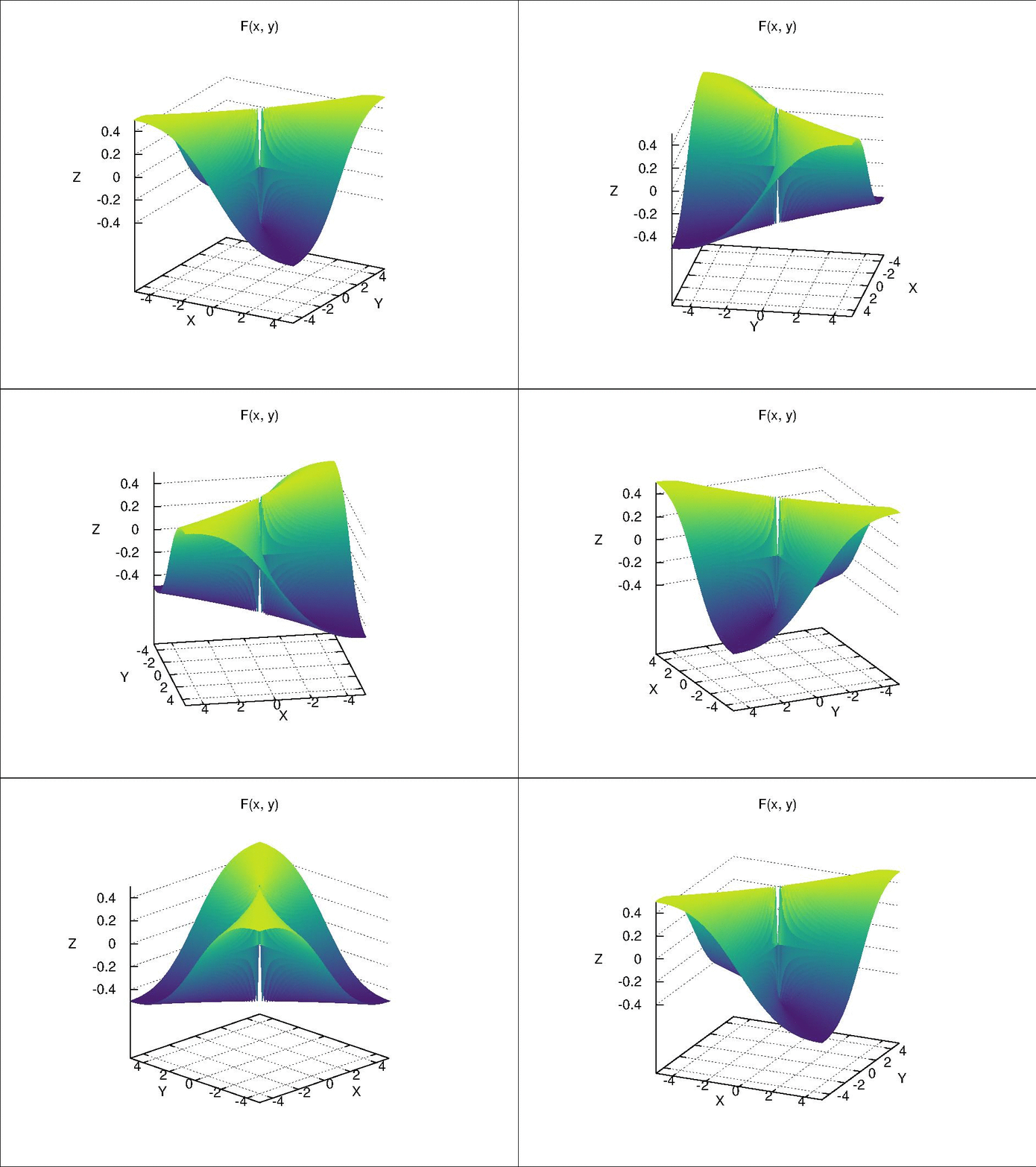
Fix \(y\) at \(y_0\), we have \(F_{y_0}(x) = F(x \times y_0)\). When \(y_0 \neq 0\), \(F_{y_0}(x)\) is continuous with respect to \(x\) because it is only a composition of continuous real valued functions via simple arithmetic. When \(y_0 = 0\), if \(x \neq 0\), \(F_0(x) = 0\); if \(x =0\), \(F_0(x)\) is also 0 due to the definition of \(F(x \times y)\). Therefore, \(F_0(x)\) is a constant function, which is continuous due to Theorem 18.2 (a). Similarly, \(F_{x_0}(y)\) is also continuous with respect to \(y\).
However, if we let \(x = y\) and approach \((x, y) = (x, x)\) to \((0, 0)\), it can be seen that \(F(x \times x)\) is not continuous, because
- when \(x \neq 0\), \(F(x \times x) = \frac{x^2}{x^2 + x^2} = \frac{1}{2}\);
- when \(x = 0\), \(F(x \times x) = 0\).
If we let \(x = -y\) and approach \((x ,y) = (x, -x)\) to \((0, 0)\), \(F = -\frac{1}{2}\) when \(x \neq 0\) and \(F = 0\) when \(x = 0\).
Then, if we select an open set such as \((-\frac{1}{4}, \frac{1}{4})\) around the function value \(0\) in \(\mathbb{R}\), its pre-image \(U\) in \(\mathbb{R} \times \mathbb{R}\) should include the point \((0, 0)\) and exclude the rays \((x, x)\) and \((x, -x)\) with \(x \in \mathbb{R}\) and \(x \neq 0\). Due to these excluded rays, there is no neighborhood of \((0, 0)\) in \(\mathbb{R} \times \mathbb{R}\) that is contained completely in \(U\). Therefore, \(U\) is not an open set and \(F(x \times y)\) is not continuous.
From the above analysis, some lessons can be learned.
- Pure analysis can be made and general conclusions can be obtained before entering into the real world with a solid example.
- A tangible counter example is a sound proof for negation of a proposition. Just one is enough!
James Munkres Topology: Sec 18 Exer 12的更多相关文章
- James Munkres Topology: Sec 22 Exer 3
Exercise 22.3 Let \(\pi_1: \mathbb{R} \times \mathbb{R} \rightarrow \mathbb{R}\) be projection on th ...
- James Munkres Topology: Sec 22 Exer 6
Exercise 22.6 Recall that \(\mathbb{R}_{K}\) denotes the real line in the \(K\)-topology. Let \(Y\) ...
- James Munkres Topology: Sec 37 Exer 1
Exercise 1. Let \(X\) be a space. Let \(\mathcal{D}\) be a collection of subsets of \(X\) that is ma ...
- James Munkres Topology: Sec 22 Example 1
Example 1 Let \(X\) be the subspace \([0,1]\cup[2,3]\) of \(\mathbb{R}\), and let \(Y\) be the subsp ...
- James Munkres Topology: Theorem 19.6
Theorem 19.6 Let \(f: A \rightarrow \prod_{\alpha \in J} X_{\alpha}\) be given by the equation \[ f( ...
- James Munkres Topology: Lemma 21.2 The sequence lemma
Lemma 21.2 (The sequence lemma) Let \(X\) be a topological space; let \(A \subset X\). If there is a ...
- James Munkres Topology: Theorem 20.3 and metric equivalence
Proof of Theorem 20.3 Theorem 20.3 The topologies on \(\mathbb{R}^n\) induced by the euclidean metri ...
- James Munkres Topology: Theorem 20.4
Theorem 20.4 The uniform topology on \(\mathbb{R}^J\) is finer than the product topology and coarser ...
- James Munkres Topology: Theorem 16.3
Theorem 16.3 If \(A\) is a subspace of \(X\) and \(B\) is a subspace of \(Y\), then the product topo ...
随机推荐
- vue 自定义指令的使用案例
参考资料: 1. vue 自定义指令: 2. vue 自定义指令实现 v-loading: v-loading,是 element-ui 组件库中的一个用于数据加载过程中的过渡动画指令,项目中也很少需 ...
- 【数学建模】day14-建立GM(1,1)预测评估模型应用
学习建立GM(1,1)灰色预测评估模型,解决实际问题: SARS疫情对某些经济指标的影响问题 一.问题的提出 2003 年的 SARS 疫情对中国部分行业的经济发展产生了一定影响,特别是对部分 疫情较 ...
- TortoiseGit安装、配置
1 TortoiseGit简介 tortoiseGit是一个开放的git版本控制系统的源客户端,支持Winxp/vista/win7.该软件功能和git一样 不同的是:git是命令行操作模式,tort ...
- consul如何限制注册的ip
假设当前服务器的ip是:192.168.56.130 允许 所有ip 注册 consul agent -server -ui -bootstrap-expect=1 -data-dir=/usr/lo ...
- CAN报文 Intel 格式与Motorola 格式的区别
当一个信号的数据长度不超过 1 个字节(8 位)时,Intel 与 Motorola 两种格式的 编码结果没有什么不同,完全一样.当信号的数据长度超过 1 个字节(8 位)时,两者的编码结果出现 了明 ...
- java 11 ZGC(可伸缩,低延迟的gc)
ZGC, A Scalable Low-Latency Garbage Collector(Experimental) 可伸缩,低延迟的gc ZGC, 这应该是JDK11最为瞩目的特性, 没有之一. ...
- GO语言系列(二)- 基本数据类型和操作符
一.文件名 & 关键字 & 标识符 1.所有go源码以.go结尾 2.标识符以字母或下划线开头,大小写敏感 3._是特殊标识符,用来忽略结果 4.保留关键字 二.Go程序的基本结构 p ...
- Spark Standalone spark-env.sh
export JAVA_HOME=/app/jdk export SPARK_MASTER_PORT=7077 export SPARK_MASTER_WEBUI_PORT=8080 export S ...
- 金融量化分析【day110】:NumPy多维数组
一.Numpy简介 NumPy 是高性能科学计算和数据分析的基础包,它是pandas等其他各种工具的基础 1.主要功能 1.ndarray,一个多维数组结构,高效且节省空间 2.无序循环对整组数据进行 ...
- CSS iconfont阿里巴巴矢量图库在开发中实战使用
前言 项目开发中,是避免不了使用小图标的,那么国内比较好用的图标网站当属iconfont了,下面我们将详细介绍如何使用. iconfont选择所需图标 1.iconfont官网 2.把所需要的添加进入 ...