
Java Method Logging with AOP and Annotations
Sometimes, I want to log (through slf4j and log4j) every execution of a method, seeing what arguments it receives, what it returns and how much time every execution takes. This is how I'm doing it, with help of AspectJ,jcabi-aspects and Java 6 annotations:
public class Foo {

  @Loggable

  public int power(int x, int p) {

    return Math.pow(x, p);

  }

}
This is what I see in log4j output:
[INFO] com.example.Foo #power(2, 10): 1024 in 12μs

[INFO] com.example.Foo #power(3, 3): 27 in 4μs
Nice, isn't it? Now, let's see how it works.
Annotation with Runtime Retention
Annotations is a technique introduced in Java 6. It is a meta-programming instrument that doesn't change the way code works, but gives marks to certain elements (methods, classes or variables). In other words, annotations are just markers attached to the code that can be seen and read. Some annotations are designed to be seen at compile time only — they don't exist in.class files after compilation. Others remain visible after compilation and can be accessed in runtime.
For example, @Override is of the first type (its retention type is SOURCE), while @Test from JUnit is of the second type (retention type is RUNTIME). @Loggable — the one I'm using in the script above — is an annotation of the second type, from jcabi-aspects. It stays with the bytecode in the.class file after compilation.
Again, it is important to understand that even though method power() is annotated and compiled, it doesn't send anything to slf4j so far. It just contains a marker saying "please, log my execution".
Aspect Oriented Programming (AOP)
AOP is a useful technique that enables adding executable blocks to the source code without explicitly changing it. In our example, we don't want to log method execution inside the class. Instead, we want some other class to intercept every call to method power(), measure its execution time and send this information to slf4j.
We want that interceptor to understand our @Loggable annotation and log every call to that specific method power(). And, of course, the same interceptor should be used for other methods where we'll place the same annotation in the future.
This case perfectly fits the original intent of AOP — to avoid re-implementation of some common behavior in multiple classes.
Logging is a supplementary feature to our main functionality, and we don't want to pollute our code with multiple logging instructions. Instead, we want logging to happen behind the scenes.
In terms of AOP, our solution can be explained as creating an aspect thatcross-cuts the code at certain join points and applies an around advice that implements the desired functionality.
AspectJ
Let's see what these magic words mean. But, first, let's see how jcabi-aspectsimplements them using AspectJ (it's a simplified example, full code you can find in MethodLogger.java):
@Aspect

public class MethodLogger {

  @Around("execution(* *(..)) && @annotation(Loggable)")

  public Object around(ProceedingJoinPoint point) {

    long start = System.currentTimeMillis();

    Object result = point.proceed();

    Logger.info(

      "#%s(%s): %s in %[msec]s",

      MethodSignature.class.cast(point.getSignature()).getMethod().getName(),

      point.getArgs(),

      result,

      System.currentTimeMillis() - start

    );

    return result;

  }

}
This is an aspect with a single around advice around() inside. The aspect is annotated with @Aspect and advice is annotated with @Around. As discussed above, these annotations are just markers in .class files. They don't do anything except provide some meta-information to those w ho are interested in runtime.
Annotation @Around has one parameter, which — in this case — says that the advice should be applied to a method if:
its visibility modifier is
*(public,protectedorprivate);its name is name
*(any name);its arguments are
..(any arguments); andit is annotated with
@Loggable
When a call to an annotated method is to be intercepted, method around()executes before executing the actual method. When a call to methodpower() is to be intercepted, method around() receives an instance of class ProceedingJoinPoint and must return an object, which will be used as a result of method power().
In order to call the original method, power(), the advice has to callproceed() of the join point object.
We compile this aspect and make it available in classpath together with our main file Foo.class. So far so good, but we need to take one last step in order to put our aspect into action — we should apply our advice.
Binary Aspect Weaving
Aspect weaving is the name of the advice applying process. Aspect weaver modifies original code by injecting calls to aspects. AspectJ does exactly that. We give it two binary Java classes Foo.class and MethodLogger.class; it gives back three — modified Foo.class, Foo$AjcClosure1.class and unmodified MethodLogger.class.
In order to understand which advices should be applied to which methods, AspectJ weaver is using annotations from .class files. Also, it usesreflection to browse all classes on classpath. It analyzes which methods satisfy the conditions from the @Around annotation. Of course, it finds our method power().
So, there are two steps. First, we compile our .java files using javac and get two files. Then, AspectJ weaves/modifies them and creates its own extra class. Our Foo class looks something like this after weaving:
public class Foo {

  private final MethodLogger logger;

  @Loggable

  public int power(int x, int p) {

    return this.logger.around(point);

  }

  private int power_aroundBody(int x, int p) {

    return Math.pow(x, p);

  }

}
AspectJ weaver moves our original functionality to a new method,power_aroundBody(), and redirects all power() calls to the aspect classMethodLogger.
Instead of one method power() in class Foo now we have four classes working together. From now on, this is what happens behind the scenes on every call to power():
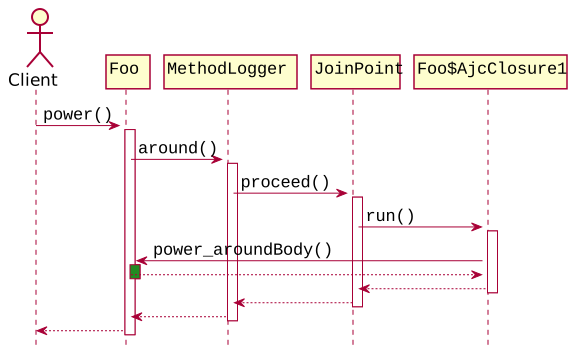
Original functionality of method power() is indicated by the small green lifeline on the diagram.
As you see, the aspect weaving process connects together classes and aspects, transferring calls between them through join points. Without weaving, both classes and aspects are just compiled Java binaries with attached annotations.
jcabi-aspects
jcabi-aspects is a JAR library that contains Loggable annotation andMethodLogger aspect (btw, there are many more aspects and annotations). You don't need to write your own aspect for method logging. Just add a few dependencies to your classpath and configure jcabi-maven-plugin for aspect weaving (get their latest versions in Maven Central):
<project>

  <dependencies>

    <dependency>

      <groupId>com.jcabi</groupId>

      <artifactId>jcabi-aspects</artifactId>

    </dependency>

    <dependency>

      <groupId>org.aspectj</groupId>

      <artifactId>aspectjrt</artifactId>

    </dependency>

  </dependencies>

  <build>

    <plugins>

      <plugin>

        <groupId>com.jcabi</groupId>

        <artifactId>jcabi-maven-plugin</artifactId>

        <executions>

          <execution>

            <goals>

              <goal>ajc</goal>

            </goals>

          </execution>

        </executions>

      </plugin>

    </plugins>

  </build>

</project>
Since this weaving procedure takes a lot of configuration effort, I created a convenient Maven plugin with an ajc goal, which does the entire aspect weaving job. You can use AspectJ directly, but I recommend that you usejcabi-maven-plugin.
That's it. Now you can use @com.jcabi.aspects.Loggable annotation and your methods will be logged through slf4j.
If something doesn't work as explained, don't hesitate to submit a Github issue.
Related Posts
You may also find these posts interesting:
Java Method Logging with AOP and Annotations的更多相关文章
- Method Swizzling和AOP(面向切面编程)实践
Method Swizzling和AOP(面向切面编程)实践 参考: http://www.cocoachina.com/ios/20150120/10959.html 上一篇介绍了 Objectiv ...
- java.util.logging.Logger 使用详解
概述: 第1部分 创建Logger对象 第2部分 日志级别 第3部分 Handler 第4部分 Formatter 第5部分 自定义 第6部分 Logger的层次关系 参考 第1部分 创建Logger ...
- java.util.logging.Logger基础教程
从JDK1.4开始即引入与日志相关的类java.util.logging.Logger,但由于Log4J的存在,一直未能广泛使用.综合网上各类说法,大致认为: (1)Logger:适用于小型系统,当日 ...
- 2.java.util.logging.Logger使用详解
一.java.util.logging.Logger简介 java.util.logging.Logger不是什么新鲜东西了,1.4就有了,可是因为log4j的存在,这个logger一直沉默着, 其实 ...
- Java基础-SSM之Spring的POJO(Plain Old Java Object)实现AOP
Java基础-SSM之Spring的POJO(Plain Old Java Object)实现AOP 作者:尹正杰 版权声明:原创作品,谢绝转载!否则将追究法律责任. 上次我分享过Spring传统的A ...
- Java动态代理-->Spring AOP
引述要学习Spring框架的技术内幕,必须事先掌握一些基本的Java知识,正所谓“登高必自卑,涉远必自迩”.以下几项Java知识和Spring框架息息相关,不可不学(我将通过一个系列分别介绍这些Jav ...
- Java程序日志:java.util.logging.Logger类
一.Logger 的级别 比log4j的级别详细,全部定义在java.util.logging.Level里面.各级别按降序排列如下:SEVERE(最高值)WARNINGINFOCONFIGFINEF ...
- paip. uapi 过滤器的java php python 实现aop filter
paip. uapi 过滤器的java php python 实现aop filter filter 是面向切面编程AOP.. 作者Attilax 艾龙, EMAIL:1466519819@qq. ...
- java.util.logging.Logger使用详解
一.创建Logger对象 static Logger getLogger(String name) 为指定子系统查找或创建一个 logger. static Logger ge ...
随机推荐
- azkaben任务调度器
azkaban学习笔记总结 01.工作流调度器azkaban 1. 任务调度概述 一个完整的数据分析系统通常都是由大量任务单元组成: shell脚本程序,java程序,mapreduce程序.hive ...
- 数据意识崛起,从企业应用看BI软件的未来发展
前阵子,和一群企业CIO聊天,希望从甲方角度看看对BI产品的看法.在问及一些成熟企业为何不上BI项目时,大家纷纷表示目前还处于观望状态. 提及BI,大家都觉得有些飘忽,和大数据一样,听着高大上,能真正 ...
- 自定义配置文件的使用及加载-txt
[Game] Version=1 [Login] Account = 阿斗阿斯顿撒 Password =我去饿我去恶趣味 Success = 成哥 Faild = 失败 [Job] Job1 = 战士 ...
- Logstash使用grok过滤nginx日志(二)
在生产环境中,nginx日志格式往往使用的是自定义的格式,我们需要把logstash中的message结构化后再存储,方便kibana的搜索和统计,因此需要对message进行解析. 本文采用grok ...
- sublime 2中Package control安装和使用
安装: 安装时,如果想查看安装进度,可打开console(View->Show Console) 安装Package control有两中方法: 方法1:通过代码安装 import urllib ...
- 导入spring源码到eclipse
1.1安装Gradle 可以从http://www.gradle.org/downloads页面下载Gradle.下载后将文件解压到指定目录,我放在D:\软件\gradle-3.3,然后设置环境变量. ...
- 制作Ubuntu14.04的Openstack镜像
下载好Ubuntu官方镜像安装文件:不要使用desktop版,在virtualbox和vm上都安装报错,因为不需要桌面,所有没去管了. 第一步.准备好如下文件: 1.ubuntu-14.04.4-se ...
- libvirt里的面向对象的C语言
C语言:类的声明和定义 // 通用父类的定义 struct _virClass { virClassPtr parent; unsigned int magic; char *name; size_t ...
- tablesorter周边文档
一.简介: Tablesorter作用于一个标准的HTML表格(有THEAD,TBODY),实现静态排序:主要特点包括: (1) 多列排序: (2) 支持文本.URI地址.数值.货币.浮点数.IP地 ...
- C# 语言规范_版本5.0 (第16章 异常)
1. 异常 C# 中的异常用于处理系统级和应用程序级的错误状态,它是一种结构化的.统一的和类型安全的处理机制.C# 中的异常机制非常类似于 C++ 的异常机制,但是有一些重要的区别: 在 C# 中,所 ...