
Spring之WebContext不使用web.xml启动 初始化重要的类源码分析(Servlet3.0以上的)
入口:
org.springframework.web.SpringServletContainerInitializer implements ServletContainerInitializer
org.springframework.web.WebApplicationInitializer
ServletContainerInitializer这个类是Servlet3.0新增的接口,源码定义如下:
package javax.servlet;

import java.util.Set;

/**

 * ServletContainerInitializers (SCIs) are registered via an entry in the

 * file META-INF/services/javax.servlet.ServletContainerInitializer that must be

 * included in the JAR file that contains the SCI implementation.

 * <p>

 * SCI processing is performed regardless of the setting of metadata-complete.

 * SCI processing can be controlled per JAR file via fragment ordering. If an

 * absolute ordering is defined, the only those JARs included in the ordering

 * will be processed for SCIs. To disable SCI processing completely, an empty

 * absolute ordering may be defined.

 * <p>

 * SCIs register an interest in annotations (class, method or field) and/or

 * types via the {@link javax.servlet.annotation.HandlesTypes} annotation which

 * is added to the class.

 *

 * @since Servlet 3.0

 */

public interface ServletContainerInitializer {

    /**

     * Receives notification during startup of a web application of the classes

     * within the web application that matched the criteria defined via the

     * {@link javax.servlet.annotation.HandlesTypes} annotation.

     *

     * @param c     The (possibly null) set of classes that met the specified

     *              criteria

     * @param ctx   The ServletContext of the web application in which the

     *              classes were discovered

     *

     * @throws ServletException If an error occurs

     */

    void onStartup(Set<Class<?>> c, ServletContext ctx) throws ServletException;

}
而SpringServletContainerInitializer实现了这个接口,源码也很简单的只有几行,这里原封不动的将注释也拷过来,便于读懂注释分析:
/**

 * Servlet 3.0 {@link ServletContainerInitializer} designed to support code-based

 * configuration of the servlet container using Spring's {@link WebApplicationInitializer}

 * SPI as opposed to (or possibly in combination with) the traditional

 * {@code web.xml}-based approach.

 *

 * <h2>Mechanism of Operation</h2>

 * This class will be loaded and instantiated and have its {@link #onStartup}

 * method invoked by any Servlet 3.0-compliant container during container startup assuming

 * that the {@code spring-web} module JAR is present on the classpath. This occurs through

 * the JAR Services API {@link ServiceLoader#load(Class)} method detecting the

 * {@code spring-web} module's {@code META-INF/services/javax.servlet.ServletContainerInitializer}

 * service provider configuration file. See the

 * <a href="http://download.oracle.com/javase/6/docs/technotes/guides/jar/jar.html#Service%20Provider">

 * JAR Services API documentation</a> as well as section <em>8.2.4</em> of the Servlet 3.0

 * Final Draft specification for complete details.

 *

 * <h3>In combination with {@code web.xml}</h3>

 * A web application can choose to limit the amount of classpath scanning the Servlet

 * container does at startup either through the {@code metadata-complete} attribute in

 * {@code web.xml}, which controls scanning for Servlet annotations or through an

 * {@code <absolute-ordering>} element also in {@code web.xml}, which controls which

 * web fragments (i.e. jars) are allowed to perform a {@code ServletContainerInitializer}

 * scan. When using this feature, the {@link SpringServletContainerInitializer}

 * can be enabled by adding "spring_web" to the list of named web fragments in

 * {@code web.xml} as follows:

 *

 * <pre class="code">

 * {@code

 * <absolute-ordering>

 *   <name>some_web_fragment</name>

 *   <name>spring_web</name>

 * </absolute-ordering>

 * }</pre>

 *

 * <h2>Relationship to Spring's {@code WebApplicationInitializer}</h2>

 * Spring's {@code WebApplicationInitializer} SPI consists of just one method:

 * {@link WebApplicationInitializer#onStartup(ServletContext)}. The signature is intentionally

 * quite similar to {@link ServletContainerInitializer#onStartup(Set, ServletContext)}:

 * simply put, {@code SpringServletContainerInitializer} is responsible for instantiating

 * and delegating the {@code ServletContext} to any user-defined

 * {@code WebApplicationInitializer} implementations. It is then the responsibility of

 * each {@code WebApplicationInitializer} to do the actual work of initializing the

 * {@code ServletContext}. The exact process of delegation is described in detail in the

 * {@link #onStartup onStartup} documentation below.

 *

 * <h2>General Notes</h2>

 * In general, this class should be viewed as <em>supporting infrastructure</em> for

 * the more important and user-facing {@code WebApplicationInitializer} SPI. Taking

 * advantage of this container initializer is also completely <em>optional</em>: while

 * it is true that this initializer will be loaded and invoked under all Servlet 3.0+

 * runtimes, it remains the user's choice whether to make any

 * {@code WebApplicationInitializer} implementations available on the classpath. If no

 * {@code WebApplicationInitializer} types are detected, this container initializer will

 * have no effect.

 *

 * <p>Note that use of this container initializer and of {@code WebApplicationInitializer}

 * is not in any way "tied" to Spring MVC other than the fact that the types are shipped

 * in the {@code spring-web} module JAR. Rather, they can be considered general-purpose

 * in their ability to facilitate convenient code-based configuration of the

 * {@code ServletContext}. In other words, any servlet, listener, or filter may be

 * registered within a {@code WebApplicationInitializer}, not just Spring MVC-specific

 * components.

 *

 * <p>This class is neither designed for extension nor intended to be extended.

 * It should be considered an internal type, with {@code WebApplicationInitializer}

 * being the public-facing SPI.

 *

 * <h2>See Also</h2>

 * See {@link WebApplicationInitializer} Javadoc for examples and detailed usage

 * recommendations.<p>

 *

 * @author Chris Beams

 * @author Juergen Hoeller

 * @author Rossen Stoyanchev

 * @since 3.1

 * @see #onStartup(Set, ServletContext)

 * @see WebApplicationInitializer

 */

@HandlesTypes(WebApplicationInitializer.class)

public class SpringServletContainerInitializer implements ServletContainerInitializer {

    /**

     * Delegate the {@code ServletContext} to any {@link WebApplicationInitializer}

     * implementations present on the application classpath.

     * <p>Because this class declares @{@code HandlesTypes(WebApplicationInitializer.class)},

     * Servlet 3.0+ containers will automatically scan the classpath for implementations

     * of Spring's {@code WebApplicationInitializer} interface and provide the set of all

     * such types to the {@code webAppInitializerClasses} parameter of this method.

     * <p>If no {@code WebApplicationInitializer} implementations are found on the classpath,

     * this method is effectively a no-op. An INFO-level log message will be issued notifying

     * the user that the {@code ServletContainerInitializer} has indeed been invoked but that

     * no {@code WebApplicationInitializer} implementations were found.

     * <p>Assuming that one or more {@code WebApplicationInitializer} types are detected,

     * they will be instantiated (and <em>sorted</em> if the @{@link

     * org.springframework.core.annotation.Order @Order} annotation is present or

     * the {@link org.springframework.core.Ordered Ordered} interface has been

     * implemented). Then the {@link WebApplicationInitializer#onStartup(ServletContext)}

     * method will be invoked on each instance, delegating the {@code ServletContext} such

     * that each instance may register and configure servlets such as Spring's

     * {@code DispatcherServlet}, listeners such as Spring's {@code ContextLoaderListener},

     * or any other Servlet API componentry such as filters.

     * @param webAppInitializerClasses all implementations of

     * {@link WebApplicationInitializer} found on the application classpath

     * @param servletContext the servlet context to be initialized

     * @see WebApplicationInitializer#onStartup(ServletContext)

     * @see AnnotationAwareOrderComparator

     */

    @Override

    public void onStartup(Set<Class<?>> webAppInitializerClasses, ServletContext servletContext)

            throws ServletException {

        List<WebApplicationInitializer> initializers = new LinkedList<WebApplicationInitializer>();

        if (webAppInitializerClasses != null) {

            for (Class<?> waiClass : webAppInitializerClasses) {

                // Be defensive: Some servlet containers provide us with invalid classes,

                // no matter what @HandlesTypes says...

                if (!waiClass.isInterface() && !Modifier.isAbstract(waiClass.getModifiers()) &&

                        WebApplicationInitializer.class.isAssignableFrom(waiClass)) {

                    try {

                        initializers.add((WebApplicationInitializer) waiClass.newInstance());

                    }

                    catch (Throwable ex) {

                        throw new ServletException("Failed to instantiate WebApplicationInitializer class", ex);

                    }

                }

            }

        }

        if (initializers.isEmpty()) {

            servletContext.log("No Spring WebApplicationInitializer types detected on classpath");

            return;

        }

        servletContext.log(initializers.size() + " Spring WebApplicationInitializers detected on classpath");

        AnnotationAwareOrderComparator.sort(initializers);

        for (WebApplicationInitializer initializer : initializers) {

            initializer.onStartup(servletContext);

        }

    }

}
TODO:
另外, 这个ServletContainerInitializer的执行是在 ServletContextListener之前,可以做个试验看看,这里我写一个简单的TestListener,代码如下
@WebListener

public class TestListener implements ServletContextListener{

    @Override

    public void contextInitialized(ServletContextEvent sce) {

        System.err.println("执行listener ......................");

    }

    @Override

    public void contextDestroyed(ServletContextEvent sce) {

    }

}
同时在上面的ServletApplicationInitializer 的onStartup方法第一行也加一个打印语句:
public class ServletApplicationInitializer implements WebApplicationInitializer {

    @Override

    public void onStartup(ServletContext container) {

        System.err.println("执行3.0 的ServletApplicationInitializer.................");

        //now add the annotations

        AnnotationConfigWebApplicationContext appContext = getContext();

        // Manage the lifecycle of the root application context

        container.addListener(new ContextLoaderListener(appContext));

        container.addListener(new Log4jConfigListener());

        ServletRegistration.Dynamic dispatcher = container.addServlet("DispatcherServlet", new DispatcherServlet(appContext));

        dispatcher.setLoadOnStartup(1);

        dispatcher.addMapping("/");

    }
启动工程,控制台出现:
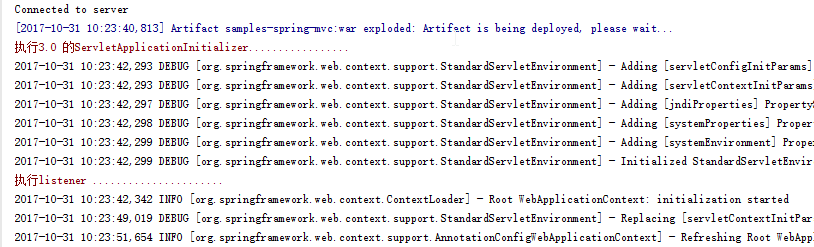
其实从上面的onStarup代码中就可以看出来:
// Manage the lifecycle of the root application context

container.addListener(new ContextLoaderListener(appContext));
因为ContextLoaderListener是继承ServletContextListener的。
Spring之WebContext不使用web.xml启动 初始化重要的类源码分析(Servlet3.0以上的)的更多相关文章
- ElasticSearch 启动时加载 Analyzer 源码分析
ElasticSearch 启动时加载 Analyzer 源码分析 本文介绍 ElasticSearch启动时如何创建.加载Analyzer,主要的参考资料是Lucene中关于Analyzer官方文档 ...
- 微服务架构 | *2.3 Spring Cloud 启动及加载配置文件源码分析(以 Nacos 为例)
目录 前言 1. Spring Cloud 什么时候加载配置文件 2. 准备 Environment 配置环境 2.1 配置 Environment 环境 SpringApplication.prep ...
- SpringBoot启动代码和自动装配源码分析
随着互联网的快速发展,各种组件层出不穷,需要框架集成的组件越来越多.每一种组件与Spring容器整合需要实现相关代码.SpringMVC框架配置由于太过于繁琐和依赖XML文件:为了方便快速集成第三 ...
- spring aop 源码分析(三) @Scope注解创建代理对象
一.源码环境的搭建: @Component @Scope(scopeName = ConfigurableBeanFactory.SCOPE_SINGLETON,proxyMode = ScopedP ...
- 【图解源码】Zookeeper3.7源码分析,包含服务启动流程源码、网络通信源码、RequestProcessor处理请求源码
Zookeeper3.7源码剖析 能力目标 能基于Maven导入最新版Zookeeper源码 能说出Zookeeper单机启动流程 理解Zookeeper默认通信中4个线程的作用 掌握Zookeepe ...
- u-boot 源码分析(1) 启动过程分析
u-boot 源码分析(1) 启动过程分析 文章目录 u-boot 源码分析(1) 启动过程分析 前言 配置 源码结构 api arch board common cmd drivers fs Kbu ...
- WebApplicationInitializer究 Spring 3.1之无web.xml式 基于代码配置的servlet3.0应用
本文转自http://hitmit1314.iteye.com/blog/1315816 大家应该都已经知道Spring 3.1对无web.xml式基于代码配置的servlet3.0应用.通过spri ...
- 精尽Spring MVC源码分析 - 寻找遗失的 web.xml
该系列文档是本人在学习 Spring MVC 的源码过程中总结下来的,可能对读者不太友好,请结合我的源码注释 Spring MVC 源码分析 GitHub 地址 进行阅读 Spring 版本:5.2. ...
- 【Spring源码分析系列】启动component-scan类扫描加载过程
原文地址:http://blog.csdn.net/xieyuooo/article/details/9089441/ 在spring 3.0以上大家都一般会配置一个Servelet,如下所示: &l ...
随机推荐
- MySQL丨5.6版本插入中文显示问号解决方法
解决办法: 1.找到安装目录下的my-default.ini 这个配置文件 2.copy一份粘贴到同目录下 另命名为my.ini 3.在my.ini 配置下加上下面几句代码 并保存 [mysql]de ...
- hdu-5724 Chess(组合游戏)
题目链接: Chess Time Limit: 2000/1000 MS (Java/Others) Memory Limit: 65536/65536 K (Java/Others) Pro ...
- [Codeforces 715C] Digit Tree
[题目链接] https://codeforces.com/contest/715/problem/C [算法] 考虑点分治 一条路径(x , y)合法当且仅当 : d(x) * 10 ^ dep(x ...
- bzoj 3992 [SDOI2015] 序列统计 —— NTT (循环卷积+快速幂)
题目:https://www.lydsy.com/JudgeOnline/problem.php?id=3992 (学习NTT:https://riteme.github.io/blog/2016-8 ...
- GC及其作用
Java GC 是垃圾回收机制,自动内存管理和垃圾清扫机制,释放内存中的资源和垃圾
- python 去停用词
Try caching the stopwords object, as shown below. Constructing this each time you call the function ...
- AngularJS系统学习之$watch(监控)
在scope的内置的所有函数中,用的最多的可能就是$watch函数了, 当你的数据模型中某一部分发生变化时,$watch函数可以向你发出通知. 你可以监控单个对象的属性,亦可以监控需要经过计算的结果( ...
- ubuntu系统下挂载新的硬盘
参考 http://zwkufo.blog.163.com/blog/static/258825120141283942244/ http://blog.csdn.net/caicai2526 ...
- 5、html的body内标签之多行文本及下拉框
一.多行文本 <textarea name="">默认值</textarea> 二.下拉框 1.单选 <select name="city& ...
- 使用ant时 出现 java.lang.OutOfMemoryErro r: Java heap space的解决办法
在Linux的shell中,使用export设置ANT_OPTS变量,值为1G export ANT_OPTS=-Xmx1g ant 同理在windows的cmd中,使用set设置ANT_OPTS变量 ...