
Baozi Leetcode solution 1036: Escape a Large Maze
Problem Statement
In a 1 million by 1 million grid, the coordinates of each grid square are (x, y) with 0 <= x, y < 10^6.
We start at the source square and want to reach the target square. Each move, we can walk to a 4-directionally adjacent square in the grid that isn't in the given list of blocked squares.
Return true if and only if it is possible to reach the target square through a sequence of moves.
Example 1:
Input: blocked = [[0,1],[1,0]], source = [0,0], target = [0,2]

Output: false

Explanation:

The target square is inaccessible starting from the source square, because we can't walk outside the grid.
Example 2:
Input: blocked = [], source = [0,0], target = [999999,999999]

Output: true

Explanation:

Because there are no blocked cells, it's possible to reach the target square.
Note:
0 <= blocked.length <= 200blocked[i].length == 20 <= blocked[i][j] < 10^6source.length == target.length == 20 <= source[i][j], target[i][j] < 10^6source != target
Hints
- If we become stuck, there's either a loop around the source or around the target.
- If there is a loop around say, the source, what is the maximum number of squares it can have?
Problem link
Video Tutorial
You can find the detailed Youtube video tutorial here
国内:B站的视频戳这里
Thought Process
At first, I am puzzled why this problem would be a hard one. It seems simply applying a BFS would get the answer. So here we go.
Brute force, simple BFS
Of course it will hit memory limit because I am allocating a 2-dimensional visited array. Assume boolean is 8 bit -> 1B, 1 Million * 1 Million = 1TB, OMG, immediately using a set instead.
P.S. fun fact, you can use this method to test how much memory leetcode allocate to this problem, you can use binary search and memory is around 300MB
However, this would start hitting Time Limit Exception. Now I begin to notice a few constrains, e.g., the block size is only 200 while the grid is 1M*1M. Simply going from source to target worst case would cause a timeout.
Next thought would be does it help if we sort the block array? While we are doing the BFS, if the block is already larger/smaller than the max/min of the block, we can early stop. However, this won't help if we simply place a block near the target. Also, this would be a nightmare to implement.
Check block loops on source and target
Following the two hints, it would be natural to come up with this idea. Given such huge contrast between the block size (0,200) and the grid size (1M, 1M), all we need to do is to check if there is any loops built by block on source and target b/c if there is a loop, we cannot explore outside of the loop. However, notice if target and source are in the same loop, then we are fine.
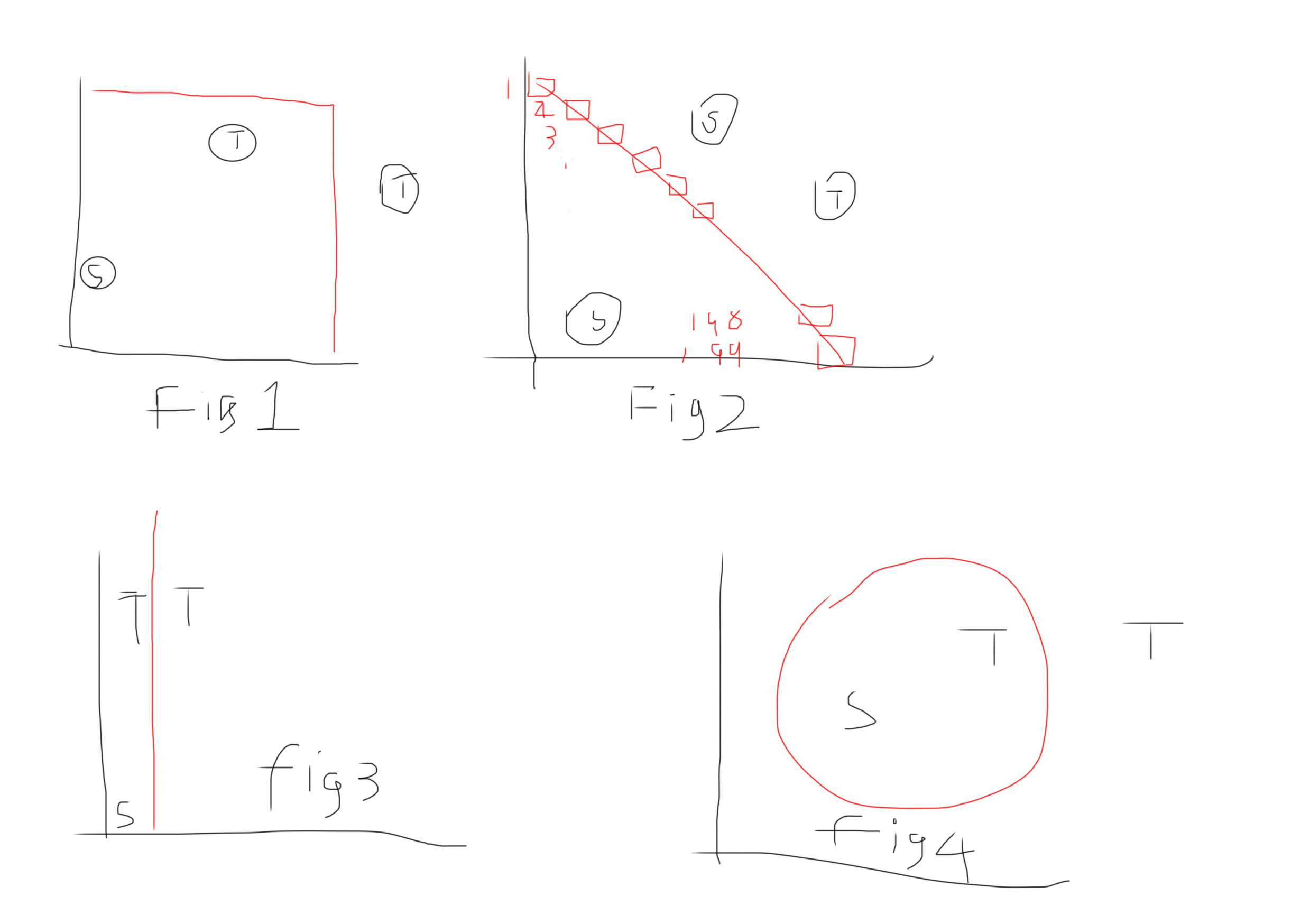
There are two ways to early stop this loop checking. One way is to count the BFS steps, the other way is to follow the hints, given 200 blocks, what's the max area it can cover. Given the length 200, Fig 2 in the below graph can result in the largest area. Therefore, we can early terminate the BFS search once we covered more than 19900 blocks. (We can relax this a bit to 20000, doesn't matter)
- Fig 1 area = 100 * 100 = 10000
- Fig 2 area = 1 + 2 + 3 + ... + 199 = (1+199)*199/2 = 19900
- Fig 3 area = 1 * 200 = 200
- Fig 4 area = 790 (2*Pi*R = 100, thus R = 15.92, Pi * R^2 = 790 )
Solutions
Brute force, simple BFS
 private final int[] xDirection = {1, 0, -1, 0};

 private final int[] yDirection = {0, -1, 0, 1};

 private final int ONE_MILLION = 1000000;

 public boolean isEscapePossible(int[][] blocked, int[] source, int[] target) {

         if (blocked == null || source == null || target == null) {

             return false;

         }

         Set<String> blockLookup = this.indexBlockedMatrixToSet(blocked);

         int m = ONE_MILLION;

         int n = ONE_MILLION;

         Set<String> visited = new HashSet<>();

         Queue<String> queue = new LinkedList<>();

         String sourceString = source[0] + "," + source[1];

         queue.offer(sourceString);

         visited.add(sourceString);

         while (!queue.isEmpty()) {

             String[] curBlock = queue.poll().split(",");

             int curX = Integer.parseInt(curBlock[0]);

             int curY = Integer.parseInt(curBlock[1]);

             if (curX == target[0] && curY == target[1]) {

                 return true;

             }

             for (int i = 0; i < 4; i++) {

                 int nextX = curX + xDirection[i];

                 int nextY = curY + yDirection[i];

                 if (this.shouldExplore(nextX, nextY, ONE_MILLION, ONE_MILLION, blockLookup, visited)) {

                     String nextKey = nextX + "," + nextY;

                     visited.add(nextKey);

                     queue.offer(nextKey);

                 }

             }

         }

         return false;

     }

     private boolean shouldExplore(

             int x,

             int y,

             int row,

             int col,

             Set<String> blockLookup,

             Set<String> visited) {

         if (!(x >= 0 && x < row && y >=0 && y < col)) {

             return false;

         }

         String index = x + "," + y;

         if (visited.contains(index)) {

             return false;

         }

         if (blockLookup.contains(index)) {

             return false;

         }

         return true;

     }

     private Set<String> indexBlockedMatrixToSet(int[][] blocked) {

         Set<String> lookup = new HashSet<>();

         for (int i = 0; i < blocked.length; i++) {

             int x = blocked[i][0];

             int y = blocked[i][1];

             String index = x + "," + y;

             lookup.add(index);

         }

         return lookup;

     }
Time Complexity: O(N), N = 1M * 1M, essentially need to cover the entire huge grid
Space Complexity: O(N), N = 1M*1M, essentially all the nodes need to be put to visited set
Check block loops on source and target
 private final int[] xDirection = {1, 0, -1, 0};

     private final int[] yDirection = {0, -1, 0, 1};

     private final int ONE_MILLION = 1000000;

     private final int MAX_COUNT_THRESHOLD = 20000;

     public boolean isEscapePossible(int[][] blocked, int[] source, int[] target) {

         if (blocked == null || source == null || target == null) {

             return false;

         }

         Set<String> blockLookup = this.indexBlockedMatrixToSet(blocked);

         boolean isSourceLoop = this.isLoopAroundPoint(source, target, blockLookup);

         if (isSourceLoop) {

             return false;

         }

         boolean isTargetLoop = this.isLoopAroundPoint(target, source, blockLookup);

         if (isTargetLoop) {

             return false;

         }

         return true;

     }

     private boolean isLoopAroundPoint(int[] source, int[] target, Set<String> blockLookup) {

         int count = 0;

         Set<String> visited = new HashSet<>();

         Queue<String> queue = new LinkedList<>();

         String index = source[0] + "," + source[1];

         queue.offer(index);

         visited.add(index);

         while (!queue.isEmpty()) {

             String[] curBlock = queue.poll().split(",");

             int curX = Integer.parseInt(curBlock[0]);

             int curY = Integer.parseInt(curBlock[1]);

             // here think about

             if (count >= MAX_COUNT_THRESHOLD) {

                 return false;

             }

             if (curX == target[0] && curY == target[1]) {

                 return false;

             }

             for (int i = 0; i < 4; i++) {

                 int nextX = curX + xDirection[i];

                 int nextY = curY + yDirection[i];

                 if (this.shouldExplore(nextX, nextY, ONE_MILLION, ONE_MILLION, blockLookup, visited)) {

                     String nextKey = nextX + "," + nextY;

                     count++;

                     visited.add(nextKey);

                     queue.offer(nextKey);

                 }

             }

         }

         return true;

     }

     private boolean shouldExplore(

             int x,

             int y,

             int row,

             int col,

             Set<String> blockLookup,

             Set<String> visited) {

         if (!(x >= 0 && x < row && y >=0 && y < col)) {

             return false;

         }

         String index = x + "," + y;

         if (visited.contains(index)) {

             return false;

         }

         if (blockLookup.contains(index)) {

             return false;

         }

         return true;

     }

     private Set<String> indexBlockedMatrixToSet(int[][] blocked) {

         Set<String> lookup = new HashSet<>();

         for (int i = 0; i < blocked.length; i++) {

             int x = blocked[i][0];

             int y = blocked[i][1];

             String index = x + "," + y;

             lookup.add(index);

         }

         return lookup;

     }
Time Complexity: O(N), N in terms of block size
Space Complexity: O(N), N in terms of block size
References
Baozi Leetcode solution 1036: Escape a Large Maze的更多相关文章
- [Swift]LeetCode1036.逃离大迷宫 | Escape a Large Maze
In a 1 million by 1 million grid, the coordinates of each grid square are (x, y) with 0 <= x, y & ...
- Baozi Leetcode Solution 205: Isomorphic Strings
Problem Statement Given two strings s and t, determine if they are isomorphic. Two strings are isomo ...
- Baozi Leetcode Solution 290: Word Pattern
Problem Statement Given a pattern and a string str, find if str follows the same pattern. Here follo ...
- leetcode solution cracked tutorial
leetcode solution cracked tutorial problemset https://leetcode.com/problemset/all/ Top Interview Que ...
- 【LeetCode】789. Escape The Ghosts 解题报告(Python & C++)
作者: 负雪明烛 id: fuxuemingzhu 个人博客: http://fuxuemingzhu.cn/ 目录 题目描述 题目大意 解题方法 日期 题目地址:https://leetcode.c ...
- 【LeetCode】830. Positions of Large Groups 解题报告(Python)
作者: 负雪明烛 id: fuxuemingzhu 个人博客: http://fuxuemingzhu.cn/ 目录 题目描述 题目大意 解题方法 日期 题目地址:https://leetcode.c ...
- 73th LeetCode Weekly Contest Escape The Ghosts
You are playing a simplified Pacman game. You start at the point (0, 0), and your destination is(tar ...
- Leetcode solution 291: Word Pattern II
Problem Statement Given a pattern and a string str, find if str follows the same pattern. Here follo ...
- Leetcode solution 227: Basic Calculator II
Problem Statement Implement a basic calculator to evaluate a simple expression string. The expressio ...
随机推荐
- Linux基础命令杂记
今天又一次搞Linux生产环境搭建.这是种步骤很多,很繁琐而且又不得不做的事情.虽然做过很多次,但还是有很多步骤.命令不记得,每一次到处找资料很麻烦,于是将一些步骤记下,以便查找. 登录远程MySQL ...
- 如何开发Office平台上的扩展应用(又称为Office 2013 App,Office 2013 Add-Ins,Apps for Office,Office 应用)
Office 扩展应用(Office Apps,Office 2013 AddIns,Apps for Office)开发 —— 中文文档 继 VBA 和 VSTO 之后, 微软为 Office 平台 ...
- Qt5 中对 C++11 一些新特性的封装
在 Qt5 中,提供更多 C++11 的特性支持,接下来我们将进行详细的说明. slots (槽) 的 Lambda 表达式 Lambda表达式 是 C++11 中的一个新语法,允许定义匿名函数.匿名 ...
- 因为 'PRIMARY' 文件组已满。请删除不需要的文件、删除文件组中的对象、将其他文件添加到文件组或为文件组中的现有文件启用自动增长,以便增加可用磁盘空间
导致你的问题的,应该有2种可能性: 1.存放你的primary文件组的磁盘,已经满了: use master--你的数据库名称 go --看看你的primary组里的文件 select ds.name ...
- 自己动手写jQuery插件---Tip(提示框)
对jQuery相信很多同学和我一样平时都是拿来主义,没办法,要怪只能怪jQuery太火了,各种插件基本能满足平时的要求.但是这毕竟不是长久之道,古人云:“授之以鱼,不如授之以渔”. 为了方便之前没有接 ...
- bootstrap组件和插件
一.用node.js读取文件 //引入fs模块 var fs= require ('fs'); // console.log(fs); //调用fs模块的readFile方法 fs.readFile( ...
- SYN591-B型 转速表
SYN591-B型 转速表 光电转速表数显转速表智能转速表使用说明视频链接: http://www.syn029.com/h-pd-249-0_310_44_-1.html 请将此链接复制到浏览 ...
- SYN6105型 GPS子钟
SYN6105型 GPS子钟 产品概述 SYN6105型GPS子钟是由西安同步电子科技有限公司精心设计.自行研发生产的一套以接收GPS卫星信号的子钟,从GPS地球同步卫星上获取标准时钟信号信息将这些时 ...
- Python处理图片
# -*- coding: UTF-8 -*- from PIL import Image import os import sys reload(sys) sys.setdefaultencodin ...
- IIS 站点和应用池命令启动和停止
在CMD下执行如下命令: IIS站点: 停止站点: C:\Windows\System32\inetsrv\appcmd.exe stop site “XXXX” 启动站点: C:\Windows\S ...