
Linked List-2
三、编码技巧
1、遍历链表
先将head指针赋值给一个局部变量current:
//return the number of nodes in a list (while-loop version)

int Length(struct node* head)

{

	int count = 0;

	struct node* current = head;

	while (current != NULL)

	{

		count++;

		current = current->next;

	}

	return count;

}
当然也可以写为:
for (current = head; current != NULL; current = current->next) {}
2、通过传递reference pointer改变某个指针
看个例子:
//Change the passed in head pointer to be NULL

//Uses a reference pointer to access the caller's memory

void ChangeToNull(struct node** headRef)  //takes a pointer to the value of interest

{

	*headRef = NULL;	//use * to access the value of interest

}

void ChangeCaller()

{

	struct node* head1;

	struct node* head2;

	ChangeToNull(&head1);	//use & to compute and pass a pointer to

	ChangeToNull(&head2);	//the value of interest

	//head1 and head2 are NULL at this point

}
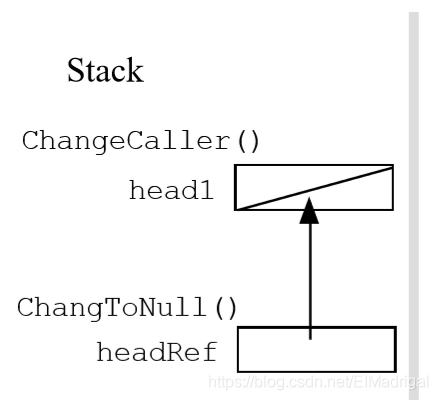
这块的思想是和(一)中的Push()类似。
内存示意图:
3、通过Push()建立链表(头插法)
这种方式的优点是速度飞快,简单易行,缺点是得到的链表是逆序的:
struct node* AddAtHead()

{

	struct node* head = NULL;

	for (int i = 1; i < 6; i++)

	{

		Push(&head, i);

	}

	//head == {5,4,3,2,1};

	return head;

}
4、尾插法建立链表
这种方法需要找到链表最后一个节点,改变其.next域:
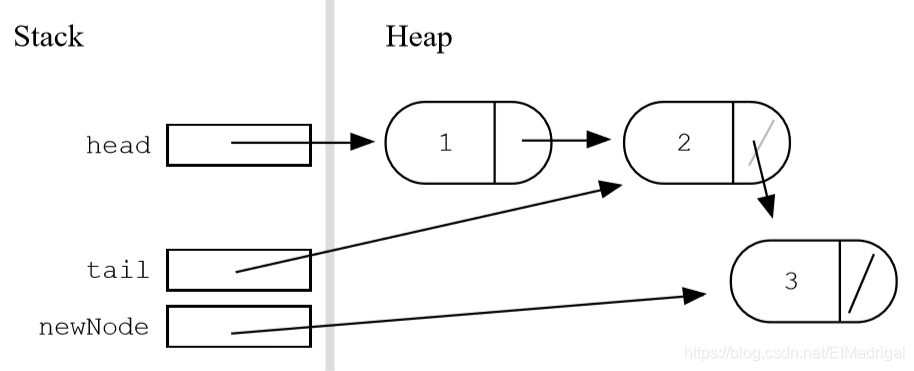
- 插入或者删除节点,需要找到该节点的前一个节点的指针,改变其
.next域; - 特例:如果涉及第一个节点的操作,那么一定要改变
head指针。
5、特例+尾插法
如果要构建一个新的链表,那么头节点就要单独处理:
struct node* BuildWithSpecialCase()

{

	struct node* head = NULL;

	struct node* tail;

	//deal with the head node here, and set the tail pointer

	Push(&head, 1);

	tail = head;

	//do all the other nodes using "tail"

	for (int i = 2; i < 6; i++)

	{

		Push(&(tail->next), i);   //add node at tail->next

		tail = tail->next;     //advance tail to point to last node

	}

	return head;    //head == {1,2,3,4,5}

}
6、临时节点建立
struct node* BuildWithDummyNode()

{

	struct node dummy;   //dummy node is temporarily the first node

	struct node* tail = &dummy;   //build the list on dummy.next

	dummy.next = NULL;

	for (int i = 1; i < 6; i++)

	{

		Push(&(tail->next), i);

		tail = tail->next;

	}

	//the real result list is now in dummy.next

	//dummy.next == {1,2,3,4,5}

	return dummy.next;

}
7、本地指针建立
struct node* BuildWithLocalRef()

{

	struct node* head = NULL;

	struct node** lastPtrRef = &head;   //start out pointing to the head pointer

	for (int i = 1; i < 6; i++)

	{

		Push(lastPtrRef, i);  //add node at the last pointer in the list

		//advance to point to the new last pointer

		lastPtrRef = &((*lastPtrRef)->next);

	}

	return head;  //head == {1,2,3,4,5}

}
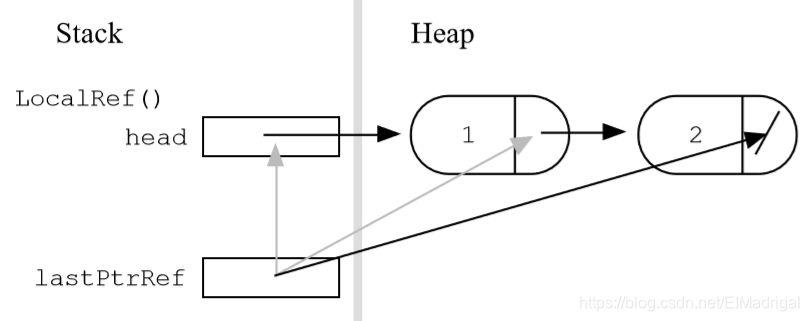
这块可能有些抽象:
1)lastPtrRef开始指向head指针,以后指向链表最后一个节点中的.next域;
2)在最后加上一个节点;
3)让lastPtrRef指针向后移动,指向最后一个节点的.next域。 (*lastPtrRef)->next可以理解为*lastPtrRef指针指向的节点的next域。
四、代码示例
1、AppendNode()
- 不使用
Push()函数:
struct node* AppendNode(struct node** headRef, int num)

{

	struct node* current = *headRef;

	struct node* newNode;

	newNode = (struct node*)malloc(sizeof(struct node));

	newNode->data = num;

	newNode->next = NULL;

	//special case for length 0

	if (current == NULL)

	{

		*headRef = newNode;

	}

	else

	{

		//Locate the last node

		while (current->next != NULL)

		{

			current = current->next;

		}

		current->next = newNode;

	}

}
- 使用
Push()函数:
struct node* AppendNode(struct node** headRef, int num)

{

	struct node* current = *headRef;

	//special case for length 0

	if (current == NULL)

	{

		Push(headRef, num);

	}

	else

	{

		//Locate the last node

		while (current->next != NULL)

		{

			current = current->next;

		}

		//Build the node after the last node

		Push(&(current->next), num);

	}

}
2、CopyList
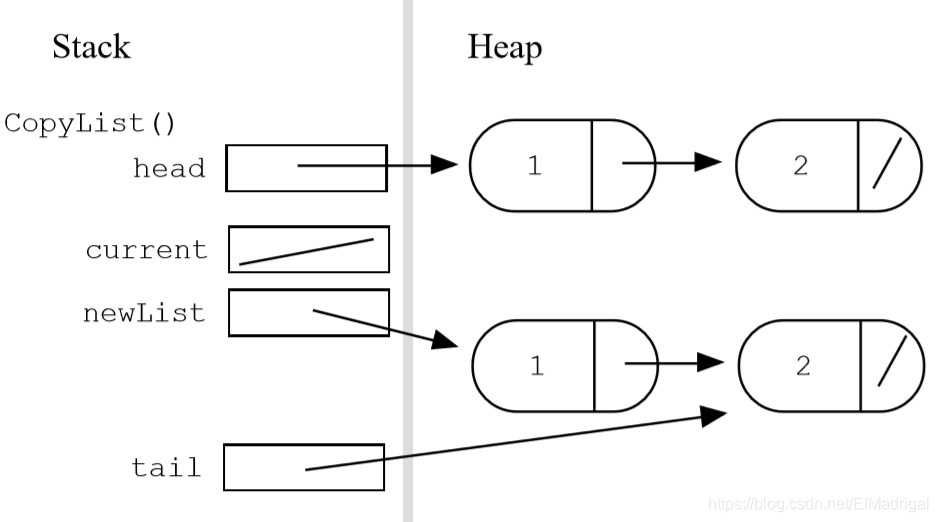
用一个指针遍历原来的链表,两个指针跟踪新生成的链表(一个head,一个tail)。
- 不使用
Push()函数:
struct node* CopyList(struct node* head)

{

	struct node* current = head;   //used to iterate over the original list

	struct node* newList = NULL;   //head of the new list

	struct node* tail = NULL;     //kept pointing to the last node in the new list

	while (current != NULL)

	{

		if (newList == NULL)    //special case for the first new node

		{

			newList = (struct node*)malloc(sizeof(struct node));

			newList->data = current->data;

			newList->next = NULL;

			tail = newList;

		}

		else

		{

			tail->next = (struct node*)malloc(sizeof(struct node));

			tail = tail->next;

			tail->data = current->data;

			tail->next = NULL;

		}

		current = current->next;

	}

	return newList;

}
内存示意图:
2) 使用Push()函数:
struct node* CopyList2(struct node* head)

{

	struct node* current = head;   //used to iterate over the original list

	struct node* newList = NULL;   //head of the new list

	struct node* tail = NULL;     //kept pointing to the last node in the new list

	while (current != NULL)

	{

		if (newList == NULL)    //special case for the first new node

		{

			Push(&newList, current->data);

			tail = newList;

		}

		else

		{

			Push(&(tail->next), current->data);   //add each node at the tail

			tail = tail->next;       //advance the tail to the new last node;

		}

		current = current->next;

	}

	return newList;

}
- 使用
Dummy Node:
struct node* CopyList3(struct node* head)

{

	struct node* current = head;   //used to iterate over the original list

	struct node* tail = NULL;     //kept pointing to the last node in the new list

	struct node dummy;            //build the new list off this dummy node

	dummy.next = NULL;

	tail = &dummy;      //start the tail pointing at the dummy

	while (current != NULL)

	{

		Push(&(tail->next), current->data);   //add each node at the tail

		tail = tail->next;                    //advance the tail to the new last node

		current = current->next;

	}

	return dummy.next;

}
- 使用
Local References:
struct node* CopyList4(struct node* head)

{

	struct node* current = head;   //used to iterate over the original list

	struct node* newList = NULL;   //head of the new list

	struct node** lastPtr;

	lastPtr = &newList;      //start off pointing to the head itself

	while (current != NULL)

	{

		Push(lastPtr, current->data);   //add each node at the lastPtr

		lastPtr = &((*lastPtr)->next);    //advance lastPtr

		current = current->next;

	}

	return newList;

}
核心思想是使用lastPtr指针指向每个节点的.next域这个指针,而不是指向节点本身。
- 使用
Recursive:
struct node* CopyList5(struct node* head)

{

	struct node* current = head;

	if (head == NULL)

		return NULL;

	else {

		struct node* newList = (struct node*)malloc(sizeof(struct node));  //make one node

		newList->data = current->data;

		newList->next = CopyList5(current->next);    //recur for the rest

		return newList;

	}

}
Linked List-2的更多相关文章
- [LeetCode] Linked List Random Node 链表随机节点
Given a singly linked list, return a random node's value from the linked list. Each node must have t ...
- [LeetCode] Plus One Linked List 链表加一运算
Given a non-negative number represented as a singly linked list of digits, plus one to the number. T ...
- [LeetCode] Odd Even Linked List 奇偶链表
Given a singly linked list, group all odd nodes together followed by the even nodes. Please note her ...
- [LeetCode] Delete Node in a Linked List 删除链表的节点
Write a function to delete a node (except the tail) in a singly linked list, given only access to th ...
- [LeetCode] Palindrome Linked List 回文链表
Given a singly linked list, determine if it is a palindrome. Follow up: Could you do it in O(n) time ...
- [LeetCode] Reverse Linked List 倒置链表
Reverse a singly linked list. click to show more hints. Hint: A linked list can be reversed either i ...
- [LeetCode] Remove Linked List Elements 移除链表元素
Remove all elements from a linked list of integers that have value val. Example Given: 1 --> 2 -- ...
- [LeetCode] Intersection of Two Linked Lists 求两个链表的交点
Write a program to find the node at which the intersection of two singly linked lists begins. For ex ...
- [LeetCode] Linked List Cycle II 单链表中的环之二
Given a linked list, return the node where the cycle begins. If there is no cycle, return null. Foll ...
- [LeetCode] Linked List Cycle 单链表中的环
Given a linked list, determine if it has a cycle in it. Follow up: Can you solve it without using ex ...
随机推荐
- python 天天生鲜项目
python 天天生鲜项目 django版:https://github.com/Ivy-1996/fresh flask版:https://github.com/Ivy-1996/flask-fre ...
- 22.3 Extends 构造方法的执行顺序
/** 1.有子父类继承关系的类中,创建父类对象未调用,执行父类无参构造* 2.有子父类继承关系的类中,创建子类对象未调用,执行顺序:默认先调用 父类无参构造---子类无参构造* 在子类的构造方法的第 ...
- 简单完成Excel导出
Excel的导出只需要三步即可完成: 1,完成excel的工具类编写,直接复制即可 package cn.com.bcl.util; import java.util.List; import org ...
- ${param.pageNo}是什么意思?
1.${param.id}与request.getParameter("id"):功能相同2.param.id获取输入的参数id,也可理解为的是form或者div表单里的ID. r ...
- sql 自增序列
一.使用set identity_insert [database][owner][table]on设置时,要在插入语句中显示列出插入的列;
- ASE课程总结 by 朱玉影
收获: 最大的收获应该就是对待选题要慎重吧,虽然前期做了一下调研,但是还是不够,所以到最后我们的项目才会不能公开发布,项目中间也是波折不断,导致我们走了很多弯路,浪费了很多时间吧.选题一定要慎重,慎重 ...
- webpack 中常用安装插件的一些命令
1:npm install html-webpack-plugin --save-dev //自动快速的帮我们生成HTML.2:npm install css-loader style-loader ...
- CLDAPReflectionDDoS(CLDAP反射放大攻击)
CLDAP Reflection DDoS 0x01 LDAP: 全称为Lightweight Directory Access Protocol,即轻量目录访问协议,基于X.500标准: 目录服务就 ...
- Linux 常用到的命令
1.按照文件所有属用户和名字查询 find -user mpsp -name \*.bin 2.根据string 字符串查找内容 more +/string test.txt 3.查找文件尾部 后20 ...
- SSH proxycommand 不在同一局域网的机器ssh直连
本地和192.168.1.10不在同一个网络,可以通过jumpserver跳转过去,操作如下 选项 -L 本机端口 -f 后台启用,可以在本机直接执行命令,无需另开新终端 -N 不打开远程shell, ...