
用一维数组实现栈(C++编程思想 p120)
1 实现思路
向栈中插入4个元素后的状态
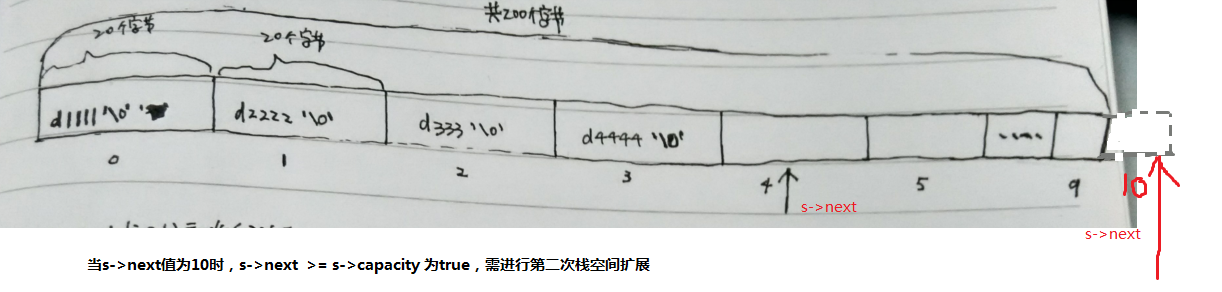
执行过程分析:
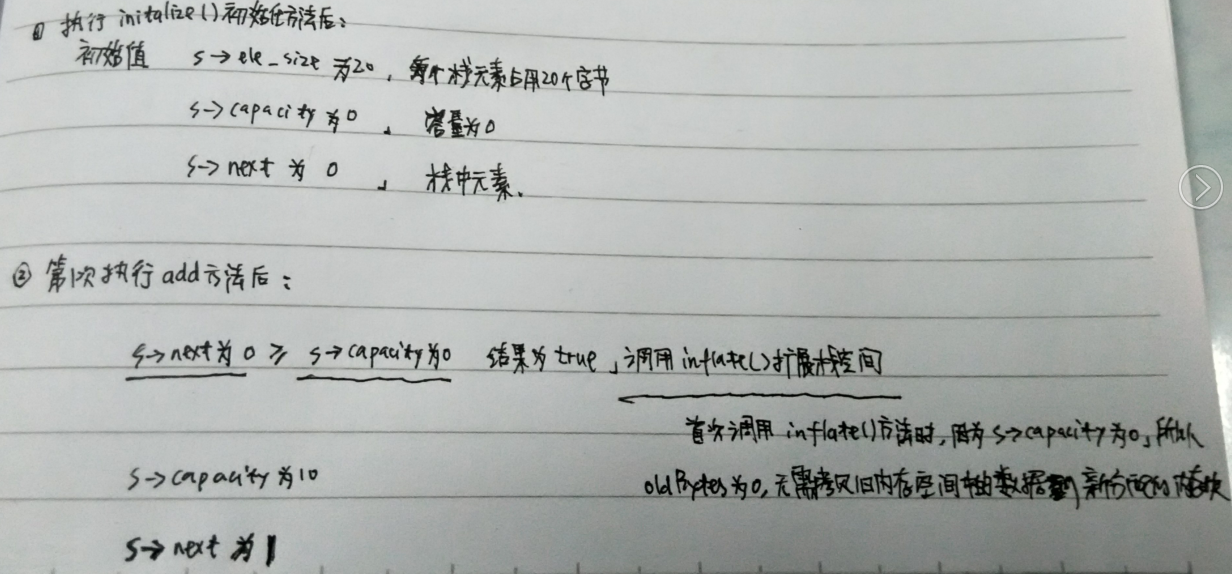
2 代码实现
clib.h 接口定义
 typedef struct CStashTag

 {

     int ele_size;                    //栈中每个元素的占用的字节数

     int capacity;                    //栈的容量,栈当前(不扩展)可容纳的元素的个数

     int next;                        //相当于栈指针(标记下一个空位索引),栈中当前元素的个数

     unsigned char* storage;            //栈存储空间字符指针,动态分配的字节数组

 } CStash;

 void initalize(CStash* s, int size);

 void cleanup(CStash* s);

 int add(CStash* s, const void* element);

 void* fetch(CStash* s, int index);

 int count(CStash* s);

 void inflate(CStash* s, int increase = );
2 Clib.cpp 函数实现
 #include <string>

 #include <iostream>

 #include <cassert>

 #include "clib.h"

 using namespace std;

 void initalize(CStash* s, int sz)

 {

     s->ele_size = sz;

     s->capacity = ;

     s->next = ;

     s->storage = ;

 }

 int add(CStash* s, const void* element)

 {

     if (s->next  >=  s->capacity)

     {

         inflate(s);

     }

     int startBytes = s->next * s->ele_size;

     unsigned char* e = (unsigned char*)element;

     for (int i=; i<s->ele_size; i++)

         s->storage[startBytes + i] = e[i];

     s->next++;

     return s->next - ;

 }

 //取出索引index处的栈元素

 void* fetch(CStash* s, int index)

 {

     assert( <= index);

     if (index >= s->next)

     {

         return ;

     }

     return &(s->storage[index * s->ele_size]);

 }

 //返回栈中元素的个数

 int count(CStash* s)

 {

     return s->next;

 }

 //扩展栈空间,增加increase个元素空间

 void inflate(CStash* s, int increase)

 {

     printf("inflate increase %d\n", increase);

     assert(increase > );

     //原栈长 + 增加的栈元素个数

     int newCapacity = s->capacity + increase;

     int newBytes = newCapacity * s->ele_size;   //新的栈空间字节数

     int oldBytes = s->capacity * s->ele_size;        //旧的栈空间字节数

     unsigned char* b = new unsigned char[newBytes]; //在堆上分配新的栈空间

     if (oldBytes)

     {

         //拷贝旧的栈空间的内容到新的栈空间,并释放旧的栈空间

         //把旧内存块中的数据拷贝到新分配的内存块

         for (int i=; i<oldBytes; i++)

             b[i] = s->storage[i];

         delete [] (s->storage); //释放旧的内存块

     }

     s->storage = b; //使栈存储空间字符指针s->storage指向新分配的内存块

     s->capacity = newCapacity; //更新栈的容量

 }

 //清理栈存储空间字符指针

 void cleanup(CStash* s)

 {

     if (s->storage != )

     {

         cout<<"freeing storage"<<endl;

         delete []s->storage;

     }

 }

 int main(int argc, char* argv[])

 {

     CStash stash;

     char str1[] = "d1111";

     char str2[] = "d2222";

     char str3[] = "d3333";

     char str4[] = "d4444";

     initalize(&stash, );

     add(&stash, str1);

     add(&stash, str2);

     add(&stash, str3);

     add(&stash, str4);

     unsigned char* result = (unsigned char*)fetch(&stash, );

     printf("fetch result %s\n", result);

     cleanup(&stash);

     return ;

 };

输出:
inflate increase 10
fetch result d3333
freeing storage
向栈中存放int型数据测试:
 void intTest()

 {

     CStash intStash;

     initalize(&intStash, sizeof(int)); //栈中存放int型数据,所以栈元素占用int--4个字节

     int i;

     for (i=; i<; i++)

         add(&intStash, &i);

     for (i=; i<count(&intStash); i++)

         cout<< "fetch(&intStash, " << i << ") = " << *(int *) fetch(&intStash, i) <<endl;

     cleanup(&intStash);

 }

输出:
inflate increase 10
inflate increase 10
fetch(&intStash, 0) = 0
fetch(&intStash, 1) = 1
fetch(&intStash, 2) = 2
fetch(&intStash, 3) = 3
fetch(&intStash, 4) = 4
fetch(&intStash, 5) = 5
fetch(&intStash, 6) = 6
fetch(&intStash, 7) = 7
fetch(&intStash, 8) = 8
fetch(&intStash, 9) = 9
fetch(&intStash, 10) = 10
fetch(&intStash, 11) = 11
fetch(&intStash, 12) = 12
fetch(&intStash, 13) = 13
fetch(&intStash, 14) = 14
fetch(&intStash, 15) = 15
fetch(&intStash, 16) = 16
fetch(&intStash, 17) = 17
fetch(&intStash, 18) = 18
fetch(&intStash, 19) = 19
freeing storage
向栈中存放字符串(字符数组指针)测试:
 void stringTest()

 {

     CStash  stringStash;

     ifstream in;

     const int bufsize = ;

     initalize(&stringStash, sizeof(char) * bufsize);

     in.open("clib.h");

     assert(in);

     string line;

     while (getline(in, line))

     {

         add(&stringStash, line.c_str());

     }

     char *cp;

     int i = ;

     while ((cp = (char *) fetch(&stringStash, i++)) != )

     {

         cout<< "fetch(&stringStash, " << i << ") = " << cp << endl;

     }

     cleanup(&stringStash);

 }

输出:
inflate increase 10
inflate increase 10
fetch(&stringStash, 1) = typedef struct CStashTag
fetch(&stringStash, 2) = {
fetch(&stringStash, 3) = int ele_size; //栈中每个元素的占用的字节数
fetch(&stringStash, 4) = int capacity; //栈的容量,栈当前(不扩展)可容纳的元素的个数
fetch(&stringStash, 5) = int next; //相当于栈指针(标记下一个空位索引),栈中当前元素的个数
fetch(&stringStash, 6) = unsigned char* storage; //栈存储空间字符指针,动态分配的字节数组
fetch(&stringStash, 7) = } CStash;
fetch(&stringStash, 8) =
fetch(&stringStash, 9) = void initalize(CStash* s, int size);
fetch(&stringStash, 10) = void cleanup(CStash* s);
fetch(&stringStash, 11) = int add(CStash* s, const void* element);
fetch(&stringStash, 12) = void* fetch(CStash* s, int index);
fetch(&stringStash, 13) = int count(CStash* s);
fetch(&stringStash, 14) = void inflate(CStash* s, int increase = 10);
freeing storage
附C++实现:
1)Stash.h头文件
 #ifndef STASH_H_INCLUDED

 #define STASH_H_INCLUDED

 class Stash

 {

     int ele_size;                    //栈中每个元素的占用的字节数

     int capacity;                    //栈的容量,栈当前(不扩展)可容纳的元素的个数

     int next;                        //相当于栈指针(标记下一个空位索引),栈中当前元素的个数

     unsigned char* storage;            //栈存储空间字符指针,动态分配的字节数组

     void inflate(int increase = );

 public:

     void initalize(int sz);

     int add(const void* element);

     void* fetch(int index);

     int count();

     void cleanup();

 };

 #endif // STASH_H_INCLUDED
2)Stash.cpp实现文件
 #include "Stash.h"

 #include <iostream>

 #include <cassert>

 using namespace std;

 void Stash::initalize(int sz)

 {

     ele_size = sz;

     capacity = ;

     next = ;

     storage = ;

 }

 int Stash::add(const void *element)

 {

     if (next >= capacity)

     {

         inflate();

     }

     int startBytes = next * ele_size;

     unsigned char *e = (unsigned char *) element;

     for (int i=; i<ele_size; i++)

     {

         storage[startBytes + i] = e[i];

     }

     next++;

     return next-;

 }

 void Stash::inflate(int increase)

 {

     cout << "inflate increase: " << increase << endl;

     assert(increase > );

     int newCapacity = capacity + increase;

     int newBytes = newCapacity * ele_size;

     int oldBytes = capacity * ele_size;

     unsigned char *b = new unsigned char[newBytes];

     if (oldBytes)

     {

         for (int i=; i<oldBytes; i++)

             b[i] = storage[i];

         delete []storage;

     }

     storage = b;

     capacity = newCapacity;

 }

 void* Stash::fetch(int index)

 {

     assert(index >= );

     if (index > next)

         return ;

     return &(storage[index * ele_size]);

 }

 int Stash::count()

 {

     return next;

 }

 void Stash::cleanup()

 {

     if (storage != )

     {

         cout << "freeing storage .... " << endl;

         delete []storage;

     }

 }
3)main.cpp测试类
 #include <iostream>

 #include <string>

 #include <fstream>

 #include "Stash.h"

 using namespace std;

 void intTest()

 {

     Stash intStash;

     intStash.initalize(sizeof(int)); //栈中存放int型数据,所以栈元素占用int--4个字节

     int i;

     for (i=; i<; i++)

         intStash.add(&i);

     for (i=; i<intStash.count(); i++)

         cout<< "intStash.fetch(" << i << ") = " << *(int *) intStash.fetch(i) <<endl;

     intStash.cleanup();

 }

 void stringTest()

 {

     Stash  stringStash;

     ifstream in;

     const int bufsize = ;

     stringStash.initalize(sizeof(char) * bufsize);

     in.open("Stash.h");

     string line;

     while (getline(in, line))

     {

         stringStash.add(line.c_str());

     }

     char *cp;

     int i = ;

     while ((cp = (char *) stringStash.fetch(i++)) != )

     {

         cout<< "stringStash.fetch(" << i << ") = " << cp << endl;

     }

     stringStash.cleanup();

 }

 int main()

 {

     //intTest();

     stringTest();

     return ;

 }
用一维数组实现栈(C++编程思想 p120)的更多相关文章
- 小马哥讲Spring栈核心编程思想 Spring IoC+Bean+Framework
小马哥出手的Spring栈核心编程思想课程,可以说是非常专业和权威的Spring课程.课程主要的方向与核心是Spring Framework总览,带领同学们重新认识重新认识IoC,Spring IoC ...
- Java编程思想—八皇后问题(数组法、堆栈法)
Java编程思想-八皇后问题(数组法.堆栈法) 实验题目:回溯法实验(八皇后问题) 实验目的: 实验要求: 实验内容: (1)问题描述 (2)实验步骤: 数组法: 堆栈法: 算法伪代码: 实验结果: ...
- 《Java编程思想》笔记 第十六章 数组
1 数组 数组和容器比较,数组的优点也只剩访问效率高这一点了. 2 数组是第一级对象 数组也是一个对象,和其他普通对象一样在堆中创建, int[ ] arr arr是数组的引用. 可以隐式创建数组对 ...
- java数组实现买彩票(二个一维数组的比较思想)
/** 设计一个程序,模拟从彩球池里随机抽取5个彩球(彩球池里一共有11个彩球,编号为1~11), 要求在控制台打印出这5个被取出来的彩球的编号(注意编号不能重复). 思路: 1.创建一个int类型的 ...
- Java编程思想 笔记
date: 2019-09-06 15:10:00 updated: 2019-09-24 08:30:00 Java编程思想 笔记 1. 四类访问权限修饰词 \ 类内部 本包 子类 其他包 publ ...
- C++编程思想重点笔记(下)
上篇请看:C++编程思想重点笔记(上) 宏的好处与坏处 宏的好处:#与##的使用 三个有用的特征:字符串定义.字符串串联和标志粘贴. 字符串定义的完成是用#指示,它容许设一个标识符并把它转化为字符串, ...
- Java编程思想(11~17)
[注:此博客旨在从<Java编程思想>这本书的目录结构上来检验自己的Java基础知识,只为笔记之用] 第十一章 持有对象 11.1 泛型和类型安全的容器>eg: List<St ...
- Java编程思想读书笔记(一)【对象导论】
2018年1月7日15:45:58 前言 作为学习Java语言的经典之作<Java编程思想>,常常被人提起.虽然这本书出版十年有余,但是内容还是很给力的.很多人说这本书不是很适合初学者,我 ...
- Java编程思想(后)
Java编程思想(后) 持有对象 如果一个程序只包含固定数量的且其生命期都是已知的对象,那么这是一个非常简单的程序. Java中的库基本类型: List, Set, Queue和Map --- 称为集 ...
随机推荐
- Spring使用JDBC配置具名参数
好处:若有多个参数,则不用再去对应位置?,直接对应参数名,便于维护 缺点:较为麻烦 使用具名参数时可以使用以下的方法 好处,通过实现类BeanPropertySqlParameterSource之间传 ...
- 【linux配置】Linux系统下安装rz/sz命令以及使用说明
Linux系统下安装rz/sz命令以及使用说明 对于经常使用Linux系统的人员来说,少不了将本地的文件上传到服务器或者从服务器上下载文件到本地,rz / sz命令很方便的帮我们实现了这个功能,但是很 ...
- 【水滴石穿】react-native-ble-demo
项目的话,是想打开蓝牙,然后连接设备 点击已经连接的设备,我们会看到一些设备 不过我这边在开启蓝牙的时候报错了 先放作者的项目地址: https://github.com/hezhii/react-n ...
- php array_key_exists() 与 isset() 的区别
一个基本的区别是isset()可用于数组和变量,而array_key_exits()只能用于数组. 但是最主要的区别在于在设定的条件下的返回值. 现在我们来验证一下这个最主要的区别. array_ke ...
- 【SPOJ 220】 PHRASES - Relevant Phrases of Annihilation
[链接]h在这里写链接 [题意] 给你n(n<=10)个字符串. 每个字符串长度最大为1e4; 问你能不能找到一个子串. 使得这个子串,在每个字符串里面都不想交出 ...
- HZOI20190714 T3建造游乐场
先放作者的正解: 先说g吧,有i个点的话,在其中i-1个点中有$C_{i-1}^{2}$种边,每个边有选和不选两种情况.如果度不是偶数呢?用剩下那个点给他连上呗.如果剩下那个点度数不是偶数呢?这是不可 ...
- 一句python,一句R︱python中的字符串操作、中文乱码、NaN情况
一句python,一句R︱python中的字符串操作.中文乱码.NaN情况 先学了R,最近刚刚上手Python,所以想着将python和R结合起来互相对比来更好理解python.最好就是一句pytho ...
- 【JZOJ3213】【SDOI2013】直径
╰( ̄▽ ̄)╭ 小 Q最近学习了一些图论知识.根据课本,有如下定义. 树:无回路且连通的无向图,每条边都有正整数的权值来表示其长度.如果一棵树有N个节点,可以证明其有且仅有 N-1 条边. 路径:一棵 ...
- oralce MTS
MTS的组件包括: processes on the system. communication software. the shared global section (SGA). ...
- Validation异常:No validator could be found for constraint '.....' validating type 'java.lang.Integer'.
javax.validation.UnexpectedTypeException: HV000030: No validator could be found for constraint 'java ...