
Deep Learning Tutorial - Classifying MNIST digits using Logistic Regression
Deep Learning Tutorial 由 Montreal大学的LISA实验室所作,基于Theano的深度学习材料.Theano是一个python库,使得写深度模型更容易些,也可以在GPU上训练深度模型。所以首先得了解python和numpy。其次,阅读Theano basic tutorial。
Deep Learning Tutorial 包括:
监督学习算法:
Logistic Regression - using Theano for something simple
Multilayer perceptron - introduction to layers
Deep Convolutional Network - a simplified version of LeNet5
无监督和半监督学习算法:
Auto Encoders, Denoising Autoencoders - description of autoencoders
Stacked Denoising Auto-Encoders - easy steps into unsupervised pre-training for deep nets
Restricted Boltzmann Machines - single layer generative RBM model
Deep Belief Networks - unsupervised generative pre-training of stacked RBMs followed by supervised fine-tuning
建立mcRBM模型:
HMC Sampling
其他:
Contractive auto-encoders:
Semantic Parsing of Speech using Recurrent Net
LSTM network
Modeling and generating sequences of polyphonic music
1.Getting started:
存储数据时用shared variables(共享变量),用小批量索引来操作数据。共享变量与利用GPU有关,如果数据时共享变量,Theano可以复制整个数据在GPU上通过一个简单的命令,不需要从CPU存储上复制任何信息。当在GPU上存储数据时需要的类型是floats,因此代码type为floatX。由于y为标签,所以要将y cast为int。
2.损失函数:
0-1损失: 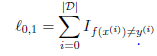
对数似然损失: ,因为0-1损失函数不可微,我们一般用最大化对数似然损失,即最小化负的对 数似然损失。
3.梯度下降
批梯度、随机梯度、小批量梯度
4.正则化
L1,L2正则化(权重衰减)
5.提前停止(Early-Stopping)
之前没注意这个算法,后面的logistic回归分类手写数字识别时用到了它。思想大致是:在验证数据集上如果连续多次迭代过程中损失函数不再显著降低,那么应该提前结束训练,同时也可防止过拟合。
6.Theano tips
若要存储在程序运行过程后所优化得到的权重参数,利用pickle或深拷贝,如果参数为共享变量w,v,u,可这样操作:
>>> import cPickle

>>> save_file = open(’path’, ’wb’) # this will overwrite current contents

>>> cPickle.dump(w.get_value(borrow=True), save_file, -1) # the -1 is for HIGHEST_PROTOCOL

>>> cPickle.dump(v.get_value(borrow=True), save_file, -1) # .. and it triggers much more efficient

>>> cPickle.dump(u.get_value(borrow=True), save_file, -1) # .. storage than numpy’s default

>>> save_file.close()
若要用这些w,v,u来预测或评价,可以再load一下:
>>> save_file = open(’path’)

>>> w.set_value(cPickle.load(save_file), borrow=True)

>>> v.set_value(cPickle.load(save_file), borrow=True)

>>> u.set_value(cPickle.load(save_file), borrow=True)
建议不要pickle训练或测试函数为长期储存,Theano函数与python深拷贝和pickle机制兼容,如果你更新了Theano文件使其内部改变,那么可能将无法在un-pickle你的模型。
CLASSIFYING MNIST DIGITS USING LOGISTIC REGRESSION
logistic regression模型(打分or评价函数):
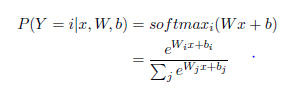
logistic regression模型(损失函数):
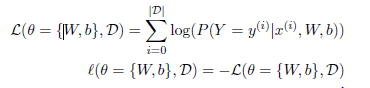
整体代码:
#coding=UTF-8

import cPickle

import gzip

import os

import sys

import timeit

import numpy

import theano

import theano.tensor as T

class LogisticRegression(object):   #此类有三个函数

    def __init__(self, input, n_in, n_out):

        self.W = theano.shared(value=numpy.zeros((n_in, n_out), dtype=theano.config.floatX),name='W',borrow=True)  #初始化参数

        self.b = theano.shared(value=numpy.zeros((n_out,), dtype=theano.config.floatX), name='b', borrow=True)

        self.p_y_given_x = T.nnet.softmax(T.dot(input, self.W) + self.b)   #计算打分、评价结果

        self.y_pred = T.argmax(self.p_y_given_x, axis=1)      #挑出可能性最大的类别标签

        self.params = [self.W, self.b]

        self.input = input

    def negative_log_likelihood(self, y):

        return -T.mean(T.log(self.p_y_given_x)[T.arange(y.shape[0]), y])    #计算损失函数

    def errors(self, y):        #计算错误率

        if y.ndim != self.y_pred.ndim:

            raise TypeError('y should have the same shape as self.y_pred', ('y', y.type, 'y_pred', self.y_pred.type))

        if y.dtype.startswith('int'):

            return T.mean(T.neq(self.y_pred, y))

        else:

            raise NotImplementedError()

def load_data(dataset):

    f = gzip.open(dataset,'rb')

    train_set, valid_set, test_set = cPickle.load(f)

    f.close()    #下载数据

    def shared_dataset(data_xy, borrow=True):   #将数据类型改为共享数据类型

        data_x, data_y = data_xy

        shared_x = theano.shared(numpy.asarray(data_x, dtype=theano.config.floatX), borrow=borrow)

        shared_y = theano.shared(numpy.asarray(data_y, dtype=theano.config.floatX), borrow=borrow)

        return shared_x, T.cast(shared_y, 'int32')

    test_set_x, test_set_y = shared_dataset(test_set)

    valid_set_x, valid_set_y = shared_dataset(valid_set)

    train_set_x, train_set_y = shared_dataset(train_set)

    rval = [(train_set_x, train_set_y), (valid_set_x, valid_set_y), (test_set_x, test_set_y)]   #改好的三种共享数据类型

    return rval

def sgd_optimization_mnist(learning_rate=0.13, n_epochs=1000, dataset='data/mnist.pkl.gz', batch_size=600):   #随机梯度下降

    datasets = load_data(dataset)                     #学习速率0.13,迭代次数1000,批梯度大小600

    train_set_x, train_set_y = datasets[0]

    valid_set_x, valid_set_y = datasets[1]

    test_set_x, test_set_y = datasets[2]

    n_train_batches = train_set_x.get_value(borrow=True).shape[0] / batch_size

    n_valid_batches = valid_set_x.get_value(borrow=True).shape[0] / batch_size

    n_test_batches = test_set_x.get_value(borrow=True).shape[0] / batch_size        #计算三种数据的批量数目,若train_set有6000个样本,批梯度大小为600,

    print '...building the model'                                                   #则n_train_batches为10.

    index = T.lscalar()

    x = T.matrix('x')

    y = T.ivector('y')

    classifier = LogisticRegression(input=x, n_in=28 * 28, n_out=10)    #Classifer为这个分类器

    cost = classifier.negative_log_likelihood(y)

    test_model = theano.function(     #测试模型

        inputs=[index],

        outputs=classifier.errors(y),

        givens={

            x: test_set_x[index * batch_size: (index + 1) * batch_size],

            y: test_set_y[index * batch_size: (index + 1) * batch_size]

        }

    )

    validate_model = theano.function(   #验证模型

        inputs=[index],

        outputs=classifier.errors(y),    #输出为错误率

        givens={

            x: valid_set_x[index * batch_size: (index + 1) * batch_size],

            y: valid_set_y[index * batch_size: (index + 1) * batch_size]

        }

    )

    g_W = T.grad(cost=cost, wrt=classifier.W)

    g_b = T.grad(cost=cost, wrt=classifier.b)

    updates = [(classifier.W, classifier.W - learning_rate * g_W), (classifier.b, classifier.b - learning_rate * g_b)]

    train_model = theano.function(    #训练模型

        inputs=[index],

        outputs=cost,

        updates=updates,

        givens={

            x: train_set_x[index * batch_size: (index + 1) * batch_size],

            y: train_set_y[index * batch_size: (index + 1) * batch_size]

        }

    )

    print '...training the model'          #以下运用了early-stop算法,并非普通的迭代n次后停止

    patience = 5000

    patience_increase = 2

    improvement_threshold = 0.995

    validation_frequency = min(n_train_batches, patience / 2)

    best_validation_loss = numpy.inf

    test_score = 0.

    start_time = timeit.default_timer()

    done_looping = False

    epoch = 0

    while (epoch < n_epochs) and (not done_looping):    #设置最大迭代次数n_epochs

        epoch = epoch + 1

        for minibatch_index in xrange(n_train_batches):     #小批量梯度,实际中n_train)batches=83

            minibatch_avg_cost = train_model(minibatch_index)

            iter = (epoch - 1) * n_train_batches + minibatch_index    #minibatch_index最大只能取到82

            if (iter + 1) % validation_frequency == 0:         #满足这个条件说明完整的迭代了一个epoch,即将所有训练样本迭代了一次

                validation_losses = [validate_model(i) for i in xrange(n_valid_batches)]

                this_validation_loss = numpy.mean(validation_losses)   #计算验证集错误率

                print('epoch %i, minibatch %i / %i, validation error %f %%' %(epoch, minibatch_index + 1, n_train_batches, this_validation_loss * 100.))

                if this_validation_loss < best_validation_loss:     #如果找到了优者

                    if this_validation_loss < best_validation_loss * improvement_threshold:  #如果找到了优者*0.995(即很吊的优者)

                        patience = max(patience, iter * patience_increase)   #遇到了更吊的优者就更新参数

                    best_validation_loss = this_validation_loss    #不论屌不屌,只要找到优者就存起来

                    test_losses = [test_model(i) for i in xrange(n_test_batches)]

                    test_score = numpy.mean(test_losses)    #计算测试集的错误率

                    print(('epoch %i, minibatch %i / %i, test error of'' best model %f %%') %(epoch,minibatch_index + 1,n_train_batches,test_score * 100.))

                    with open('best_model.pkl', 'w') as f:cPickle.dump(classifier, f)    #存储已跑完的训练模型结果!

            if patience <= iter:   #当满足这个条件跳出迭代!

                done_looping = True

                break

    end_time = timeit.default_timer()

    print(('Optimization complete with best validation score of %f %%,''with test performance %f %%') %(best_validation_loss*100.,test_score*100.))

    print 'The code run for %d epochs,with %f epochs/esc' % (epoch, 1.*epoch/(end_time-start_time))

def predict():

    classifier = cPickle.load(open('best_model.pkl'))   #调出已存好了的训练模型!

    predict_model = theano.function(inputs=[classifier.input], outputs=classifier.y_pr ed)  #预测模型

    dataset = 'data/mnist.pkl.gz'

    datasets = load_data(dataset)

    test_set_x, test_set_y = datasets[2]

    test_set_x = test_set_x.get_value()      #取出其值

    #test_set_y = test_set_y

    predicted_values = predict_model(test_set_x[:10])        #取出前10个预测下

    print("predicted values for the first 10 examples in test set:")

    print predicted_values
Deep Learning Tutorial - Classifying MNIST digits using Logistic Regression的更多相关文章
- Deep Learning Tutorial - Convolutional Neural Networks(LENET)
CNN很多概述和要点在CS231n.Neural Networks and Deep Learning中有详细阐述,这里补充Deep Learning Tutorial中的内容.本节前提是前两节的内容 ...
- 深度学习材料:从感知机到深度网络A Deep Learning Tutorial: From Perceptrons to Deep Networks
In recent years, there’s been a resurgence in the field of Artificial Intelligence. It’s spread beyo ...
- 深度学习 Deep LearningUFLDL 最新Tutorial 学习笔记 2:Logistic Regression
1 Logistic Regression 简述 Linear Regression 研究连续量的变化情况,而Logistic Regression则研究离散量的情况.简单地说就是对于推断一个训练样本 ...
- 读《Deep Learning Tutorial》(台湾大学 李宏毅 深度学习教学ppt)后杂记
原ppt下载:pan.baidu.com/s/1nv54p9R,密码:3mty 需深入实践并理解的重要概念: Deep Learning: SoftMax Fuction(输出层归一化函数,与sigm ...
- (原创)Stanford Machine Learning (by Andrew NG) --- (week 3) Logistic Regression & Regularization
coursera上面Andrew NG的Machine learning课程地址为:https://www.coursera.org/course/ml 我曾经使用Logistic Regressio ...
- Deep Learning Tutorial
http://www.slideshare.net/tw_dsconf/ss-62245351?qid=c0f0f97a-6ca8-4df0-97e2-984452215ee7&v=& ...
- 读李宏毅《一天看懂深度学习》——Deep Learning Tutorial
大牛推荐的入门用深度学习导论,刚拿到有点懵,第一次接触PPT类型的学习资料,但是耐心看下来收获还是很大的,适合我这种小白入门哈哈. 原PPT链接:http://www.slideshare.net/t ...
- Deep Learning Tutorial 李宏毅(一)深度学习介绍
大纲 深度学习介绍 深度学习训练的技巧 神经网络的变体 展望 深度学习介绍 深度学习介绍 深度学习属于机器学习的一种.介绍深度学习之前,我们先大致了解一下机器学习. 机器学习,拿监督学习为例,其本质上 ...
- Deep Learning Tutorial - Multilayer perceptron
Multilayer perceptron:多层感知器 本节实现两层网络(一个隐层)作为分类器实现手写数字分类.引入的内容:激活函数(双曲正切.L1和L2正则化).Theano的共享变量.grad.f ...
随机推荐
- CodeForces621E 快速矩阵幂优化dp
有时些候在用快速矩阵幂优化dp的时候,它的矩阵乘法是不那么容易被具体为题目背景的意思的,大多数时候难以理解矩阵之间相乘的实际意义,正如有时候我们不知道现在在做手头这些事情的意义,但倘若是因一个目标而去 ...
- RHCE基础环境系统的搭建
RHCE基础环境系统的搭建 安装前提: 安装的时候对系统和硬件的要求: 红帽系统安装队系统的要求:Windows操作系统选择64位的内存至少6GCPU需要支持虚拟化技术在做红帽系统实验的时候,把360 ...
- httprouter使用pprof
httprouter使用pprof 参考:https://github.com/feixiao/httpprof 性能分析参考:https://github.com/caibirdme/hand-to ...
- 利用jieba,word2vec,LR进行搜狐新闻文本分类
一.简介 1)jieba 中文叫做结巴,是一款中文分词工具,https://github.com/fxsjy/jieba 2)word2vec 单词向量化工具,https://radimrehurek ...
- docker mesos集群资源调度平台
mesos原理与架构 首先,再次需要强调 Mesos 自身只是一个资源调度框架,并非一整套完整的应用管理平台,所以只有 Mesos 自己是不能干活的.但是基于 Mesos,可以比较容易地为各种应用管理 ...
- MySQL常用函数介绍
MySQL常用函数介绍 作者:尹正杰 版权声明:原创作品,谢绝转载!否则将追究法律责任. 一.操作符介绍 1>.操作符优先级 mysql; +----------+ | +----------+ ...
- MyBatis-Select 流程
mybatis 版本:3.5.1 测试代码: public interface MyUserMapperAnnotation { @Select("select * from myuser ...
- powershell 中常用cmd,unix命令(get-alias)
powershell 中常用cmd,unix命令(get-alias) Get-Content Alias cat -> Get-Content Alias gc -> Get-Conte ...
- React 记录(1)
作为一个前端工程师,前端框架是必须会的,所以开始学习React. 学习的方法是:先实践,后图文记录. React官网:https://reactjs.org React中文网站:https://www ...
- Elasticsearch集群节点配置详解
注意:如果是在局域网中运行elasticsearch集群也是很简单的,只要cluster.name设置一致,并且机器在同一网段下,启动的es会自动发现对方,组成集群. 2.elasticsearch- ...