
FreeRTOS --(5)内存管理 heap4
FreeRTOS 中的 heap 4 内存管理,可以算是 heap 2 的增强版本,在 《FreeRTOS --(3)内存管理 heap2》中,我们可以看到,每次内存分配后都会产生一个内存块,多次分配后,会产生很多内存碎片,在较为复杂的场景(需要经常动态分配和释放场景)下,几乎是无法胜任;
所以就有了 heap 4,它相比 heap 2 来说,提供了相邻空闲的内存块合并的功能,一定程度上减少了内存碎片,使得释放了的内存能够再度合并称为较为大的内存块,以供有大内存块的分配场景使用;
1、内存大小
和 heap 2 一样,用于内存管理的内存大小来自于一个大数组,数组的下标就是整个需要被管理的内存的大小,这个是和具体芯片所支持的 RAM 大小相关:
configTOTAL_HEAP_SIZE
被管理的内存定义为:
static uint8_t ucHeap[ configTOTAL_HEAP_SIZE ];
ucHeap 就是管理的对象;
这些基本的结构都是和之前的 heap2 保持一致,不再多说;
2、对齐
对齐的部分也是和 heap 2 一致,不在多说,更多的参考:《FreeRTOS --(3)内存管理 heap2》的对齐章节;
3、内存块
内存块的定义依然是:
typedef struct A_BLOCK_LINK

{

    struct A_BLOCK_LINK *pxNextFreeBlock;    /*<< The next free block in the list. */

    size_t xBlockSize;                        /*<< The size of the free block. */

} BlockLink_t;
没有任何差别,依然有 xStart 和 xEnd 来描述两个 marker,和 heap 2 几乎一样《FreeRTOS --(3)内存管理 heap2》;这里不再多说;
4、内存初始化
和 heap 2 一样,内存初始化使用 prvHeapInit,在第一次调用内存分配的时候,检查是否有初始化,否则进行 prvHeapInit 的调用,初始化相关的结构:
static void prvHeapInit( void )

{

BlockLink_t *pxFirstFreeBlock;

uint8_t *pucAlignedHeap;

size_t uxAddress;

size_t xTotalHeapSize = configTOTAL_HEAP_SIZE;

    /* Ensure the heap starts on a correctly aligned boundary. */

    uxAddress = ( size_t ) ucHeap;

    if( ( uxAddress & portBYTE_ALIGNMENT_MASK ) != 0 )

    {

        uxAddress += ( portBYTE_ALIGNMENT - 1 );

        uxAddress &= ~( ( size_t ) portBYTE_ALIGNMENT_MASK );

        xTotalHeapSize -= uxAddress - ( size_t ) ucHeap;

    }

    pucAlignedHeap = ( uint8_t * ) uxAddress;

    /* xStart is used to hold a pointer to the first item in the list of free

    blocks.  The void cast is used to prevent compiler warnings. */

    xStart.pxNextFreeBlock = ( void * ) pucAlignedHeap;

    xStart.xBlockSize = ( size_t ) 0;

    /* pxEnd is used to mark the end of the list of free blocks and is inserted

    at the end of the heap space. */

    uxAddress = ( ( size_t ) pucAlignedHeap ) + xTotalHeapSize;

    uxAddress -= xHeapStructSize;

    uxAddress &= ~( ( size_t ) portBYTE_ALIGNMENT_MASK );

    pxEnd = ( void * ) uxAddress;

    pxEnd->xBlockSize = 0;

    pxEnd->pxNextFreeBlock = NULL;

    /* To start with there is a single free block that is sized to take up the

    entire heap space, minus the space taken by pxEnd. */

    pxFirstFreeBlock = ( void * ) pucAlignedHeap;

    pxFirstFreeBlock->xBlockSize = uxAddress - ( size_t ) pxFirstFreeBlock;

    pxFirstFreeBlock->pxNextFreeBlock = pxEnd;

    /* Only one block exists - and it covers the entire usable heap space. */

    xMinimumEverFreeBytesRemaining = pxFirstFreeBlock->xBlockSize;

    xFreeBytesRemaining = pxFirstFreeBlock->xBlockSize;

    /* Work out the position of the top bit in a size_t variable. */

    xBlockAllocatedBit = ( ( size_t ) 1 ) << ( ( sizeof( size_t ) * heapBITS_PER_BYTE ) - 1 );

}
从编码风格的角度上来说,看上去感觉和 heap 2 不是同一个人写的(同样的逻辑,不同的表达),不过没关系,含义都是一样的;
依然是初始化了 xStart 和 xEnd 两个 marker;做了一些对齐处理后,将能够分配的所有的空间一并挂到了 xStart->pxNextFreeBlock 链表;
和 heap 2 不一样的是,heap 4 定义了一个标记,以表示内存是否有被使用,这里定义了 xBlockAllocatedBit;如果是 32bit CPU 的话,这个 xBlockAllocatedBit = 0x01<<31;32 bit 的最高位,这显然是安全的;
5、内存分配
内存分配,还是使用的 pvPortMalloc 接口,正确分配,返回可用的内存地址,出错返回 NULL:
void *pvPortMalloc( size_t xWantedSize )

{

BlockLink_t *pxBlock, *pxPreviousBlock, *pxNewBlockLink;

void *pvReturn = NULL;

    vTaskSuspendAll();

    {

        /* If this is the first call to malloc then the heap will require

        initialisation to setup the list of free blocks. */

        if( pxEnd == NULL )

        {

            prvHeapInit();

        }

        else

        {

            mtCOVERAGE_TEST_MARKER();

        }

        /* Check the requested block size is not so large that the top bit is

        set.  The top bit of the block size member of the BlockLink_t structure

        is used to determine who owns the block - the application or the

        kernel, so it must be free. */

        if( ( xWantedSize & xBlockAllocatedBit ) == 0 )

        {

            /* The wanted size is increased so it can contain a BlockLink_t

            structure in addition to the requested amount of bytes. */

            if( xWantedSize > 0 )

            {

                xWantedSize += xHeapStructSize;

                /* Ensure that blocks are always aligned to the required number

                of bytes. */

                if( ( xWantedSize & portBYTE_ALIGNMENT_MASK ) != 0x00 )

                {

                    /* Byte alignment required. */

                    xWantedSize += ( portBYTE_ALIGNMENT - ( xWantedSize & portBYTE_ALIGNMENT_MASK ) );

                    configASSERT( ( xWantedSize & portBYTE_ALIGNMENT_MASK ) == 0 );

                }

                else

                {

                    mtCOVERAGE_TEST_MARKER();

                }

            }

            else

            {

                mtCOVERAGE_TEST_MARKER();

            }

            if( ( xWantedSize > 0 ) && ( xWantedSize <= xFreeBytesRemaining ) )

            {

                /* Traverse the list from the start    (lowest address) block until

                one    of adequate size is found. */

                pxPreviousBlock = &xStart;

                pxBlock = xStart.pxNextFreeBlock;

                while( ( pxBlock->xBlockSize < xWantedSize ) && ( pxBlock->pxNextFreeBlock != NULL ) )

                {

                    pxPreviousBlock = pxBlock;

                    pxBlock = pxBlock->pxNextFreeBlock;

                }

                /* If the end marker was reached then a block of adequate size

                was    not found. */

                if( pxBlock != pxEnd )

                {

                    /* Return the memory space pointed to - jumping over the

                    BlockLink_t structure at its start. */

                    pvReturn = ( void * ) ( ( ( uint8_t * ) pxPreviousBlock->pxNextFreeBlock ) + xHeapStructSize );

                    /* This block is being returned for use so must be taken out

                    of the list of free blocks. */

                    pxPreviousBlock->pxNextFreeBlock = pxBlock->pxNextFreeBlock;

                    /* If the block is larger than required it can be split into

                    two. */

                    if( ( pxBlock->xBlockSize - xWantedSize ) > heapMINIMUM_BLOCK_SIZE )

                    {

                        /* This block is to be split into two.  Create a new

                        block following the number of bytes requested. The void

                        cast is used to prevent byte alignment warnings from the

                        compiler. */

                        pxNewBlockLink = ( void * ) ( ( ( uint8_t * ) pxBlock ) + xWantedSize );

                        configASSERT( ( ( ( size_t ) pxNewBlockLink ) & portBYTE_ALIGNMENT_MASK ) == 0 );

                        /* Calculate the sizes of two blocks split from the

                        single block. */

                        pxNewBlockLink->xBlockSize = pxBlock->xBlockSize - xWantedSize;

                        pxBlock->xBlockSize = xWantedSize;

                        /* Insert the new block into the list of free blocks. */

                        prvInsertBlockIntoFreeList( pxNewBlockLink );

                    }

                    else

                    {

                        mtCOVERAGE_TEST_MARKER();

                    }

                    xFreeBytesRemaining -= pxBlock->xBlockSize;

                    if( xFreeBytesRemaining < xMinimumEverFreeBytesRemaining )

                    {

                        xMinimumEverFreeBytesRemaining = xFreeBytesRemaining;

                    }

                    else

                    {

                        mtCOVERAGE_TEST_MARKER();

                    }

                    /* The block is being returned - it is allocated and owned

                    by the application and has no "next" block. */

                    pxBlock->xBlockSize |= xBlockAllocatedBit;

                    pxBlock->pxNextFreeBlock = NULL;

                }

                else

                {

                    mtCOVERAGE_TEST_MARKER();

                }

            }

            else

            {

                mtCOVERAGE_TEST_MARKER();

            }

        }

        else

        {

            mtCOVERAGE_TEST_MARKER();

        }

        traceMALLOC( pvReturn, xWantedSize );

    }

    ( void ) xTaskResumeAll();

    #if( configUSE_MALLOC_FAILED_HOOK == 1 )

    {

        if( pvReturn == NULL )

        {

            extern void vApplicationMallocFailedHook( void );

            vApplicationMallocFailedHook();

        }

        else

        {

            mtCOVERAGE_TEST_MARKER();

        }

    }

    #endif

    configASSERT( ( ( ( size_t ) pvReturn ) & ( size_t ) portBYTE_ALIGNMENT_MASK ) == 0 );

    return pvReturn;

}
内存分配部分的代码和之前的 heap 2 的代码几乎完全一样,这里不做过多的解释;
6、内存释放
内存释放是 vPortFree 接口:
void vPortFree( void *pv )

{

uint8_t *puc = ( uint8_t * ) pv;

BlockLink_t *pxLink;

    if( pv != NULL )

    {

        /* The memory being freed will have an BlockLink_t structure immediately

        before it. */

        puc -= xHeapStructSize;

        /* This casting is to keep the compiler from issuing warnings. */

        pxLink = ( void * ) puc;

        /* Check the block is actually allocated. */

        configASSERT( ( pxLink->xBlockSize & xBlockAllocatedBit ) != 0 );

        configASSERT( pxLink->pxNextFreeBlock == NULL );

        if( ( pxLink->xBlockSize & xBlockAllocatedBit ) != 0 )

        {

            if( pxLink->pxNextFreeBlock == NULL )

            {

                /* The block is being returned to the heap - it is no longer

                allocated. */

                pxLink->xBlockSize &= ~xBlockAllocatedBit;

                vTaskSuspendAll();

                {

                    /* Add this block to the list of free blocks. */

                    xFreeBytesRemaining += pxLink->xBlockSize;

                    traceFREE( pv, pxLink->xBlockSize );

                    prvInsertBlockIntoFreeList( ( ( BlockLink_t * ) pxLink ) );

                }

                ( void ) xTaskResumeAll();

            }

            else

            {

                mtCOVERAGE_TEST_MARKER();

            }

        }

        else

        {

            mtCOVERAGE_TEST_MARKER();

        }

    }

}
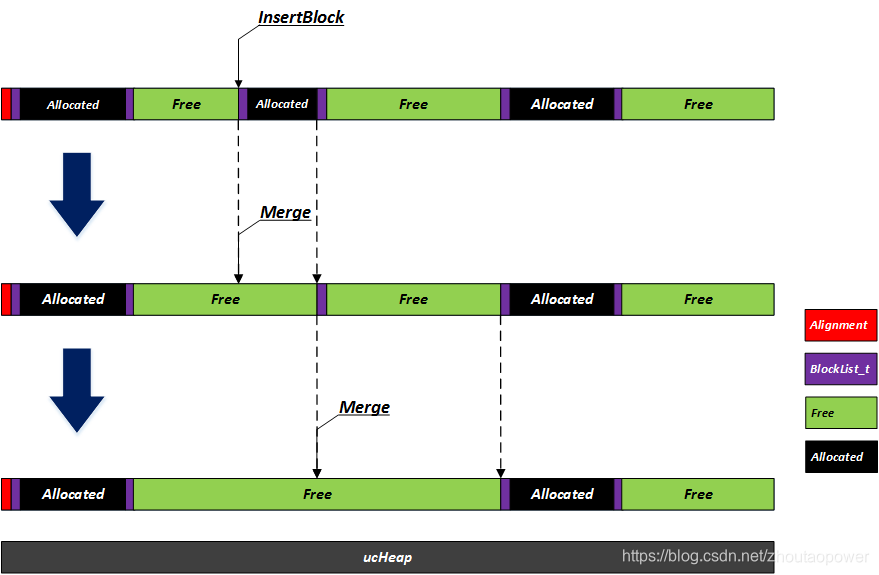
释放的时候,将之前的内存通过调用 prvInsertBlockIntoFreeList 插入到 Free List 中,内存块的合并就体现在这个函数;
6.1、合并
当释放内存的时候调用到了 prvInsertBlockIntoFreeList,它实现了相邻内存块的合并工作,这也是 heap 4 与 heap 2 最大不同的地方:
static void prvInsertBlockIntoFreeList( BlockLink_t *pxBlockToInsert )

{

BlockLink_t *pxIterator;

uint8_t *puc;

    /* Iterate through the list until a block is found that has a higher address

    than the block being inserted. */

    for( pxIterator = &xStart; pxIterator->pxNextFreeBlock < pxBlockToInsert; pxIterator = pxIterator->pxNextFreeBlock )

    {

        /* Nothing to do here, just iterate to the right position. */

    }

    /* Do the block being inserted, and the block it is being inserted after

    make a contiguous block of memory? */

    puc = ( uint8_t * ) pxIterator;

    if( ( puc + pxIterator->xBlockSize ) == ( uint8_t * ) pxBlockToInsert )

    {

        pxIterator->xBlockSize += pxBlockToInsert->xBlockSize;

        pxBlockToInsert = pxIterator;

    }

    else

    {

        mtCOVERAGE_TEST_MARKER();

    }

    /* Do the block being inserted, and the block it is being inserted before

    make a contiguous block of memory? */

    puc = ( uint8_t * ) pxBlockToInsert;

    if( ( puc + pxBlockToInsert->xBlockSize ) == ( uint8_t * ) pxIterator->pxNextFreeBlock )

    {

        if( pxIterator->pxNextFreeBlock != pxEnd )

        {

            /* Form one big block from the two blocks. */

            pxBlockToInsert->xBlockSize += pxIterator->pxNextFreeBlock->xBlockSize;

            pxBlockToInsert->pxNextFreeBlock = pxIterator->pxNextFreeBlock->pxNextFreeBlock;

        }

        else

        {

            pxBlockToInsert->pxNextFreeBlock = pxEnd;

        }

    }

    else

    {

        pxBlockToInsert->pxNextFreeBlock = pxIterator->pxNextFreeBlock;

    }

    /* If the block being inserted plugged a gab, so was merged with the block

    before and the block after, then it's pxNextFreeBlock pointer will have

    already been set, and should not be set here as that would make it point

    to itself. */

    if( pxIterator != pxBlockToInsert )

    {

        pxIterator->pxNextFreeBlock = pxBlockToInsert;

    }

    else

    {

        mtCOVERAGE_TEST_MARKER();

    }

}
在 heap 2中,也有这个函数,但是它是按照内存块的小到大进行排序,由于有相邻内存块合并的要求,所以在 heap 4 中,内存块链表的组织形式,是按照他们的地址顺序由小到大组织的;
首先通过 xStart 开始,获取第一个空闲块的地址,并比较它的下一个空闲块地址和待插入空闲块地址的大小,以便获得合适的插入位置;
获得合适的位置了以后,判断待插入的这个空闲块是否和前一个空闲块相邻,如果相邻的话,就将两个块合并到一起:
/* Do the block being inserted, and the block it is being inserted after

    make a contiguous block of memory? */

    puc = ( uint8_t * ) pxIterator;

    if( ( puc + pxIterator->xBlockSize ) == ( uint8_t * ) pxBlockToInsert )

    {

        pxIterator->xBlockSize += pxBlockToInsert->xBlockSize;

        pxBlockToInsert = pxIterator;

    }

    else

    {

        mtCOVERAGE_TEST_MARKER();

    }
然后在判断是否和后一个空闲块也相邻,如果相邻,也将他们合并,当然这里需要判断是否是紧挨着 xEnd:
/* Do the block being inserted, and the block it is being inserted before

    make a contiguous block of memory? */

    puc = ( uint8_t * ) pxBlockToInsert;

    if( ( puc + pxBlockToInsert->xBlockSize ) == ( uint8_t * ) pxIterator->pxNextFreeBlock )

    {

        if( pxIterator->pxNextFreeBlock != pxEnd )

        {

            /* Form one big block from the two blocks. */

            pxBlockToInsert->xBlockSize += pxIterator->pxNextFreeBlock->xBlockSize;

            pxBlockToInsert->pxNextFreeBlock = pxIterator->pxNextFreeBlock->pxNextFreeBlock;

        }

        else

        {

            pxBlockToInsert->pxNextFreeBlock = pxEnd;

        }

    }

    else

    {

        pxBlockToInsert->pxNextFreeBlock = pxIterator->pxNextFreeBlock;

    }
打个比方:
多次分配和释放后,内存布局如下所示:

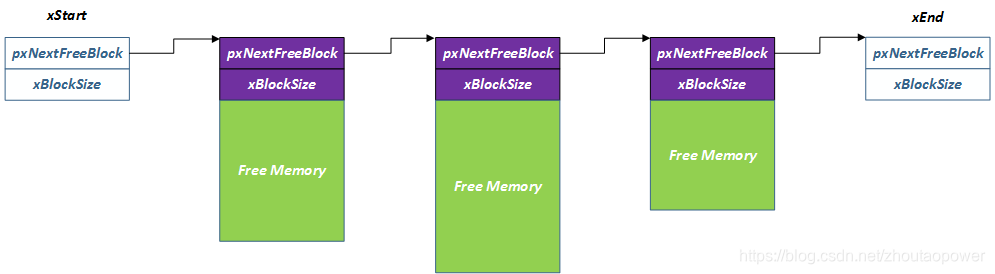
如果要释放中间那个内存,那么就会触发向上和向下的合并:
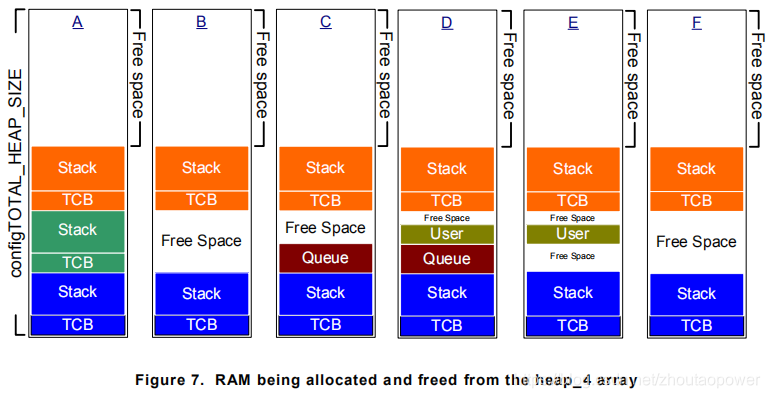
官方针对这个 heap 4 的官图为:
FreeRTOS --(5)内存管理 heap4的更多相关文章
- 轻量级操作系统FreeRTOS的内存管理机制(一)
本文由嵌入式企鹅圈原创团队成员朱衡德(Hunter_Zhu)供稿. 近几年来,FreeRTOS在嵌入式操作系统排行榜中一直位居前列,作为开源的嵌入式操作系统之一,它支持许多不同架构的处理器以及多种编译 ...
- FreeRTOS 动态内存管理
以下转载自安富莱电子: http://forum.armfly.com/forum.php 本章节为大家讲解 FreeRTOS 动态内存管理,动态内存管理是 FreeRTOS 非常重要的一项功能,前面 ...
- FreeRTOS的内存管理
FreeRTOS提供了几个内存堆管理方案,有复杂的也有简单的.其中最简单的管理策略也能满足很多应用的要求,比如对安全要求高的应用,这些应用根本不允许动态内存分配的. FreeRTOS也允许你自己实现内 ...
- freertos之内存管理
任务.信号量.邮箱才调度器开始调度之前就应该创建,所以它不可能像裸奔程序那样的函数调用能确定需要多少内存资源,RTOS提供了3种内存管理的方法: 1 方法一:确定性好适合于任务.信号量.队列都不被删除 ...
- FreeRTOS --(6)内存管理 heap5
转载自https://blog.csdn.net/zhoutaopower/article/details/106748308 FreeRTOS 中的 heap 5 内存管理,相对于 heap 4&l ...
- FreeRTOS内存管理
简介 Freertos的内存管理分别在heap_1.c,heap_2.c,heap_3.c,heap_4.c,heap_5.c个文件中,选择合适的一种应用于嵌入式项目中即可. 本文的图片中 红色部分B ...
- FreeRTOS --(3)内存管理 heap2
在<FreeRTOS --(2)内存管理 heap1>知道 heap 1 的内存管理其实只是简单的实现了内存对齐的分配策略,heap 2 的实现策略相比 heap 1 稍微复杂一点,不仅仅 ...
- FreeRTOS --(2)内存管理 heap1
转载自https://blog.csdn.net/zhoutaopower/article/details/106631237 FreeRTOS 提供了5种内存堆管理方案,分别对应heap1/heap ...
- FreeRTOS--堆内存管理
因为项目需要,最近开始学习FreeRTOS,一开始有些紧张,因为两个星期之前对于FreeRTOS的熟悉度几乎为零,经过对FreeRTOS官网的例子程序的摸索,和项目中问题的解决,遇到了很多熟悉的身影, ...
随机推荐
- idea如何打包项目,部署到linux后台运行
服务器安装tomcat 上传好tomcat包 scp -r tomcat liwwww@111116.11222.101121.12111111:/opt/ linux下启动tomcat服务的命令 ...
- 用 Java 写一个线程安全的单例模式(Singleton)?
请参考答案中的示例代码,这里面一步一步教你创建一个线程安全的 Java 单例类.当我们说线程安全时,意思是即使初始化是在多线程环境中,仍然能保证单个实例.Java 中,使用枚举作为单例类是最简单的方式 ...
- jvm-learning-双亲委派机制
是什么 工作原理 例子 优势 什么是沙箱安全机制 其他知识 对类加载器的引用 类的主动使用和被动使用
- Web,RESTful API 在微服务中的作用是什么?
微服务架构基于一个概念,其中所有服务应该能够彼此交互以构建业务功能.因 此,要实现这一点,每个微服务必须具有接口.这使得 Web API 成为微服务的一 个非常重要的推动者.RESTful API 基 ...
- kafka客户端打印日志
kafka 0.10.0 java客户端使用slf4j作为日志门面,需要我们加入具体的日志实现依赖才能打印日志,日志框架:http://www.cnblogs.com/set-cookie/p/883 ...
- scrapy--使用案例
1.scrapy框架 1.1 安装scrapy pip3 install wheel 下载twisted http://www.lfd.uci.edu/~gohlke/pythonlibs/#twis ...
- Spring Security OAuth 笔记
1 单点登录 关于单点登录的原理,我觉得下面这位老哥讲的比较清楚,有兴趣可以看一下,下面我把其中的重点在此做个笔记总结 https://juejin.cn/post/6844904079274197 ...
- ZEGO音视频服务的高可用架构设计与运营
前言: ZEGO 即构科技作为一家实时音视频的提供商,系统稳定性直接影响用户的主观体验,如何保障服务高可用且用户体验最优是行业面临的挑战,本文结合实际业务场景进行思考,介绍 ZEGO 即构在高可用架构 ...
- 什么是静态内部(Static Inner)类,语法要注意什么?
4静态内部类(Static Inner Classes) 马克-to-win:这里的内部类的static,意思是它可以不用实例化外部类,就自己单独被实例化,单独存在(有点像生活中的办公室和办公桌(独立 ...
- Java学习笔记(韩顺平教育 b站有课程)
Java重要特点 面向对象(oop) 健壮性:强类型机制,异常处理,垃圾的自动收集 跨平台性的 (一个编译好的.class可以在多个系统下运行) TEST.java -> TEST.class ...