
Buy Tickets(线段树)
Description
Railway tickets were difficult to buy around the Lunar New Year in China, so we must get up early and join a long queue…
The Lunar New Year was approaching, but unluckily the Little Cat still had schedules going here and there. Now, he had to travel by train to Mianyang, Sichuan Province for the winter camp selection of the national team of Olympiad in Informatics.
It was one o’clock a.m. and dark outside. Chill wind from the northwest did not scare off the people in the queue. The cold night gave the Little Cat a shiver. Why not find a problem to think about? That was none the less better than freezing to death!
People kept jumping the queue. Since it was too dark around, such moves would not be discovered even by the people adjacent to the queue-jumpers. “If every person in the queue is assigned an integral value and all the information about those who have jumped the queue and where they stand after queue-jumping is given, can I find out the final order of people in the queue?” Thought the Little Cat.
Input
There will be several test cases in the input. Each test case consists of N + 1 lines where N (1 ≤ N ≤ 200,000) is given in the first line of the test case. The next N lines contain the pairs of values Posi and Vali in the increasing order of i (1 ≤ i ≤ N). For each i, the ranges and meanings of Posi and Vali are as follows:
- Posi ∈ [0, i − 1] — The i-th person came to the queue and stood right behind the Posi-th person in the queue. The booking office was considered the 0th person and the person at the front of the queue was considered the first person in the queue.
- Vali ∈ [0, 32767] — The i-th person was assigned the value Vali.
There no blank lines between test cases. Proceed to the end of input.
Output
For each test cases, output a single line of space-separated integers which are the values of people in the order they stand in the queue.
Sample Input
4

0 77

1 51

1 33

2 69

4

0 20523

1 19243

1 3890

0 31492
Sample Output
77 33 69 51

31492 20523 3890 19243
Hint
The figure below shows how the Little Cat found out the final order of people in the queue described in the first test case of the sample input.
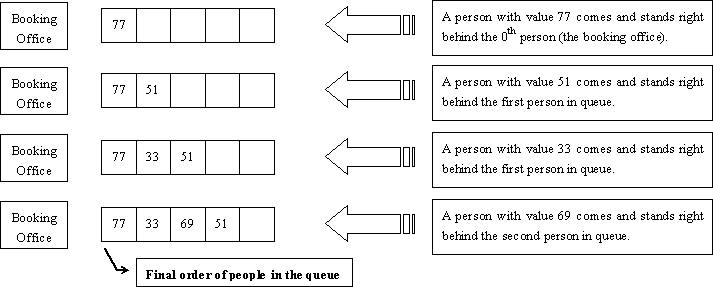
 #include<iostream>

 #include<stdio.h>

 #include<string.h>

 #define N 200010

 #define lson p << 1

 #define rson p << 1 | 1

 using namespace std;

 struct Nod

 {

     int l , r ;

     int va ; // Gap

 }node[N << ];

 int pos[N] , val[N] , ans[N] ;

 void build ( int l , int r , int p )

 {

     node[p].l = l ;

     node[p].r = r ;

     node[p].va = r - l +  ;

     if ( l == r)

         return ;

     int mid = ( l + r ) >>  ;

     build ( l , mid , lson ) ;

     build ( mid +  , r , rson ) ;

 }

 int update ( int ps , int p )

 {

     node[p].va-- ;   //Gap - 1 ;

     if ( node[p].l == node[p].r ) {

         return node[p].l ; //return the position of the insert

     }

     if ( node[lson].va >= ps ) {

         update ( ps , lson ) ;//when lson's Gap equal to or greater than the insertion location , inserted to the left

     }

     else {

         ps -= node[lson].va ;//when Gap on the left is less than the ps , insert the right side , the right of the insertion laction is

                                 // ps minus Gap on the left

         update ( ps , rson ) ;

     }

 }

 int main ()

 {

     //freopen ( "a.txt" , "r" , stdin ) ;

     int n ;

     while (~scanf ("%d" , &n ) ) {

         build (  , n ,  ) ;

         for ( int i =  ; i <= n ; i++ ) {

             scanf ("%d%d" , pos + i , val + i ) ;

         }

         for ( int i = n ; i >=  ; i-- ) {

             int id = update ( pos[i] +  ,  ) ;    // get the insert position

             ans[id] = val[i] ;  // in ans Array

         }

         for ( int i =  ; i < n ; i++ ) {

             printf ( "%d " , ans[i] ) ;

         }

         printf ( "%d\n" , ans[n] ) ;

     }

     return  ;

 }
倒推法
集训时大神介绍了一种能节省空间的写法:
 #include<iostream>

 #include<stdio.h>

 #include<string.h>

 #define N 200010

 #define lson o << 1 , l , mid

 #define rson o << 1 | 1 , mid + 1 , r

 using namespace std;

 int va[N << ] ; // Gap

 int pos[N] , val[N] , ans[N] ;

 void build (int o , int l , int r )

 {

     va[o] = r - l +  ;

     if ( l == r )

         return ;

     int mid = ( l + r ) >>  ;

     build ( lson ) ;

     build ( rson ) ;

 }

 int update ( int ps ,int o , int l , int r  )

 {

     va[o]-- ;   //Gap - 1 ;

     if ( l == r ) {

         return l ; //return the position of the insert

     }

     int mid = ( l + r ) >>  ;

     if ( va[o << ] >= ps ) {

         update ( ps , lson ) ;//when lson's Gap equal to or greater than the insertion location , inserted to the left

     }

     else {

         ps -= va[o << ] ;//when Gap on the left is less than the ps , insert the right side , the right of the insertion laction is

                                 // ps minus Gap on the left

         update ( ps , rson ) ;

     }

 }

 int main ()

 {

     //freopen ( "a.txt" , "r" , stdin ) ;

     int n ;

     while (~scanf ("%d" , &n ) ) {

         build (  ,  , n ) ;

         for ( int i =  ; i <= n ; i++ ) {

             scanf ("%d%d" , pos + i , val + i ) ;

         }

         for ( int i = n ; i >=  ; i-- ) {

             int id = update ( pos[i] +  ,  ,  , n ) ;    // get the insert position

             ans[id] = val[i] ;  // in ans Array

         }

         for ( int i =  ; i < n ; i++ ) {

             printf ( "%d " , ans[i] ) ;

         }

         printf ( "%d\n" , ans[n] ) ;

     }

     return  ;

 }
省了4000k
Buy Tickets(线段树)的更多相关文章
- [poj2828] Buy Tickets (线段树)
线段树 Description Railway tickets were difficult to buy around the Lunar New Year in China, so we must ...
- 【poj2828】Buy Tickets 线段树 插队问题
[poj2828]Buy Tickets Description Railway tickets were difficult to buy around the Lunar New Year in ...
- poj 2828 Buy Tickets (线段树(排队插入后输出序列))
http://poj.org/problem?id=2828 Buy Tickets Time Limit: 4000MS Memory Limit: 65536K Total Submissio ...
- POJ 2828 Buy Tickets 线段树 倒序插入 节点空位预留(思路巧妙)
Buy Tickets Time Limit: 4000MS Memory Limit: 65536K Total Submissions: 19725 Accepted: 9756 Desc ...
- Buy Tickets(线段树)
Buy Tickets Time Limit: 4000MS Memory Limit: 65536K Total Submissions: 16607 Accepted: 8275 Desc ...
- poj-----(2828)Buy Tickets(线段树单点更新)
Buy Tickets Time Limit: 4000MS Memory Limit: 65536K Total Submissions: 12930 Accepted: 6412 Desc ...
- POJ 2828 Buy Tickets (线段树 or 树状数组+二分)
题目链接:http://poj.org/problem?id=2828 题意就是给你n个人,然后每个人按顺序插队,问你最终的顺序是怎么样的. 反过来做就很容易了,从最后一个人开始推,最后一个人位置很容 ...
- poj2828 Buy Tickets (线段树 插队问题)
Buy Tickets Time Limit: 4000MS Memory Limit: 65536K Total Submissions: 22097 Accepted: 10834 Des ...
- POJ 2828 Buy Tickets | 线段树的喵用
题意: 给你n次插队操作,每次两个数,pos,w,意为在pos后插入一个权值为w的数; 最后输出1~n的权值 题解: 首先可以发现,最后一次插入的位置是准确的位置 所以这个就变成了若干个子问题, 所以 ...
- POJ 2828 Buy Tickets(线段树·插队)
题意 n个人排队 每一个人都有个属性值 依次输入n个pos[i] val[i] 表示第i个人直接插到当前第pos[i]个人后面 他的属性值为val[i] 要求最后依次输出队中各个人的属性 ...
随机推荐
- 如何远程断点调试本地localhost项目
前言 对于一般开发网站的IDE自带的服务器是都跑在 localhost 地址上的.(如下图的asp.net) 而这种地址是只能在本机通过 localhost 或 127.0.0.1 地址访问到,而无法 ...
- IT行业工作6年回顾
IT行业工作6年回顾 时间一晃,已经出来工作六七年了,当真岁月如梭,时光如箭,回首往昔,当真叹一句:“太多东西都失于路上”,今天偷得浮生半日闲,做个回顾,权当是给自己做个小结,也希望给他人一些可用的借 ...
- 如何用MAT分析Android应用内存泄露
使用工具:Android Studio 2.0 Preview, Android Device Monitor, MAT(Memory Analyzer). 点击Android Studio工具栏上的 ...
- Object C学习笔记19-枚举
一. 枚举类型 枚举类型是一个基本类型,不能再分为为任何其他的类型.在一般的编程语言中都有枚举(enum)这种数据结构类型.枚举类型主要用于将一个变量限定在特定的范围内.比如一周有七天,那么一周的值就 ...
- Moqui学习Day4
添加一个新建表单 添加一个按钮来弹出新建表单,并创建一个转换来处理输入数据操作. 在FindTutorial.xml文件中添加一个转换. <!--新增 列表 --> <transit ...
- beta发布排序结果
排序结果 序号 组名 组长 项目简称 1 飞天小女警 沈柏杉 选礼物 1 奋斗吧兄弟 黄兴 食物链 3 天天向上 王森 连连看 4 金洲勇士 尹良亮 考试 5 新蜂 武志远 俄罗斯 6 nice! 李 ...
- git 命令的学习
我们在安装好gitlab 之后就是怎么使用它了,这里我选择http://www.liaoxuefeng.com/wiki/0013739516305929606dd18361248578c67b806 ...
- winform之判断验证码,,附加验证码的一般处理程序
这里用的一般处理程序画的验证码图片. 判断验证码步骤: ①先在一般处理程序中获取验证码(一般处理程序中session的调用→context.Session[]) string code = GetRn ...
- 百分比定位加position定位的常用布局
<!doctype html> <html> <head> <meta charset="utf-8"> <title> ...
- druid(德鲁伊)数据源的使用和配置 阿里出品
pom.xml <dependency> <groupId>com.alibaba</groupId> <artifactId>drui ...