
Buy Tickets(线段树)
Description
Railway tickets were difficult to buy around the Lunar New Year in China, so we must get up early and join a long queue…
The Lunar New Year was approaching, but unluckily the Little Cat still had schedules going here and there. Now, he had to travel by train to Mianyang, Sichuan Province for the winter camp selection of the national team of Olympiad in Informatics.
It was one o’clock a.m. and dark outside. Chill wind from the northwest did not scare off the people in the queue. The cold night gave the Little Cat a shiver. Why not find a problem to think about? That was none the less better than freezing to death!
People kept jumping the queue. Since it was too dark around, such moves would not be discovered even by the people adjacent to the queue-jumpers. “If every person in the queue is assigned an integral value and all the information about those who have jumped the queue and where they stand after queue-jumping is given, can I find out the final order of people in the queue?” Thought the Little Cat.
Input
There will be several test cases in the input. Each test case consists of N + 1 lines where N (1 ≤ N ≤ 200,000) is given in the first line of the test case. The next N lines contain the pairs of values Posi and Vali in the increasing order of i (1 ≤ i ≤ N). For each i, the ranges and meanings of Posi and Vali are as follows:
- Posi ∈ [0, i − 1] — The i-th person came to the queue and stood right behind the Posi-th person in the queue. The booking office was considered the 0th person and the person at the front of the queue was considered the first person in the queue.
- Vali ∈ [0, 32767] — The i-th person was assigned the value Vali.
There no blank lines between test cases. Proceed to the end of input.
Output
For each test cases, output a single line of space-separated integers which are the values of people in the order they stand in the queue.
Sample Input
4

0 77

1 51

1 33

2 69

4

0 20523

1 19243

1 3890

0 31492
Sample Output
77 33 69 51

31492 20523 3890 19243
Hint
The figure below shows how the Little Cat found out the final order of people in the queue described in the first test case of the sample input.
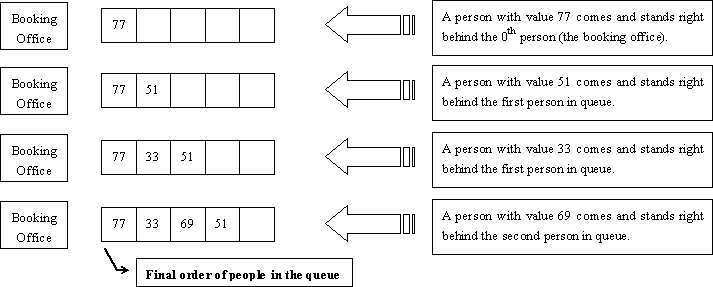
 #include<iostream>

 #include<stdio.h>

 #include<string.h>

 #define N 200010

 #define lson p << 1

 #define rson p << 1 | 1

 using namespace std;

 struct Nod

 {

     int l , r ;

     int va ; // Gap

 }node[N << ];

 int pos[N] , val[N] , ans[N] ;

 void build ( int l , int r , int p )

 {

     node[p].l = l ;

     node[p].r = r ;

     node[p].va = r - l +  ;

     if ( l == r)

         return ;

     int mid = ( l + r ) >>  ;

     build ( l , mid , lson ) ;

     build ( mid +  , r , rson ) ;

 }

 int update ( int ps , int p )

 {

     node[p].va-- ;   //Gap - 1 ;

     if ( node[p].l == node[p].r ) {

         return node[p].l ; //return the position of the insert

     }

     if ( node[lson].va >= ps ) {

         update ( ps , lson ) ;//when lson's Gap equal to or greater than the insertion location , inserted to the left

     }

     else {

         ps -= node[lson].va ;//when Gap on the left is less than the ps , insert the right side , the right of the insertion laction is

                                 // ps minus Gap on the left

         update ( ps , rson ) ;

     }

 }

 int main ()

 {

     //freopen ( "a.txt" , "r" , stdin ) ;

     int n ;

     while (~scanf ("%d" , &n ) ) {

         build (  , n ,  ) ;

         for ( int i =  ; i <= n ; i++ ) {

             scanf ("%d%d" , pos + i , val + i ) ;

         }

         for ( int i = n ; i >=  ; i-- ) {

             int id = update ( pos[i] +  ,  ) ;    // get the insert position

             ans[id] = val[i] ;  // in ans Array

         }

         for ( int i =  ; i < n ; i++ ) {

             printf ( "%d " , ans[i] ) ;

         }

         printf ( "%d\n" , ans[n] ) ;

     }

     return  ;

 }
倒推法
集训时大神介绍了一种能节省空间的写法:
 #include<iostream>

 #include<stdio.h>

 #include<string.h>

 #define N 200010

 #define lson o << 1 , l , mid

 #define rson o << 1 | 1 , mid + 1 , r

 using namespace std;

 int va[N << ] ; // Gap

 int pos[N] , val[N] , ans[N] ;

 void build (int o , int l , int r )

 {

     va[o] = r - l +  ;

     if ( l == r )

         return ;

     int mid = ( l + r ) >>  ;

     build ( lson ) ;

     build ( rson ) ;

 }

 int update ( int ps ,int o , int l , int r  )

 {

     va[o]-- ;   //Gap - 1 ;

     if ( l == r ) {

         return l ; //return the position of the insert

     }

     int mid = ( l + r ) >>  ;

     if ( va[o << ] >= ps ) {

         update ( ps , lson ) ;//when lson's Gap equal to or greater than the insertion location , inserted to the left

     }

     else {

         ps -= va[o << ] ;//when Gap on the left is less than the ps , insert the right side , the right of the insertion laction is

                                 // ps minus Gap on the left

         update ( ps , rson ) ;

     }

 }

 int main ()

 {

     //freopen ( "a.txt" , "r" , stdin ) ;

     int n ;

     while (~scanf ("%d" , &n ) ) {

         build (  ,  , n ) ;

         for ( int i =  ; i <= n ; i++ ) {

             scanf ("%d%d" , pos + i , val + i ) ;

         }

         for ( int i = n ; i >=  ; i-- ) {

             int id = update ( pos[i] +  ,  ,  , n ) ;    // get the insert position

             ans[id] = val[i] ;  // in ans Array

         }

         for ( int i =  ; i < n ; i++ ) {

             printf ( "%d " , ans[i] ) ;

         }

         printf ( "%d\n" , ans[n] ) ;

     }

     return  ;

 }
省了4000k
Buy Tickets(线段树)的更多相关文章
- [poj2828] Buy Tickets (线段树)
线段树 Description Railway tickets were difficult to buy around the Lunar New Year in China, so we must ...
- 【poj2828】Buy Tickets 线段树 插队问题
[poj2828]Buy Tickets Description Railway tickets were difficult to buy around the Lunar New Year in ...
- poj 2828 Buy Tickets (线段树(排队插入后输出序列))
http://poj.org/problem?id=2828 Buy Tickets Time Limit: 4000MS Memory Limit: 65536K Total Submissio ...
- POJ 2828 Buy Tickets 线段树 倒序插入 节点空位预留(思路巧妙)
Buy Tickets Time Limit: 4000MS Memory Limit: 65536K Total Submissions: 19725 Accepted: 9756 Desc ...
- Buy Tickets(线段树)
Buy Tickets Time Limit: 4000MS Memory Limit: 65536K Total Submissions: 16607 Accepted: 8275 Desc ...
- poj-----(2828)Buy Tickets(线段树单点更新)
Buy Tickets Time Limit: 4000MS Memory Limit: 65536K Total Submissions: 12930 Accepted: 6412 Desc ...
- POJ 2828 Buy Tickets (线段树 or 树状数组+二分)
题目链接:http://poj.org/problem?id=2828 题意就是给你n个人,然后每个人按顺序插队,问你最终的顺序是怎么样的. 反过来做就很容易了,从最后一个人开始推,最后一个人位置很容 ...
- poj2828 Buy Tickets (线段树 插队问题)
Buy Tickets Time Limit: 4000MS Memory Limit: 65536K Total Submissions: 22097 Accepted: 10834 Des ...
- POJ 2828 Buy Tickets | 线段树的喵用
题意: 给你n次插队操作,每次两个数,pos,w,意为在pos后插入一个权值为w的数; 最后输出1~n的权值 题解: 首先可以发现,最后一次插入的位置是准确的位置 所以这个就变成了若干个子问题, 所以 ...
- POJ 2828 Buy Tickets(线段树·插队)
题意 n个人排队 每一个人都有个属性值 依次输入n个pos[i] val[i] 表示第i个人直接插到当前第pos[i]个人后面 他的属性值为val[i] 要求最后依次输出队中各个人的属性 ...
随机推荐
- 用一个下午从零开始搭建一个基础lbs查询服务
背景 现在做一个sns如果没有附近的功能,那就是残缺的.网上也有很多现成的lbs服务,封装的很完整了. 我首先用了下百度lbs云,但是有点不适合自己的需要,因此考虑用mongodb建一个简单的lbs服 ...
- css3动画 bug
1. .myanimate{ transition-property: left;transition-duration: .3s;transition-timing-function: ease } ...
- Github上Python开发者应该关心的Repo
carbaugh/lice lice : Generate license files for your projects 一个用来为你的项目生成许可证的工具.这下可方便了,不用手工的去修改了! co ...
- [Aaronyang] 写给自己的WPF4.5 失传的第十本秘籍4[wpf使用FontAwesome,并送其他3招心法]
总有一个人他教会你成长,然后又独自离开--Aaronyang的博客(www.ayjs.net)-www.8mi.me =============时隔两年后再看WPF,有些秘籍不太适合公开,公开了就不值 ...
- 第二章:javascript: 数组
数组是编程世界里最常见的数据结构.任何一种编程语言都包含数组,只是形式稍微有差异.数组是编程语言中的内建类型,通常效率都很高.可以满足不同需求的数据存储,本章将探索javascript中的数组工作原理 ...
- Eclipse字体大小设置
打开Eclipse,在主界面下Window->Preferences->General->Appearance->Colors and Fonts, 然后在右边展开框Basic ...
- Qt学习思考
对各个部件基本了解,初步理解GUI应用程序的创建 2D图形文字绘制,3D图形(openGL)等 模型/视图框架编程,处理复杂的数据 多媒体框架 数据库,xml,文件读写等 网络编程 做出比较美观的界面 ...
- SQLHelper初实现---杨中科版(易懂,代码多点)
public class SQLHelper { //获取连接字符串,,引用Configurationl类库,并引用命名空间using System.Configuration; private st ...
- svn版本控制方案:多分支并行开发,多环境自动部署
背景 keywords:svn,trunk,branch,jenkins,maven,merge 两地同时开发一个产品,目前线上有3个环境:测试环境.预发布环境.生产环境.目前系统部署采用jenkin ...
- hihocoder #1034 毁灭者问题
传送门 时间限制:10000ms 单点时限:1000ms 内存限制:256MB 描述 在 Warcraft III 之冰封王座中,毁灭者是不死族打三本后期时的一个魔法飞行单位. 毁灭者的核心技能之一, ...