
【Static Program Analysis - Chapter 2】 代码的表征之控制流图
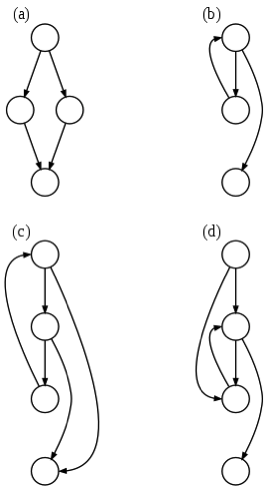
(a) an if-then-else
(b) a while loop
(c) a natural loop with two exits, e.g. while with an if...break in the middle; non-structured but reducible
(d) an irreducible CFG: a loop with two entry points, e.g. goto into a while or for loop
控制流图是代码的一种表征形式。
wiki:
Definition
In a control flow graph each node in the graph represents a basic block, i.e. a straight-line piece of code without any jumps or jump targets; jump targets start a block, and jumps end a block. Directed edges are used to represent jumps in the control flow. There are, in most presentations, two specially designated blocks: the entry block, through which control enters into the flow graph, and the exit block, through which all control flow leaves.[3]
Because of its construction procedure, in a CFG, every edge A→B has the property that:
The CFG can thus be obtained, at least conceptually, by starting from the program's (full) flow graph—i.e. the graph in which every node represents an individual instruction—and performing an edge contraction for every edge that falsifies the predicate above, i.e. contracting every edge whose source has a single exit and whose destination has a single entry. This contraction-based algorithm is of no practical importance, except as a visualization aid for understanding the CFG construction, because the CFG can be more efficiently constructed directly from the program by scanning it for basic blocks.[4]
Example
Consider the following fragment of code:
0: (A) t0 = read_num
1: (A) if t0 mod 2 == 0
2: (B) print t0 + " is even."
3: (B) goto 5
4: (C) print t0 + " is odd.” [jump targets]
5: (D) end program [jump targets]
In the above, we have 4 basic blocks:
A from 0 to 1, [entry block]
B from 2 to 3,
C at 4,
D at 5. [exit block]
A graph for this fragment has edges from A to B, A to C, B to D and C to D.
Reachability
Reachability is a graph property useful in optimization.
If a subgraph is not connected from the subgraph containing the entry block, that subgraph is unreachable during any execution, and so is unreachable code; under normal conditions it can be safely removed.
If the exit block is unreachable from the entry block, an infinite loop may exist. Not all infinite loops are detectable, see Halting problem. A halting order may also exist there.
Unreachable code and infinite loops are possible even if the programmer does not explicitly code them: optimizations like constant propagation and constant folding followed by jump threading can collapse multiple basic blocks into one, cause edges to be removed from a CFG, etc., thus possibly disconnecting parts of the graph.
Domination relationship
A block M dominates a block N if every path from the entry that reaches block N has to pass through block M. The entry block dominates all blocks.
In the reverse direction, block M postdominates block N if every path from N to the exit has to pass through block M. The exit block postdominates all blocks.
It is said that a block M immediately dominates block N if M dominates N, and there is no intervening block P such that M dominates P and P dominates N. In other words, M is the last dominator on all paths from entry to N. Each block has a unique immediate dominator.
Similarly, there is a notion of immediate postdominator, analogous to immediate dominator.
The dominator tree is an ancillary data structure depicting the dominator relationships. There is an arc from Block M to Block N if M is an immediate dominator of N. This graph is a tree, since each block has a unique immediate dominator. This tree is rooted at the entry block. The dominator tree can be calculated efficiently using Lengauer–Tarjan's algorithm.
A postdominator tree is analogous to the dominator tree. This tree is rooted at the exit block.
Special edges
A back edge is an edge that points to a block that has already been met during a depth-first (DFS) traversal of the graph. Back edges are typical of loops.
A critical edge is an edge which is neither the only edge leaving its source block, nor the only edge entering its destination block. These edges must be split: a new block must be created in the middle of the edge, in order to insert computations on the edge without affecting any other edges.
An abnormal edge is an edge whose destination is unknown. Exception handling constructs can produce them. These edges tend to inhibit optimization.
An impossible edge (also known as a fake edge) is an edge which has been added to the graph solely to preserve the property that the exit block postdominates all blocks. It cannot ever be traversed.
Loop management
A loop header (sometimes called the entry point of the loop) is a dominator that is the target of a loop-forming back edge. The loop header dominates all blocks in the loop body. A block may be a loop header for more than one loop. A loop may have multiple entry points, in which case it has no "loop header".
Suppose block M is a dominator with several incoming edges, some of them being back edges (so M is a loop header). It is advantageous to several optimization passes to break M up into two blocks Mpre and Mloop. The contents of M and back edges are moved to Mloop, the rest of the edges are moved to point into Mpre, and a new edge from Mpre to Mloop is inserted (so that Mpre is the immediate dominator of Mloop). In the beginning, Mpre would be empty, but passes like loop-invariant code motion could populate it. Mpre is called the loop pre-header, and Mloop would be the loop header.
【Static Program Analysis - Chapter 2】 代码的表征之控制流图的更多相关文章
- 【Static Program Analysis - Chapter 2】 代码的表征之抽象语法树
抽象语法树:AbstractSyntaxTrees 定义(wiki): 在计算机科学中,抽象语法树(abstract syntax tree或者缩写为AST),或者语法树(syntax tree),是 ...
- 【Static Program Analysis - Chapter 4】格理论(Lattice Theory)与程序分析
# 从一个例子说起, **任务:给定这样一段代码,假设我们想分析出这段代码中,每个数值型变量和表达式的符号,即正数,负数或0.** 此外,还有可能出现两种情况就是: 1.我们无法分析出结果,即我们无法 ...
- 【Static Program Analysis - Chapter 3】Type Analysis
类型分析,个人理解就是(通过静态分析技术)分析出代码中,哪些地方只能是某种或某几种数据类型,这是一种约束. 例如,给定一个程序: 其中,我们可以很直接地得到一些约束: 最后,经过简化可以得到: 对 ...
- 【Static Program Analysis - Chapter 1】 Introduction
Regarding correctness, programmers routinely use testing to gain confidence that their programs work ...
- The Ultimate List of Open Source Static Code Analysis Security Tools
https://www.checkmarx.com/2014/11/13/the-ultimate-list-of-open-source-static-code-analysis-security- ...
- Top 40 Static Code Analysis Tools
https://www.softwaretestinghelp.com/tools/top-40-static-code-analysis-tools/ In this article, I have ...
- 静态时序分析(static timing analysis)
静态时序分析(static timing analysis,STA)会检测所有可能的路径来查找设计中是否存在时序违规(timing violation).但STA只会去分析合适的时序,而不去管逻辑操作 ...
- static timing analysis 基础
此博文依据 特权同学在电子发烧友上的讲座PPT进行整理而成. static timing analysis 静态时序分析基础 过约束:有不必要的约束,或者是约束不能再某一情况下满足.——约束过头了 ...
- Soot生成代码控制流图
Soot可以对代码进行分析,提供了多种字节码分析和变换功能,通过它可以进行过程内和过程间的分析优化,以及程序流图的生成,还能通过图形化的方式输出. http://www.brics.dk/SootGu ...
随机推荐
- “百度杯”CTF比赛 九月场---123
右键查看源代码 然后构造user.php,显示空白,源码也是空白,既然上边说用户名,密码了,参考大佬的博客,放文件user.php.bak这是备份文件,一打开上边全是用户名,有戏,爆破 添加字典,也就 ...
- flask内容学习第三天(flak中的csrf跨站请求)
问题一:什么是csrf? 英文全称Cross Site Request Forgery(跨站请求伪造): 通俗来讲就是攻击者盗用你的身份,冒用你的名义发出恶意请求,包括发送邮件,电话信息,甚至于转账或 ...
- JS_高阶函数(filter)
//2017/7/18 //高阶函数:filter. //filter也是一个常用的操作,它用于把Array的某些元素过滤掉,然后返回剩下的元素.和map()类似,Array的filter()也接收一 ...
- Hibernate(6)关联关系_单向n对1
1.单向 n-1 关联只需从 n 的一端可以访问 1 的一端 2.实体类 n端:Order.java public class Order { private Integer orderId; pri ...
- sort函数比较cmp写法
hihocoder1566http://hihocoder.com/problemset/problem/1566 一直WA因为cmp的写法写错了,未能正确实现排序功能. #include<io ...
- flink 有状态udf 引起血案一
版权声明:本文为博主原创文章,未经博主同意不得转载. https://blog.csdn.net/rlnLo2pNEfx9c/article/details/83422587 场景 近期在做一个画像的 ...
- Linux 添加开机启动项的两种方法
1.编辑文件 /etc/rc.localvim /etc/rc.local #!/bin/sh## This script will be executed *after* all the oth ...
- Docker Mysql数据库主从同步配置方法
一.背景 最近在做内部平台架构上的部署调整,顺便玩了一下数据库的主从同步,特此记录一下操作- 二.具体操作 1.先建立数据存放目录(-/test/mysql_test/) --mysql --mast ...
- (原)caffe中的conv
转载请注明出处: https://www.cnblogs.com/darkknightzh/p/10486686.html conv总体调用流程如下图所示: 说明:带o的为输出,如Wo代表输出宽度:带 ...
- sqlite3常用技巧
数据库是一种工具,在合理的条件下使用数据库可以获得许多益处. 使用SQL语句可以完成复杂的统计,可以少写许多复杂逻辑 使用数据库无需担心内存溢出问题 原来可能需要许多文件来保存,现在只需要一个sqli ...