
Entity Framework Code-First(12):Configure One-to-Many
Configure One-to-Many Relationship:
Here, we will learn how to configure One-to-Many relationship between two entities in code-first. Take an example of Student and Standard (grade) entities where one Standard can include many Students. So the relation between Student and Standard entities would be one-to-many.
Visit Entity Relationship section to understand how EF manages one-to-one, one-to-many, and many-to-many relationships between the entities.
Configure One-to-Many relationship using DataAnnotations:
Consider the following Student and Standard entity.
public class Student

{

    public Student() { }

    public int StudentId { get; set; }

    public string StudentName { get; set; }

    public virtual Standard Standard { get; set; }

}

public class Standard

{

    public Standard()

    {

        Students = new List<Student>();

    }

    public int StandardId { get; set; }

    public string Description { get; set; }

    public virtual ICollection<Student> Students { get; set; }

}
In the above example, Student entity includes navigation property Standard and Standard entity includes collection property for Student. This is the default convention to form one-to-many relationship.
We do not need to configure for one-to-many relationships either using DataAnnotations or Fluent API, if entity classes follow this convention.
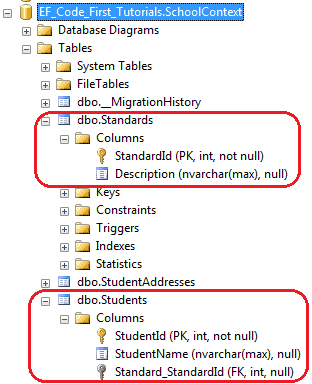
EF code-first would create one-to-many relationship by adding Standard_StandardId column in the student table as shown below.
Entity includes ForeignKey Id property:
It is recommended to include foreign key property in an entity class. For example, if Student entity includes StandardId property which automatically becomes foreignkey property because it follows the convention for foreignkey <Type Name>Id.
If foreignkey property name is not as per the convention, for example, Student entity uses different name of foreignkey for Standard entity than StandardId then we need to apply ForeignKey attribute on a property.
For example, the following Student entity includes StandardRefId property.
public class Student

{

    public Student() { }

    public int StudentId { get; set; }

    public string StudentName { get; set; }

        public int StdandardRefId { get; set; }

    [ForeignKey("StandardRefId")]

    public virtual Standard Standard { get; set; }

}

public class Standard

{

    public Standard()

    {

        StudentsList = new List<Student>();

    }

    public int StandardId { get; set; }

    public string Description { get; set; }

    public virtual ICollection<Student> Students { get; set; }

}
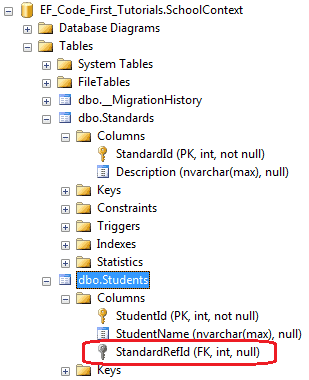
In the above example, ForeignKey attribute is applied on Standard navigation property to specify foreignkey property name for Standard property. So now, EF will create StandardRefId column as a FK as shown below.
Configure One-to-Many relationship using Fluent API:
Here, we will learn configure One-to-Many relationship between Student and Standard entities using Fluent API.
Let’s configure one-to-many for following Student and Standard entities.
public class Student

{

    public Student(){ }

    public int StudentId { get; set; }

    public string StudentName { get; set; }

    public int StandardId { get; set; }

    public virtual Standard Standard { get; set; }

}

public class Standard

{

    public Standard()

    {

        StudentsList = new List<Student>();

    }

    public int StandardId { get; set; }

    public string Description { get; set; }

    public virtual ICollection<Student> Students { get; set; }

}
Now, you can configure one-to-many as shown below.
protected override void OnModelCreating(DbModelBuilder modelBuilder)

{

        //one-to-many

        modelBuilder.Entity<Student>()

                    .HasRequired<Standard>(s => s.Standard) // Student entity requires Standard

                    .WithMany(s => s.Students); // Standard entity includes many Students entities

}
Suppose Student and Standard entity class doesn't follow Code-First conventions for foreign key. Student class will include a different foreign key name for Standard than StandardId.
public class Student

{

    public Student(){ }

    public int StudentId { get; set; }

    public string StudentName { get; set; }

    //StdId is not following code first conventions name

    public int StdId { get; set; }

    public virtual Standard Standard { get; set; }

}

public class Standard

{

    public Standard()

    {

        StudentsList = new List<Student>();

    }

    public int StandardId { get; set; }

    public string Description { get; set; }

    public virtual ICollection<Student> Students { get; set; }

}
So now, you can use Fluent API to configure a One-to-Many relationship using Student entity classes, as shown below.
protected override void OnModelCreating(DbModelBuilder modelBuilder)

{

        //one-to-many

        modelBuilder.Entity<Student>()

                    .HasRequired<Standard>(s => s.Standard)

                    .WithMany(s => s.Students)

                    .HasForeignKey(s => s.StdId);

}
As you can see, modelBuilder.Entity<Student>().HasRequired<Standard>(s => s.Standard) specifies that Student entity requires NotNull Standard navigation property. .WithMany(s => s.Students).HasForeignKey(s => s.StdId) specifies that the other side of Student (means Standard entity ) can include many Students in Students collection property and foreign key is StdId.
Another possible way: We can also start with Standard entity.
protected override void OnModelCreating(DbModelBuilder modelBuilder)

{

        //configure one-to-many

        modelBuilder.Entity<Standard>()

                    .HasMany<Student>(s => s.Students) Standard has many Students

                    .WithRequired(s => s.Standard)  Student require one Standard

                    .HasForeignKey(s => s.StdId);Student includes specified foreignkey property name for Standard

}
The code shown above will create the following database:
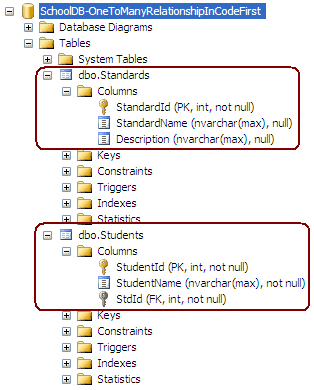
Notice that StdId is Not Null column. So you must assign Standard with Student entity every time you add or update Student.
Nullable foreign key for one-to-many relationship.
Use HasOptional method instead of HasRequired method to make foreign key column nullable.
protected override void OnModelCreating(DbModelBuilder modelBuilder)

{

        //one-to-many

        modelBuilder.Entity<Student>()

                    .HasOptional<Standard>(s => s.Standard)

                    .WithMany(s => s.Students)

                    .HasForeignKey(s => s.StdId);

}
Learn how to configure many-to-many relationship in the next section.
Entity Framework Code-First(12):Configure One-to-Many的更多相关文章
- Entity Framework Tutorial Basics(12):Model First
Model First development with Entity Framework: In the Model First approach, you create Entities, rel ...
- Entity Framework Code first(转载)
一.Entity Framework Code first(代码优先)使用过程 1.1Entity Framework 代码优先简介 不得不提Entity Framework Code First这个 ...
- Entity Framework Code First (三)Data Annotations
Entity Framework Code First 利用一种被称为约定(Conventions)优于配置(Configuration)的编程模式允许你使用自己的 domain classes 来表 ...
- Entity Framework Code First (二)Custom Conventions
---------------------------------------------------------------------------------------------------- ...
- Entity Framework Code First (一)Conventions
Entity Framework 简言之就是一个ORM(Object-Relational Mapper)框架. Code First 使得你能够通过C#的类来描述一个模型,模型如何被发现/检测就是通 ...
- Entity Framework Tutorial Basics(11):Code First
Code First development with Entity Framework: Entity Framework supports three different development ...
- Entity Framework Code First (七)空间数据类型 Spatial Data Types
声明:本文针对 EF5+, Visual Studio 2012+ 空间数据类型(Spatial Data Types)是在 EF5 中引入的,空间数据类型表现有两种: Geography (地理学上 ...
- Entity Framework Code First (四)Fluent API - 配置属性/类型
上篇博文说过当我们定义的类不能遵循约定(Conventions)的时候,Code First 提供了两种方式来配置你的类:DataAnnotations 和 Fluent API, 本文将关注 Flu ...
- Entity Framework Code First (八)迁移 Migrations
创建初始模型和数据库 在开始使用迁移(Migrations)之前,我们需要一个 Project 和一个 Code First Model, 对于本文将使用典型的 Blog 和 Post 模型 创建一个 ...
- Entity Framework Code First (六)存储过程
声明:本文只针对 EF6+ 默认情况下,Code First 对实体进行插入.更新.删除操作是直接在表上进行的,从 EF6 开始你可以选择使用存储过程(Stored Procedures) 简单实体映 ...
随机推荐
- debian下使用ft232为stm32f429i-discovery烧写uboot和uImage
操作系统:debian 软件: openocd minicom 硬件: MiniUSB线.stm32f429i-discovery, WaveShare FT232串口模块(可以在淘宝上买到) 关 ...
- Luogu-4410 [HNOI2009]无归岛
裸的仙人掌最大独立子集,结果一个zz的错误让我调了好久... \(-inf\)开始设为\(0x7fffffff\)结果\(A_i\)有负数一加就炸了 #include<cstdio> #i ...
- perl常用字符串函数
1.$position = index(string,substring,skipchars): 该函数返回子串substring在字符串string中的位置,如果不存在,则返回-1:参数skipch ...
- Oracle的PL_SQL的异常处理
--什么是异常 --异常是在PL/SQL运行过程中有可能出现的错误. --执行异常的语句 exception when [异常] when --异常输出信息. --Oracle的预定义异常 CASE_ ...
- ubantu16.04
http://mirror.pnl.gov/releases/xenial/ ubuntu16.04下载地址: 中科大源 http://mirrors.ustc.edu.cn/ubuntu ...
- BZOJ 2002 [Hnoi2010]Bounce 弹飞绵羊:分块
题目链接:http://www.lydsy.com/JudgeOnline/problem.php?id=2002 题意: 某天,Lostmonkey发明了一种超级弹力装置,为了在他的绵羊朋友面前显摆 ...
- python3全方位教程
http://www.runoob.com/python3/python3-tutorial.html http://www.runoob.com/
- 【Educational Codeforces Round 38】D. Buy a Ticket 堆优化Dijkstra
题意 给定一张无向图,对每个点$i\in S$求$\min_{j\in S} {2\times d(i,j)+a_j}$ 考虑多源多汇最短路会超时,换个角度考虑每个$j$,如果$j=i$,那么答案为$ ...
- Chrome focus样式
-webkit-box-shadow: 0 0 0 1000px #131313 inset;//获取焦点时候可以去除背景色 -webkit-text-fill-color: #fff;//字体颜色
- JS性能之setTimeout与clearTimeout
测试环境: chrome浏览器 结论: 1 一个页面用setTimeout越多,该页面消耗的内存就会越多,几乎成正比. 2 在'startCount(1000000);-->100万'情况下,不 ...