
算法Sedgewick第四版-第1章基础-2.1Elementary Sortss-001选择排序法(Selection sort)
一、介绍
1.算法的时间和空间间复杂度

2.特点
Running time is insensitive to input. The process of finding the smallest item on one
pass through the array does not give much information about where the smallest item
might be on the next pass. This property can be disadvantageous in some situations.
For example, the person using the sort client might be surprised to realize that it takes
about as long to run selection sort for an array that is already in order or for an array
with all keys equal as it does for a randomly-ordered array! As we shall see, other algo-
rithms are better able to take advantage of initial order in the input.
Data movement is minimal. Each of the N exchanges changes the value of two array
entries, so selection sort uses N exchanges—the number of array accesses is a linear
function of the array size. None of the other sorting algorithms that we consider have
this property (most involve linearithmic or quadratic growth).
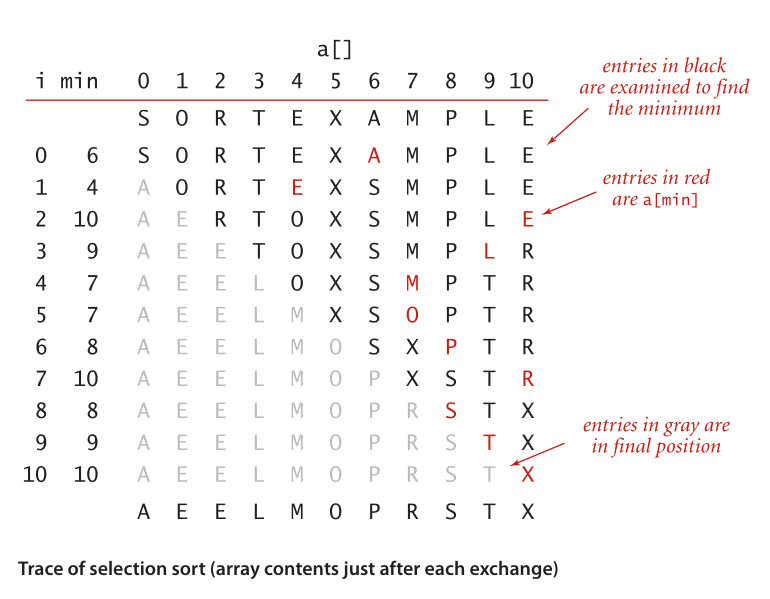
3.过程
二、代码
 package algorithms.elementary21;

 /******************************************************************************

  *  Compilation:  javac Selection.java

  *  Execution:    java  Selection < input.txt

  *  Dependencies: StdOut.java StdIn.java

  *  Data files:   http://algs4.cs.princeton.edu/21sort/tiny.txt

  *                http://algs4.cs.princeton.edu/21sort/words3.txt

  *

  *  Sorts a sequence of strings from standard input using selection sort.

  *

  *  % more tiny.txt

  *  S O R T E X A M P L E

  *

  *  % java Selection < tiny.txt

  *  A E E L M O P R S T X                 [ one string per line ]

  *

  *  % more words3.txt

  *  bed bug dad yes zoo ... all bad yet

  *

  *  % java Selection < words3.txt

  *  all bad bed bug dad ... yes yet zoo    [ one string per line ]

  *

  ******************************************************************************/

 import java.util.Comparator;

 import algorithms.util.StdIn;

 import algorithms.util.StdOut;

 /**

  *  The <tt>Selection</tt> class provides static methods for sorting an

  *  array using selection sort.

  *  <p>

  *  For additional documentation, see <a href="http://algs4.cs.princeton.edu/21elementary">Section 2.1</a> of

  *  <i>Algorithms, 4th Edition</i> by Robert Sedgewick and Kevin Wayne.

  *

  *  @author Robert Sedgewick

  *  @author Kevin Wayne

  */

 public class Selection {

     // This class should not be instantiated.

     private Selection() { }

     /**

      * Rearranges the array in ascending order, using the natural order.

      * @param a the array to be sorted

      */

     public static void sort(Comparable[] a) {

         int N = a.length;

         for (int i = 0; i < N; i++) {

             int min = i;

             for (int j = i+1; j < N; j++) {

                 if (less(a[j], a[min])) min = j;

             }

             exch(a, i, min);

             assert isSorted(a, 0, i);

         }

         assert isSorted(a);

     }

     /**

      * Rearranges the array in ascending order, using a comparator.

      * @param a the array

      * @param c the comparator specifying the order

      */

     public static void sort(Object[] a, Comparator c) {

         int N = a.length;

         for (int i = 0; i < N; i++) {

             int min = i;

             for (int j = i+1; j < N; j++) {

                 if (less(c, a[j], a[min])) min = j;

             }

             exch(a, i, min);

             assert isSorted(a, c, 0, i);

         }

         assert isSorted(a, c);

     }

    /***************************************************************************

     *  Helper sorting functions.

     ***************************************************************************/

     // is v < w ?

     private static boolean less(Comparable v, Comparable w) {

         return v.compareTo(w) < 0;

     }

     // is v < w ?

     private static boolean less(Comparator c, Object v, Object w) {

         return c.compare(v, w) < 0;

     }

     // exchange a[i] and a[j]

     private static void exch(Object[] a, int i, int j) {

         Object swap = a[i];

         a[i] = a[j];

         a[j] = swap;

     }

    /***************************************************************************

     *  Check if array is sorted - useful for debugging.

     ***************************************************************************/

     // is the array a[] sorted?

     private static boolean isSorted(Comparable[] a) {

         return isSorted(a, 0, a.length - 1);

     }

     // is the array sorted from a[lo] to a[hi]

     private static boolean isSorted(Comparable[] a, int lo, int hi) {

         for (int i = lo + 1; i <= hi; i++)

             if (less(a[i], a[i-1])) return false;

         return true;

     }

     // is the array a[] sorted?

     private static boolean isSorted(Object[] a, Comparator c) {

         return isSorted(a, c, 0, a.length - 1);

     }

     // is the array sorted from a[lo] to a[hi]

     private static boolean isSorted(Object[] a, Comparator c, int lo, int hi) {

         for (int i = lo + 1; i <= hi; i++)

             if (less(c, a[i], a[i-1])) return false;

         return true;

     }

     // print array to standard output

     private static void show(Comparable[] a) {

         for (int i = 0; i < a.length; i++) {

             StdOut.println(a[i]);

         }

     }

     /**

      * Reads in a sequence of strings from standard input; selection sorts them;

      * and prints them to standard output in ascending order.

      */

     public static void main(String[] args) {

         String[] a = StdIn.readAllStrings();

         Selection.sort(a);

         show(a);

     }

 }
算法Sedgewick第四版-第1章基础-2.1Elementary Sortss-001选择排序法(Selection sort)的更多相关文章
- 算法Sedgewick第四版-第1章基础-2.1Elementary Sortss-007归并排序(自下而上)
一. 1. 2. 3. 二.代码 package algorithms.mergesort22; import algorithms.util.StdIn; import algorithms.uti ...
- 算法Sedgewick第四版-第1章基础-2.1Elementary Sortss-006归并排序(Mergesort)
一. 1.特点 (1)merge-sort : to sort an array, divide it into two halves, sort the two halves (recursivel ...
- 算法Sedgewick第四版-第1章基础-2.1Elementary Sortss-005插入排序的改进版
package algorithms.elementary21; import algorithms.util.StdIn; import algorithms.util.StdOut; /***** ...
- 算法Sedgewick第四版-第1章基础-2.1Elementary Sortss-004希尔排序法(Shell Sort)
一.介绍 1.希尔排序的思路:希尔排序是插入排序的改进.当输入的数据,顺序是很乱时,插入排序会产生大量的交换元素的操作,比如array[n]的最小的元素在最后,则要经过n-1次交换才能排到第一位,因为 ...
- 算法Sedgewick第四版-第1章基础-2.1Elementary Sortss-002插入排序法(Insertion sort)
一.介绍 1.时间和空间复杂度 运行过程 2.特点: (1)对于已排序或接近排好的数据,速度很快 (2)对于部分排好序的输入,速度快 二.代码 package algorithms.elementar ...
- 算法Sedgewick第四版-第1章基础-2.1Elementary Sortss-008排序算法的复杂度(比较次数的上下限)
一. 1. 2.
- 算法Sedgewick第四版-第1章基础-2.1Elementary Sortss-003比较算法及算法的可视化
一.介绍 1. 2. 二.代码 1. package algorithms.elementary21; /*********************************************** ...
- 算法Sedgewick第四版-第1章基础-001递归
一. 方法可以调用自己(如果你对递归概念感到奇怪,请完成练习 1.1.16 到练习 1.1.22).例如,下面给出了 BinarySearch 的 rank() 方法的另一种实现.我们会经常使用递归, ...
- 算法Sedgewick第四版-第1章基础-1.3Bags, Queues, and Stacks-001可变在小的
1. package algorithms.stacks13; /******************************************************************* ...
随机推荐
- Spring_总结_03_装配Bean(四)_导入与混合配置
一.前言 本文承接上一节:Spring_总结_03_装配Bean(三)之XML配置 在典型的Spring应用中,我们可能会同时使用自动化和显示配置.同时,可能在某些场景下我们需要混合使用JavaCon ...
- Leetcode 904. Fruit Into Baskets
sliding window(滑动窗口)算法 class Solution(object): def totalFruit(self, tree): """ :type ...
- Linux命令学习(20):traceroute命令
版权声明 更新:2017-06-13博主:LuckyAlan联系:liuwenvip163@163.com声明:吃水不忘挖井人,转载请注明出处! 1 文章介绍 本文介绍了Linux下面的mv命令. 2 ...
- Angular 隨記
Windows下更新Node 和NPM方法 管理員模式打開powershell 執行以下命令: Set-ExecutionPolicy Unrestricted -Scope CurrentUser ...
- 聊聊“现在学习MFC有用吗?”
我用MFC做了4年多,后来转到WPF也做了快5年.对于二者,不敢说精通,但应该算入门.结合自己经历,如果不考虑项目需求,我认为新手学习WPF或许更好点.有3点: 1)大家都知道最近几年Motorola ...
- Linux网络编程——I/O复用之poll函数
一.回顾前面的select select优点: 目前几乎在所有的平台上支持,其良好跨平台支持也是它的一个优点 select缺点: 1.每次调用 select(),都需要把 fd 集合从用户态拷贝到内核 ...
- Linux评估 CPU使用情况
评价参数 1)CPU utilization:最直观最重要的就是CPU的使用率.如果长期超过80%,则表明CPU遇到了瓶颈:2)User time: 用户进程使用的CPU:该数值越高越好,表明越多的C ...
- 一些js和JQuery的方法
取值填值: js: get-- innerText, innerHTML, value; set-- innerText=?, innerHTML=?, value=?; JQuery: get-- ...
- AngularJS:表单
ylbtech-AngularJS:表单 1.返回顶部 1. AngularJS 表单 AngularJS 表单是输入控件的集合. HTML 控件 以下 HTML input 元素被称为 HTML 控 ...
- net.sf.json.JSONObject 和org.json.JSONObject
参考 net.sf.json.JSONObject 和org.json.JSONObject 的差别