
算法Sedgewick第四版-第1章基础-2.1Elementary Sortss-006归并排序(Mergesort)
一、
1.特点
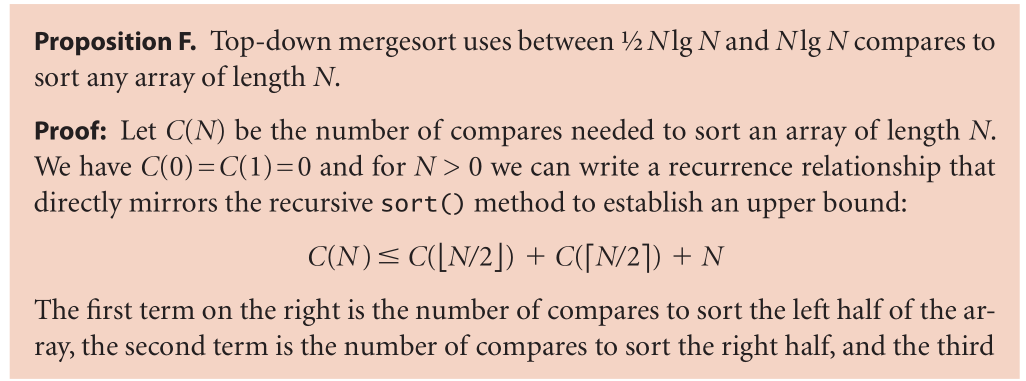
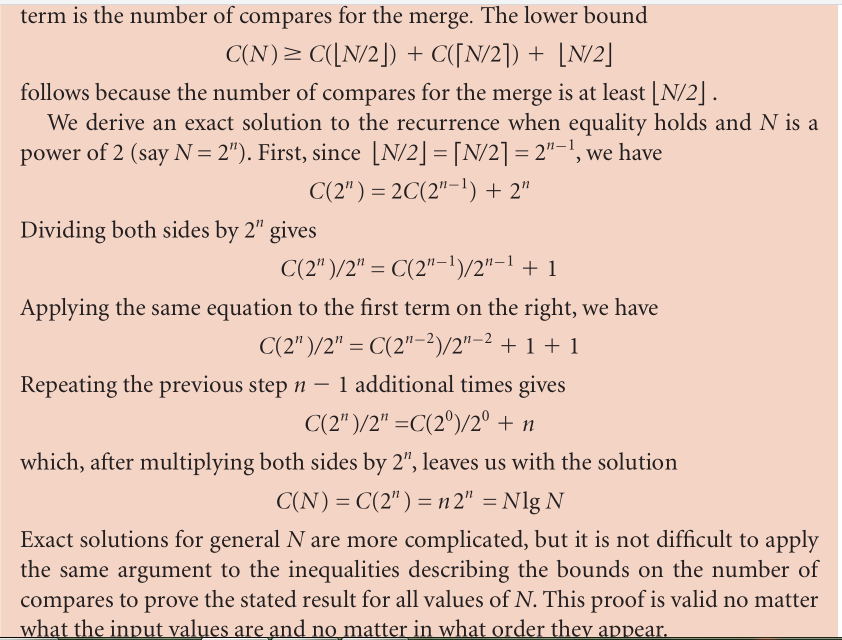
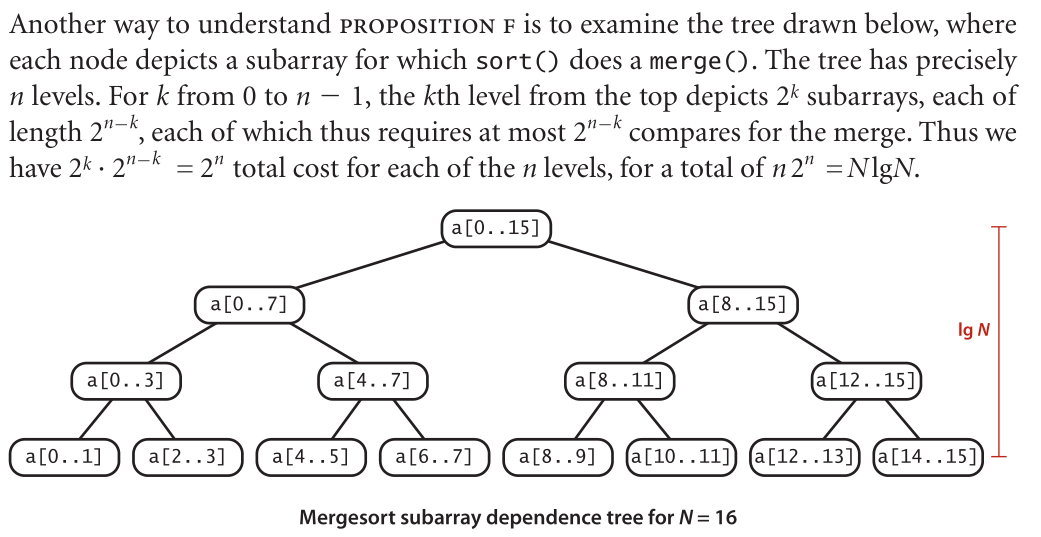
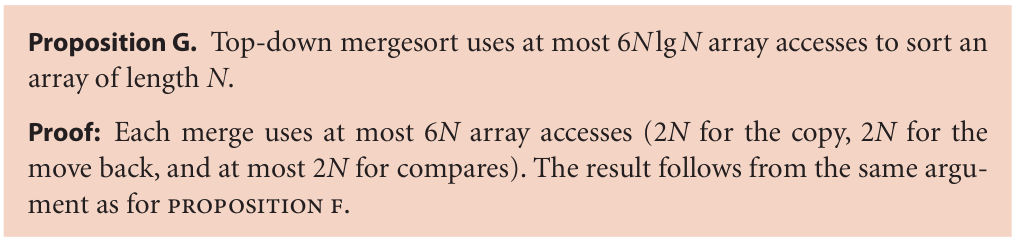
(1)merge-sort : to sort an array, divide it into two halves, sort the two halves (recursively), and then merge the results. As you will see, one of mergesort’s most attractive properties is that it guarantees to sort any array of N items in time proportional to N log N. Its prime disadvantage is that it uses extra space proportional to N.
(2)
(3)
(4)
(5)
2.缺点
■ Mergesort is not optimal with respect to space usage.
■ The worst case may not be likely in practice.
■ Operations other than compares (such as array accesses) may be important.
■ One can sort certain data without using any compares.
Thus, we shall be considering several other sorting methods in this book.
3.介绍
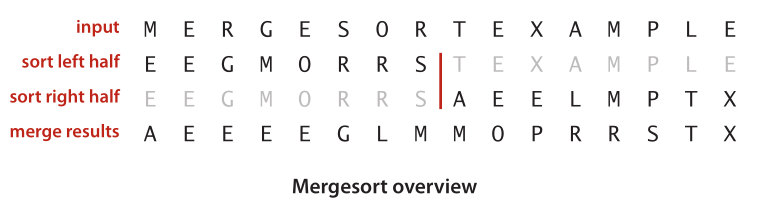
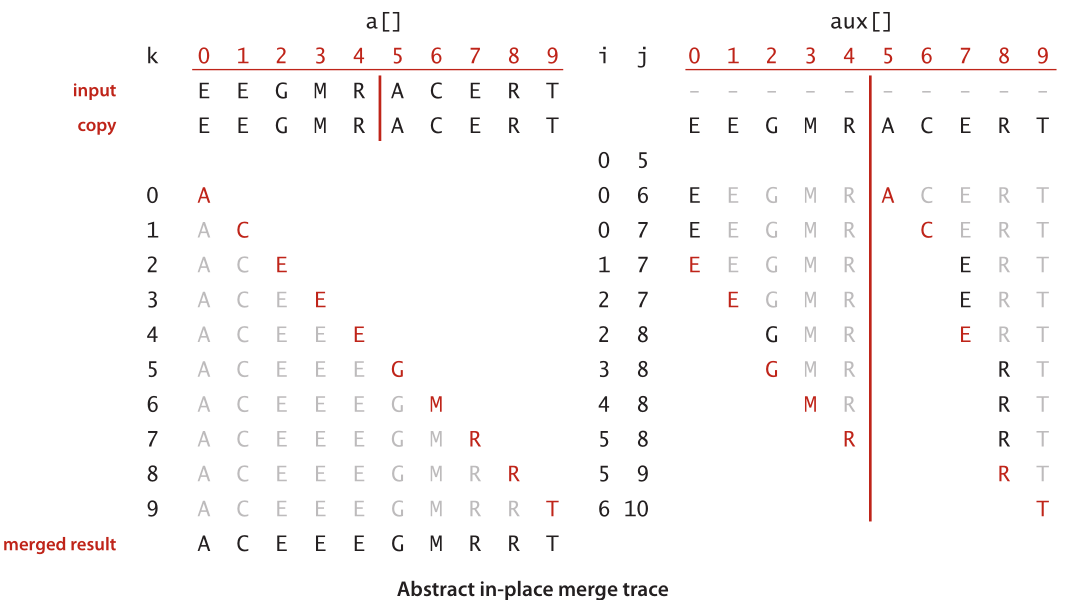
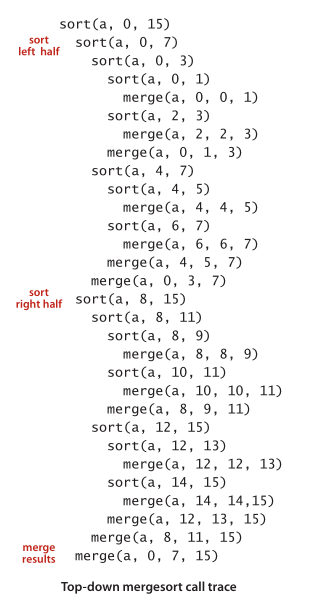
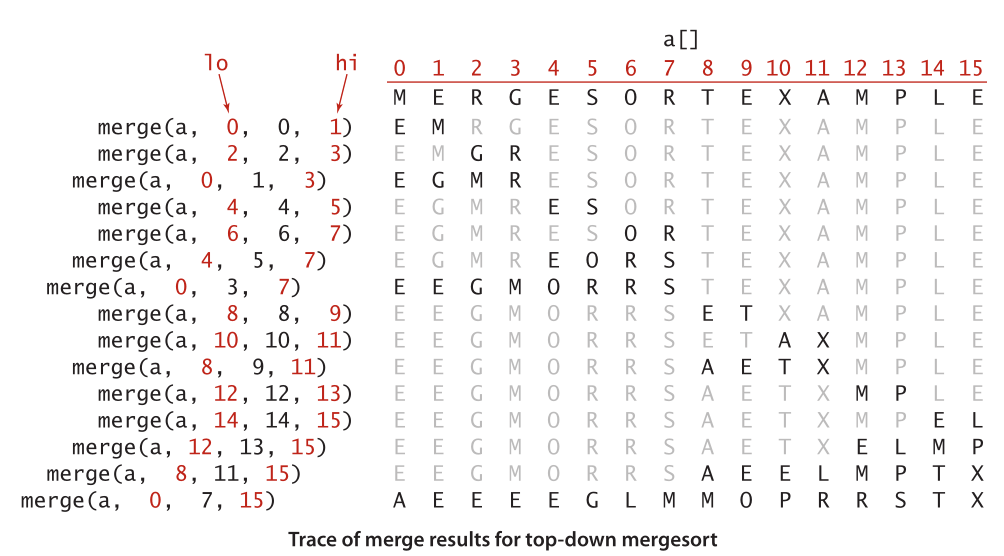
二、
1.代码
 package algorithms.mergesort22;

 import algorithms.util.StdIn;

 import algorithms.util.StdOut;

 /******************************************************************************

  *  Compilation:  javac Merge.java

  *  Execution:    java Merge < input.txt

  *  Dependencies: StdOut.java StdIn.java

  *  Data files:   http://algs4.cs.princeton.edu/22mergesort/tiny.txt

  *                http://algs4.cs.princeton.edu/22mergesort/words3.txt

  *

  *  Sorts a sequence of strings from standard input using mergesort.

  *

  *  % more tiny.txt

  *  S O R T E X A M P L E

  *

  *  % java Merge < tiny.txt

  *  A E E L M O P R S T X                 [ one string per line ]

  *

  *  % more words3.txt

  *  bed bug dad yes zoo ... all bad yet

  *

  *  % java Merge < words3.txt

  *  all bad bed bug dad ... yes yet zoo    [ one string per line ]

  *

  ******************************************************************************/

 /**

  *  The <tt>Merge</tt> class provides static methods for sorting an

  *  array using mergesort.

  *  <p>

  *  For additional documentation, see <a href="http://algs4.cs.princeton.edu/22mergesort">Section 2.2</a> of

  *  <i>Algorithms, 4th Edition</i> by Robert Sedgewick and Kevin Wayne.

  *  For an optimized version, see {@link MergeX}.

  *

  *  @author Robert Sedgewick

  *  @author Kevin Wayne

  */

 public class Merge {

     // This class should not be instantiated.

     private Merge() { }

     // stably merge a[lo .. mid] with a[mid+1 ..hi] using aux[lo .. hi]

     private static void merge(Comparable[] a, Comparable[] aux, int lo, int mid, int hi) {

         // precondition: a[lo .. mid] and a[mid+1 .. hi] are sorted subarrays

         assert isSorted(a, lo, mid);

         assert isSorted(a, mid+1, hi);

         // copy to aux[]

         for (int k = lo; k <= hi; k++) {

             aux[k] = a[k];

         }

         // merge back to a[]

         int i = lo, j = mid+1;

         for (int k = lo; k <= hi; k++) {

             if      (i > mid)              a[k] = aux[j++];

             else if (j > hi)               a[k] = aux[i++];

             else if (less(aux[j], aux[i])) a[k] = aux[j++];

             else                           a[k] = aux[i++];

         }

         // postcondition: a[lo .. hi] is sorted

         assert isSorted(a, lo, hi);

     }

     // mergesort a[lo..hi] using auxiliary array aux[lo..hi]

     private static void sort(Comparable[] a, Comparable[] aux, int lo, int hi) {

         if (hi <= lo) return;

         int mid = lo + (hi - lo) / 2;

         sort(a, aux, lo, mid);

         sort(a, aux, mid + 1, hi);

         merge(a, aux, lo, mid, hi);

     }

     /**

      * Rearranges the array in ascending order, using the natural order.

      * @param a the array to be sorted

      */

     public static void sort(Comparable[] a) {

         Comparable[] aux = new Comparable[a.length];

         sort(a, aux, 0, a.length-1);

         assert isSorted(a);

     }

    /***************************************************************************

     *  Helper sorting functions.

     ***************************************************************************/

     // is v < w ?

     private static boolean less(Comparable v, Comparable w) {

         return v.compareTo(w) < 0;

     }

     // exchange a[i] and a[j]

     private static void exch(Object[] a, int i, int j) {

         Object swap = a[i];

         a[i] = a[j];

         a[j] = swap;

     }

    /***************************************************************************

     *  Check if array is sorted - useful for debugging.

     ***************************************************************************/

     private static boolean isSorted(Comparable[] a) {

         return isSorted(a, 0, a.length - 1);

     }

     private static boolean isSorted(Comparable[] a, int lo, int hi) {

         for (int i = lo + 1; i <= hi; i++)

             if (less(a[i], a[i-1])) return false;

         return true;

     }

    /***************************************************************************

     *  Index mergesort.

     ***************************************************************************/

     // stably merge a[lo .. mid] with a[mid+1 .. hi] using aux[lo .. hi]

     private static void merge(Comparable[] a, int[] index, int[] aux, int lo, int mid, int hi) {

         // copy to aux[]

         for (int k = lo; k <= hi; k++) {

             aux[k] = index[k];

         }

         // merge back to a[]

         int i = lo, j = mid+1;

         for (int k = lo; k <= hi; k++) {

             if      (i > mid)                    index[k] = aux[j++];

             else if (j > hi)                     index[k] = aux[i++];

             else if (less(a[aux[j]], a[aux[i]])) index[k] = aux[j++];

             else                                 index[k] = aux[i++];

         }

     }

     /**

      * Returns a permutation that gives the elements in the array in ascending order.

      * @param a the array

      * @return a permutation <tt>p[]</tt> such that <tt>a[p[0]]</tt>, <tt>a[p[1]]</tt>,

      *    ..., <tt>a[p[N-1]]</tt> are in ascending order

      */

     public static int[] indexSort(Comparable[] a) {

         int N = a.length;

         int[] index = new int[N];

         for (int i = 0; i < N; i++)

             index[i] = i;

         int[] aux = new int[N];

         sort(a, index, aux, 0, N-1);

         return index;

     }

     // mergesort a[lo..hi] using auxiliary array aux[lo..hi]

     private static void sort(Comparable[] a, int[] index, int[] aux, int lo, int hi) {

         if (hi <= lo) return;

         int mid = lo + (hi - lo) / 2;

         sort(a, index, aux, lo, mid);

         sort(a, index, aux, mid + 1, hi);

         merge(a, index, aux, lo, mid, hi);

     }

     // print array to standard output

     private static void show(Comparable[] a) {

         for (int i = 0; i < a.length; i++) {

             StdOut.println(a[i]);

         }

     }

     /**

      * Reads in a sequence of strings from standard input; mergesorts them;

      * and prints them to standard output in ascending order.

      */

     public static void main(String[] args) {

         //String[] a = StdIn.readAllStrings();

         Integer[] a = {3,1,2,5,4};

         Merge.sort(a);

         show(a);

     }

 }
2.可视化
package algorithms.mergesort22;

import algorithms.util.StdDraw;

import algorithms.util.StdRandom;

/******************************************************************************

 *  Compilation:  javac MergeBars.java

 *  Execution:    java MergeBars M N

 *  Dependencies: StdDraw.java

 *

 *  Sort N random real numbers between 0 and 1 (with M disintct values)

 *  using mergesort with cutoff to insertion sort.

 *

 *  Visualize the results by ploting bars with heights proportional

 *  to the values.

 *

 *  % java MergeBars 1000 96

 *

 *  Comments

 *  --------

 *   - suggest removing the 10% default StdDraw border

 *   - if image is too large, it may not display properly but you can

 *     still save it to a file

 *

 ******************************************************************************/

public class MergeBars {

    private static final int VERTICAL = 70;

    private static final int CUTOFF = 12;

    private static int numberOfRows;

    private static int row = 0;

    // stably merge a[lo .. mid] with a[mid+1 .. hi] using aux[lo .. hi]

    public static void merge(double[] a, double[] aux, int lo, int mid, int hi) {

        // copy to aux[]

        for (int k = lo; k <= hi; k++) {

            aux[k] = a[k];

        }

        // merge back to a[]

        int i = lo, j = mid+1;

        for (int k = lo; k <= hi; k++) {

            if      (i > mid)              a[k] = aux[j++];

            else if (j > hi)               a[k] = aux[i++];

            else if (less(aux[j], aux[i])) a[k] = aux[j++];

            else                           a[k] = aux[i++];

        }

    }

    // mergesort a[lo..hi] using auxiliary array aux[lo..hi]

    private static void sort(double[] a, double[] aux, int lo, int hi) {

        int N = hi - lo + 1;

        if (N <= CUTOFF) {

            insertionSort(a, lo, hi);

            show(a, lo, hi);

            return;

        }

        if (hi <= lo) return;

        int mid = lo + (hi - lo) / 2;

        sort(a, aux, lo, mid);

        sort(a, aux, mid + 1, hi);

        merge(a, aux, lo, mid, hi);

        show(a, lo, hi);

    }

    public static void sort(double[] a) {

        double[] aux = new double[a.length];

        sort(a, aux, 0, a.length-1);

    }

    // sort from a[lo] to a[hi] using insertion sort

    private static void insertionSort(double[] a, int lo, int hi) {

        for (int i = lo; i <= hi; i++)

            for (int j = i; j > lo && less(a[j], a[j-1]); j--)

                exch(a, j, j-1);

    }

    private static boolean less(double v, double w) {

        return v < w;

    }

    private static void exch(double[] a, int i, int j) {

        double t = a[i];

        a[i] = a[j];

        a[j] = t;

    }

    // draw one row of trace

    private static void show(double[] a, int lo, int hi) {

        double y = numberOfRows - row - 1;

        for (int k = 0; k < a.length; k++) {

            if      (k < lo)             StdDraw.setPenColor(StdDraw.LIGHT_GRAY);

            else if (k > hi)             StdDraw.setPenColor(StdDraw.LIGHT_GRAY);

            else                         StdDraw.setPenColor(StdDraw.BLACK);

            StdDraw.filledRectangle(k, y + a[k]*.25, .25, a[k]*.25);

        }

        row++;

    }

    public static void main(String[] args) {

        int M = Integer.parseInt(args[0]);

        int N = Integer.parseInt(args[1]);

        if (args.length == 3) {

            long seed = Long.parseLong(args[2]);

            StdRandom.setSeed(seed);

        }

        double[] a = new double[N];

        double[] b = new double[N];

        for (int i = 0; i < N; i++) {

            a[i] = (1 + StdRandom.uniform(M)) / (double) M;

            b[i] = a[i];

        }

        // precompute the number of rows

        StdDraw.show(0);

        numberOfRows = 0;

        sort(b);

        numberOfRows = row;

        row = 0;

        StdDraw.clear();

        StdDraw.setCanvasSize(800, numberOfRows*VERTICAL);

        StdDraw.show(0);

        StdDraw.square(.5, .5, .5);

        StdDraw.setXscale(-1, N);

        StdDraw.setYscale(-0.5, numberOfRows);

        StdDraw.show(0);

        sort(a);

        StdDraw.show(0);

    }

}
算法Sedgewick第四版-第1章基础-2.1Elementary Sortss-006归并排序(Mergesort)的更多相关文章
- 算法Sedgewick第四版-第1章基础-2.1Elementary Sortss-001选择排序法(Selection sort)
一.介绍 1.算法的时间和空间间复杂度 2.特点 Running time is insensitive to input. The process of finding the smallest i ...
- 算法Sedgewick第四版-第1章基础-2.1Elementary Sortss-007归并排序(自下而上)
一. 1. 2. 3. 二.代码 package algorithms.mergesort22; import algorithms.util.StdIn; import algorithms.uti ...
- 算法Sedgewick第四版-第1章基础-2.1Elementary Sortss-005插入排序的改进版
package algorithms.elementary21; import algorithms.util.StdIn; import algorithms.util.StdOut; /***** ...
- 算法Sedgewick第四版-第1章基础-2.1Elementary Sortss-004希尔排序法(Shell Sort)
一.介绍 1.希尔排序的思路:希尔排序是插入排序的改进.当输入的数据,顺序是很乱时,插入排序会产生大量的交换元素的操作,比如array[n]的最小的元素在最后,则要经过n-1次交换才能排到第一位,因为 ...
- 算法Sedgewick第四版-第1章基础-2.1Elementary Sortss-002插入排序法(Insertion sort)
一.介绍 1.时间和空间复杂度 运行过程 2.特点: (1)对于已排序或接近排好的数据,速度很快 (2)对于部分排好序的输入,速度快 二.代码 package algorithms.elementar ...
- 算法Sedgewick第四版-第1章基础-2.1Elementary Sortss-008排序算法的复杂度(比较次数的上下限)
一. 1. 2.
- 算法Sedgewick第四版-第1章基础-2.1Elementary Sortss-003比较算法及算法的可视化
一.介绍 1. 2. 二.代码 1. package algorithms.elementary21; /*********************************************** ...
- 算法Sedgewick第四版-第1章基础-001递归
一. 方法可以调用自己(如果你对递归概念感到奇怪,请完成练习 1.1.16 到练习 1.1.22).例如,下面给出了 BinarySearch 的 rank() 方法的另一种实现.我们会经常使用递归, ...
- 算法Sedgewick第四版-第1章基础-1.3Bags, Queues, and Stacks-001可变在小的
1. package algorithms.stacks13; /******************************************************************* ...
随机推荐
- 条款44:将与参数无关的代码剥离template
使用template时,不小心的时候可能就会带来代码膨胀的问题: template<typename T, std::size_t n> class SquareMatrix{ publi ...
- hadoop2.5.2 安装与部署
主从机构 主:jobtracker 从:tasktracker 四个阶段 1. split 2. Mapper: key-value(对象) 3. shuffle a) 分区(partition,H ...
- BackBone 源码解读及思考
说明 前段时间略忙,终于找到时间看看backbone代码. 正如知友们说的那样,backbone简单.随性. 代码简单的看一眼,就能知道作者的思路.因为简单,所以随性,可以很自由的和其他类库大搭配使用 ...
- hdu1085 Holding Bin-Laden Captive!(母函数)
简单的母函数应用. #include<iostream> #include<cstdio> #include<cstdlib> #include<cstrin ...
- MyISAM引擎的特点及优化方法
1.什么是MyISAM引擎?MyISAM引擎是MySQL关系数据库管理系统的默认存储引擎(MySQL5.5.5以前),这种MySQL的表存储结构从旧的ISAM代码扩展出许多有用的功能.在存储的时候,每 ...
- C程序设计语言阅读笔记
预处理器 ->.i 编译器 >.s 汇编器 >.o 链接器 --可执行文件 ------------------ math.h头文件包含各种数学函数的声明,所有函数都返回一个 ...
- npm镜像安装
安装淘宝NPM镜像 https://npm.taobao.org/ npm install -g cnpm --registry=https://registry.npm.taobao.org 配置 ...
- andriod&linux&c函数原型
1.dlopen 功能:打开一个动态链接库,并返回动态链接库的句柄 包含头文件: #include <dlfcn.h> 函数定义: void * dlopen( const char * ...
- java程序员图文并茂细说Unity中调用Android的接口
http://bbs.csdn.net/topics/391876421 最近做一个项目,为同事提供接口,能使他在Unity中调用Android中的函数来实现QQ登陆并获取用户信息.按照一些书上和一些 ...
- Python函数-callable()
callable(object) 作用: 检查对象object是否可调用.如果返回True,object仍然可能调用失败:但如果返回False,调用对象ojbect绝对不会成功. 注意: 类是可调用的 ...