
数据结构开发(10):Linux内核链表
0.目录
1.老生常谈的两个宏(Linux)
- 1.1 offsetof
- 1.2 container_of
2.Linux内核链表剖析
3.小结
1.老生常谈的两个宏(Linux)
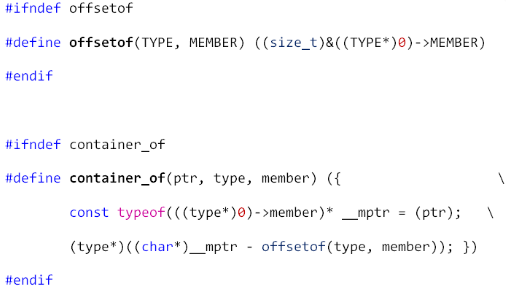
Linux 内核中常用的两个宏定义:
1.1 offsetof
见招拆招——第一式:编译器做了什么?
- offsetof 用于计算 TYPE 结构体中 MEMBER 成员的偏移位置。
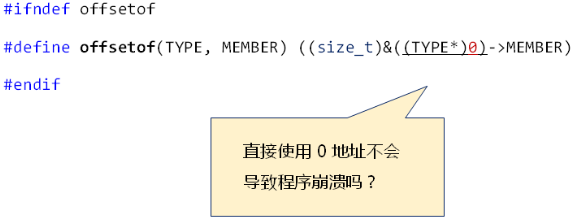
- 编译器清楚的知道结构体成员变量的偏移位置
- 通过结构体变量首地址与偏移量定位成员变量

示例——offsetof:
#include <stdio.h>

#ifndef offsetof

#define offsetof(TYPE, MEMBER) ((size_t)&((TYPE*)0)->MEMBER)

#endif

struct ST

{

    int i;   //  0

    int j;   //  4

    char c;  //  8

};

void func(struct ST* pst)

{

    int* pi = &(pst->i);   //  (unsigned int)pst + 0

    int* pj = &(pst->j);   //  (unsigned int)pst + 4

    char* pc = &(pst->c);  //  (unsigned int)pst + 8

    printf("pst = %p\n", pst);

    printf("pi = %p\n", pi);

    printf("pj = %p\n", pj);

    printf("pc = %p\n", pc);

}

int main()

{

    struct ST s = {0};

    func(&s);

    func(NULL);

    printf("offset i: %d\n", offsetof(struct ST, i));

    printf("offset j: %d\n", offsetof(struct ST, j));

    printf("offset c: %d\n", offsetof(struct ST, c));

    return 0;

}
运行结果为:
pst = 0000008D8575FA60

pi = 0000008D8575FA60

pj = 0000008D8575FA64

pc = 0000008D8575FA68

pst = 0000000000000000

pi = 0000000000000000

pj = 0000000000000004

pc = 0000000000000008

offset i: 0

offset j: 4

offset c: 8
1.2 container_of
见招拆招——第二式:( { } )是何方神圣?
- ( { } ) 是 GNU C 编译器的语法扩展
- ( { } ) 与逗号表达式类似,结果为最后一个语句的值

示例——( { } ):
#include <stdio.h>

void method_1()

{

    int a = 0;

    int b = 0;

    int r = (

           a = 1,

           b = 2,

           a + b

                );

    printf("r = %d\n", r);

}

void method_2()

{

    int r = ( {

                  int a = 1;

                  int b = 2;

                  a + b;

              } );

    printf("r = %d\n", r);

}

int main()

{

    method_1();

    method_2();

    return 0;

}
运行结果为:
r = 3

r = 3
见招拆招——第三式:typeof是一个关键字吗?
- typeof 是 GNU C 编译器的特有关键字
- typeof 只在编译器生效,用于得到变量的类型

示例——typeof:
#include <stdio.h>

void type_of()

{

    int i = 100;

    typeof(i) j = i;

    const typeof(j)* p = &j;

    printf("sizeof(j) = %d\n", sizeof(j));

    printf("j = %d\n", j);

    printf("*p = %d\n", *p);

}

int main()

{

    type_of();

    return 0;

}
运行结果为:
sizeof(j) = 4

j = 100

*p = 100
见招拆招——第四式:最后的原理

示例——container_of:
#include <stdio.h>

#ifndef offsetof

#define offsetof(TYPE, MEMBER) ((size_t)&((TYPE*)0)->MEMBER)

#endif

#ifndef container_of

#define container_of(ptr, type, member) ({		         \

        const typeof(((type*)0)->member)* __mptr = (ptr);   \

        (type*)((char*)__mptr - offsetof(type, member)); })

#endif

#ifndef container_of_new

#define container_of_new(ptr, type, member) ((type*)((char*)(ptr) - offsetof(type, member)))

#endif

struct ST

{

    int i;   //  0

    int j;   //  4

    char c;  //  8

};

int main()

{

    struct ST s = {0};

    char* pc = &s.c;

    struct ST* pst = container_of(pc, struct ST, c);

    struct ST* pst_new = container_of_new(pc, struct ST, c);

    printf("&s = %p\n", &s);

    printf("pst = %p\n", pst);

    printf("pst_new = %p\n", pst_new);

    return 0;

}
运行结果为:
&s = 0061FF14

pst = 0061FF14

pst_new = 0061FF14
(container_of与container_of_new的区别在于container_of在宏中加入了类型检查,如果传入的不是一个结构体,编译的时候就会发生一个警告!)
2.Linux内核链表剖析
本节目标:
- 移植 Linux 内核链表,使其适用于非 GNU 编译器
- 分析 Linux 内核中链表的基本实现
Linux内核链表的位置及依赖:
- 位置
{linux-2.6.39}\\indude\linux\list.h
- 依赖
#include <linux/types.h>#include <linux/stddef.h>#include <linux/poison.h>#include <linux/prefetch.h>
移植时的注意事项:
- 清除文件间的依赖
- 剥离依赖文件中与链表实现相关的代码
- 清除平台相关代码( GNU C )
( { } )typeof__builtin_prefetchstatic inline
移植后的 Linux.h(代码过长,请下载后查看):Linux.h(4KB)
Linux内核链表的实现:
- 带头节点的双向循环链表,且头节点为表中成员
- 头结点的 next 指针指向首结点
- 头节点的 prev 指针指向尾结点

Linux内核链表的结点定义:

使用 struct list_head 自定义链表结点:

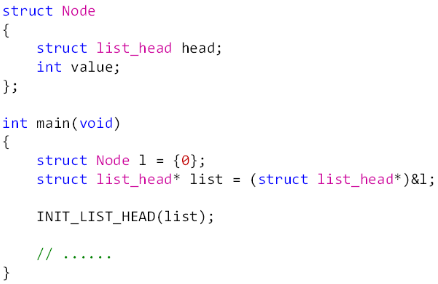
Linux内核链表的创建及初始化:
Linux内核链表的插入操作:
- 在链表头部插入:list_add(new, head)
- 在链表尾部插入:list_add_tail(new, head)
next->prev = new;

new->next = next;

new->prev = prev;

prev->next = new;
Linux内核链表的删除操作:

Linux内核链表的遍历:
- 正向遍历:list_for_each(pos, head)
- 逆向遍历:list_for_each_prev(pos, head)

示例1——使用Linux内核链表测试插入删除:
#include <stdio.h>

#include "LinuxList.h"

void list_demo_1()

{

    struct Node

    {

        struct list_head head;

        int value;

    };

    struct Node l = {0};

    struct list_head* list = (struct list_head*)&l;

    struct list_head* slider = NULL;

    int i = 0;

    INIT_LIST_HEAD(list);

    printf("Insert begin ...\n");

    for(i=0; i<5; i++)

    {

        struct Node* n = (struct Node*)malloc(sizeof(struct Node));

        n->value = i;

        list_add_tail((struct list_head*)n, list);

    }

    list_for_each(slider, list)

    {

        printf("%d\n", ((struct Node*)slider)->value);

    }

    printf("Insert end ...\n");

    printf("Delete begin ...\n");

    list_for_each(slider, list)

    {

        if( ((struct Node*)slider)->value == 3 )

        {

            list_del(slider);

            free(slider);

            break;

        }

    }

    list_for_each(slider, list)

    {

        printf("%d\n", ((struct Node*)slider)->value);

    }

    printf("Delete end ...\n");

}

int main()

{

    list_demo_1();

    return 0;

}
运行结果为:
Insert begin ...

0

1

2

3

4

Insert end ...

Delete begin ...

0

1

2

4

Delete end ...
示例2——改变Node结点的自定义顺序后的测试list_entry:
#include <stdio.h>

#include "LinuxList.h"

void list_demo_2()

{

    struct Node

    {

        int value;

        struct list_head head;

    };

    struct Node l = {0};

    struct list_head* list = &l.head;

    struct list_head* slider = NULL;

    int i = 0;

    INIT_LIST_HEAD(list);

    printf("Insert begin ...\n");

    for(i=0; i<5; i++)

    {

        struct Node* n = (struct Node*)malloc(sizeof(struct Node));

        n->value = i;

        list_add(&n->head, list);

    }

    list_for_each(slider, list)

    {

        printf("%d\n", list_entry(slider, struct Node, head)->value);

    }

    printf("Insert end ...\n");

    printf("Delete begin ...\n");

    list_for_each(slider, list)

    {

        struct Node* n = list_entry(slider, struct Node, head);

        if( n->value == 3 )

        {

            list_del(slider);

            free(n);

            break;

        }

    }

    list_for_each(slider, list)

    {

        printf("%d\n", list_entry(slider, struct Node, head)->value);

    }

    printf("Delete end ...\n");

}

int main()

{

    list_demo_2();

    return 0;

}
运行结果为:
Insert begin ...

4

3

2

1

0

Insert end ...

Delete begin ...

4

2

1

0

Delete end ...
3.小结
- 编译器清楚的知道结构体成员变量的偏移位置
- ( { } ) 与逗号表达式类似,结果为最后一个语句的值
- typeof 只在编译期生效,用于得到变量的类型
- container_of 使用 ( { } ) 进行类型安全检查
- Linux内核链表移植时需要剔除依赖以及平台相关代码
- Linux内核链表是带头节点的双向循环链表
- 使用Linux内核链表时需要自定义链表结点
- 将 struct list_head 作为结构体的第一个成员或最后一个成员
- struct list_head 作为最后一个成员时,需要使用 list_entry 宏
- list_entry 的定义中使用了 container_of 宏
数据结构开发(10):Linux内核链表的更多相关文章
- Linux 内核链表实现和使用(一阴一阳,太极生两仪~)
0. 概述 学习使用一下 linux 内核链表,在实际开发中我们可以高效的使用该链表帮我们做点事, 链表是Linux 内核中常用的最普通的内建数据结构,链表是一种存放和操作可变数据元 素(常称为节点) ...
- Linux 内核链表的使用及深入分析【转】
转自:http://blog.csdn.net/BoArmy/article/details/8652776 1.内核链表和普通链表的区别 内核链表是一个双向链表,但是与普通的双向链表又有所区别.内核 ...
- Linux 内核链表 list.h 的使用
Linux 内核链表 list.h 的使用 C 语言本身并不自带集合(Collection)工具,当我们需要把结构体(struct)实例串联起来时,就需要在结构体内声明指向下一实例的指针,构成所谓的& ...
- Linux 内核链表使用举例
链表数据结构的定义非常简洁: struct list_head { struct list_head *next, *prev; }; list_head结构包括两个指向list_head结构的指针p ...
- Linux内核链表——看这一篇文章就够了
本文从最基本的内核链表出发,引出初始化INIT_LIST_HEAD函数,然后介绍list_add,通过改变链表位置的问题引出list_for_each函数,然后为了获取容器结构地址,引出offseto ...
- 深入分析 Linux 内核链表--转
引用地址:http://www.ibm.com/developerworks/cn/linux/kernel/l-chain/index.html 一. 链表数据结构简介 链表是一种常用的组织有序数据 ...
- linux内核链表分析
一.常用的链表和内核链表的区别 1.1 常规链表结构 通常链表数据结构至少应包含两个域:数据域和指针域,数据域用于存储数据,指针域用于建立与下一个节点的联系.按照指针域的组织以及各个节 ...
- 深入分析 Linux 内核链表
转载:http://www.ibm.com/developerworks/cn/linux/kernel/l-chain/ 一. 链表数据结构简介 链表是一种常用的组织有序数据的数据结构,它通过指 ...
- Linux 内核 链表 的简单模拟(1)
第零章:扯扯淡 出一个有意思的题目:用一个宏定义FIND求一个结构体struct里某个变量相对struc的编移量,如 struct student { int a; //FIND(struct stu ...
随机推荐
- APP性能测试中的几个重要概念
转载一篇文章,关于app性能测试的几个概念,对于想要接触app测试的朋友或许有些帮助. 我们在使用各种 App 的时候基本会关注到:这款软件挺耗流量的?运行起来设备掉电有点快嘛?切换页面的时候还会有卡 ...
- 「专题训练」游走(BZOJ-3143)
题意与分析 定义走到每条边的期望为\(e_i\),一开始的想法是给定一个\(\large\sum_{i=1}^n e_i a_i\),求一个a的排列使得这个和最小.问题在于这样等于没对题目作分析,而且 ...
- Maven仓库 - 分发构件至远程仓库
分发构件至远程仓库 mvn install 会将项目生成的构件安装到本地Maven仓库,mvn deploy 用来将项目生成的构件分发到远程Maven仓库.本地Maven仓库的构件只能供当前用户使 ...
- GsonFormat插件主要用于使用Gson库将JSONObject格式的String 解析成实体,该插件可以加快开发进度,使用非常方便,效率高。
GsonFormat插件主要用于使用Gson库将JSONObject格式的String 解析成实体,该插件可以加快开发进度,使用非常方便,效率高. 插件地址:https://plugins.jetbr ...
- Docker 入门之docker容器创建
使用docker容器的大多数人都是因为想要隔离不同运行环境的差异,使得自己的应用能更好的移植和部署.那么我们来看看掌握docker需要掌握哪些方面. 1,搭建docker环境 2,编译镜像并将其运行成 ...
- 为centos虚拟机配置固定ip
在virtual上安装centos虚拟机以后,发现虚拟机没有ip,无法联网 将虚拟机的网络适配器改为桥接模式,桥接到物理机的无线网卡 为虚拟机配置固定IP(vi /etc/sysconfig/netw ...
- 测试效率 timeit cProfile
timeit使用 def f1(lIn): l1 = sorted(lIn) # O(nlogn) C语言的 l2 = [i for i in l1 if i<0.5] # O(n) retur ...
- hexo主题中添加相册功能
博客已迁移至http://lwzhang.github.io. 基本上所有的hexo主题默认都没有实现相册功能,一方面相册功能的需求较少,毕竟hexo主要是写博客用的:另一方面实现相册功能比较麻烦,比 ...
- spring boot的maven项目报404错误
$.ajax({ async: false, type: "POST", url:'searchFileSource', contentType : "applicati ...
- 团队博客作业week1——成员介绍
我们小组的成员由六人组成,其中包括一名七班的韩国同学. 1.玉钟焕同学 玉钟焕是七班的同学.由于老师为了让我们尽早体验与不熟悉的同学共同工作的环境而提出团队需要跨行政班.于是我们便邀请钟焕同学加入我们 ...