
@interface注释用法
java用 @interface Annotation{ } 定义一个注解 @Annotation,一个注解是一个类。
@Override,@Deprecated,@SuppressWarnings为常见的3个注解。
注解相当于一种标记,在程序中加上了注解就等于为程序加上了某种标记,以后,
JAVAC编译器,开发工具和其他程序可以用反射来了解你的类以及各种元素上有无任何标记,看你有什么标记,就去干相应的事。
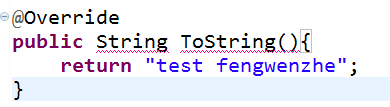
注解@Override用在方法上,当我们想重写一个方法时,在方法上加@Override,当我们方法
的名字出错时,编译器就会报错,如下图:
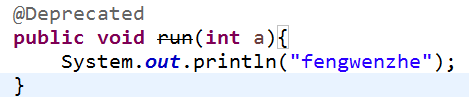
注解@Deprecated,用来表示某个类的属性或方法已经过时,不想别人再用时,在属性和方法
上用@Deprecated修饰,如图:
注解@SuppressWarnings用来压制程序中出来的警告,比如在没有用泛型或是方法已经过时的时候:

注解@Retention可以用来修饰注解,是注解的注解,称为元注解。
Retention注解有一个属性value,是RetentionPolicy类型的,Enum RetentionPolicy是一个枚举类型,
这个枚举决定了Retention注解应该如何去保持,也可理解为Rentention 搭配 RententionPolicy使用。RetentionPolicy有3个值:CLASS RUNTIME SOURCE
用@Retention(RetentionPolicy.CLASS)修饰的注解,表示注解的信息被保留在class文件(字节码文件)中当程序编译时,但不会被虚拟机读取在运行的时候;
用@Retention(RetentionPolicy.SOURCE )修饰的注解,表示注解的信息会被编译器抛弃,不会留在class文件中,注解的信息只会留在源文件中;
用@Retention(RetentionPolicy.RUNTIME )修饰的注解,表示注解的信息被保留在class文件(字节码文件)中当程序编译时,会被虚拟机保留在运行时,
所以他们可以用反射的方式读取。RetentionPolicy.RUNTIME 可以让你从JVM中读取Annotation注解的信息,以便在分析程序的时候使用。
    package com.self;

    import java.lang.annotation.Retention;

    import java.lang.annotation.RetentionPolicy;

    @Retention(RetentionPolicy.RUNTIME)

    public @interface MyTarget

    { }

    定义个一注解@MyTarget,用RetentionPolicy.RUNTIME修饰;

    package com.self;

    import java.lang.reflect.Method;

    public class MyTargetTest

    {

     @MyTarget

     public void doSomething()

     {

      System.out.println("hello world");

     }

     public static void main(String[] args) throws Exception

     {

      Method method = MyTargetTest.class.getMethod("doSomething",null);

      if(method.isAnnotationPresent(MyTarget.class))//如果doSomething方法上存在注解@MyTarget,则为true

      {

       System.out.println(method.getAnnotation(MyTarget.class));

      }

      }

    }

    上面程序打印:@com.self.MyTarget(),如果RetentionPolicy值不为RUNTIME,则不打印。

     @Retention(RetentionPolicy.SOURCE )

    public @interface Override

    @Retention(RetentionPolicy.SOURCE )

    public @interface SuppressWarnings

    @Retention(RetentionPolicy.RUNTIME )

    public @interface Deprecated

    由上可以看出,只有注解@Deprecated在运行时可以被JVM读取到

    注解中可以定义属性,看例子:

    @Retention(RetentionPolicy.RUNTIME)

    public @interface MyAnnotation

    {

     String hello() default "gege";

      String world();

      int[] array() default { 2, 4, 5, 6 };

      EnumTest.TrafficLamp lamp() ;

      TestAnnotation lannotation() default @TestAnnotation(value = "ddd");

      Class style() default String.class;

    }

    上面程序中,定义一个注解@MyAnnotation,定义了6个属性,他们的名字为:

    hello,world,array,lamp,lannotation,style.

    属性hello类型为String,默认值为gege

    属性world类型为String,没有默认值

    属性array类型为数组,默认值为2,4,5,6

    属性lamp类型为一个枚举,没有默认值

    属性lannotation类型为注解,默认值为@TestAnnotation,注解里的属性是注解

    属性style类型为Class,默认值为String类型的Class类型

    看下面例子:定义了一个MyTest类,用注解@MyAnnotation修饰,注解@MyAnnotation定义的属性都赋了值

    @MyAnnotation(hello = "beijing", world="shanghai",array={},lamp=TrafficLamp.RED,style=int.class)

    public class MyTest

    {

     @MyAnnotation(lannotation=@TestAnnotation(value="baby"), world = "shanghai",array={1,2,3},lamp=TrafficLamp.YELLOW)

     @Deprecated

     @SuppressWarnings("")

     public void output()

     {

      System.out.println("output something!");

     }

    }

     接着通过反射读取注解的信息:

    public class MyReflection

    {

     public static void main(String[] args) throws Exception

     {

      MyTest myTest = new MyTest();

        Class<MyTest> c = MyTest.class;

        Method method = c.getMethod("output", new Class[] {});

           //如果MyTest类名上有注解@MyAnnotation修饰,则为true

      if(MyTest.class.isAnnotationPresent(MyAnnotation.class))

      {

       System.out.println("have annotation");

      }

       if (method.isAnnotationPresent(MyAnnotation.class))

       {

       method.invoke(myTest, null); //调用output方法

       //获取方法上注解@MyAnnotation的信息

         MyAnnotation myAnnotation = method.getAnnotation(MyAnnotation.class);

        String hello = myAnnotation.hello();

       String world = myAnnotation.world();

       System.out.println(hello + ", " + world);//打印属性hello和world的值

       System.out.println(myAnnotation.array().length);//打印属性array数组的长度

       System.out.println(myAnnotation.lannotation().value()); //打印属性lannotation的值

       System.out.println(myAnnotation.style());

       }

        //得到output方法上的所有注解,当然是被RetentionPolicy.RUNTIME修饰的

         Annotation[] annotations = method.getAnnotations();

          for (Annotation annotation : annotations)

      {

       System.out.println(annotation.annotationType().getName());

      }

       }

    }

    上面程序打印:

    have annotation

    output something!

    gege, shanghai

    3

    baby

    class java.lang.String

    com.heima.annotation.MyAnnotation

    java.lang.Deprecated

    如果注解中有一个属性名字叫value,则在应用时可以省略属性名字不写。

    可见,@Retention(RetentionPolicy.RUNTIME )注解中,RetentionPolicy.RUNTIME是注解属性值,属性名字是value,

    属性的返回类型是RetentionPolicy,如下:

    public @interface MyTarget

    {

        String value();

    }

    可以这样用:

      @MyTarget("aaa")

     public void doSomething()

     {

      System.out.println("hello world");

     }

    注解@Target也是用来修饰注解的元注解,它有一个属性ElementType也是枚举类型,

    值为:ANNOTATION_TYPE CONSTRUCTOR  FIELD LOCAL_VARIABLE METHOD PACKAGE PARAMETER TYPE

    如@Target(ElementType.METHOD) 修饰的注解表示该注解只能用来修饰在方法上。

    @Target(ElementType.METHOD)

    @Retention(RetentionPolicy.RUNTIME)

    public @interface MyTarget

    {

     String value() default "hahaha";

    }

    如把@MyTarget修饰在类上,则程序报错,如:

    @MyTarget

    public class MyTargetTest

    注解大都用在开发框架中吧,好了有关注解就学习那么多了,谢谢。
@interface注释用法的更多相关文章
- HTML条件注释用法诠释
HTML条件注释用法诠释 注释内容以样式为例,如下: 1.支持所有IE浏览器 <!--[if IE]> <link rel="stylesheet" href=& ...
- java中自定义注释@interface的用法
一.什么是注释 说起注释,得先提一提什么是元数据(metadata).所谓元数据就是数据的数据.也就是说,元数据是描述数据的.就象数据表中的字段一样,每个字段描述了这个字段下的数据的含义.而J ...
- [转]自定义注释@interface的用法
一.什么是注释 说起注释,得先提一提什么是元数据(metadata).所谓元数据就是数据的数据.也就是说,元数据是描述数据的.就象数据表中的字段一样,每个字段描述了这个字段下的数据的含义.而J ...
- Java annotation 自定义注释@interface的用法
最近看到很多项目都是用了自定义注解,例如 1.什么是注解? 元数据(metadata),就是指数据的数据,元数据是描述数据的,就像数据库中的,表的字段,每一个 字段描述这个字段下面·的数据的含义,j2 ...
- Java注释@interface的用法【转】
Java用 @interface Annotation{ } 定义一个注解 @Annotation,一个注解是一个类.@Override,@Deprecated,@SuppressWarnings为 ...
- Java注释@interface的用法
转---------- java用 @interface Annotation{ } 定义一个注解 @Annotation,一个注解是一个类.@Override,@Deprecated,@Suppr ...
- Java 自定义注释@interface的用法
最简单的待校验的注解定义 @Documented @Constraint(validatedBy = ExistBlankByListValidator.class) @Target({PARAMET ...
- Java注释@interface的用法【转】 --好文章 很好理解
java用 @interface Annotation{ } 定义一个注解 @Annotation,一个注解是一个类. @Override,@Deprecated,@SuppressWarnings ...
- python学习第二天标准输入输出和注释用法
任何编程语言都有输入输出和用打交道,python也不例外,输入input(),输出print() 玖乐网络(http://www.96net.com.cn/)分享自己的心得 1,input()用法实例 ...
随机推荐
- [学习笔记]nim游戏
普通nim游戏: n堆石子,每个人每次对着一堆拿若干个.不能拿者判输. 只有两种情况,先手必胜,先手必败. 先手必胜当且仅当:a1^a2^...^an!=0 证明: 设=x(x不为0),选择最高位和x ...
- svn cleanup
SVN 本地更新时,由于一些操作中断更新,如磁盘空间不够,用户取消. 可能会造成本地文件被锁定的情况.一般出现这种情况的解决方法: 1.可以使用SVN clean up来清除锁定. 2.如果不是本目录 ...
- Java体验的重点难点-----总结
1.关于JVM原理:http://www.cnblogs.com/zhanglei93/p/6590609.html 2.关于垃圾收集机制:http://www.cnblogs.com/zhangle ...
- Django中Celery http请求异步处理(四)
Django中Celery http请求异步处理 本章延续celery之前的系列 1.settings配置 2.编写task jib_update_task任务为更新salt jid数据 3.url设 ...
- JQuery中2个等号与3个等号的区别
首先,== equality 等同,=== identity 恒等.==, 两边值类型不同的时候,要先进行类型转换,再比较.===,不做类型转换,类型不同的一定不等. 下面分别说明:先说 ===,这个 ...
- 一个很实用的css3兼容工具很多属性可以兼容到IE6
当你看到这样的效果图是不是已经崩溃了 css3没出来之前大部分人基本都是用图片的方式拼出来的 腾讯邮箱就是这么做的 然后你想和设计说换直角吧.我用图片的好烦的感觉!而且我们还要兼容到ie6 她和你说别 ...
- [转载]DOMContentLoaded与interactive
http://www.cnblogs.com/muxrwc/archive/2011/01/13/1934379.html ie中inline script执行时竟然第一次进入页面,doc.ready ...
- 格式化 SQL 来提高效率
本文由 伯乐在线 - cucr 翻译,黄利民 校稿.未经许可,禁止转载!英文出处:msiman.ga.欢迎加入翻译小组. 背景 已格式化的SQL并不比未格式化SQL运行地更快.数据库可能真的不太在意你 ...
- 分布式文件系统 之 数据块(Block)
众所周知,HDFS中以数据块(block)为单位进行存储管理.本文简单介绍一下HDFS中数据块(block)的概念,以及众多分布式存储系统(不止是HDFS)使用block作为存储管理基本单位的意义. ...
- 由于找不到MSVCP20.dll,无法继续执行代码
系统:win10 专业版,刚升级win10没几天 mysql 5.7.21 解压安装,初始化时报错,错误如图: 一.查找错误原因 参考:MySQL安装使用遇到的问题, 找到微软中文官方网站,搜索 ms ...