
论文:Show, Attend and Tell: Neural Image Caption Generation with Visual Attention-阅读总结
Show, Attend and Tell: Neural Image Caption Generation with Visual Attention-阅读总结
笔记不能简单的抄写文中的内容,得有自己的思考和理解。
一、基本信息
**\1.标题:**Show, Attend and Tell: Neural Image Caption Generation with Visual Attention
**\2.作者:**Kelvin Xu,Jimmy Lei Ba,Ryan Kiros,Kyunghyun Cho,Aaron Courville,Ruslan Salakhutdinov,Richard S. Zemel,Yoshua Bengio
**\3.作者单位:**UC Berkeley,University of Toronto,Google Research,New York University&Facebook AI Research,Université de Montréal,CMU,University of Toronto, University of Montreal
**\4.发表期刊/会议:**ICML
**\5.发表时间:**2015
二、看本篇论文的目的
to study the attention mechanism used in natural image caption algorithm.
三、场景和问题
scene: image caption, natural image, scene understanding
problem: how to train the model in a deterministic manner using standard backpropagation techniques and stochastically by maximizing a variational lower bound.
四、研究目标
Models with an attention mechanism can attend to the salient part of an image while generating its caption.
五、主要思路/创新
Main inspiration:
\1.one of the most curious facets of the human cisual system is the presence of attention.
\2.Using representations (such as those from the very top layer of a convnet) that distill information in image down to the most salient objects has one potential drawback of losing informaiton which could be useful for richer, more descriptive captions.
\3.It necessitates a powerful mechanism to steer the model to informaiton important to the task at hand when using lower-level representation.
\4.Recent advances in caption generation and recent successes in employing attention in machine translation and object recognition.
Main innovation:
\1.Two attention mechanism:
a "soft" deterministic attention mechanism trainable by standard back-propagation methods.
a "hard" stochastic attention mechanism trainable by maximizing an approximate variational lower bound or equivalently by REINFORCE.
\2.Show how to gain insight and interpret the results of the framework by visualizing "where" and "what" the attention focused on.
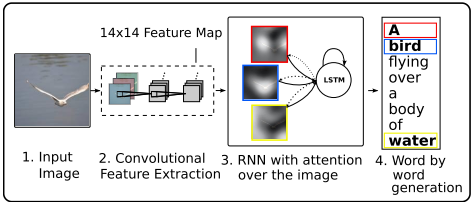
六、算法概述
\1.Encoder:
①.caption y is encoded as a sequence of 1-of-K encoded words:
y={\{\mathtt{y_1,\dots,y_C}\}},\mathtt{y_i}\in\mathbb{R}^K
\]
K is the size of the vocabulary and C is the length of the caption.
②.extractor (a convolutional neural network) produces L vectors, each of which is a D-dimensional representation corresponding to a part of the iamge:
a={\{\mathtt{a_1,\dots,a_L}\}},\mathtt{a_i}\in\mathbb{R}^D
\]
features are extracted from a lower convolutional layer, which allows the decoder to selectively focus on certain parts of an image by weighting a subset of all the feature vectors.
\2.Decoder:
①.LSTM network:
\begin{align*}
& \mathbf{i_t}=\sigma(W_iE\mathbf{y}_{t-1}+U_i\mathbf{h}_{t-1}+Z_i\mathbf{\hat{z}}_t+\mathbf{b}_i)\\
& \mathbf{f_t}=\sigma(W_fE\mathbf{y}_{t-1}+U_f\mathbf{h}_{t-1}+Z_f\mathbf{\hat{z}}_t+\mathbf{b}_f)\\
& \mathbf{c}_t=\mathbf{f}_t\mathbf{c}_{t-1}+\mathbf{i}_t\mathsf{tanh}(W_cE\mathbf{y}_{t-1}+U_c\mathbf{h}_{t-1}+Z_c\mathbf{\hat{z}}_t+\mathbf{b}_c)\\
& \mathbf{o}_t=\sigma(W_oE\mathbf{y}_{t-1}+U_o\mathbf{h}_{t-1}+Z_o\mathbf{\hat{z}}_t+\mathbf{b}_o)\\
&\mathbf{h}_t=\mathbf{o}_t\mathsf{tanh}(\mathbf{c}_t)
\end{align*}
\]
\(\mathbf{i_t,f_t,c_t,o_t,h_t}\) are the input, forget, memory, output and hidden state of the LSTM respectively. \(W_{\bullet},U_{\bullet},Z_{\bullet},\mathbf{b}_{\bullet}\) are learned weight matricies and biases.\(\mathbf{E}\in\mathbb{R}^{m\times K}\) is an embedding matrix. \(m\) and \(n\) denote the embedding and LSTM dimensionality. \(\sigma\) is the logistic sigmoid activation.
②.\(\mathbf{\hat{z}}_t\) is a dynamic representation of the relevant part of the image input at time t.
③.a mechanism \(\phi\) computes \(\mathbf{\hat{z}}_t\) from the annotation vectors \(\mathbf{a}_i,i=1,\dots,L\) corresponding to the features extracted at different image locations.
For each location \(i\), \(\phi\) generates a positive weight \(\alpha_i\) which can be interpreted either as the probability that location \(i\) is the right place to focus for producing the next word (stochastic attention mechanism), or as the relative importance to give to location \(i\) in blending the $ \mathbf_i$'s together (deterministic attention mechanism).
④.weight \(\alpha_i\) of each annotation vector \(a_i\) is computed by an \(attention\,model\,f_{att}\) (a multilayer perceptron conditioned on the previous hidden state \(\mathbf{h}_{t-1}\))
\begin{align*}
&e_{ti}=f_{att}({\mathbf{a}_i},\mathbf{h}_{t-1})\\
&\alpha_{ti}=\frac{exp(e_{ti})}{\sum^L_{k=1}exp(e_{tk})}
\end{align*}
\]
once the wrights (which sum to one) are computed, the context vector \(\hat{z}_t\) is computed by:
\mathbf{\hat{z}_t}=\phi(\{\mathbf{a}_i\},\{\alpha_i\})
\]
⑤.The initial memory state and hidden state of the LSTM:
\mathbf{c}_0=f_{init,c}\left(\frac{1}{L}\sum^L_i\mathbf{a}_i\right),\mathbf{h}_0=f_{init,h}\left({\frac{1}{L}\sum^L_i\mathbf{a}_i}\right)
\]
⑥.a deep output layer computes the output word probability from the image (the context vector), the previously generated word, and the decoder state (\(h_t\)):
p(\mathbf{y}_t|\mathbf{a},\mathbf{y}_1^{t-1})\propto exp(\mathbf{L}_o(\mathbf{Ey_{t-1}}+\mathbf{L}_h\mathbf{h}_t+\mathbf{L}_z\mathbf{\hat{z}}_t))
\]
\(\mathbf{L}_o\in \mathbb{R}^{K\times m},\mathbf{L}_h\in \mathbb{R}^{m\times n},\mathbf{L}_z\in \mathbb{R}^{m\times D}\,and\,\mathbf{E}\) are learned parameters initialized randomly.
七、两种Attention机制实现细节
Stochastic "Hard" Attention:
\1.location variable \(s_{t,i}\), an indicator one-hot variable which is set to 1 if the \(i\)-th location (out of \(L\)) is the one used to extract visual features for generating the \(t\)-th word.
\2.Assign a multinoulli distribution parametrized by \(\{\alpha_i \}\) to treat the attention locations as intermediate latent variables, and \(\mathbf{\hat{z}}_t\) can be viewed as a random variable:
理解:multinoulli distribution explanation
\begin{align*}
&p(s_{t,i}=1|s_{j<t},\mathbf{a})=\alpha_{t,i}\\
&\mathbf{\hat{z}}_t=\sum_is_{t,i}\mathbf{a}_i
\end{align*}
\]
\3.a new objective function \(L_s\):
\begin{align*}
L_s & =\sum_s\,p(s|\mathbf{a})\mathsf{log}\, p(\mathbf{y}|s,\mathbf{a})\\
&\leq \mathsf{log\sum_s}\, p(s|\mathbf{a})p(\mathbf{y}|s,\mathbf{a})\\
&=\mathsf{log}\,p(\mathbf{y}|\mathbf{a})
\end{align*}
\]
\(\mathbf{y}\) the sequence of words, \(\mathbf{a}\) the given image features, So parameters \(W\) of the models can be derived by directly optimizing.
\4.\(L_s\)'s gradient:
\frac{\partial L_s}{\partial W}=\sum_s\,p(s|\mathbf{a})\left[\frac{\partial\,\mathsf{log}\,p(\mathbf{y}|s,\mathbf{a})}{\partial W}+\mathsf{log}\,p(\mathbf{y}|s,\mathbf{a})\frac{\partial\,\mathsf{log}\,p(s|\mathbf{a})}{\partial W}\right]
\]
the gradient of \(L_s\) is approximated by a Monte Carlo method:
\frac{\partial L_s}{\partial W}\approx \frac{1}{N}\sum_s^N\left[\frac{\partial\,\mathsf{log}\,p(\mathbf{y}|\tilde{s}^n,\mathbf{a})}{\partial W}+\mathsf{log}\,p(\mathbf{y}|\tilde{s}^n,\mathbf{a})\frac{\partial\,\mathsf{log}\,p(\tilde{s}^n|\mathbf{a})}{\partial W}\right]\\
\tilde{s}^n_t \sim \mathbf{Multinoulli}(\{\ \alpha_i^n \})
\]
\(\tilde{s}^n=(s^n_1,s^n_2,\dots)\) is a sequence of sampled attention locations from a multinouilli distribution.
\5.Moving average baseline technique -- to reduce the variance of the estimator:
b_k = 0.9\times b_{k-1} + 0.1\times \mathsf{log}\,p(\mathbf{y}|\tilde{s}_k,\mathbf{a})
\]
to further reduce the estimator variance, the gradient of the entropy \(H[s]\) of the multinouilli distribution is added to the RHS of Eq.(7), final learning rule for the model:
\begin{align*}
\frac{\partial L_s}{\partial W}&\approx \frac{1}{N}\sum_{n=1}^N\left[\frac{\partial\,\mathsf{log}\,p(\mathbf{y}|\tilde{s}^n,\mathbf{a})}{\partial W}+\\
\lambda_r(\mathsf{log}\,p(\mathbf{y}|\tilde{s}^n,\mathbf{a})-b)\frac{\partial\,\mathsf{log}\,p(\tilde{s}^n|\mathbf{a})}{\partial W}+\lambda_e\frac{\partial H[\tilde{s}^n]}{\partial W}\right]
\end{align*}
\]
\(\lambda_r\) and \(\lambda_e\) are two hyper-parameters set by cross-validation.
\6.to further improve the robustness fo the learning rule, with probability 0.5 for a given image, the sampled attention location \(\tilde{s}\) is set to its expected value \(\alpha\) (equivalent to the deterministic attention).
the formulation is equivalent to the \(\mathbf{RENIFORCE}\) learning rule, where the reward for the attention choosing a sequence of actions is a real value proportional to the log likelihood of the target sentence under the sampled attention trajectory.
Deterministic "Soft" Attention:
\1.Instead of sampling the attention location \(s_t\) each time, it just take the expectation of the context vector \(\hat{z}_t\) directly:
\mathbb{E}_{p(s_t|a)}[\mathbf{\hat{z}}_t]=\sum_{i=1}^L\, \alpha_{t,i}\mathbf{a}_i
\]
the soft attention weighted annotation vector is computed by : \(\phi(\{\mathbf{a_i}\},\{\alpha_i\})=\sum^L_i\alpha_i\mathbf{a}_i\), which corresponds to feeding in a soft \(\alpha\) weighted context into the system.
\2.\(\mathbf{n}_{t,i}\) is denoted as \(\mathbf{n}\) in Eq.(2) with \(\mathbf{\hat{z}}_t\) set to \(\mathbf{a}_i\). The normalized weighted geometric mean (NWGM) of the softmax of \(k\)-th word prediction:
\begin{align*}
\mathbf{NWGM}[p(y_t=k|\mathbf{a})]&=\frac{\prod_i\mathsf{exp}(n_{t,k,i})^{p(s_{t,i}=1|a)}}{\sum_j\prod_i\mathsf{exp}(n_{t,j,i})^{p(s_{t,i} = 1|a)}}\\
&=\frac{\mathsf{exp}(\mathbb{E}_{p(s_t|a)}[n_{t,k}])}{\sum_j\mathsf{exp}(\mathbb{E_{p(s_t|a)}}[n_{t,j}])}
\end{align*}
\]
This implies that the NWGM of the word prediction can be well approximated by using the expected context vector \(\mathbb{E}[\mathbf{\hat{z}}_t]\), instead of the sampled context vector \(\mathbf{a}_i\). Furthermore, the \(\mathbf{NWGM}\) can be computed by a single feedforward computation approximates the expection \(\mathbb{E}[p(y_t=k|\mathbf{a})]\) of the output over all possible attention locations induced by random variable \(s_t\).
Suggesting that the proposed deterministic attention model approximately maximizes the marginal likelihood over all possible attention locations.
\3.①.In training the deterministic model, a doubly stochastic regularization encourages the model to pay equal attention to every part of the image.
The attention \(\sum_i\alpha_{ti} = 1\) makes it possible for the decoder to ignore some parts of the input image, and encourage \(\sum_t\alpha_{ti}\approx \tau,\tau \ge \frac{L}{D}\). This penalty quantitatively improves overall performance and it qualitatively leads to more descriptive captions.
②.the soft attention model predicts a gating scalar \(\beta\) from previous hidden state \(\mathbf{h}_{t-1}\) at each time step t, such that, \(\phi(\{\mathbf{a_i}\},\{\alpha_i\})=\beta\sum_i^L\alpha_i\mathbf{a}_i\), \(\beta_t=\sigma(f_{\beta}(\mathbf{h}_{t-1}))\). This gating variable lets the decoder decide whether to put more emphasis on language modeling or on the context at each time step.
③.The soft attention model is trained end-to-end by minimizing the penalized negative log-likelihood:
L_d=-log(p(\mathbf{y}|\mathbf{a}))+\lambda\sum_i^L(1-\sum^C_t\alpha_{ti})^2
\]
\(\tau\) is simply fixed to 1.
八、采用的数据集&评价指标
Datasets:
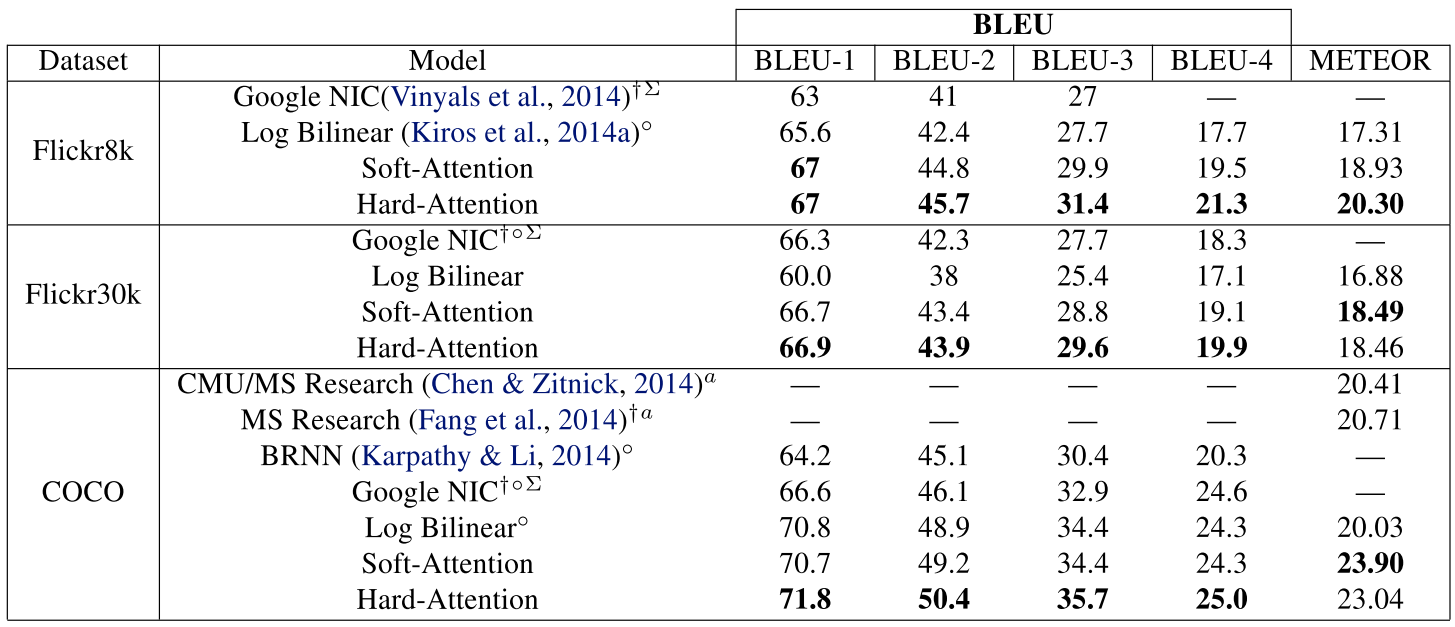
Flickr8k, Flickr30k,(each image has 5 reference captions),MS COCO(discarding caption in excess of 5 to maintain a same number of references between the datasets).
Metrics:
BLEU (from 1 to 4 without a brevity penalty), METEOR (because of the criticism of BLEU)
九、实验细节
Training Details:
\1.Both model were trained with stochastic gradient descent using adaptive learning rates. Flickr8k dataset--RMSProp works best, Flickr30k/MSCOCO dataset--Adam algorithm is quite effective.
\2.the encoder (creates the annotations \(a_i\)) -- the Oxford VGGnet pretrained on ImageNet without finetuning, and just use the $14\times14\times512$ feature map of the fourth convolutional layer before max pooling to create the flattened $196\times512$ encoding to the decoder. In addition, with enough data, the encoder could also be trained from scratch (or fine-tune) with the rest of the model.
\3.problem: the implementation requires time proportional to the length of the longest sentence per update, and training on a random group of captions is computationally wasteful.
solution: In preprocessing, building a dictionary to map the length of a sentence to the corresponding subset of captions. During training, randomly sampling a length and retrieve a mini-batch of size 64 of that length.
performance: greatly improved convergence speed with no noticeable diminishment, on the largest dataset(MS COCO) it takes less than 3 days training on an NVIDIA Titan Black GPU.
\4.regularization strategy: dropout, early stopping on BLEU score (it observed a breakdown in correlation between the validation set log-likelihood and BLEU in the later stages of training during the experiments.)
十、验证的问题&效果
Question 1:
single model versus ensemble comparison:
in the results, it just report a single mdel performance.
Question 2:
differences between dataset splits:
Flickr8k -- predefined splits
Flickr30k and COCO -- lack of standardized splits, reported with publicly available splits used in previous work
however, the differences in splits do not make a substantial difference in overall performance.
Question 3:
quantitative effectiveness of attention:
①.obtain state of the art performance on the Flickr8k, Flickr30k and MS COCO.
②.significantly improve the state-of-the-art performance METEOR on MS COCO.
③.it speculates that the improvement connected to some of the regularization techniques and the lower-level representation.
Question 4:
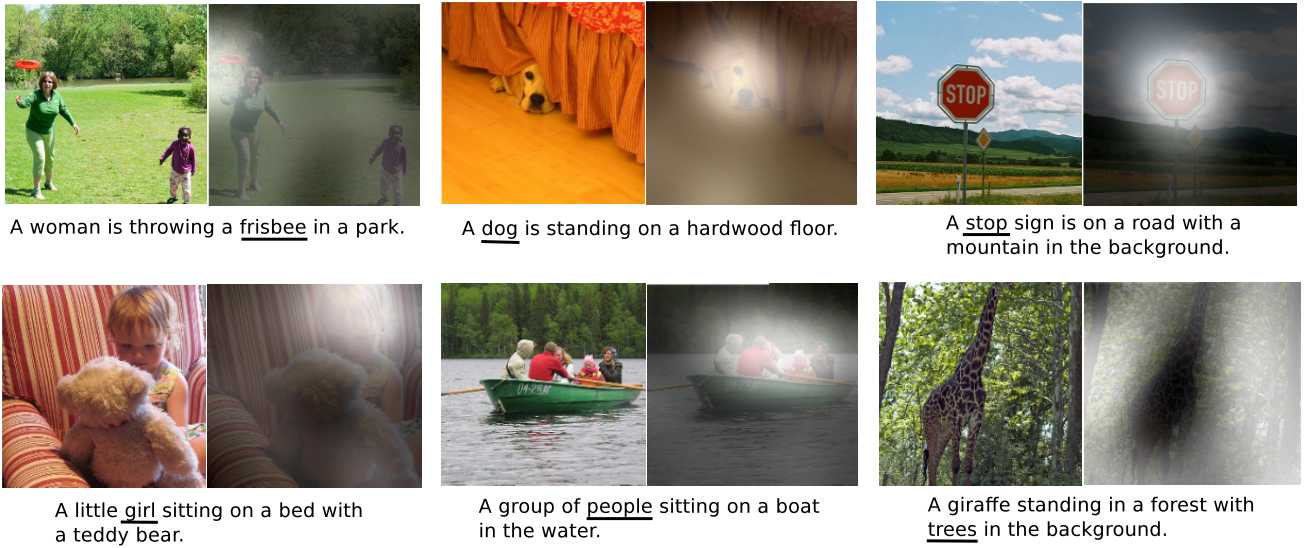
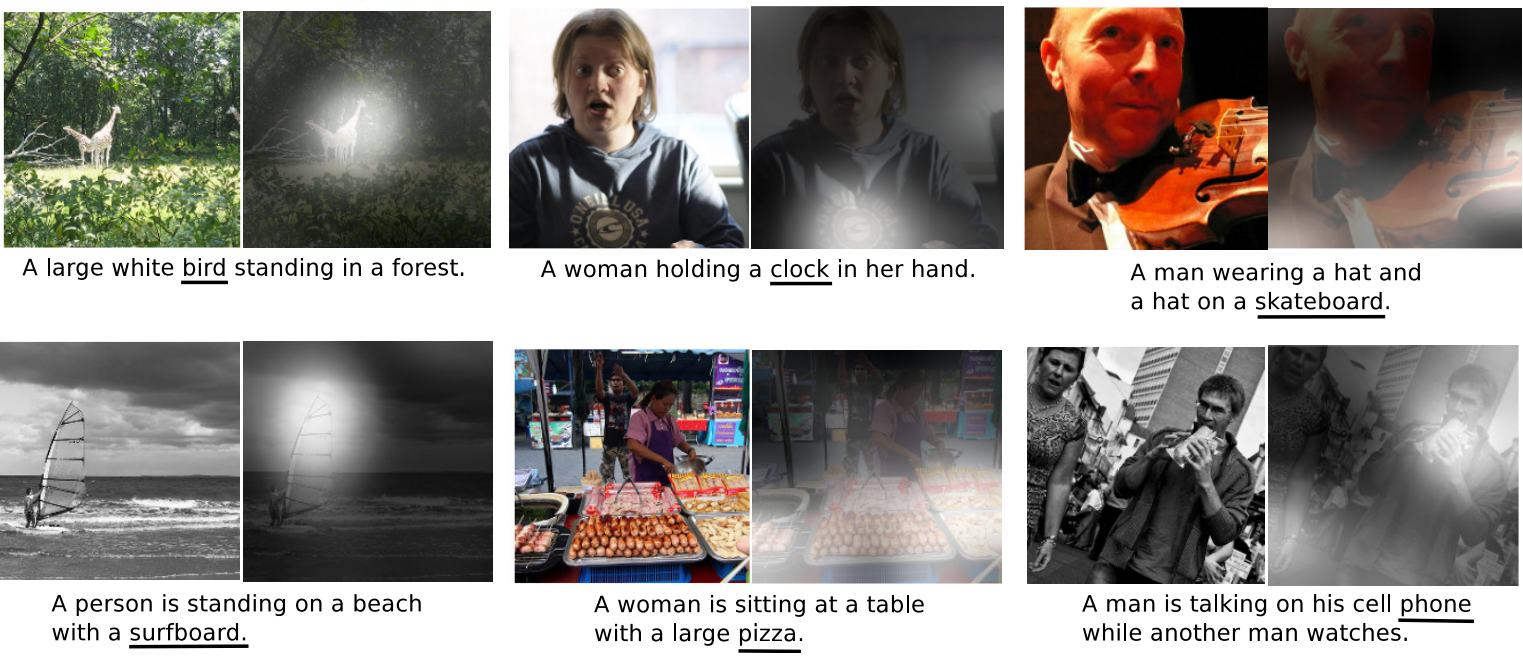
visualizing the attention learned by the model:
add an extra layer of interpretability to the output of the model.
①.the only time the feature maps decrease in size are due to the max pooling layers, because the 19-layer OxfordNet uses stacks of 3x3 filters.
②.The input image is resized so that the shortest side is 256-dimensional with preserved aspect ratio, and input the center-cropped 224x224 image to the convolutional network, then with four max pooling layers, it gets an output dimension of the top convolutional layer of 14x14.
③.upsample the weights by a factor of $2^4=16$ and apply a Gaussian filter to emulate the large receptive field size to visulize the attention weights for the soft model.
论文:Show, Attend and Tell: Neural Image Caption Generation with Visual Attention-阅读总结的更多相关文章
- 论文笔记:Show, Attend and Tell: Neural Image Caption Generation with Visual Attention
Show, Attend and Tell: Neural Image Caption Generation with Visual Attention 2018-08-10 10:15:06 Pap ...
- [Paper Reading] Show, Attend and Tell: Neural Image Caption Generation with Visual Attention
论文链接:https://arxiv.org/pdf/1502.03044.pdf 代码链接:https://github.com/kelvinxu/arctic-captions & htt ...
- Paper Reading - Show, Attend and Tell: Neural Image Caption Generation with Visual Attention ( ICML 2015 )
Link of the Paper: https://arxiv.org/pdf/1502.03044.pdf Main Points: Encoder-Decoder Framework: Enco ...
- 论文:Show and Tell: A Neural Image Caption Generator-阅读总结
Show and Tell: A Neural Image Caption Generator-阅读总结 笔记不能简单的抄写文中的内容,得有自己的思考和理解. 一.基本信息 标题 作者 作者单位 发表 ...
- Paper Reading - Show and Tell: A Neural Image Caption Generator ( CVPR 2015 )
Link of the Paper: https://arxiv.org/abs/1411.4555 Main Points: A generative model ( NIC, GoogLeNet ...
- 论文解读《Bilinear Graph Neural Network with Neighbor Interactions》
论文信息 论文标题:Bilinear Graph Neural Network with Neighbor Interactions论文作者:Hongmin Zhu, Fuli Feng, Xiang ...
- 从Image Caption Generation理解深度学习
0. 前面的话 建丁让我写一篇深度学习相关小文章,目标读者是国内的开发者.刚接到这个任务时我是颇为忐忑的,写文章要讲究厚积薄发,如果“水之积也不厚”,“则其负大舟也无力”.因为我自知水平很有限,又不是 ...
- 论文笔记之: Recurrent Models of Visual Attention
Recurrent Models of Visual Attention Google DeepMind 模拟人类看东西的方式,我们并非将目光放在整张图像上,尽管有时候会从总体上对目标进行把握,但是也 ...
- Paper Reading - Mind’s Eye: A Recurrent Visual Representation for Image Caption Generation ( CVPR 2015 )
Link of the Paper: https://ieeexplore.ieee.org/document/7298856/ A Correlative Paper: Learning a Rec ...
随机推荐
- LinkedBlockingQueue 和 ConcurrentLinkedQueue的区别
1. 简单的开篇 LinkedBlockingQueue 和 ConcurrentLinkedQueue 是 Java 高并发场景中最常使用的队列.尽管这两个队列经常被用作并发场景的数据结构,但它们之 ...
- Scala集合中的函数(扩展)
1.拉链(zip) 将两个集合进行 对偶元组合并,可以使用拉链 object Demo_031 { def main(args: Array[String]): Unit = { val list1 ...
- Java面试通关要点汇总整理
简历篇 请自我介绍 请介绍项目 基础篇 基本功 面向对象的特征 final, finally, finalize 的区别 int 和 Integer 有什么区别 重载和重写的区别 抽象类和接口有什么区 ...
- 跟我一起学.NetCore之选项(Options)核心类型简介
前言 .NetCore中提供的选项框架,我把其理解为配置组,主要是将服务中可供配置的项提取出来,封装成一个类型:从而服务可根据应用场景进行相关配置项的设置来满足需求,其中使用了依赖注入的形式,使得更加 ...
- eclipse git提交项目以及down项目大致步骤
down git项目步骤: 复制了url之后,import projects项目选中from git ,会出现如下截图,信息会自动填充 填好信息一直Next即可 完成之后,打开“Git Reposit ...
- 认证授权:学习OAuth协议
1.什么是OAuth协议? OAUTH协议为用户资源的授权提供了一个安全的.开放而又简易的标准.同时,任何第三方都可以使用OAuth认证服务,任何服务提供商都可以实现自身的OAuth认证服务,因而OA ...
- Java算法——分治法
一.基本概念 在计算机科学中,分治法是一种很重要的算法.字面上的解释是“分而治之”,就是把一个复杂的问题分成两个或更多的相同或相似的子问题,再把子问题分成更小的子问题……直到最后子问题可以简 ...
- [转] Linux操作系统启动流程
总启动流程 这部分转自:https://www.cnblogs.com/liang-io/p/9651656.html 一般来说,所有的操作系统的启动流程基本就是: 总的来说,linux系统启动流程可 ...
- SQL语句中IF的简单使用 - 关联leetcode 627.交换工资
MySQL的IF既可以作为表达式用,也可在存储过程中作为流程控制语句使用,如下是做为表达式使用: IF表达式 IF(expr1,expr2,expr3) 如果 expr1 是TRUE (expr1 & ...
- 招新裁老,两面派互联网大厂,培训三个月,就拿15K,凭什么?
看到一位朋友在发帖子求问:亲身经历,(如有谎言我名字倒过来写)一个大学同学18年毕业的.在兰州一个二本学的兽医农牧,毕业难找工作,去深圳一个机构培训了三个月吧,然后就去做大数据 算法了,然后又去做ja ...