
java并发之停止线程
停止一个线程意味着在任务处理完任务之前停掉正在做的操作,也就是放弃当前的操作。停止一个线程可以用Thread.stop()方法,但最好不要用它。虽然它确实可以停止一个正在运行的线程,但是这个方法是不安全的,而且是已被废弃的方法。
在java中有以下3种方法可以终止正在运行的线程:
- 使用退出标志,使线程正常退出,也就是当run方法完成后线程终止。(我们什么也不做)
- 使用stop方法强行终止,但是不推荐这个方法,因为stop和suspend及resume一样都是过期作废的方法。(调用stop)
- 使用interrupt方法中断线程:(1:我们自己用interrupted()或isInterrupted()方法判断是否当前线程是否被打了停止标志(调用interrupt方法打标志),如果打了自己new异常对象抛出,即停止了线程;2:interruupt方法打停止标志和sleep结合,先睡再打或者先打再睡都会自动抛出 InterruptedException 异常对象,我们捕获即可。)
1. 停止不了的线程
interrupt()方法的使用效果并不像for+break语句那样,马上就停止循环。调用interrupt方法是在当前线程中打了一个停止标志,并不是真的停止线程。
 public class MyThread extends Thread {

     public void run(){

         super.run();

         for(int i=0; i<500000; i++){

             System.out.println("i="+(i+1));

         }

     }

 }

 public class Run {

     public static void main(String args[]){

         Thread thread = new MyThread();

         thread.start();

         try {

             Thread.sleep(2000);

             thread.interrupt();

         } catch (InterruptedException e) {

             e.printStackTrace();

         }

     }

 }
输出结果:
...

i=499994

i=499995

i=499996

i=499997

i=499998

i=499999

i=500000
从运行结果看调用interrupt方法并没有停止线程。
2. 判断线程是否停止状态
Thread.java类中提供了两种方法:
- this.interrupted(): 测试当前线程是否已经中断;
- this.isInterrupted(): 测试线程是否已经中断;
那么这两个方法有什么图区别呢?
我们先来看看this.interrupted()方法的解释:测试当前线程是否已经中断,当前线程是指运行this.interrupted()方法的线程。
 public class MyThread extends Thread {

     public void run(){

         super.run();

         for(int i=0; i<500000; i++){

             i++;

 //            System.out.println("i="+(i+1));

         }

     }

 }

 public class Run {

     public static void main(String args[]){

         Thread thread = new MyThread();

         thread.start();

         try {

             Thread.sleep(2000);

             thread.interrupt();

             System.out.println("stop 1??" + thread.interrupted());

             System.out.println("stop 2??" + thread.interrupted());

         } catch (InterruptedException e) {

             e.printStackTrace();

         }

     }

 }
运行结果:
stop 1??false

stop 2??false
类Run.java中虽然是在thread对象上调用以下代码:thread.interrupt(), 后面又使用
System.out.println("stop 1??" + thread.interrupted());

System.out.println("stop 2??" + thread.interrupted());
来判断thread对象所代表的线程是否停止,但从控制台打印的结果来看,线程并未停止,这也证明了interrupted()方法的解释,测试当前线程是否已经中断。这个当前线程是main,它从未中断过,所以打印的结果是两个false.
如何使main线程产生中断效果呢?
public class Run2 {

    public static void main(String args[]){

        Thread.currentThread().interrupt();

        System.out.println("stop 1??" + Thread.interrupted());

        System.out.println("stop 2??" + Thread.interrupted());

        System.out.println("End");

    }

}
运行效果为:
stop 1??true

stop 2??false

End
方法interrupted()的确判断出当前线程是否是停止状态。但为什么第2个布尔值是false呢? 官方帮助文档中对interrupted方法的解释:
测试当前线程是否已经中断。线程的中断状态由该方法清除。 换句话说,如果连续两次调用该方法,则第二次调用返回false。
下面来看一下isInterrupted()方法。
public class Run3 {

    public static void main(String args[]){

        Thread thread = new MyThread();

        thread.start();

        thread.interrupt();

        System.out.println("stop 1??" + thread.isInterrupted());

        System.out.println("stop 2??" + thread.isInterrupted());

    }

}
运行结果:
stop 1??true

stop 2??true
isInterrupted()并不会清除状态,所以打印了两个true。
所以:
this.interrupted():测试当前线程是否已经是中断状态,执行后具有将状态标志位清除为false的功能。
this.isInterrupted():测试线程Thread对象是否已经是中断状态,但不清除状态标志。
3. 能停止的线程--异常法
有了前面学习过的知识点,就可以在线程中用for语句来判断一下线程是否是停止状态,如果是停止状态,则后面的代码不再运行即可:
public class MyThread extends Thread {

    public void run(){

        super.run();

        for(int i=0; i<500000; i++){

            if(this.interrupted()) {

                System.out.println("线程已经终止, for循环不再执行");

                break;

            }

            System.out.println("i="+(i+1));

        }

    }

}

public class Run {

    public static void main(String args[]){

        Thread thread = new MyThread();

        thread.start();

        try {

            Thread.sleep(2000);

            thread.interrupt();

        } catch (InterruptedException e) {

            e.printStackTrace();

        }

    }

}
运行结果:
...

i=202053

i=202054

i=202055

i=202056

线程已经终止, for循环不再执行
上面的示例虽然停止了线程,但如果for语句下面还有语句,还是会继续运行的。看下面的例子:
 public class MyThread extends Thread {

     public void run(){

         super.run();

         for(int i=0; i<500000; i++){

             if(this.interrupted()) {

                 System.out.println("线程已经终止, for循环不再执行");

                 break;

             }

             System.out.println("i="+(i+1));

         }

         System.out.println("这是for循环外面的语句,也会被执行");

     }

 }
使用Run.java执行的结果是:
...

i=180136

i=180137

i=180138

i=180139

线程已经终止, for循环不再执行

这是for循环外面的语句,也会被执行
如何解决语句继续运行的问题呢? 看一下更新后的代码:(用了抛异常的方式,当检测到线程被中断(即有中断标志位时)抛异常)
public class MyThread extends Thread {

    public void run(){

        super.run();

        try {

            for(int i=0; i<500000; i++){

                if(this.interrupted()) {

                    System.out.println("线程已经终止, for循环不再执行");

                        throw new InterruptedException();

                }

                System.out.println("i="+(i+1));

            }

            System.out.println("这是for循环外面的语句,也会被执行");

        } catch (InterruptedException e) {

            System.out.println("进入MyThread.java类中的catch了。。。");

            e.printStackTrace();

        }

    }

}
使用Run.java运行的结果如下:
...

i=203798

i=203799

i=203800

线程已经终止, for循环不再执行

进入MyThread.java类中的catch了。。。

java.lang.InterruptedException

    at thread.MyThread.run(MyThread.java:13)
4. 在沉睡中停止
如果线程在sleep()状态下停止线程,会是什么效果呢?
package stopThread;

public class SleepThread1 extends Thread {

    public void run(){

        super.run();

        try {

            System.out.println(this.currentThread().getId() + "线程开始。。。");

            Thread.sleep(2000);//睡2000毫秒

            System.out.println(this.currentThread().getId() + "线程结束。");

        } catch (InterruptedException e) {

            System.out.println(this.currentThread().getId() +"在沉睡中被停止, 进入catch, 调用isInterrupted()方法的结果是:" + this.isInterrupted());

            e.printStackTrace();

        }

    }

}
package stopThread;

public class Run1 {

    public static void main(String args[]){

        Thread thread1 = new SleepThread1();

        Thread thread2 = new SleepThread1();

        thread1.start();

        thread2.start();

        thread1.interrupt();

    }

}
运行的结果是:
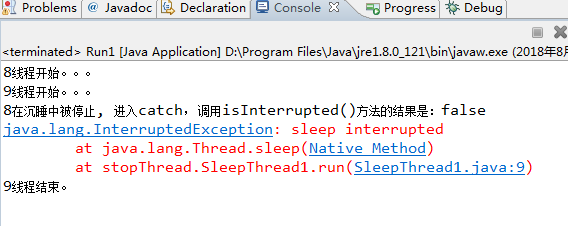
前一个实验是先sleep然后再用interrupt()停止,与之相反的操作在学习过程中也要注意:
public class MyThread extends Thread {

    public void run(){

        super.run();

        try {

            System.out.println("线程开始。。。");

            for(int i=0; i<10000; i++){

                System.out.println("i=" + i);

            }

            Thread.sleep(200000);

            System.out.println("线程结束。");

        } catch (InterruptedException e) {

             System.out.println("先停止,再遇到sleep,进入catch异常");

            e.printStackTrace();

        }

    }

}

public class Run {

    public static void main(String args[]){

        Thread thread = new MyThread();

        thread.start();

        thread.interrupt();

    }

}
运行结果:
i=9998

i=9999

先停止,再遇到sleep,进入catch异常

java.lang.InterruptedException: sleep interrupted

    at java.lang.Thread.sleep(Native Method)

    at thread.MyThread.run(MyThread.java:15)
说明:
无论先sleep,后interrupt,还是先interrupt,后sleep,后者运行都会抛出 InterruptedException异常(即停止的线程),我们catch该异常即可。
顺便说一下,上面单独用interrupt是停止不了线程的,是我们自己new了异常对象抛出(我们抛之前还判断了是否有interrupt标志位)才停止的线程
5. 能停止的线程---暴力停止
使用stop()方法停止线程则是非常暴力的。
 public class MyThread extends Thread {

     private int i = 0;

     public void run(){

         super.run();

         try {

             while (true){

                 System.out.println("i=" + i);

                 i++;

                 Thread.sleep(200);

             }

         } catch (InterruptedException e) {

             e.printStackTrace();

         }

     }

 }

 public class Run {

     public static void main(String args[]) throws InterruptedException {

         Thread thread = new MyThread();

         thread.start();

         Thread.sleep(2000);

         thread.stop();

     }

 }
运行结果:
i=0

i=1

i=2

i=3

i=4

i=5

i=6

i=7

i=8

i=9

Process finished with exit code 0
6.方法stop()与java.lang.ThreadDeath异常
调用stop()方法时会抛出java.lang.ThreadDeath异常,但是通常情况下,此异常不需要显示地捕捉。
public class MyThread extends Thread {

    private int i = 0;

    public void run(){

        super.run();

        try {

            this.stop();

        } catch (ThreadDeath e) {

            System.out.println("进入异常catch");

            e.printStackTrace();

        }

    }

}

public class Run {

    public static void main(String args[]) throws InterruptedException {

        Thread thread = new MyThread();

        thread.start();

    }

}
stop()方法以及作废,因为如果强制让线程停止有可能使一些清理性的工作得不到完成。另外一个情况就是对锁定的对象进行了解锁,导致数据得不到同步的处理,出现数据不一致的问题。
7. 释放锁的不良后果
使用stop()释放锁将会给数据造成不一致性的结果。如果出现这样的情况,程序处理的数据就有可能遭到破坏,最终导致程序执行的流程错误,一定要特别注意:
 public class SynchronizedObject {

     private String name = "a";

     private String password = "aa";

     public synchronized void printString(String name, String password){

         try {

             this.name = name;

             Thread.sleep(100000);

             this.password = password;

         } catch (InterruptedException e) {

             e.printStackTrace();

         }

     }

     public String getName() {

         return name;

     }

     public void setName(String name) {

         this.name = name;

     }

     public String getPassword() {

         return password;

     }

     public void setPassword(String password) {

         this.password = password;

     }

 }

 public class MyThread extends Thread {

     private SynchronizedObject synchronizedObject;

     public MyThread(SynchronizedObject synchronizedObject){

         this.synchronizedObject = synchronizedObject;

     }

     public void run(){

         synchronizedObject.printString("b", "bb");

     }

 }

 public class Run {

     public static void main(String args[]) throws InterruptedException {

         SynchronizedObject synchronizedObject = new SynchronizedObject();

         Thread thread = new MyThread(synchronizedObject);

         thread.start();

         Thread.sleep(500);

         thread.stop();

         System.out.println(synchronizedObject.getName() + "  " + synchronizedObject.getPassword());

     }

 }
输出结果:
b aa
由于stop()方法以及在JDK中被标明为“过期/作废”的方法,显然它在功能上具有缺陷,所以不建议在程序张使用stop()方法。
8. 使用return停止线程
将方法interrupt()与return结合使用也能实现停止线程的效果:
 public class MyThread extends Thread {

     public void run(){

         while (true){

             if(this.isInterrupted()){

                 System.out.println("线程被停止了!");

                 return;

             }

             System.out.println("Time: " + System.currentTimeMillis());

         }

     }

 }

 public class Run {

     public static void main(String args[]) throws InterruptedException {

         Thread thread = new MyThread();

         thread.start();

         Thread.sleep(2000);

         thread.interrupt();

     }

 }
输出结果:
...

Time: 1467072288503

Time: 1467072288503

Time: 1467072288503

线程被停止了!
不过还是建议使用“抛异常”的方法来实现线程的停止,因为在catch块中还可以将异常向上抛,使线程停止事件得以传播。
参考:
《java多线程编程核心技术》 高洪岩著
https://www.cnblogs.com/greta/p/5624839.html
java并发之停止线程的更多相关文章
- java多线程之停止线程
/*1.让各个对象或类相互灵活交流2.两个线程都冻结了,就不能唤醒了,因为根据代码要一个线程活着才能执行唤醒操作,就像玩木游戏3.中断状态就是冻结状态4.当主线程退出的时候,里面的两个线程都处于冻结状 ...
- Java并发之(2):线程通信wait/notify(TIJ_21_5)
简介: java中线程间同步的最基本的方式就是使用wait()¬ify()¬ifyAll(),它们是线程间的握手机制.除了上述方法,java5还在java.util.con ...
- Java并发之ThreadPoolExecutor 线程执行服务
package com.thread.test.thread; import java.util.concurrent.ExecutorService; import java.util.concur ...
- java线程之停止线程
在Java中有以下3种方法可以终止一个正在运行的线程: 1.使用退出标志,是线程正常退出,也就是run方法完成后线程终止. 2.使用stop方法强制终止线程,但不推荐使用 ...
- JAVA之旅(十五)——多线程的生产者和消费者,停止线程,守护线程,线程的优先级,setPriority设置优先级,yield临时停止
JAVA之旅(十五)--多线程的生产者和消费者,停止线程,守护线程,线程的优先级,setPriority设置优先级,yield临时停止 我们接着多线程讲 一.生产者和消费者 什么是生产者和消费者?我们 ...
- Java并发之线程转储
一.java线程转储 java的线程转储可以被定义为JVM中在某一个给定的时刻运行的所有线程的快照.一个线程转储可能包含一个单独的线程或者多个线程.在多线程环境中,比如J2EE应用服务器,将会有许多线 ...
- java如何正确停止一个线程
Thread类中有start(), stop()方法,不过stop方法已经被废弃掉. 平时其实也有用过,共享一个变量,相当于标志,不断检查标志,判断是否退出线程 如果有阻塞,需要使用Thread的in ...
- java中线程的几种状态和停止线程的方法
1.线程的状态图 需要注意的是:线程调用start方法是使得线程到达就绪状态而不是运行状态 2.停止线程的两种方法 1)自然停止:线程体自然执行完毕 2)外部干涉:通过线程体标识 1.线程类中定义线程 ...
- Java如何停止线程?
在Java编程中,如何停止线程? 以下示例演示了如何通过创建一个用户定义的方法run()方法和Timer类来停止线程. package com.yiibai; import java.util.Tim ...
随机推荐
- CSS3:box-sizing:不再为盒子模型而烦恼
题外话: W3C奉行的标准,就是content-box,就是须要计算边框,填充还有内容的;可是就我个人而言, 比較喜欢的是传统IE6时候的怪异模式,不用考虑容器是否会被撑开(打乱布局); 盒子模型差异 ...
- pat解题报告【1082】
1082. Read Number in Chinese (25) 时间限制 400 ms 内存限制 32000 kB 代码长度限制 16000 B 判题程序 Standard ...
- WPF学习笔记——ListBox用ItemsSource绑定数据源
作为一个WPF初学者,感到困难重重.在网上想查个ListBox绑定数据源的示例,结果出来一大堆代码,一看心就烦. 我给个简洁一点的代码: 后台代码: protected class UserItem ...
- 一个简单的JS日期挂历脚本
分享一个JS脚本做的日期挂历,在需要的时候可以引入你的程序. 如需单独引入这个脚本,请将它保存在一个文件中然后引入它:如这样 <script type="text/javascript ...
- PCB Genesis 鼠标滚轮缩放与TGZ拖放 插件实现
一.背景: 做过CAM的人都用过Geneiss软件,由于处理资料强大,目前奥宝公司出品的Genesis占领整个PCB行业,整个行业无人不知呀, 而此软件有一个吐槽点Genesis 无滚轮缩放与TGZ拖 ...
- 从0开始学习BFC
为什么需要BFC? <style> .red { background: red; } .blue { background: #1890ff; } .green { background ...
- Appium + python -小程序实例
from appium import webdriverfrom appium.webdriver.common.touch_action import TouchActionfrom time im ...
- 模拟Queue(wait/notify)
BlockingQueue:顾名思义,首先它是一个队列,并且支持阻塞的机制,阻塞的放入和得到数据.我们要实现LinkedBlockingQueue下面的两个方法put和take. put(anObje ...
- android开发 设备调试问题
如果在mac下面用趁机开发android程序,发现不能连接上时就需要进行简单设置即可 先设置Finder为可以显示所有隐藏文件夹: 打开终端,输入如下命令: 显示Mac隐藏文件的命令:defaults ...
- PL/SQL之基础篇
参考文献:<Oracle完全学习手册>第11章 1.PL/SQL概述 PL/SQL(Procedure Language/Structuer Query Language)是Oracle对 ...