
桌面小部件----LED电子时钟实现
桌面控件是通过 Broadcast 的形式来进行控制的,因此每个桌面控件都对应于一个BroadcastReceiver。为了简化桌面控件的开发,Android 系统提供了一个 AppWidgetProvider类 , 它 就 是 BroadcastReceiver 的 子 类 , 也 就 是 说 开 发 者 开 发 桌 面 控 件 只 要 继 承
AppWidgetProvider 类即可。
为了开发桌面控件,开发者只要开发一个继承 AppWidgetProvider 的子类,并重写AppWidgetProvider 不同状态的生命周期方法即可。AppWidgetProvider 里提供如下 4 个不同的生命周期方法。
- onUpdate():负责更新桌面控件的方法;实现桌面控件通常会考虑重写该方法。
- onDeleted():当一个或多个桌面控件被删除时回调该方法。
- onEnabled():当接收到ACTION_APPWIDGET_ENABLED Broadcast 时回调该方法。
- onDisabled():当接收到 ACTION_APPWIDGET_DISABLED Broadcast 时回调该方法。
一般来说,开发桌面控件只需要定义一个 AppWidgetProvider 的子类,并重写它的onUpdate()方法即可,重写该方法按如下步骤进行。
- 创建一个 RemoteViews 对象,创建该对象时可以指定加载指定的界面布局文件。
- 如果需要改变上一步所加载的界面布局文件的的内容,可通过 RemoteViews 对象进行修改。
- 创建一个 ComponentName 对象。
- 调用 AppWidgetManager 更新桌面控件。
如下代码简单的将一张图片作为部件放到桌面上:
public class DesktopApp extends AppWidgetProvider

{

    @Override

    public void onUpdate(Context context, AppWidgetManager appWidgetManager,

        int[] appWidgetIds)

    {

        // 加载指定界面布局文件,创建RemoteViews对象

        RemoteViews remoteViews = new RemoteViews(

            context.getPackageName(),

            R.layout.main);  //①

        // 为show ImageView设置图片

        remoteViews.setImageViewResource(R.id.show

            , R.drawable.logo);   //②

        // 将AppWidgetProvider子类实例包装成ComponentName对象

        ComponentName componentName = new ComponentName(

            context, DesktopApp.class);  //③

        // 调用AppWidgetManager将remoteViews添加到ComponentName中

        appWidgetManager.updateAppWidget(componentName

            , remoteViews);  //④

    }

}
为了实现一个液晶时钟的桌面组件,开发者需要在程序界面上定义 8 个 ImageView,其中 6 个 ImageView 用于显示小时、分钟、秒钟的数字,另外两个 ImageView 用于显示小时、分钟、秒钟之间的冒号。
为了让桌面组件实时地显示当前时间,程序需要每隔 1 秒更新一次程序界面上的 6 个ImageView,让它们显示当前小时、分钟、秒钟的数字即可。
LED电子时钟桌面部件依赖如下代码实现:
main.xml
<?xml version="1.0" encoding="utf-8"?>

<LinearLayout xmlns:android="http://schemas.android.com/apk/res/android"

    android:orientation="horizontal"

    android:layout_width="fill_parent"

    android:layout_height="fill_parent"

    >

<!-- 定义5个ImageView来显示液晶数字 -->

<ImageView

    android:id="@+id/img01"

    android:layout_width="wrap_content"

    android:layout_height="wrap_content"

    />

<ImageView

    android:id="@+id/img02"

    android:layout_width="wrap_content"

    android:layout_height="wrap_content"

    />

<ImageView

    android:id="@+id/img03"

    android:layout_width="wrap_content"

    android:layout_height="wrap_content"

    android:src="@drawable/su00"

    />

<ImageView

    android:id="@+id/img04"

    android:layout_width="wrap_content"

    android:layout_height="wrap_content"

    />

<ImageView

    android:id="@+id/img05"

    android:layout_width="wrap_content"

    android:layout_height="wrap_content"

    />

<ImageView

    android:id="@+id/img06"

    android:layout_width="wrap_content"

    android:layout_height="wrap_content"

    android:src="@drawable/su00"

    />

<ImageView

    android:id="@+id/img07"

    android:layout_width="wrap_content"

    android:layout_height="wrap_content"

    />

<ImageView

    android:id="@+id/img08"

    android:layout_width="wrap_content"

    android:layout_height="wrap_content"

    />

</LinearLayout>
Manifest.xml
<?xml version="1.0" encoding="utf-8"?>

<manifest

    xmlns:android="http://schemas.android.com/apk/res/android"

    package="org.crazyit.desktop"

    android:versionCode="1"

    android:versionName="1.0">

    <uses-sdk

        android:minSdkVersion="10"

        android:targetSdkVersion="17" />

    <application

        android:icon="@drawable/ic_launcher"

        android:label="@string/app_name">

        <receiver

            android:name=".LedClock"

            android:label="@string/app_name">

            <!-- 将该BroadcastReceiver当成桌面控件 -->

            <intent-filter>

                <action android:name="android.appwidget.action.APPWIDGET_UPDATE" />

            </intent-filter>

            <!-- 指定桌面控件的meta-data -->

            <meta-data

                android:name="android.appwidget.provider"

                android:resource="@xml/my_clock" />

        </receiver>

    </application>

</manifest>
my_clock.xml
<?xml version="1.0" encoding="utf-8"?>

<!-- 指定该桌面组件的基本配置信息:

    minWidth:桌面控件的最小宽度。

    minWidth:桌面控件的最小高度。

    updatePeriodMillis:更新频率

    initialLayout:初始时显示的布局 -->

<appwidget-provider

    xmlns:android="http://schemas.android.com/apk/res/android"

    android:minWidth="800px"

    android:minHeight="30px"

    android:updatePeriodMillis="1000"

    android:initialLayout="@layout/main"/>
LedClock.java
package org.crazyit.desktop;

import java.text.SimpleDateFormat;

import java.util.Date;

import java.util.Timer;

import java.util.TimerTask;

import android.appwidget.AppWidgetManager;

import android.appwidget.AppWidgetProvider;

import android.content.ComponentName;

import android.content.Context;

import android.os.Handler;

import android.os.Message;

import android.widget.RemoteViews;

/**

 * Description:

 * <br/>site: <a href="http://www.crazyit.org">crazyit.org</a>

 * <br/>Copyright (C), 2001-2014, Yeeku.H.Lee

 * <br/>This program is protected by copyright laws.

 * <br/>Program Name:

 * <br/>Date:

 * @author  Yeeku.H.Lee kongyeeku@163.com

 * @version  1.0

 */

public class LedClock extends AppWidgetProvider

{

    private Timer timer = new Timer();

    private AppWidgetManager appWidgetManager;

    private Context context;

    // 将0~9的液晶数字图片定义成数组

    private int[] digits = new int[]

    {

        R.drawable.su01,

        R.drawable.su02,

        R.drawable.su03,

        R.drawable.su04,

        R.drawable.su05,

        R.drawable.su06,

        R.drawable.su07,

        R.drawable.su08,

        R.drawable.su09,

        R.drawable.su10,

    };

    // 将显示小时、分钟、秒钟的ImageView定义成数组

    private int[] digitViews = new int[]

       {

           R.id.img01,

           R.id.img02,

           R.id.img04,

           R.id.img05,

           R.id.img07,

           R.id.img08

       };

    @Override

    public void onUpdate(Context context, AppWidgetManager appWidgetManager,

            int[] appWidgetIds)

    {

        System.out.println("--onUpdate--");

        this.appWidgetManager = appWidgetManager;

        this.context = context;

        // 定义计时器

        timer = new Timer();

        // 启动周期性调度

        timer.schedule(new TimerTask()

        {

            public void run()

            {

                // 发送空消息,通知界面更新

                handler.sendEmptyMessage(0x123);

            }

        }, 0, 1000);

    }

    private Handler handler = new Handler()

    {

        public void handleMessage(Message msg)

        {

            if (msg.what == 0x123)

            {

                RemoteViews views = new RemoteViews(context

                        .getPackageName(), R.layout.main);

                // 定义SimpleDateFormat对象

                SimpleDateFormat df = new SimpleDateFormat(

                        "HHmmss");

                // 将当前时间格式化成HHmmss的形式

                String timeStr = df.format(new Date());

                for(int i = 0 ; i < timeStr.length() ;i++)

                {

                    // 将第i个数字字符转换为对应的数字,charAt函数返回的是ASCII编码,1的ASCII编码是49,所以需要减去偏移量48。

                    int num = timeStr.charAt(i) - 48;

                    // 将第i个图片的设为对应的液晶数字图片

                    views.setImageViewResource(digitViews[i], digits[num]);

                }

                // 将AppWidgetProvider子类实例包装成ComponentName对象

                ComponentName componentName = new ComponentName(context,

                    LedClock.class);

                // 调用AppWidgetManager将remoteViews添加到ComponentName中

                appWidgetManager.updateAppWidget(componentName, views);

            }

            super.handleMessage(msg);

        }

    };

}
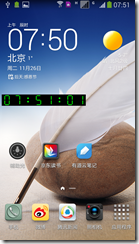
效果:
桌面小部件----LED电子时钟实现的更多相关文章
- 解决 三星Note3 桌面小部件不实时更新/不刷新 的问题
机型及问题描述:我的是三星note3 (国行 SM-N9008V),已ROOT,安装了LBE安全大师.在桌面小部件中,有些不会实时更新.比如有 滴答清单(办过的事项无法勾选),百度云音乐(歌曲播放更新 ...
- Android 桌面小部件
1. 添加AppWidgetProvider 实际上就是个带有界面的BroadcastReceiver public class SimpleWidgetProvider extends AppWid ...
- Android开发中实现桌面小部件
详细信息请参考原文:Android开发中实现桌面小部件 在Android开发中,有时候我们的App设计的功能比较多的时候,需要根据需要更简洁的为用户提供清晰已用的某些功能的时候,用桌面小部件就是一个很 ...
- 桌面小部件AppWidgetProvider简单分析
1.一般桌面小部件涉及到的类 AppWidgetProvider :BroadcastRecevier子类,用于接收更新,删除通知 AppWidgetProvderInfo:AppWidget相关信息 ...
- 桌面小部件Wight父类AppWidgetProvider的三个方法
onUpdate()这个方法会在每次更新App Widget的时候调用,数据更新的逻辑都写在这个方法里边.而且要注意的是:在用户添加小部件的时候,会首先调用这个方法,应该在这个方法里进行初始化操作,比 ...
- 优质Android小部件:索尼滚动相册
虽然骚尼手机卖的不怎么样,但是有些东西还是做的挺好的,工业设计就不用说了,索尼的相册的双指任意缩放功能也是尤其炫酷.其桌面小部件滚动相册我觉得也挺好的,比谷歌原生的相册墙功能好多了,网上搜了一下也没发 ...
- Android-RemoteView-桌面小部件
Android-RemoteView-桌面小部件 学习自 <Android开发艺术探索> https://developer.android.google.cn/guide/topics/ ...
- 【Android界面实现】AppWidght全面学习之电量监控小部件的实现具体解释
版权声明:本文为博主原创文章,未经博主同意不得转载. https://blog.csdn.net/bz419927089/article/details/35791047 前几天翻看之前下载的各种资料 ...
- Android简易实战教程--第十四话《模仿金山助手创建桌面Widget小部件》
打开谷歌api,对widget小部件做如下说明: App Widgets are miniature application views that can be embedded in otherap ...
随机推荐
- mysql 字符串类型数字排序
排序字段+0,类似 Java 把 其他类型转换成字符串 比如 +“”: SELECT b.tag_value AS NAME, sum(b.uv) ASVALUE FROM met ...
- C#快速剔除字符串中不合法的文件名或者文件路径字符
C#快速剔除字符串中不合法的文件名 string strFileName= "文件名称"; StringBuilder rBuilder = new StringBuilder( ...
- android scrollview组件禁止滑动的方法
xml配置: android:id="@+id/sc_freement" android:layout_width="fill ...
- QML 语言基础
在<Qt Quick 简单介绍>中我们提到 QML 语法和 Json 相似,请參考<Qt on Android: http下载与Json解析>查看 Json 语法.当然这里我们 ...
- session绑定javaBean
1.HttpSessionBindingListener 这个监听器,可以让javaBean对象,感知它被绑定到session中或从session中移除.2.HttpSessionActivati ...
- AsyncTask和Handler的对比
AsyncTask和Handler对比 1 ) AsyncTask实现的原理,和适用的优缺点 AsyncTask,是android提供的轻量级的异步类,可以直接继承AsyncTask,在类中实现异步操 ...
- 织梦(dedecms)如何清空全部文章和删除后新增文章id号归1的方法
很多朋友在使用织梦程序做网站的过程中,难免需要添加一些测试文章用于测试网站功能模板等,还有些人朋友网站改版需要变更内容的时候,面对着众多的老文章后总是一筹莫展! 由于织梦后台并不自带一键删除整站文章的 ...
- 二维码生成Demo
在C#中直接引用ThoughtWorks.QRCode.dll 类, 下载 dll 类 http://file.111cn.net/download/2013/06/29/20120516165420 ...
- 工时统计的sql练习--包含时间处理
//按月统计,除去周末的考勤,(工时,请假,缺勤) --建表sql 创建[dbo].[AbsenceHourld]CREATE TABLE [dbo].[AbsenceHourld]( [id] [i ...
- 使用EditText搜索listview里面的内容,实现Listview跟随变动的情况
1.布局的XML文件里面添加EditText控件(省略)控件id=mSearch ListView的id=admin_lv; 2.一.获取ListView展示的数据(通过适配器获取) 二.这个是我要说 ...