
UVa 1103 Ancient Messages(二重深搜)
In order to understand early civilizations, archaeologists often study texts written in ancient languages.One such language, used in Egypt more than 3000 years ago, is based on characters called hieroglyphs.Figure C.1 shows six hieroglyphs and their names. In this problem, you will write a program to recognize these six characters.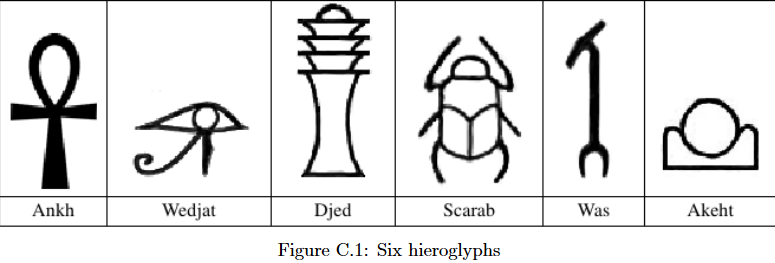
Input
The input consists of several test cases, each of which describes an image containing one or morehieroglyphs chosen from among those shown in Figure C.1. The image is given in the form of a seriesof horizontal scan lines consisting of black pixels (represented by 1) and white pixels (represented by0). In the input data, each scan line is encoded in hexadecimal notation. For example, the sequence ofeight pixels 10011100 (one black pixel, followed by two white pixels, and so on) would be represented inhexadecimal notation as 9c. Only digits and lowercase letters a through f are used in the hexadecimalencoding. The first line of each test case contains two integers, H and W. H (0 < H ≤ 200) is thenumber of scan lines in the image. W (0 < W ≤ 50) is the number of hexadecimal characters in each line. The next H lines contain the hexadecimal characters of the image, working from top to bottom.
Input images conform to the following rules:
• The image contains only hieroglyphs shown in Figure C.1.
• Each image contains at least one valid hieroglyph.
• Each black pixel in the image is part of a valid hieroglyph.
• Each hieroglyph consists of a connected set of black pixels and each black pixel has at least one other black pixel on its top, bottom, left, or right side.
• The hieroglyphs do not touch and no hieroglyph is inside another hieroglyph.
• Two black pixels that touch diagonally will always have a common touching black pixel.
• The hieroglyphs may be distorted but each has a shape that is topologically equivalent to one of the symbols in Figure C.1. (Two figures are topologically equivalent if each can be transformed into the other by stretching without tearing.)
The last test case is followed by a line containing two zeros.
Output
For each test case, display its case number followed by a string containing one character for each
hieroglyph recognized in the image, using the following code:
Ankh: A
Wedjat: J
Djed: D
Scarab: S
Was: W
Akhet: K
In each output string, print the codes in alphabetic order. Follow the format of the sample output.
The sample input contains descriptions of test cases shown in Figures C.2 and C.3. Due to space constraints not all of the sample input can be shown on this page.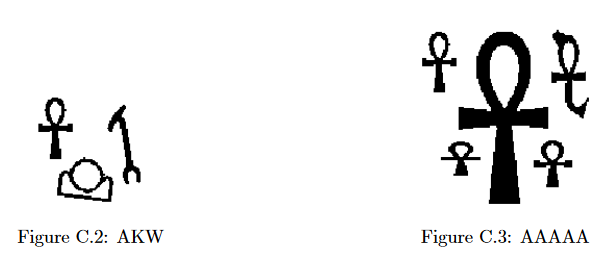
Sample Input
100 25
0000000000000000000000000
0000000000000000000000000
...(50 lines omitted)...
00001fe0000000000007c0000
00003fe0000000000007c0000
...(44 lines omitted)...
0000000000000000000000000
0000000000000000000000000
150 38
00000000000000000000000000000000000000
00000000000000000000000000000000000000
...(75 lines omitted)...
0000000003fffffffffffffffff00000000000
0000000003fffffffffffffffff00000000000
...(69 lines omitted)...
00000000000000000000000000000000000000
000000000000000000000000000000000000
00000000000000000000000000000000000000
0 0
Sample Output
Case 1: AKW
Case 2: AAAAA
题意
给你n行m列十六进制字符(0-f)每个字符等于4个二进制数(1代表黑点,0代表白点),再给你6个图,请按字典序输出所有符号
题解
首先找6个图怎么变都不会变的条件,黑点中间的白洞数量分别为(1,3,5,4,0,2)
问题就在于怎么找符号内的白洞
dfs()用于清除白点0变成2,dfs1()用于找黑点
1.首先根据输入,所有符号不会接触,也就是说,符号外的白点属于多余的白点得去掉
这时候就需要在图的最外一圈填上0,连通所有多余的白点,dfs(0,0)
2.然后根据输入,每个符号都是1个四连块,也就是说,符号是连通的,这样只需要dfs1(黑点)
如果是1,继续搜
如果是0,白洞+1,dfs(这个点)
代码
 #include<bits/stdc++.h>

 using namespace std;

 char s[+][*+];

 int dx[]={,,,-};

 int dy[]={,-,,};

 int n,m,cnt;

 bool check(int x,int y)//边界

 {

     if(x>=&&x<=n+&&y>=&&y<=m*+)return true;

     return false;

 }

 int dfs(int x,int y)//清除白点

 {

     if(s[x][y]=='')return ;

     s[x][y]='';

     for(int i=;i<;i++)

     {

         int xx=x+dx[i];

         int yy=y+dy[i];

         if(check(xx,yy)&&s[xx][yy]=='')

             dfs(xx,yy);

     }

     return ;

 }

 int dfs1(int x,int y)//搜索黑点

 {

     if(s[x][y]=='')return ;

     s[x][y]='';

     for(int i=;i<;i++)

     {

         int xx=x+dx[i];

         int yy=y+dy[i];

         if(check(xx,yy))

         {

             if(s[xx][yy]=='')

                 dfs1(xx,yy);

             if(s[xx][yy]=='')

                 cnt++,dfs(xx,yy);

         }

     }

     return ;

 }

 int main()

 {

     int o=;

     char ch;

     map<char,string> ma;

     ma['']="";ma['']="";ma['']="";ma['']="";ma['']="";

     ma['']="";ma['']="";ma['']="";ma['']="";ma['']="";

     ma['a']="";ma['b']="";ma['c']="";ma['d']="";ma['e']="";

     ma['f']="";

     map<int,char> mb;

     mb[]='W';mb[]='A';mb[]='K';mb[]='J';mb[]='S';mb[]='D';

     while(scanf("%d %d",&n,&m)!=EOF,n||m)

     {

         getchar();

         memset(s,'',sizeof(s));//填0

         for(int i=;i<=n;i++)

         {

             for(int j=;j<m;j++)

             {

                 scanf("%c",&ch);

                 s[i][j*+]=ma[ch][];

                 s[i][j*+]=ma[ch][];

                 s[i][j*+]=ma[ch][];

                 s[i][j*+]=ma[ch][];

             }

             getchar();

         }

         dfs(,);

         vector<char> vec;

         for(int i=;i<=n+;i++)

         {

             for(int j=;j<=m*+;j++)

             {

                 if(s[i][j]=='')

                 {

                     cnt=;

                     dfs1(i,j);

                     vec.push_back(mb[cnt]);

                 }

             }

         }

         sort(vec.begin(),vec.end());

         printf("Case %d: ",o++);

         for(int i=;i<vec.size();i++)

             printf("%c",vec[i]);

         printf("\n");

     }

     return ;

 }
UVa 1103 Ancient Messages(二重深搜)的更多相关文章
- Uva 1103 Ancient Messages
大致思路是DFS: 1. 每个图案所包含的白色连通块数量不一: Ankh : 1 ; Wedjat : 3 ; Djed : 5 ; Scarab : 4 ; Was : 0 ; Ak ...
- UVA 10160 Servicing Stations(深搜 + 剪枝)
Problem D: Servicing stations A company offers personal computers for sale in N towns (3 <= N < ...
- UVA 165 Stamps (DFS深搜回溯)
Stamps The government of Nova Mareterrania requires that various legal documents have stamps attac ...
- 图-用DFS求连通块- UVa 1103和用BFS求最短路-UVa816。
这道题目甚长, 代码也是甚长, 但是思路却不是太难.然而有好多代码实现的细节, 确是十分的巧妙. 对代码阅读能力, 代码理解能力, 代码实现能力, 代码实现技巧, DFS方法都大有裨益, 敬请有兴趣者 ...
- K - Ancient Messages(dfs求联通块)
K - Ancient Messages Time Limit:3000MS Memory Limit:0KB 64bit IO Format:%lld & %llu Subm ...
- hdu 1010 Tempter of the Bone(深搜+奇偶剪枝)
Tempter of the Bone Time Limit: 2000/1000 MS (Java/Others) Memory Limit: 65536/32768 K (Java/Othe ...
- HDU--杭电--1195--Open the Lock--深搜--都用双向广搜,弱爆了,看题了没?语文没过关吧?暴力深搜难道我会害羞?
这个题我看了,都是推荐的神马双向广搜,难道这个深搜你们都木有发现?还是特意留个机会给我装逼? Open the Lock Time Limit: 2000/1000 MS (Java/Others) ...
- 利用深搜和宽搜两种算法解决TreeView控件加载文件的问题。
利用TreeView控件加载文件,必须遍历处所有的文件和文件夹. 深搜算法用到了递归. using System; using System.Collections.Generic; using Sy ...
- 2016弱校联盟十一专场10.3---Similarity of Subtrees(深搜+hash、映射)
题目链接 https://acm.bnu.edu.cn/v3/problem_show.php?pid=52310 problem description Define the depth of a ...
随机推荐
- C# 调用 C++ 的 DLL 返回值为 bool 时,值混乱
现象:C++ 导出函数的返回值为 false,C# 调用该函数获取的返回值却为 true . 原因:C++ 导出函数返回 false 时,采取的方式是: 将 C# 定义的用来接收返回值的 bool 所 ...
- SED命令用法整理
sed '/Started/'q 匹配到Started字符串则退出sed命令 sed '/Started/{/in/q}' 同时匹配到Started和in两个字符时则退出sed命令 ------- ...
- mycat的schema.xml的个人的一点理解
官方文档里讲的详细的部分的我就不再赘述了,我只是谈谈我自己的理解 刚开始接触mycat,最重要的几个配置文件有server.xml,schema.xml,还有个rule.xml配置文件 具体都是干啥用 ...
- vmware搭建lnmp环境配置域名
找到nginx配置文件,修改server_name 然后找到/etc/hosts文件 修改成如下 之后在Windows本地的C盘的hosts文件中添加解析 好了,这样就可以访问了 通往牛逼的路上,在意 ...
- python实现排序算法三:插入排序
插入排序基本思想:假设一个无序数组A,则对于只有一个元素A[0]的子数组C来讲,其是有序的,然后将A[1]插入到C中,则就是将A[1]与A[0]进行比较,如果A[1]比A[0]小,则交换两者的顺序,这 ...
- delphi 原创应用工具箱
用到的主要知识点: (1) listview背景透明 (2) 读取应用图标 (3)图标透明 (4)实时显示微软必应首页图,裁剪图片等
- overload重载
方法的重载 /** * 重载 overload * @author Administrator *同一个类,同一个方法 *不同:参数列表不同(类型,个数,顺序) 只和 参数列表有关 * 跟 返回值 和 ...
- asp.net 如何判断输入的值 包括 汉字?
string input = " 里面是不是汉字 ";bool bl= System.Text.RegularExpressions.Regex.IsMatch(input, @& ...
- VR/AR 科技了解
Dream学院学习资料: VR/AR科技学习需要先学习NDK技术 AR/VR->图像学->图像处理(OpenCV->Intel公司在1999年发布3.2).图像绘制渲染(OpenGL ...
- java.security.MessageDigest (1)
我们知道,编程中数据的传输,保存,为了考虑安全性的问题,需要将数据进行加密.我们拿数据库做例子.如果一个用户注册系统的数据库,没有对用户的信息进行保存,如,我去页面注册,输入"Vicky&q ...