
Flink standalone模式作业执行流程
宏观流程如下图:
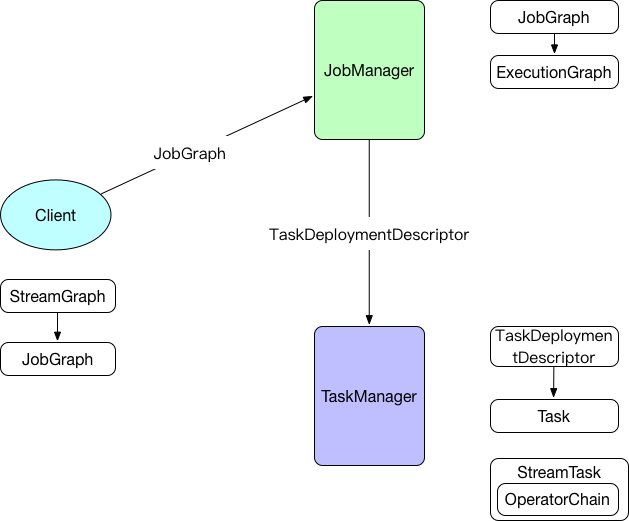
client端
生成StreamGraph
    env.addSource(new SocketTextStreamFunction(...))

       .flatMap(new FlatMapFunction())

       .keyBy("word")

       .timeWindow(Time.seconds(5))

       .reduce(new ReduceFunction())

       .print()
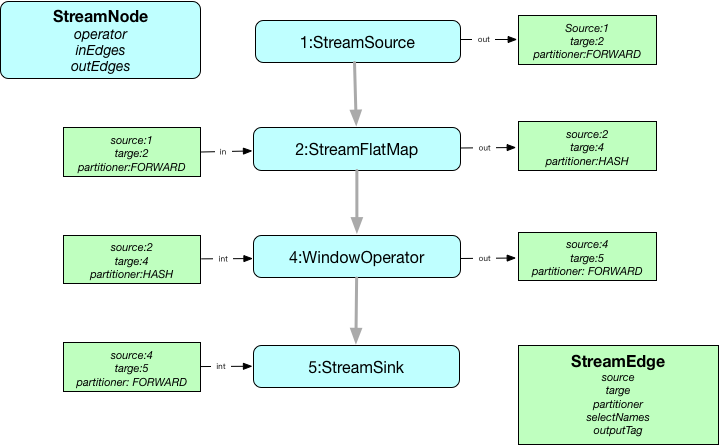
StreamExecutionEnvironment上的一系列api调用会在env->transformations中添加相应的StreamTransformation对象,然后调用StreamGraphGenerator->transformation方法遍历所有的StreamTransformation对象生成最终的StreamGraph。
如上代码段会生成如下StreamGraph:
StreamGraph->JobGraph
	private List<StreamEdge> createChain(

			Integer startNodeId,

			Integer currentNodeId,

			Map<Integer, byte[]> hashes,

			List<Map<Integer, byte[]>> legacyHashes,

			int chainIndex,

			Map<Integer, List<Tuple2<byte[], byte[]>>> chainedOperatorHashes)
从StreamGraph的所有sourceStreamNode开始遍历处理,如果是可链接的(isChainable为true)则继续,同时生成该节点的StreamConfig信息(包含StreamOperator``chainIndex``chainEnd等),否则生成新的JobVertex,最后链接connect函数创建JobEdge对象链接JobVertex。
	public static boolean isChainable(StreamEdge edge, StreamGraph streamGraph) {

		StreamNode upStreamVertex = edge.getSourceVertex();

		StreamNode downStreamVertex = edge.getTargetVertex();

		StreamOperator<?> headOperator = upStreamVertex.getOperator();

		StreamOperator<?> outOperator = downStreamVertex.getOperator();

		return downStreamVertex.getInEdges().size() == 1

				&& outOperator != null

				&& headOperator != null

				&& upStreamVertex.isSameSlotSharingGroup(downStreamVertex)

				&& outOperator.getChainingStrategy() == ChainingStrategy.ALWAYS

				&& (headOperator.getChainingStrategy() == ChainingStrategy.HEAD ||

					headOperator.getChainingStrategy() == ChainingStrategy.ALWAYS)

				&& (edge.getPartitioner() instanceof ForwardPartitioner)

				&& upStreamVertex.getParallelism() == downStreamVertex.getParallelism()

				&& streamGraph.isChainingEnabled();

	}
如上代码会生成包含两个JobVertex对象的JobGraph:
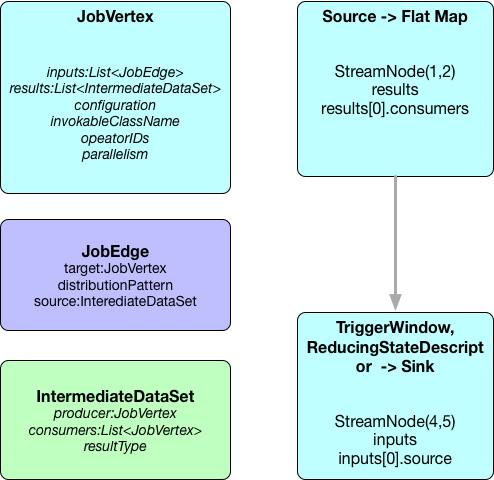
JobVertex的configuration属性中的chainedTaskConfig_``chainedOutputs分别包含了该节点链接的所有StreamNode节点的配置信息和所有SteamNode本身序列化后的二进制数组
JobManager
主要把客户端提交的JobGraph转化成ExecutionGraph,并把ExecutionGraph包含的所有ExecutionVertex对应的Execution提交给分配到其执行所需资源的TaskManager
DistributionPattern分发模式用于确定生产者(产生中间结果IntermediateResultPartition)与其消费者(通过ExecutionEdge)怎样链接
		switch (channel.getShipStrategy()) {

			case FORWARD:

				distributionPattern = DistributionPattern.POINTWISE;

				break;

			case PARTITION_RANDOM:

			case BROADCAST:

			case PARTITION_HASH:

			case PARTITION_CUSTOM:

			case PARTITION_RANGE:

			case PARTITION_FORCED_REBALANCE:

				distributionPattern = DistributionPattern.ALL_TO_ALL;

				break;

			default:

				throw new RuntimeException("Unknown runtime ship strategy: " + channel.getShipStrategy());

		}
ExecutionVertex之间如何链接:
ALL_TO_ALL模式:
则每一个并行的ExecutionVertex节点都会链接到源节点产生的所有中间结果IntermediateResultPartition

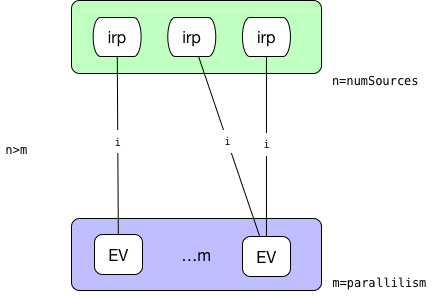
POINTWISE模式:源的并行度和目标并行度相等。这种情况下,采用一对一的链接方式:

源的并行度小于目标并行度。这种情况下,对于每一个执行节点链接到的源的中间结果分区由如下公式计算得到:
sourcePartition = (int)subTaskIndex / (((float) parallelism) / numSources)
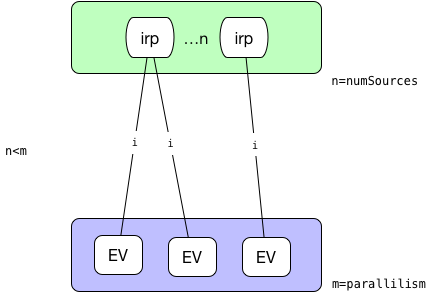 * 源的并行度大于目标并行度。这种情况下,计算每一个执行节点会平均链接到几个源节点,平均分配后余下的都分给最后一个节点。
最后提交给TaskManager的TaskDeploymentDescriptor如下:
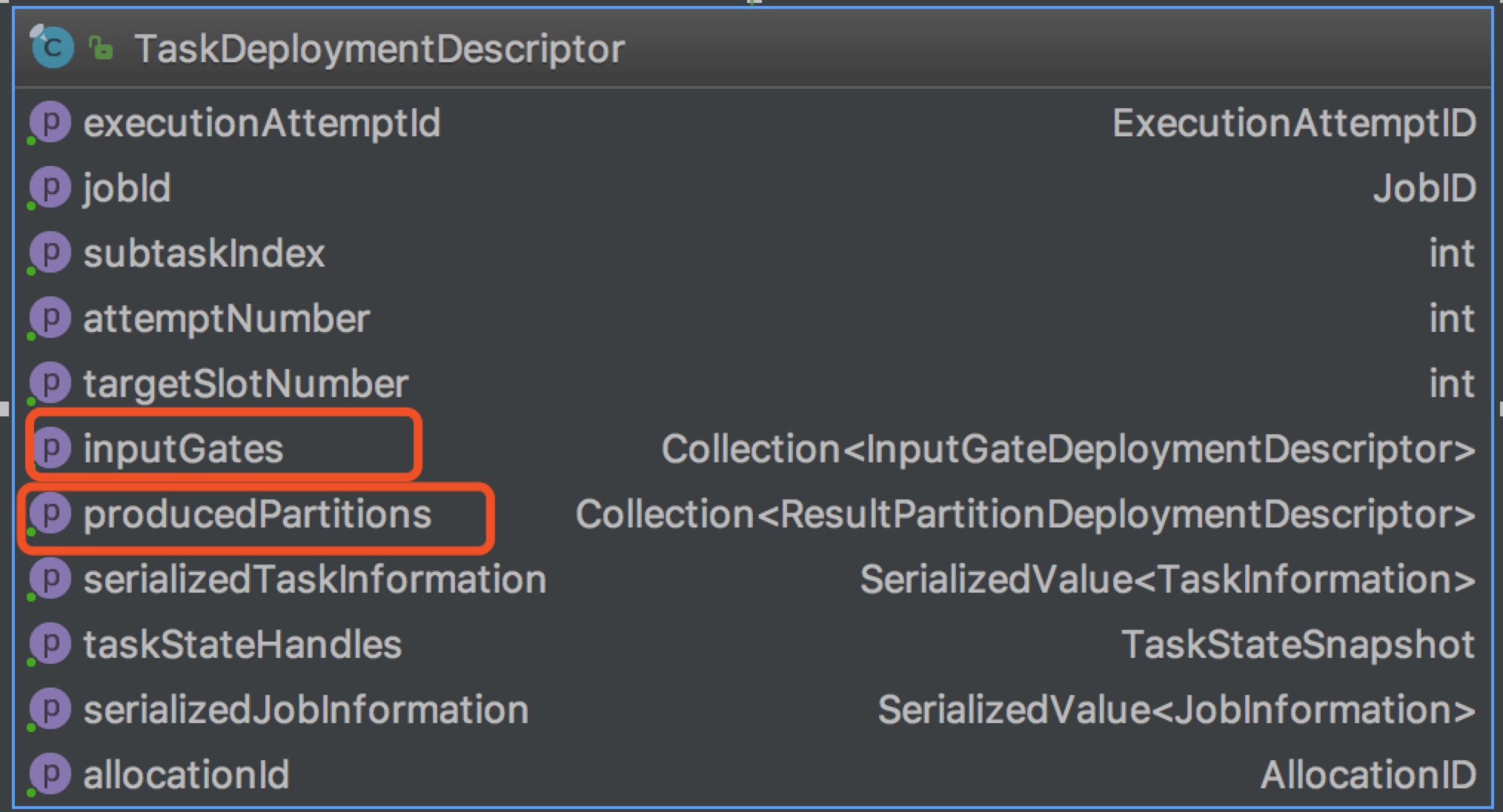
ResultPartitionDeploymentDescriptor有一个numberOfSubpartitions字段,其等于此ResultPartition的消费者的数量(被下级链接到的边数),因为最终执行的时候每一个ResultPartition还会拆分为numberOfSubpartitions相同数量的ResultSubPartition。
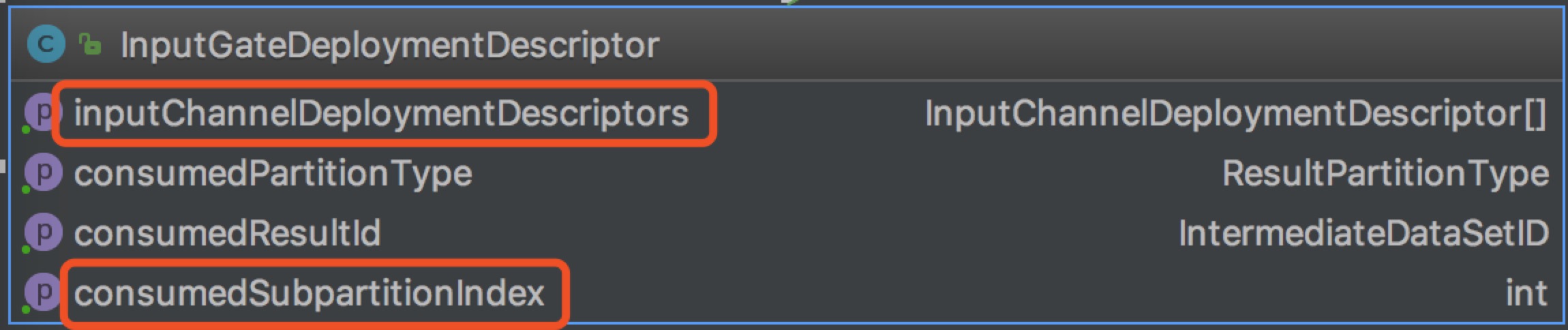
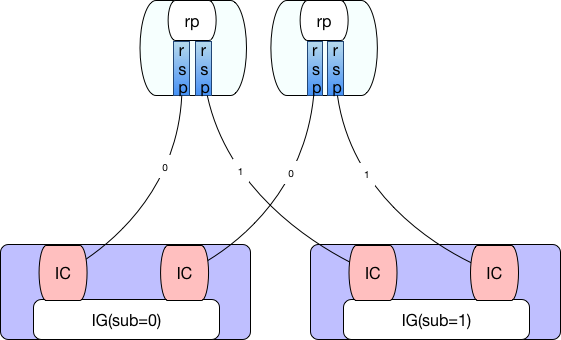
InputGateDeploymentDescriptor包含多个InputChannelDeploymentDescriptor和一个用以指示消费第几个ResultSubPartition的consumedSubpartitionIndex。每一个InputGateDeploymentDescriptor消费的所有ResultPartition的subPartitionIndex是一样的。
例如并行度均为2的两个ExecutionJobVertex采用ALL_TO_ALL方式链接的结果如下:
TaskManager
TaskManager接收到TaskDeploymentDescriptor对象后进行反序列化生成Task对象并进行一系列的初始化操作(如:根据ResultPartitionDeploymentDescriptor对象初始化writers[ResultPartitionWriter],根据InputGateDeploymentDescriptor初始化inputGates[SingleInputGate],重新设置classLoader等)然后启用新线程执行invokable[AbstractInvokable]->invoke方法。
也就是说Task的主要业务逻辑其实都包含在了AbstractInvokable对象中,我们来具体看下其子类StreamTask(SourceStreamTask和OneInputStreamTask)
StreamTask的invoke方法会创建OperatorChain
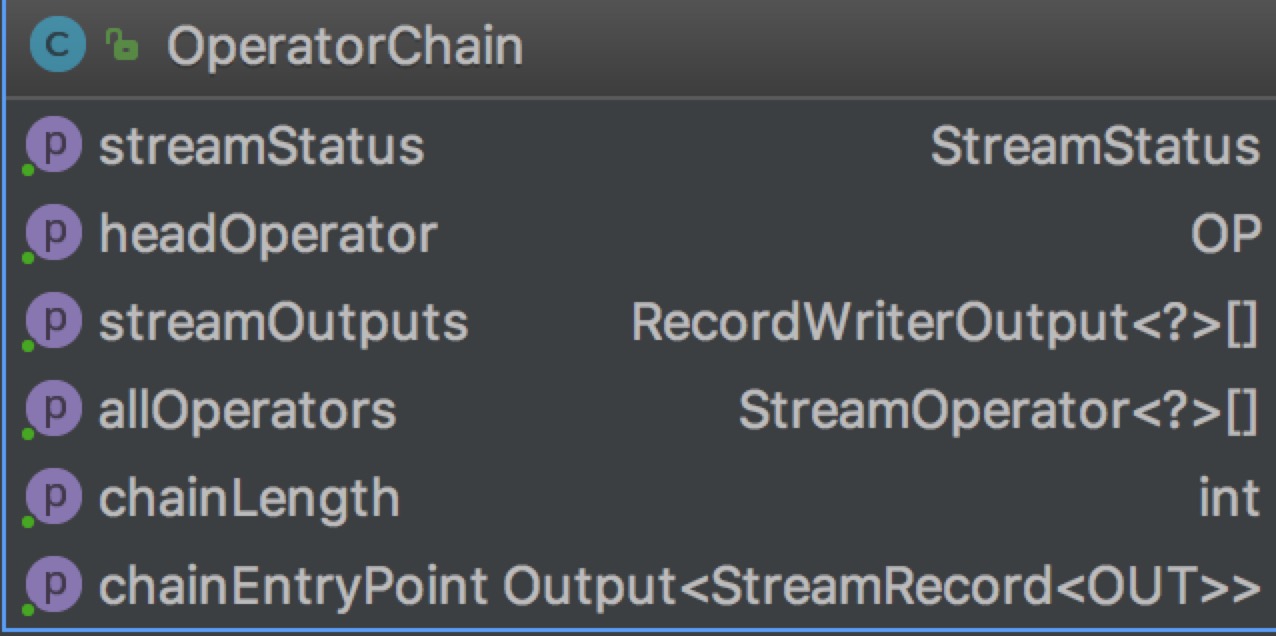
重点关注chainEntryPoint这个属性是BroadcastingOutputCollector类型,其collect方法如下:
		public void collect(StreamRecord<T> record) {

			for (Output<StreamRecord<T>> output : outputs) {

				output.collect(record);

			}

		}
即使依次遍历链中的每一个output进行collect操作,而其中的每一个output又是ChainingOutput及其子类。
		@Override

		public void collect(StreamRecord<T> record) {

			if (this.outputTag != null) {

				// we are only responsible for emitting to the main input

				return;

			}

			pushToOperator(record);

		}

		protected <X> void pushToOperator(StreamRecord<X> record) {

			try {

				// we know that the given outputTag matches our OutputTag so the record

				// must be of the type that our operator expects.

				@SuppressWarnings("unchecked")

				StreamRecord<T> castRecord = (StreamRecord<T>) record;

				numRecordsIn.inc();

				operator.setKeyContextElement1(castRecord);

				operator.processElement(castRecord);

			}

			catch (Exception e) {

				throw new ExceptionInChainedOperatorException(e);

			}

		}
其中operator是OneInputStreamOperator类型其子类业务实现逻辑(processElement)方法:调用用户自定义函数userFunction[Function]处理后按需调用output.collect(element)其中output可能也是一个ChainingOutput类型,这样整个执行链路就被一级一级链接起来了。
			this.chainEntryPoint = createOutputCollector(

				containingTask,

				configuration,

				chainedConfigs,

				userCodeClassloader,

				streamOutputMap,

				allOps);

			if (headOperator != null) {

				Output output = getChainEntryPoint();

				headOperator.setup(containingTask, configuration, output);

			}
对于StreamTask常见的一个子类SourceStreamTask,其run方法:
	@Override

	protected void run() throws Exception {

		headOperator.run(getCheckpointLock(), getStreamStatusMaintainer());

	}
对于OperatorChain链上最后一个operator其output为RecordWriterOutput类型其封装了StreamRecordWriter配合ChannelSelector写入到具体的某个ResultSubPartition
	public void emit(T record) throws IOException, InterruptedException {

		for (int targetChannel : channelSelector.selectChannels(record, numChannels)) {

			sendToTarget(record, targetChannel);

		}

	}
常见的ChannelSelector:
RescalePartitioner|RebalancePartitioner: 轮询KeyGroupStreamPartitioner: 基于key分组GlobalPartitioner: 全局,只通过subpartition==0ShufflePartitioner:随机到子分区ForwardPartitioner: 本地转发BroadcastPartitioner: 广播到所有分区
另一个StreamTask常见的一个子类OneInputStreamTask,其run方法:
	@Override

	protected void run() throws Exception {

		// cache processor reference on the stack, to make the code more JIT friendly

		final StreamInputProcessor<IN> inputProcessor = this.inputProcessor;

		while (running && inputProcessor.processInput()) {

			// all the work happens in the "processInput" method

		}

	}
其inputProcessor是StreamInputProcessor类型,在init方法中创建
		if (checkpointMode == CheckpointingMode.EXACTLY_ONCE) {

			long maxAlign = taskManagerConfig.getLong(TaskManagerOptions.TASK_CHECKPOINT_ALIGNMENT_BYTES_LIMIT);

			if (!(maxAlign == -1 || maxAlign > 0)) {

				throw new IllegalConfigurationException(

						TaskManagerOptions.TASK_CHECKPOINT_ALIGNMENT_BYTES_LIMIT.key()

						+ " must be positive or -1 (infinite)");

			}

			this.barrierHandler = new BarrierBuffer(inputGate, ioManager, maxAlign);

		}

		else if (checkpointMode == CheckpointingMode.AT_LEAST_ONCE) {

			this.barrierHandler = new BarrierTracker(inputGate);

		}
barrierHandler与设置的CheckpointingMode相关:
EXACTLY_ONCE:BarrierBufferAT_LEAST_ONCE:BarrierTracker
inputProcessor的processInput方法会调用barrierHandler.getNextNonBlocked()如果获取到一条完整记录则调用streamOperator.processElement(record)触发整体调用链的执行。
Flink standalone模式作业执行流程的更多相关文章
- 追源索骥:透过源码看懂Flink核心框架的执行流程
li,ol.inline>li{display:inline-block;padding-right:5px;padding-left:5px}dl{margin-bottom:20px}dt, ...
- 透过源码看懂Flink核心框架的执行流程
前言 Flink是大数据处理领域最近很火的一个开源的分布式.高性能的流式处理框架,其对数据的处理可以达到毫秒级别.本文以一个来自官网的WordCount例子为引,全面阐述flink的核心架构及执行流程 ...
- Spark架构与作业执行流程简介(scala版)
在讲spark之前,不得不详细介绍一下RDD(Resilient Distributed Dataset),打开RDD的源码,一开始的介绍如此: 字面意思就是弹性分布式数据集,是spark中最基本的数 ...
- Spark架构与作业执行流程简介
https://www.cnblogs.com/shenh062326/p/3658543.html
- Flink架构分析之Standalone模式启动流程
概述 FLIP6 对Flink架构进行了改进,引入了Dispatcher组件集成了所有任务共享的一些组件:SubmittedJobGraphStore,LibraryCacheManager等,为了保 ...
- Map/Reduce 工作机制分析 --- 作业的执行流程
前言 从运行我们的 Map/Reduce 程序,到结果的提交,Hadoop 平台其实做了很多事情. 那么 Hadoop 平台到底做了什么事情,让 Map/Reduce 程序可以如此 "轻易& ...
- 第九篇:Map/Reduce 工作机制分析 - 作业的执行流程
前言 从运行我们的 Map/Reduce 程序,到结果的提交,Hadoop 平台其实做了很多事情. 那么 Hadoop 平台到底做了什么事情,让 Map/Reduce 程序可以如此 "轻易& ...
- 面试高频SpringMVC执行流程最优解(源码分析)
文章已托管到GitHub,大家可以去GitHub查看阅读,欢迎老板们前来Star! 搜索关注微信公众号 码出Offer 领取各种学习资料! SpringMVC执行流程 SpringMVC概述 Spri ...
- Thinkphp设计模式和执行流程
ThinkPHP设计模式 单例模式:数据库连接DB工厂模式:比如Db.class.php中的factory()方法适配器模式:驱动类,数据库观察者模式:Hook类 注册树模式:绑定容器外观模式:fac ...
随机推荐
- 用JS制作《飞机大作战》游戏_第1讲(素材查找和界面框架搭建)-陈远波
一.查找素材: 二.分析游戏界面框架: 登录界面.游戏界面.暂停游戏界面.玩家死亡后弹出界面:并对应的界面包含什么元素: 三.分别搭建以上四个界面: 1.登录界面与游戏界面框架(隐藏游戏界面,四个界面 ...
- 阿里八八Alpha阶段Scrum(7/12)
今日进度 叶文滔: Andriod Studio新版打开旧版项目存在兼容性问题,仍在寻求解决办法 王国超: 今天还是在调bug,真机运行总是闪退 俞鋆: 正在学习api制作和相关的文档编写,研究了一些 ...
- 团队作业——Alpha冲刺 5/12
团队作业--Alpha冲刺 冲刺任务安排 杨光海天 今日任务:编辑界面完成部分内容,学习了下拉菜单控件的建立,完善界面标题内容,以及交互. 明日任务:继续完善编辑界面,学习使用gallery,着手配图 ...
- jstl格式化日期
<%@ page contentType="text/html" pageEncoding="GBK"%> <%@ page import=& ...
- BZOJ1211:[HNOI2004]树的计数(组合数学,Prufer)
Description 一个有n个结点的树,设它的结点分别为v1, v2, …, vn,已知第i个结点vi的度数为di,问满足这样的条件的不同的树有多少棵.给定n,d1, d2, …, dn,编程需要 ...
- java通过http服务执行shell命令
服务端代码/** * 执行shell命令 * @param command 执行命令 * @return */public String exeCommandByPath( String comman ...
- Python os.walk() 方法
#coding=utf-8 import os #(dirpath, dirnames, filenames)[文件夹路径, 文件夹名字, 文件名] def file_name(file_dir): ...
- error occurred at recursive SQL level 1
ORA-00604: error occurred at recursive SQL level 1出现的错误:java.sql.SQLException: ORA-00604: error occu ...
- 【转】SVN branches trunk 合并 讲解
转自:http://blog.csdn.net/e3002/article/details/21469437 使用svn几年了,一直对分支和合并敬而远之,一来是因为分支的管理不该我操心,二来即使涉及到 ...
- ArcGIS中的坐标系统定义与投影转换方法
坐标系统是GIS数据重要的数学基础,用于表示地理要素.图像和观测结果的参照系统,坐标系统的定义能够保证地理数据在软件中正确的显示其位置.方向和距离,缺少坐标系统的GIS数据是不完善的,因此在ArcGI ...