
Matrices and Vectors
Matrices and Vectors
Matrices are 2-dimensional arrays:
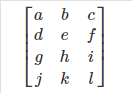
A vector is a matrix with one column and many rows:The above matrix has four rows and three columns, so it is a 4 x 3 matrix.
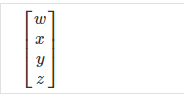
Notation and terms:So vectors are a subset of matrices. The above vector is a 4 x 1 matrix.
- Aij refers to the element in the ith row and jth column of matrix A.
- A vector with 'n' rows is referred to as an 'n'-dimensional vector.
- vi refers to the element in the ith row of the vector.
- In general, all our vectors and matrices will be 1-indexed. Note that for some programming languages, the arrays are 0-indexed.
- Matrices are usually denoted by uppercase names while vectors are lowercase.
- "Scalar" means that an object is a single value, not a vector or matrix.
- R refers to the set of scalar real numbers.
- Rn refers to the set of n-dimensional vectors of real numbers.
Run the cell below to get familiar with the commands in Octave/Matlab. Feel free to create matrices and vectors and try out different things.
% The ; denotes we are going back to a new row.

A = [1, 2, 3; 4, 5, 6; 7, 8, 9; 10, 11, 12]

% Initialize a vector

v = [1;2;3]

% Get the dimension of the matrix A where m = rows and n = columns

[m,n] = size(A)

% You could also store it this way

dim_A = size(A)

% Get the dimension of the vector v

dim_v = size(v)

% Now let's index into the 2nd row 3rd column of matrix A

A_23 = A(2,3)
Addition and Scalar Multiplication
Addition and subtraction are element-wise, so you simply add or subtract each corresponding element:

Subtracting Matrices:

In scalar multiplication, we simply multiply every element by the scalar value:To add or subtract two matrices, their dimensions must be the same.
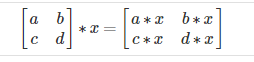
Experiment below with the Octave/Matlab commands for matrix addition and scalar multiplication. Feel free to try out different commands. Try to write out your answers for each command before running the cell below.In scalar division, we simply divide every element by the scalar value:
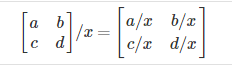
Experiment below with the Octave/Matlab commands for matrix addition and scalar multiplication. Feel free to try out different commands. Try to write out your answers for each command before running the cell below.
% Initialize matrix A and B

A = [1, 2, 4; 5, 3, 2]

B = [1, 3, 4; 1, 1, 1]

% Initialize constant s

s = 2

% See how element-wise addition works

add_AB = A + B

% See how element-wise subtraction works

sub_AB = A - B

% See how scalar multiplication works

mult_As = A * s

% Divide A by s

div_As = A / s

% What happens if we have a Matrix + scalar?

add_As = A + s
Matrix-Vector Multiplication
We map the column of the vector onto each row of the matrix, multiplying each element and summing the result.
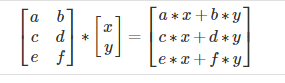
An m x n matrix multiplied by an n x 1 vector results in an m x 1 vector.The result is a vector. The number of columns of the matrix must equal the number of rows of the vector.
Below is an example of a matrix-vector multiplication. Make sure you understand how the multiplication works. Feel free to try different matrix-vector multiplications.
% Initialize matrix A

A = [1, 2, 3; 4, 5, 6;7, 8, 9]

% Initialize vector v

v = [1; 1; 1]

% Multiply A * v

Av = A * v
Matrix-Matrix Multiplication
We multiply two matrices by breaking it into several vector multiplications and concatenating the result.

To multiply two matrices, the number of columns of the first matrix must equal the number of rows of the second matrix.An m x n matrix multiplied by an n x o matrix results in an m x o matrix. In the above example, a 3 x 2 matrix times a 2 x 2 matrix resulted in a 3 x 2 matrix.
For example:
% Initialize a 3 by 2 matrix

A = [1, 2; 3, 4;5, 6]

% Initialize a 2 by 1 matrix

B = [1; 2]

% We expect a resulting matrix of (3 by 2)*(2 by 1) = (3 by 1)

mult_AB = A*B

% Make sure you understand why we got that result
Matrix Multiplication Properties
- Matrices are not commutative: A∗B≠B∗A
- Matrices are associative: (A∗B)∗C=A∗(B∗C)
The identity matrix, when multiplied by any matrix of the same dimensions, results in the original matrix. It's just like multiplying numbers by 1. The identity matrix simply has 1's on the diagonal (upper left to lower right diagonal) and 0's elsewhere.
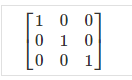
When multiplying the identity matrix after some matrix (A∗I), the square identity matrix's dimension should match the other matrix's columns. When multiplying the identity matrix before some other matrix (I∗A), the square identity matrix's dimension should match the other matrix's rows
.
% Initialize random matrices A and B

A = [1,2;4,5]

B = [1,1;0,2]

% Initialize a 2 by 2 identity matrix

I = eye(2)

% The above notation is the same as I = [1,0;0,1]

% What happens when we multiply I*A ?

IA = I*A

% How about A*I ?

AI = A*I

% Compute A*B

AB = A*B

% Is it equal to B*A?

BA = B*A

% Note that IA = AI but AB != BA
Inverse and Transpose
The inverse of a matrix A is denoted A−1. Multiplying by the inverse results in the identity matrix.
A non square matrix does not have an inverse matrix. We can compute inverses of matrices in octave with the pinv(A) function and in Matlab with the inv(A) function. Matrices that don't have an inverse are singular or degenerate.
The transposition of a matrix is like rotating the matrix 90° in clockwise direction and then reversing it. We can compute transposition of matrices in matlab with the transpose(A) function or A':
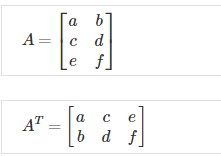
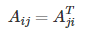
In other words:
% Initialize matrix A

A = [1,2,0;0,5,6;7,0,9]

% Transpose A

A_trans = A'

% Take the inverse of A

A_inv = inv(A)

% What is A^(-1)*A?

A_invA = inv(A)*A
Matrices and Vectors的更多相关文章
- RNN 入门教程 Part 2 – 使用 numpy 和 theano 分别实现RNN模型
转载 - Recurrent Neural Networks Tutorial, Part 2 – Implementing a RNN with Python, Numpy and Theano 本 ...
- [zt]矩阵求导公式
今天推导公式,发现居然有对矩阵的求导,狂汗--完全不会.不过还好网上有人总结了.吼吼,赶紧搬过来收藏备份. 基本公式:Y = A * X --> DY/DX = A'Y = X * A --&g ...
- Applying Eigenvalues to the Fibonacci Problem
http://scottsievert.github.io/blog/2015/01/31/the-mysterious-eigenvalue/ The Fibonacci problem is a ...
- 图像处理之image stitching
背景介绍 图像拼接是一项应用广泛的图像处理技术.根据特征点的相互匹配,可以将多张小视角的图像拼接成为一张大视角的图像,在广角照片合成.卫星照片处理.医学图像处理等领域都有应用.早期的图像拼接主要是运用 ...
- 对于fmri的设计矩阵构造的一个很直观的解释-by 西南大学xulei教授
本程序意在解释这样几个问题:完整版代码在本文的最后. 1.实验的设计如何转换成设计矩阵? 2.设计矩阵的每列表示一个刺激条件,如何确定它们? 3.如何根据设计矩阵和每个体素的信号求得该体素对刺激的敏感 ...
- Introduction to Gaussian Processes
Introduction to Gaussian Processes Gaussian processes (GP) are a cornerstone of modern machine learn ...
- The Model Complexity Myth
The Model Complexity Myth (or, Yes You Can Fit Models With More Parameters Than Data Points) An oft- ...
- SparkMLlib-----GMM算法
Gaussian Mixture Model(GMM)是一个很流行的聚类算法.它与K-Means的很像,但是K-Means的计算结果是算出每个数据点所属的簇,而GMM是计算出这些数据点分配到各个类别的 ...
- Machine-learning of Andrew Ng(Stanford University)
1.基础概念 机器学习是一门研究在非特定编程条件下让计算机采取行动的学科.最近二十年,机器学习为我们带来了自动驾驶汽车.实用的语音识别.高效的网络搜索,让我们对人类基因的解读能力大大提高.当今机器学习 ...
随机推荐
- .NET Core 使用RabbitMQ
RabbitMQ简介 AMQP,即Advanced Message Queuing Protocol,高级消息队列协议,是应用层协议的一个开放标准,为面向消息的中间件设计.消息中间件主要用于组件之间的 ...
- DI in ASP.NET Core
.NET-Core Series Server in ASP.NET-Core DI in ASP.NET-Core Routing in ASP.NET-Core Error Handling in ...
- 使用JavaScript实现ATM取款机
ATM机需求描述如下: 假设一个简单的ATM机的取款过程为: 首先提示用户输入密码(password),假设默认密码为111111,最多只能输入3次, 超过3次则提示用户"密码错误,请取 ...
- [js高手之路] 设计模式系列课程 - DOM迭代器(2)
如果你对jquery比较熟悉的话,应该用过 eq, first, last, get, prev, next, siblings等过滤器和方法.本文,我们就用迭代设计模式来封装实现,类似的功能 < ...
- TTabControl
1.TTabControl 组件的典型用法TTabControl 组件使用起来,根本不会使程序简单化,所以不提倡使用此组件,可以用TPageControl组件代替.与多页组件不同的是,虽然Tab 组件 ...
- Spring Boot Document Part I
最近准备学习Spring Boot 随便翻一下官方的文档 Part I. Spring Boot Documentation Spirng Boot简短介绍,作为接下来内容的导航,可快速预览本章内容. ...
- 不可不知的socket和TCP连接过程
html { font-family: sans-serif } body { margin: 0 } article,aside,details,figcaption,figure,footer,h ...
- Springboot - 学习笔记 ②
前言 这一篇是关于spring boot中的配置(configuration)的介绍,我们接下来要说的男主就是 “application.properties”. “男神”默认是生成在“/src/ma ...
- Ubuntu 16安装GPU版本tensorflow
pre { direction: ltr; color: rgb(0, 0, 0) } pre.western { font-family: "Liberation Mono", ...
- 【框架学习与探究之宿主服务--Topshelf】
前言 此文欢迎转载,原始链接地址:http://www.cnblogs.com/DjlNet/p/7603819.html 正文 原先也偶然见过这个关键词,当时只是有个大致了解貌似和WinServic ...