
Codeforces Round #432 (Div. 2, based on IndiaHacks Final Round 2017)ABCD
1 second
256 megabytes
standard input
standard output
Arpa is researching the Mexican wave.
There are n spectators in the stadium, labeled from 1 to n. They start the Mexican wave at time 0.
- At time 1, the first spectator stands.
- At time 2, the second spectator stands.
- ...
- At time k, the k-th spectator stands.
- At time k + 1, the (k + 1)-th spectator stands and the first spectator sits.
- At time k + 2, the (k + 2)-th spectator stands and the second spectator sits.
- ...
- At time n, the n-th spectator stands and the (n - k)-th spectator sits.
- At time n + 1, the (n + 1 - k)-th spectator sits.
- ...
- At time n + k, the n-th spectator sits.
Arpa wants to know how many spectators are standing at time t.
The first line contains three integers n, k, t (1 ≤ n ≤ 109, 1 ≤ k ≤ n, 1 ≤ t < n + k).
Print single integer: how many spectators are standing at time t.
10 5 3
3
10 5 7
5
10 5 12
3
In the following a sitting spectator is represented as -, a standing spectator is represented as ^.
- At t = 0 ----------
 number of standing spectators = 0.
 - At t = 1 ^--------- number of standing spectators = 1.
- At t = 2 ^^-------- number of standing spectators = 2.
- At t = 3 ^^^------- number of standing spectators = 3.
- At t = 4 ^^^^------ number of standing spectators = 4.
- At t = 5 ^^^^^----- number of standing spectators = 5.
- At t = 6 -^^^^^---- number of standing spectators = 5.
- At t = 7 --^^^^^--- number of standing spectators = 5.
- At t = 8 ---^^^^^-- number of standing spectators = 5.
- At t = 9 ----^^^^^- number of standing spectators = 5.
- At t = 10 -----^^^^^ number of standing spectators = 5.
- At t = 11 ------^^^^ number of standing spectators = 4.
- At t = 12 -------^^^ number of standing spectators = 3.
- At t = 13 --------^^ number of standing spectators = 2.
- At t = 14 ---------^ number of standing spectators = 1.
- At t = 15 ---------- number of standing spectators = 0.
水题
#include<bits/stdc++.h>

#define pb push_back

#define ll long long

using namespace std;

const int maxn=1e2+;

int k,t,n;

int main()

{

    std::ios::sync_with_stdio(false);

    cin.tie();

    cout.tie();

    cin>>n>>k>>t;

    if(t<=k)

    {

        cout<<t<<endl;

    }

    else if(t<=n)

    {

        cout<<k<<endl;

    }

    else

    {

        cout<<k-t+n<<endl;

    }

    return ;

}
2 seconds
256 megabytes
standard input
standard output
Arpa is taking a geometry exam. Here is the last problem of the exam.
You are given three points a, b, c.
Find a point and an angle such that if we rotate the page around the point by the angle, the new position of a is the same as the old position of b, and the new position of b is the same as the old position of c.
Arpa is doubting if the problem has a solution or not (i.e. if there exists a point and an angle satisfying the condition). Help Arpa determine if the question has a solution or not.
The only line contains six integers ax, ay, bx, by, cx, cy (|ax|, |ay|, |bx|, |by|, |cx|, |cy| ≤ 109). It's guaranteed that the points are distinct.
Print "Yes" if the problem has a solution, "No" otherwise.
You can print each letter in any case (upper or lower).
0 1 1 1 1 0
Yes
1 1 0 0 1000 1000
No
In the first sample test, rotate the page around (0.5, 0.5) by  .
.
In the second sample test, you can't find any solution.
题意:给三个不同的点a,b,c,问你是否可以找一个点d和角度v,把这三个点再围绕d转动v度使得,a在b原来的位置,b在原来的位置。
题解:只要三个点不在一条直线上并且ab==bc,就可以。注意求长度时开方会导致精度出错,所以不开方直接用整数表示。
#include<bits/stdc++.h>

#define pb push_back

#define ll long long

using namespace std;

const int maxn=1e2+;

const double inf=0x3f3f3f3f3f;

const double eps=1e-;

ll ax,ay,bx,by,cx,cy;

ll dis(ll x1,ll y1,ll x2,ll y2 )

{

    ll ans;

    ans=(x1-x2)*(x1-x2)+(y1-y2)*(y1-y2);

    return ans;

}

int main()

{

    std::ios::sync_with_stdio(false);

    cin.tie();

    cout.tie();

    cin>>ax>>ay>>bx>>by>>cx>>cy;

    ll tmp1=dis(ax,ay,bx,by);

    ll tmp2=dis(bx,by,cx,cy);

    double k1=abs(bx-ax)>?double(by-ay)/(bx-ax):inf;

    double k2=abs(cx-bx)>?double(cy-by)/(cx-bx):inf;

    if(k1==k2)

    {

        cout<<"NO"<<'\n';return ;

    }

    if(tmp1==tmp2)

    {

        cout<<"YES"<<'\n';

    }

    else

    {

        cout<<"NO"<<'\n';

    }

    return ;

}
2 seconds
256 megabytes
standard input
standard output
You are given set of n points in 5-dimensional space. The points are labeled from 1 to n. No two points coincide.
We will call point a bad if there are different points b and c, not equal to a, from the given set such that angle between vectors  and
and  is acute (i.e. strictly less than
  ). Otherwise, the point is called good.
The angle between vectors  and
and  in 5-dimensional space is defined as
  , where
  is the scalar product and
  is length of .
Given the list of points, print the indices of the good points in ascending order.
The first line of input contains a single integer n (1 ≤ n ≤ 103) — the number of points.
The next n lines of input contain five integers ai, bi, ci, di, ei (|ai|, |bi|, |ci|, |di|, |ei| ≤ 103) — the coordinates of the i-th point. All points are distinct.
First, print a single integer k — the number of good points.
Then, print k integers, each on their own line — the indices of the good points in ascending order.
6
0 0 0 0 0
1 0 0 0 0
0 1 0 0 0
0 0 1 0 0
0 0 0 1 0
0 0 0 0 1
1
1
3
0 0 1 2 0
0 0 9 2 0
0 0 5 9 0
0
In the first sample, the first point forms exactly a angle with all other pairs of points, so it is good.
In the second sample, along the cd plane, we can see the points look as follows:
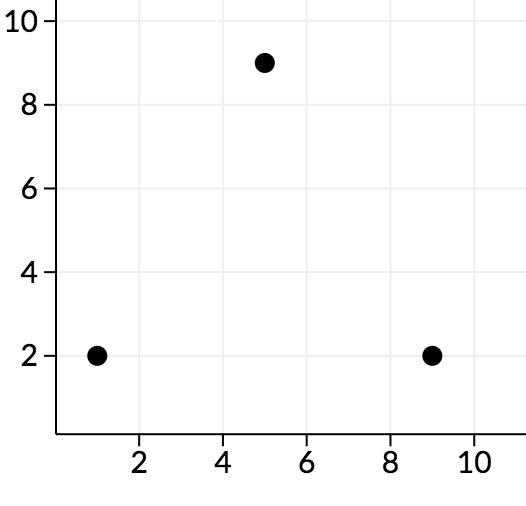
We can see that all angles here are acute, so no points are good.
题意:给你n个五维的点,一个点跟所有其他点构成的向量的角度都是钝角或直角的话则称这个点好。问给的点中有几个好点
题解:暴力判断每个点,(本来以为会被卡没想到过了)
#include<bits/stdc++.h>

#define pb push_back

#define ll long long

#define PI 3.14159265

using namespace std;

const int maxn=1e3+;

double a[maxn],b[maxn],c[maxn],d[maxn],e[maxn];

int ans[maxn],tmp,n;

struct node

{

    double a,b,c,d,e;

};

double dis(node t,node tt)

{

    return t.a*tt.a+t.b*tt.b+t.c*tt.c+t.d*tt.d+t.e*tt.e;

}

int slove(node x,node y)

{

    double sum=dis(x,y);

    double sum1=sqrt(dis(x,x))*sqrt(dis(y,y));

    return acos(sum/sum1)*180.0 / PI;

}

void s(int i)

{

        for(int j=;j<n;j++)

        {

            if(j==i)continue;

            for(int k=j+;k<=n;k++)

            {

                if(k==i)continue;

                node x,y;

                x.a=a[j]-a[i];y.a=a[k]-a[i];

                x.b=b[j]-b[i];y.b=b[k]-b[i];

                x.c=c[j]-c[i];y.c=c[k]-c[i];

                x.d=d[j]-d[i];y.d=d[k]-d[i];

                x.e=e[j]-e[i];y.e=e[k]-e[i];

                if(slove(x,y)<)

                {

                    return ;

                }

            }

        }

        ans[tmp++]=i;

}

int main()

{

    std::ios::sync_with_stdio(false);

    cin.tie();

    cout.tie();

    cin>>n;

    for(int i=;i<=n;i++)

    {

        cin>>a[i]>>b[i]>>c[i]>>d[i]>>e[i];

    }

    for(int i=;i<=n;i++)

    {

        s(i);

    }

    cout<<tmp<<endl;

    for(int i=;i<tmp;i++)

    {

        cout<<ans[i]<<endl;

    }

}
2 seconds
256 megabytes
standard input
standard output
Arpa has found a list containing n numbers. He calls a list bad if and only if it is not empty and gcd (see notes section for more information) of numbers in the list is 1.
Arpa can perform two types of operations:
- Choose a number and delete it with cost x.
- Choose a number and increase it by 1 with cost y.
Arpa can apply these operations to as many numbers as he wishes, and he is allowed to apply the second operation arbitrarily many times on the same number.
Help Arpa to find the minimum possible cost to make the list good.
First line contains three integers n, x and y (1 ≤ n ≤ 5·105, 1 ≤ x, y ≤ 109) — the number of elements in the list and the integers x and y.
Second line contains n integers a1, a2, ..., an (1 ≤ ai ≤ 106) — the elements of the list.
Print a single integer: the minimum possible cost to make the list good.
4 23 17
1 17 17 16
40
10 6 2
100 49 71 73 66 96 8 60 41 63
10
In example, number 1 must be deleted (with cost 23) and number 16 must increased by 1 (with cost 17).
A gcd (greatest common divisor) of a set of numbers is the maximum integer that divides all integers in the set. Read more about gcd here.
题意:给n个数,删除一个数花费x,把一个数加一花费y,问使得这n个数的gcd不为1的最小花费。
题解:用vis[]记录,每个数的出现次数,找到2~max(a[1~n])个数之间的所有质数,求出每个质数能把n个数整除的个数然后再根据这个排一下序,再用前面三个质数做为gcd,求出其中的最小值
#include<bits/stdc++.h>

#define pb push_back

#define ll long long

#define PI 3.14159265

using namespace std;

const int maxn=1e6+;

const ll inf=0xfffffffffffffff;

int a[maxn],n,x,y,maxt;

int vis[maxn];

bool prime[(int)1e6+];

vector<int>p;

bool cmp(int x,int y)

{

    return vis[x]!=vis[y]?vis[x]>vis[y]:x<y;

}

int main()

{

    std::ios::sync_with_stdio(false);

    cin.tie();

    cout.tie();

    cin>>n>>x>>y;

    for(int i=;i<=n;i++)

    cin>>a[i],vis[a[i]]++,maxt=max(maxt,a[i]);

    bool flag=false;

    if(maxt>)flag=true;

        for(int i=;i<=min(maxt,maxn-);i++)

    {

        if(!prime[i])

        {

            p.pb(i);

            for(int j=i*;j<=min(maxt,maxn-);j+=i)prime[j]=true,vis[i]+=vis[j];

        }

    }

    if(!flag)p.pb();

    sort(p.begin(),p.end(),cmp);

     ll ans=inf;

     for(int k=;k<min((int)p.size(),);k++)

     {

         ll sum=;

             for(int i=;i<=n;i++)

         {

             int t=a[i]%p[k];

             if(t)

             sum+=min((ll)x,(ll)(p[k]-t)*y);

          }

            ans=min(ans,sum);

     }

      cout<<ans<<endl;

}
Codeforces Round #432 (Div. 2, based on IndiaHacks Final Round 2017)ABCD的更多相关文章
- D. Arpa and a list of numbers Codeforces Round #432 (Div. 2, based on IndiaHacks Final Round 2017)
http://codeforces.com/contest/851/problem/D 分区间操作 #include <cstdio> #include <cstdlib> # ...
- Codeforces Round #432 (Div. 1, based on IndiaHacks Final Round 2017) D. Tournament Construction(dp + 构造)
题意 一个竞赛图的度数集合是由该竞赛图中每个点的出度所构成的集合. 现给定一个 \(m\) 个元素的集合,第 \(i\) 个元素是 \(a_i\) .(此处集合已经去重) 判断其是否是一个竞赛图的度数 ...
- 【前缀和】【枚举倍数】 Codeforces Round #432 (Div. 2, based on IndiaHacks Final Round 2017) D. Arpa and a list of numbers
题意:给你n个数,一次操作可以选一个数delete,代价为x:或者选一个数+1,代价y.你可以进行这两种操作任意次,让你在最小的代价下,使得所有数的GCD不为1(如果全删光也视作合法). 我们从1到m ...
- 【推导】【暴力】Codeforces Round #432 (Div. 2, based on IndiaHacks Final Round 2017) C. Five Dimensional Points
题意:给你五维空间内n个点,问你有多少个点不是坏点. 坏点定义:如果对于某个点A,存在点B,C,使得角BAC为锐角,那么A是坏点. 结论:如果n维空间内已经存在2*n+1个点,那么再往里面添加任意多个 ...
- 【推导】Codeforces Round #432 (Div. 2, based on IndiaHacks Final Round 2017) B. Arpa and an exam about geometry
题意:给你平面上3个不同的点A,B,C,问你能否通过找到一个旋转中心,使得平面绕该点旋转任意角度后,A到原先B的位置,B到原先C的位置. 只要A,B,C构成等腰三角形,且B为上顶点.那么其外接圆圆心即 ...
- Codeforces Round #432 (Div. 2, based on IndiaHacks Final Round 2017) D
Arpa has found a list containing n numbers. He calls a list bad if and only if it is not empty and g ...
- Codeforces Round #432 (Div. 2, based on IndiaHacks Final Round 2017) C
You are given set of n points in 5-dimensional space. The points are labeled from 1 to n. No two poi ...
- Codeforces Round #432 (Div. 2, based on IndiaHacks Final Round 2017) B
Arpa is taking a geometry exam. Here is the last problem of the exam. You are given three points a, ...
- Codeforces Round #432 (Div. 2, based on IndiaHacks Final Round 2017) A
Arpa is researching the Mexican wave. There are n spectators in the stadium, labeled from 1 to n. Th ...
随机推荐
- hdu2222 Keywords Search(AC自动机初步)
题目大意: 给出多个模式串和一个主串,求多少个模式串在主串中出现过. 传送门 这是一道AC自动机的模板题. 在学习AC自动机之前,首先要学习WA自动机.TLE自动机和MLE自动机(雾 AC自动机是一种 ...
- windows平台下node,npm,gulp配置
参考文献:http://blog.csdn.net/yuanyuan214365/article/details/53749583 1.安装nodejs:nodejs nodejs安装路径随意 nod ...
- 处理 Vue 单页面应用 SEO 的另一种思路
vue-meta-info 官方地址: monkeyWangs/vue-meta-info (设置vue 单页面meta info信息,如果需要单页面SEO,可以和 prerender-spa-plu ...
- 猜数字游戏--基于python
"""题目:练习使用python写一个猜数字的游戏,数字范围0-100,每次猜错,需要给出缩小后的范围,每个人只有10次的猜测机会,猜测机会用完游戏结束!"&q ...
- poj3249 拓扑排序+DP
题意:给出一个有向无环图,每个顶点都有一个权值.求一条从入度为0的顶点到出度为0的顶点的一条路径,路径上所有顶点权值和最大. 思路:因为是无环图,则对于每个点经过的路径求其最大权值有,dp[i]=ma ...
- ★不容错过的PPT教程!
IT工程师必须学会的计算机基础应用之一--PPT! 28项大神级PPT制作技术,学会后让你变成PPT高手哦!更多实用教程,请关注@IT工程师 !
- 【1414软工助教】团队作业6——展示博客(Alpha版本) 得分榜
题目 团队作业6--展示博客(Alpha版本) 作业提交情况情况 为所欲为 团队没有提交,其余都按时提交. 往期成绩 个人作业1:四则运算控制台 结对项目1:GUI 个人作业2:案例分析 结对项目2: ...
- 微信小程序中的微信支付js代码和流程详解
微信支付流程 步骤 (一)获取用户的信息 (二)统一下单(返回的prepay_id用于第(三)步的请求参数) (三)发起支付请求 操作(这边假设你已经获得了用户的openId) (一).获取用户ope ...
- 团队作业4——第一次项目冲刺(Alpha版本)日志集合处
Day 1: http://www.cnblogs.com/TeamOf/p/6754373.html Day 2: http://www.cnblogs.com/TeamOf/p/6754410.h ...
- 201521123074 《Java程序设计》第7周学习总结
1. 本周学习总结 以你喜欢的方式(思维导图或其他)归纳总结集合相关内容. (嗯..都画了那么久的导图,还是用导图归纳吧~) 2. 书面作业 ArrayList代码分析 1.1 解释ArrayList ...