
5.request对象详解

可以通过request对象获取表单提交的值,get或者post方式都是可以得
例子:login.jsp表单
<%@ page language="java" import="java.util.*"

    contentType="text/html; charset=utf-8"%>

<%

    String path = request.getContextPath();

    String basePath = request.getScheme() + "://"

            + request.getServerName() + ":" + request.getServerPort()

            + path + "/";

%>

<!DOCTYPE HTML PUBLIC "-//W3C//DTD HTML 4.01 Transitional//EN">

<html>

<head>

<base href="<%=basePath%>">

<title>My JSP 'login.jsp' starting page</title>

<meta http-equiv="pragma" content="no-cache">

<meta http-equiv="cache-control" content="no-cache">

<meta http-equiv="expires" content="0">

<meta http-equiv="keywords" content="keyword1,keyword2,keyword3">

<meta http-equiv="description" content="This is my page">

<!--

    <link rel="stylesheet" type="text/css" href="styles.css">

    -->

</head>

<body>

    <h1>用户注册</h1>

    <hr>

    <form action="request.jsp" name="regForm" method="post">

        <table>

            <tr>

                <td>用户名:</td>

                <td><input type="text" name="username" />

                </td>

            </tr>

            <tr>

                <td>爱好:</td>

                <td>

                <input type="checkbox" name="favorite" value="read" />读书

                <input type="checkbox" name="favorite" value="music" />音乐

                <input type="checkbox" name="favorite" value="movie" />电影

                <input type="checkbox" name="favorite" value="internet" />上网

                </td>

            </tr>

            <tr>

                <td colspan="2"><input type="submit" value="注册"></td>

            </tr>

        </table>

    </form>

</body>

</html>
2.request.jsp接收表单的内容并且打印出来
<%@ page language="java" import="java.util.*" contentType="text/html; charset=utf-8" %>
<%
String path = request.getContextPath();
String basePath = request.getScheme()+"://"+request.getServerName()+":"+request.getServerPort()+path+"/";
%> <!DOCTYPE HTML PUBLIC "-//W3C//DTD HTML 4.01 Transitional//EN">
<html>
<head>
<base href="<%=basePath%>"> <title>My JSP 'login.jsp' starting page</title> <meta http-equiv="pragma" content="no-cache">
<meta http-equiv="cache-control" content="no-cache">
<meta http-equiv="expires" content="0">
<meta http-equiv="keywords" content="keyword1,keyword2,keyword3">
<meta http-equiv="description" content="This is my page">
<!--
<link rel="stylesheet" type="text/css" href="styles.css">
--> </head> <body>
<h1>request内置对象</h1>
<%
request.setCharacterEncoding("utf-8");
%>
用户名<%=request.getParameter("username") %><br>
爱好<%
String[] favorites = request.getParameterValues("favorite");
for(int i = 0;i<favorites.length;i++){
out.println(favorites[i]+"  ");
}
%>
<hr>
</body>
</html>
3.效果如下:


注意编码的问题:在request接收的时候需要设置编码,否则中文会乱码
request.setCharacterEncoding("utf-8");
4.也可以通过简单的url传递参数而不通过提交表单的方式
<a href = "request.jsp?username=cai" >URL传参</a>
获取的时候一样通过request的方法
<%=request.getParameter("username") %>
但是url传递参数会出现中文乱码的问题,要解决需要打开tomcat目录下的conf的server.xml
在这里添加一句,改成这样子
   <Connector port="8080" protocol="HTTP/1.1"

               connectionTimeout="20000"

               redirectPort="8443" URIEncoding="utf-8"/>
重启tomcat服务器即可
5.可以在request对象中保存一些属性,以键值对的形式存在
设置password的值是123456
<% request.setAttribute("password","123465");%>
获取password的值
<%=request.getAttribute("password")%>
6.其他的函数
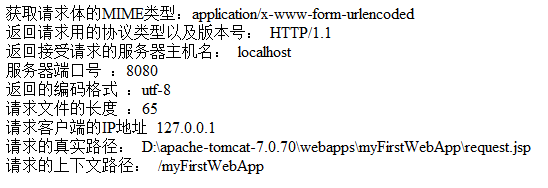
 获取请求体的MIME类型:<%=request.getContentType()%><br>

   返回请求用的协议类型以及版本号: <%=request.getProtocol()%><br>

   返回接受请求的服务器主机名:  <%=request.getServerName()%><br>

   服务器端口号 :<%=request.getServerPort()%><br>

  返回的编码格式 :<%=request.getCharacterEncoding()%><br>

  请求文件的长度 :<%=request.getContentLength()%><br>

  请求客户端的IP地址 <%=request.getRemoteAddr()%><br>

  请求的真实路径: <%=request.getRealPath("request.jsp")%><br>

  请求的上下文路径: <%=request.getContextPath()%><br>
结果:
5.request对象详解的更多相关文章
- django中request对象详解(转载)
django中的request对象详解 Request 我们知道当URLconf文件匹配到用户输入的路径后,会调用对应的view函数,并将 HttpRequest对象 作为第一个参数传入该函数. ...
- request对象详解
先来了解一下Request的主要方法: setAttribute(String name,Object):设置名字为name的request的参数值getAttribute(String name): ...
- jsp request 对象详解
转自:http://www.cnblogs.com/qqnnhhbb/archive/2007/10/16/926234.html 1.request对象 客户端的请求信息被封装在request对象中 ...
- JSP中Out和Request对象详解
内置表示不需要new便可直接使用. 一.基础知识 1.缓冲区:IO最原始是一个一个字节的读取,这就像吃米饭的时候一粒一粒的吃,很没有效率,这时候就有了碗,一碗一碗的吃,岂不痛快. 2.Get提交不能超 ...
- django的views里面的request对象详解大全
简介 HTTP 应用的信息是通过 请求报文 和 响应报文 传递的,关于更多的相关知识,可以阅读<HTTP权威指南>获得. 其中 请求报文 由客户端发送,其中包含和许多的信息,而 djang ...
- django中的request对象详解
Request 我们知道当URLconf文件匹配到用户输入的路径后,会调用对应的view函数,并将 HttpRequest对象 作为第一个参数传入该函数. 我们来看一看这个HttpRequest对 ...
- Django_视图中的request对象详解(八)
本文参考:http://www.cnblogs.com/MnCu8261/p/5871085.html Request 我们知道当URLconf文件匹配到用户输入的路径后,会调用对应的view函数,并 ...
- response对象和request对象详解
request方法列举:request.getAuthType() // 获取保护servlet的认证方案名(BASIC或SSL),未受保护的servlet返回的就是nullrequest.getCh ...
- mvc-servlet---ServletConfig与ServletContext对象详解(转载)
ServletConfig与ServletContext对象详解 一.ServletConfig对象 在Servlet的配置文件中,可以使用一个或多个<init-param>标签为s ...
随机推荐
- 我总结的常用sql语句
建表: Set sql_mode='strict_trans_tables': 存储引擎启用严格模式,非法数据值被拒绝 Create table t3(id int(4) primary key a ...
- VUE依赖webpack分别给开发环境和生产环境配置不同的常量值并在项目中动态引用
当在开发和产品上线的时候,我们经常会遇到在同一个地方由于环境的不同而地址也不同的情况,这时候如果在代码中将该地址写死,那势必会造成上线时手动改动,多人开发及多处使用该地址难以维护等一系列问题,为避免这 ...
- 使用Git初始化项目
1.在Git官网上点击New repository新建项目: 2.在本地新建一个同名文件: 3.打开git bash切换到新建的文件目录: 4.echo "# myprojectname&q ...
- struts2.1.6教程六、使用标签
1.基础表单标签 准备工作:建立struts2tag项目,搭建好struts2的开发环境.在html我们常用的基础表单标签主要有文本域.密码域.提交.重置四种.它们在strust2中可以通过标签来生成 ...
- 源码阅读—Iterator接口和LIstIterator接口
在继续看ArrayList源码之前,先了解Iterator接口和ListIterator接口,下篇文章详细讲解ArrayList是如何实现它们的. 我们知道,接口只是一种规范,当继承接口并实现其中的方 ...
- 常用统计分析 SQL 在 AWK 中的实现(转)
转自:http://my.oschina.net/leejun2005/blog/100710 最近有需求需要本地处理一些临时的数据,用做统计分析.如果单纯的 MYSQL 也能实现, 不过一堆临时数据 ...
- 01 json环境搭建
1 导包 <project xmlns="http://maven.apache.org/POM/4.0.0" xmlns:xsi="http://www.w3.o ...
- Python教程(2.1)——控制台输入
这一节,我们来学习如何写一个简单的Python程序. 我们知道,很多编程语言一开始就是学习怎么输出"Hello, world",对吧?那么,现在我们来学习怎么用Python输出&q ...
- TreeSet集合排序方式一:自然排序Comparable
TreeSet集合默认会进行排序.因此必须有排序,如果没有就会报类型转换异常. 自然排序 Person class->实现Comparable,实现compareTo()方法 package H ...
- 磁盘文件I/O,SSD结构,局部性原理 笔记
磁盘文件I/O过程 进程向内核发起read scene.dat请求: 内核根据inode获取对应该进程的address space,在address space查找page_cache,如果没有找到, ...