
Dot Product
These are vectors:
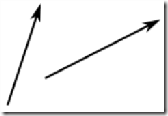
They can be multiplied using the "Dot Product" (also see Cross Product).
Calculating
You can calculate the Dot Product of two vectors this way:

a · b = |a| × |b| × cos(θ)
Where:
|a| is the magnitude (length) of vector a
|b| is the magnitude (length) of vector b
θ is the angle between a and b
So we multiply the length of a times the length of b, then multiply by the cosine of the angle between a and b
OR you can calculate it this way:
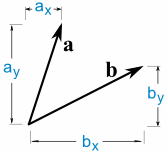
a · b = ax × bx + ay × by
So we multiply the x's, multiply the y's, then add.
Both methods work!
Example: Calculate the dot product of vectors a and b:
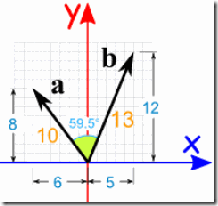
a · b = |a| × |b| × cos(θ)
a · b = 10 × 13 × cos(59.5°)
a · b = 10 × 13 × 0.5075...
a · b = 65.98... = 66 (rounded)
a · b = ax × bx + ay × by
a · b = -6 × 5 + 8 × 12
a · b = -30 + 96
a · b = 66
Both methods came up with the same result (after rounding)
Also note that we used minus 6 for ax (it is heading in the negative x-direction)
Note: you can use the Vector Calculator to help you.
Why cos(θ) ?
OK, to multiply two vectors it makes sense to multiply their lengths together but only when they point in the same direction.
So we make one "point in the same direction" as the other by multiplying by cos(θ):
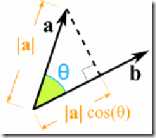
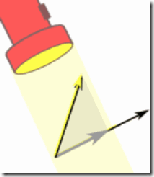
We take the component of a
that lies alongside b
Like shining a light to see
where the shadow lies
THEN we multiply !
It works exactly the same if we "projected" b alongside a then multiplied:
Because it doesn't matter which order we do the multiplication:
|a| × |b| × cos(θ) = |a| × cos(θ) × |b|

Right Angles
When two vectors are at right angles to each other the dot product is zero.
Example: calculate the Dot Product for:

a · b = |a| × |b| × cos(θ)
a · b = | a| × | b| × cos(90°)
a · b = | a| × | b| × 0
a · b = 0
a · b = ax × bx + ay × by
a · b = -12 × 12 + 16 × 9
a · b = -144 + 144
a · b = 0
This can be a handy way to find out if two vectors are at right angles.
Three or More Dimensions
This all works fine in 3 (or more) dimensions, too.
And can actually be very useful!
Example: Sam has measured the end-points of two poles, and wants to know the angle between them:
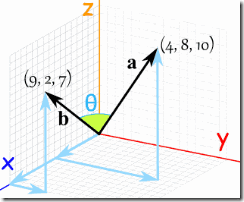
We have 3 dimensions, so don't forget the z-components:
a · b = ax × bx + ay × by + az × bz
a · b = 9 × 4 + 2 × 8 + 7 × 10
a · b = 36 + 16 + 70
a · b = 122
Now for the other formula:
a · b = |a| × |b| × cos(θ)
But what is |a| ? It is the magnitude, or length, of the vector a. We can use Pythagoras:
- |a| = √(42 + 82 + 102)
- |a| = √(16 + 64 + 100)
- |a| = √180
Likewise for |b|:
- |b| = √(92 + 22 + 72)
- |b| = √(81 + 4 + 49)
- |b| = √134
And we know from the calculation above that a · b = 122, so:
a · b = |a| × |b| × cos(θ)
122 = √180 × √134 × cos(θ)
cos(θ) = 122 / (√180 × √134)
cos(θ) = 0.7855...
θ = cos -1(0.7855...) = 38.2...°
Done!
I tried a calculation like that once, but worked all in angles and distances ... it was very hard, involved lots of trigonometry, and my brain hurt. The method above is much easier.
Cross Product
The Dot Product gives a scalar (ordinary number) answer, and is sometimes called the scalar product.
But there is also the Cross Product which gives a vector as an answer, and is sometimes called the vector product.
Dot Product的更多相关文章
- [UCSD白板题] Minimum Dot Product
Problem Introduction The dot product of two sequences \(a_1,a_2,\cdots,a_n\) and \(b_1,b_2,\cdots,b_ ...
- FB面经Prepare: Dot Product
Conduct Dot Product of two large Vectors 1. two pointers 2. hashmap 3. 如果没有额外空间,如果一个很大,一个很小,适合scan小的 ...
- CUDA Samples: dot product(使用零拷贝内存)
以下CUDA sample是分别用C++和CUDA实现的点积运算code,CUDA包括普通实现和采用零拷贝内存实现两种,并对其中使用到的CUDA函数进行了解说,code参考了<GPU高性能编程C ...
- 向量点积(Dot Product),向量叉积(Cross Product)
参考的是<游戏和图形学的3D数学入门教程>,非常不错的书,推荐阅读,老外很喜欢把一个东西解释的很详细. 1.向量点积(Dot Product) 向量点积的结果有什么意义?事实上,向量的点积 ...
- CUDA Samples: Dot Product
以下CUDA sample是分别用C++和CUDA实现的两个非常大的向量实现点积操作,并对其中使用到的CUDA函数进行了解说,各个文件内容如下: common.hpp: #ifndef FBC_CUD ...
- vector - vector product
the inner product Givens two vectors \(x,y\in \mathbb{R}^n\), the quantity \(x^\top y\), sometimes c ...
- CF 405C Unusual Product(想法题)
题目链接: 传送门 Domino Effect time limit per test:1 second memory limit per test:256 megabytes Descrip ...
- Cross Product
Cross Product These are two vectors: They can be multiplied using the "Cross Product" (als ...
- 对NumPy中dot()函数的理解
今天学习到numpy基本的运算方法,遇到了一个让我比较难理解的问题.就是dot函数是如何对矩阵进行运算的. 一.dot()的使用 参考文档:https://docs.scipy.org/doc/num ...
随机推荐
- java自动装箱的陷阱
自动装箱和拆箱是java的一颗语法糖,在给我们带来使用便利的同时也带来一些疑惑,请看下面的代码: public class TestClass { public static void main(St ...
- centos7 install rvm
不管其他,先按要求更新一下包 yum install -y gcc-c++ patch readline readline-devel zlib zlib-devel libyaml-devel li ...
- 洛谷-神奇的幻方-NOIP2015提高组复赛
题目描述 幻方是一种很神奇的N*N矩阵:它由数字1,2,3,--,N*N构成,且每行.每列及两条对角线上的数字之和都相同. 当N为奇数时,我们可以通过以下方法构建一个幻方: 首先将1写在第一行的中间. ...
- Spark编程模型及RDD操作
转载自:http://blog.csdn.net/liuwenbo0920/article/details/45243775 1. Spark中的基本概念 在Spark中,有下面的基本概念.Appli ...
- java操作mongodb——更新数据
Java中可以通过updateOne,updateMany,replaceOne方法进行集合的文档更新.但是 _id 是不能更新的 updateOne只会更新一条数据,即使通过Filters.lt(& ...
- 【.NET】Repeater控件简单的数据绑定(有bool,日期,序号)
前述: 讲的是Repeater,使用的是XML文件读取,没用ADO.NET ,而分页有很多方法,比如用PagedDataSource,或者通过参数在数据源写SQL语句来实现. 页面: <%@ I ...
- java模拟数据库缓存
实现缓存一些数据到本地,避免重复查询数据库,对数据库造成压力,代码如下: package threadLock; import java.util.HashMap; import java.util. ...
- 【锋利的Jquery】读书笔记二
一.jquery选择器 基本选择器 层次选择器 过滤选择器 基本过滤 内容过滤 可见性过滤 属性过滤 子元素过滤 first : 获取单个元素 $("div:first&quo ...
- PL SQL Developer报错框乱码
在系统变量里设置 变量名:NLS_LANG 变量值设为:SIMPLIFIED CHINESE_CHINA.ZHS16GBK
- PHP中使用CURL之备忘(一)
1.curl只能抓取页面的部分内容的原因分析: 错误提示:CURL transport error: transfer closed with outstanding read data remain ...