
『TensorFlow』单&双隐藏层自编码器设计
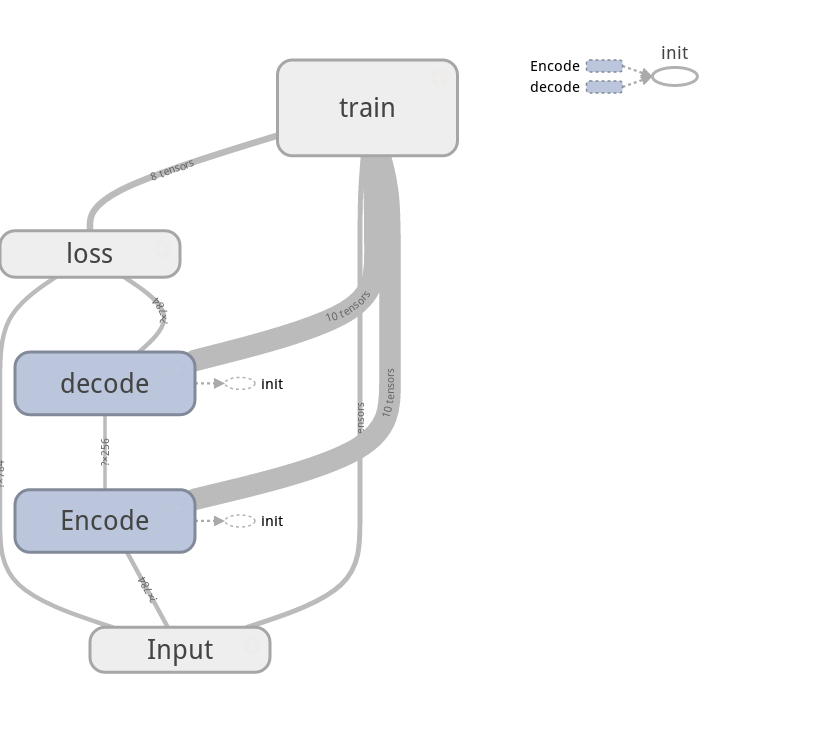
计算图设计
很简单的实践,
- 多了个隐藏层
- 没有上节的高斯噪声
- 网络写法由上节的面向对象改为了函数式编程,
其他没有特别需要注意的,实现如下:
import numpy as np

import matplotlib.pyplot as plt

import tensorflow as tf

from tensorflow.examples.tutorials.mnist import input_data

import os

os.environ['TF_CPP_MIN_LOG_LEVEL'] = '2'

learning_rate = 0.01                          # 学习率

training_epochs = 20                          # 训练轮数,1轮等于n_samples/batch_size

batch_size = 128                              # batch容量

display_step = 1                              # 展示间隔

example_to_show = 10                          # 展示图像数目

n_hidden_units = 256

n_input_units = 784

n_output_units = n_input_units

def WeightsVariable(n_in, n_out, name_str):

    return tf.Variable(tf.random_normal([n_in, n_out]), dtype=tf.float32, name=name_str)

def biasesVariable(n_out, name_str):

    return tf.Variable(tf.random_normal([n_out]), dtype=tf.float32, name=name_str)

def encoder(x_origin, activate_func=tf.nn.sigmoid):

    with tf.name_scope('Layer'):

        Weights = WeightsVariable(n_input_units, n_hidden_units, 'Weights')

        biases = biasesVariable(n_hidden_units, 'biases')

        x_code = activate_func(tf.add(tf.matmul(x_origin, Weights), biases))

    return x_code

def decode(x_code, activate_func=tf.nn.sigmoid):

    with tf.name_scope('Layer'):

        Weights = WeightsVariable(n_hidden_units, n_output_units, 'Weights')

        biases = biasesVariable(n_output_units, 'biases')

        x_decode = activate_func(tf.add(tf.matmul(x_code, Weights), biases))

    return x_decode

with tf.Graph().as_default():

    with tf.name_scope('Input'):

        X_input = tf.placeholder(tf.float32, [None, n_input_units])

    with tf.name_scope('Encode'):

        X_code = encoder(X_input)

    with tf.name_scope('decode'):

        X_decode = decode(X_code)

    with tf.name_scope('loss'):

        loss = tf.reduce_mean(tf.pow(X_input - X_decode, 2))

    with tf.name_scope('train'):

        Optimizer = tf.train.RMSPropOptimizer(learning_rate)

        train = Optimizer.minimize(loss)

    init = tf.global_variables_initializer()

    # 因为使用了tf.Graph.as_default()上下文环境

    # 所以下面的记录必须放在上下文里面,否则记录下来的图是空的(get不到上面的default)

    writer = tf.summary.FileWriter(logdir='logs', graph=tf.get_default_graph())

    writer.flush()
计算图:
训练程序
import numpy as np

import matplotlib.pyplot as plt

import tensorflow as tf

from tensorflow.examples.tutorials.mnist import input_data

import os

os.environ['TF_CPP_MIN_LOG_LEVEL'] = '2'

learning_rate = 0.01  # 学习率

training_epochs = 20  # 训练轮数,1轮等于n_samples/batch_size

batch_size = 128  # batch容量

display_step = 1  # 展示间隔

example_to_show = 10  # 展示图像数目

n_hidden_units = 256

n_input_units = 784

n_output_units = n_input_units

def WeightsVariable(n_in, n_out, name_str):

    return tf.Variable(tf.random_normal([n_in, n_out]), dtype=tf.float32, name=name_str)

def biasesVariable(n_out, name_str):

    return tf.Variable(tf.random_normal([n_out]), dtype=tf.float32, name=name_str)

def encoder(x_origin, activate_func=tf.nn.sigmoid):

    with tf.name_scope('Layer'):

        Weights = WeightsVariable(n_input_units, n_hidden_units, 'Weights')

        biases = biasesVariable(n_hidden_units, 'biases')

        x_code = activate_func(tf.add(tf.matmul(x_origin, Weights), biases))

    return x_code

def decode(x_code, activate_func=tf.nn.sigmoid):

    with tf.name_scope('Layer'):

        Weights = WeightsVariable(n_hidden_units, n_output_units, 'Weights')

        biases = biasesVariable(n_output_units, 'biases')

        x_decode = activate_func(tf.add(tf.matmul(x_code, Weights), biases))

    return x_decode

with tf.Graph().as_default():

    with tf.name_scope('Input'):

        X_input = tf.placeholder(tf.float32, [None, n_input_units])

    with tf.name_scope('Encode'):

        X_code = encoder(X_input)

    with tf.name_scope('decode'):

        X_decode = decode(X_code)

    with tf.name_scope('loss'):

        loss = tf.reduce_mean(tf.pow(X_input - X_decode, 2))

    with tf.name_scope('train'):

        Optimizer = tf.train.RMSPropOptimizer(learning_rate)

        train = Optimizer.minimize(loss)

    init = tf.global_variables_initializer()

    # 因为使用了tf.Graph.as_default()上下文环境

    # 所以下面的记录必须放在上下文里面,否则记录下来的图是空的(get不到上面的default)

    writer = tf.summary.FileWriter(logdir='logs', graph=tf.get_default_graph())

    writer.flush()

    mnist = input_data.read_data_sets('../Mnist_data/', one_hot=True)

    with tf.Session() as sess:

        sess.run(init)

        total_batch = int(mnist.train.num_examples / batch_size)

        for epoch in range(training_epochs):

            for i in range(total_batch):

                batch_xs, batch_ys = mnist.train.next_batch(batch_size)

                _, Loss = sess.run([train, loss], feed_dict={X_input: batch_xs})

                Loss = sess.run(loss, feed_dict={X_input: batch_xs})

            if epoch % display_step == 0:

                print('Epoch: %04d' % (epoch + 1), 'loss= ', '{:.9f}'.format(Loss))

        writer.close()

        print('训练完毕!')

        '''比较输入和输出的图像'''

        # 输出图像获取

        reconstructions = sess.run(X_decode, feed_dict={X_input: mnist.test.images[:example_to_show]})

        # 画布建立

        f, a = plt.subplots(2, 10, figsize=(10, 2))

        for i in range(example_to_show):

            a[0][i].imshow(np.reshape(mnist.test.images[i], (28, 28)))

            a[1][i].imshow(np.reshape(reconstructions[i], (28, 28)))

        f.show()  # 渲染图像

        plt.draw()  # 刷新图像

        # plt.waitforbuttonpress()
debug一上午的收获:接受sess.run输出的变量名不要和tensor节点的变量名重复,会出错的... ...好低级的错误。mmdz
比较图像一部分之前没做过,介绍了matplotlib.pyplot的花式用法,
原来plt.subplots()是会返回 画布句柄 & 子图集合 句柄的,子图集合句柄可以像数组一样调用子图
pyplot是有show()和draw()两个方法的,show是展示出画布,draw会刷新原图,可以交互的修改画布
waitforbuttonpress()监听键盘按键如果用户按的是键盘,返回True,如果是其他(如鼠标单击),则返回False
另,发现用surface写程序其实还挺带感... ...
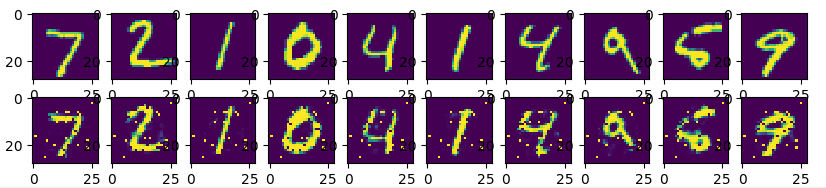
输出图像如下:
双隐藏层版本
import numpy as np

import matplotlib.pyplot as plt

import tensorflow as tf

from tensorflow.examples.tutorials.mnist import input_data

import os

os.environ['TF_CPP_MIN_LOG_LEVEL'] = '2'

batch_size = 128  # batch容量

display_step = 1  # 展示间隔

learning_rate = 0.01  # 学习率

training_epochs = 20  # 训练轮数,1轮等于n_samples/batch_size

example_to_show = 10  # 展示图像数目

n_hidden1_units = 256  # 第一隐藏层

n_hidden2_units = 128  # 第二隐藏层

n_input_units = 784

n_output_units = n_input_units

def WeightsVariable(n_in, n_out, name_str):

    return tf.Variable(tf.random_normal([n_in, n_out]), dtype=tf.float32, name=name_str)

def biasesVariable(n_out, name_str):

    return tf.Variable(tf.random_normal([n_out]), dtype=tf.float32, name=name_str)

def encoder(x_origin, activate_func=tf.nn.sigmoid):

    with tf.name_scope('Layer1'):

        Weights = WeightsVariable(n_input_units, n_hidden1_units, 'Weights')

        biases = biasesVariable(n_hidden1_units, 'biases')

        x_code1 = activate_func(tf.add(tf.matmul(x_origin, Weights), biases))

    with tf.name_scope('Layer2'):

        Weights = WeightsVariable(n_hidden1_units, n_hidden2_units, 'Weights')

        biases = biasesVariable(n_hidden2_units, 'biases')

        x_code2 = activate_func(tf.add(tf.matmul(x_code1, Weights), biases))

    return x_code2

def decode(x_code, activate_func=tf.nn.sigmoid):

    with tf.name_scope('Layer1'):

        Weights = WeightsVariable(n_hidden2_units, n_hidden1_units, 'Weights')

        biases = biasesVariable(n_hidden1_units, 'biases')

        x_decode1 = activate_func(tf.add(tf.matmul(x_code, Weights), biases))

    with tf.name_scope('Layer2'):

        Weights = WeightsVariable(n_hidden1_units, n_output_units, 'Weights')

        biases = biasesVariable(n_output_units, 'biases')

        x_decode2 = activate_func(tf.add(tf.matmul(x_decode1, Weights), biases))

    return x_decode2

with tf.Graph().as_default():

    with tf.name_scope('Input'):

        X_input = tf.placeholder(tf.float32, [None, n_input_units])

    with tf.name_scope('Encode'):

        X_code = encoder(X_input)

    with tf.name_scope('decode'):

        X_decode = decode(X_code)

    with tf.name_scope('loss'):

        loss = tf.reduce_mean(tf.pow(X_input - X_decode, 2))

    with tf.name_scope('train'):

        Optimizer = tf.train.RMSPropOptimizer(learning_rate)

        train = Optimizer.minimize(loss)

    init = tf.global_variables_initializer()

    # 因为使用了tf.Graph.as_default()上下文环境

    # 所以下面的记录必须放在上下文里面,否则记录下来的图是空的(get不到上面的default)

    writer = tf.summary.FileWriter(logdir='logs', graph=tf.get_default_graph())

    writer.flush()

    mnist = input_data.read_data_sets('../Mnist_data/', one_hot=True)

    with tf.Session() as sess:

        sess.run(init)

        total_batch = int(mnist.train.num_examples / batch_size)

        for epoch in range(training_epochs):

            for i in range(total_batch):

                batch_xs, batch_ys = mnist.train.next_batch(batch_size)

                _, Loss = sess.run([train, loss], feed_dict={X_input: batch_xs})

                Loss = sess.run(loss, feed_dict={X_input: batch_xs})

            if epoch % display_step == 0:

                print('Epoch: %04d' % (epoch + 1), 'loss= ', '{:.9f}'.format(Loss))

        writer.close()

        print('训练完毕!')

        '''比较输入和输出的图像'''

        # 输出图像获取

        reconstructions = sess.run(X_decode, feed_dict={X_input: mnist.test.images[:example_to_show]})

        # 画布建立

        f, a = plt.subplots(2, 10, figsize=(10, 2))

        for i in range(example_to_show):

            a[0][i].imshow(np.reshape(mnist.test.images[i], (28, 28)))

            a[1][i].imshow(np.reshape(reconstructions[i], (28, 28)))

        f.show()  # 渲染图像

        plt.draw()  # 刷新图像

        # plt.waitforbuttonpress()
输出图像如下:
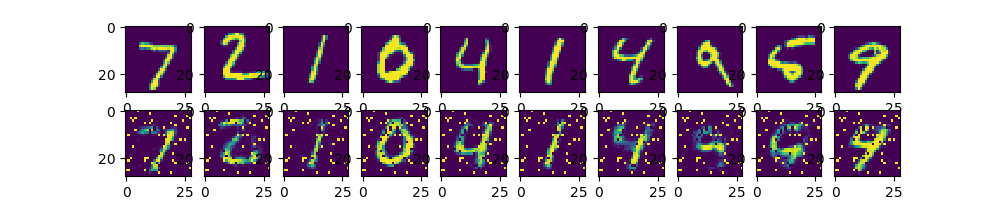
由于压缩到128个节点损失信息过多,所以结果不如之前单层的好。
有意思的是我们把256的那层改成128(也就是双128)后,结果反而比上面的要好:
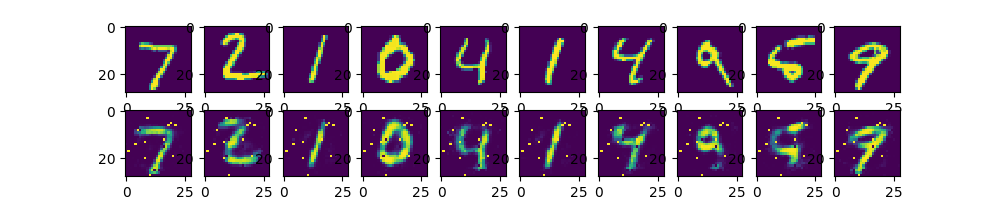
但是仍然比不上单隐藏层,数据比较简单时候复杂网络效果可能不那么好(loss值我没有截取,但实际上是这样,虽然不同网络loss直接比较没什么意义),当然,也有可能是复杂网络没收敛的结果。
可视化双隐藏层自编码器
import tensorflow as tf

from tensorflow.examples.tutorials.mnist import input_data

import os

os.environ['TF_CPP_MIN_LOG_LEVEL'] = '2'

batch_size = 128  # batch容量

display_step = 1  # 展示间隔

learning_rate = 0.01  # 学习率

training_epochs = 20  # 训练轮数,1轮等于n_samples/batch_size

example_to_show = 10  # 展示图像数目

n_hidden1_units = 256  # 第一隐藏层

n_hidden2_units = 128  # 第二隐藏层

n_input_units = 784

n_output_units = n_input_units

def variable_summaries(var): #<---

    """

    可视化变量全部相关参数

    :param var:

    :return:

    """

    with tf.name_scope('summaries'):

        mean = tf.reduce_mean(var)

        tf.summary.histogram('mean', mean)

        with tf.name_scope('stddev'):

            stddev = tf.sqrt(tf.reduce_mean(tf.square(var - mean)))

            tf.summary.scalar('stddev', stddev)  # 注意,这是标量

            tf.summary.scalar('max', tf.reduce_max(var))

            tf.summary.scalar('min', tf.reduce_min(var))

            tf.summary.histogram('histogram', var)

def WeightsVariable(n_in,n_out,name_str):

    return tf.Variable(tf.random_normal([n_in,n_out]),dtype=tf.float32,name=name_str)

def biasesVariable(n_out,name_str):

    return tf.Variable(tf.random_normal([n_out]),dtype=tf.float32,name=name_str)

def encoder(x_origin,activate_func=tf.nn.sigmoid):

    with tf.name_scope('Layer1'):

        Weights = WeightsVariable(n_input_units,n_hidden1_units,'Weights')

        biases = biasesVariable(n_hidden1_units,'biases')

        x_code1 = activate_func(tf.add(tf.matmul(x_origin,Weights),biases))

        variable_summaries(Weights) #<---

        variable_summaries(biases) #<---

    with tf.name_scope('Layer2'):

        Weights = WeightsVariable(n_hidden1_units,n_hidden2_units,'Weights')

        biases = biasesVariable(n_hidden2_units,'biases')

        x_code2 = activate_func(tf.add(tf.matmul(x_code1,Weights),biases))

        variable_summaries(Weights) #<---

        variable_summaries(biases) #<---

    return x_code2

def decode(x_code,activate_func=tf.nn.sigmoid):

    with tf.name_scope('Layer1'):

        Weights = WeightsVariable(n_hidden2_units,n_hidden1_units,'Weights')

        biases = biasesVariable(n_hidden1_units,'biases')

        x_decode1 = activate_func(tf.add(tf.matmul(x_code,Weights),biases))

        variable_summaries(Weights) #<---

        variable_summaries(biases) #<---

    with tf.name_scope('Layer2'):

        Weights = WeightsVariable(n_hidden1_units,n_output_units,'Weights')

        biases = biasesVariable(n_output_units,'biases')

        x_decode2 = activate_func(tf.add(tf.matmul(x_decode1,Weights),biases))

        variable_summaries(Weights) #<---

        variable_summaries(biases) #<---

    return x_decode2

with tf.Graph().as_default():

    with tf.name_scope('Input'):

        X_input = tf.placeholder(tf.float32,[None,n_input_units])

    with tf.name_scope('Encode'):

        X_code = encoder(X_input)

    with tf.name_scope('decode'):

        X_decode = decode(X_code)

    with tf.name_scope('loss'):

        loss = tf.reduce_mean(tf.pow(X_input - X_decode,2))

    with tf.name_scope('train'):

        Optimizer = tf.train.RMSPropOptimizer(learning_rate)

        train = Optimizer.minimize(loss)

    # 标量汇总

    with tf.name_scope('LossSummary'):

        tf.summary.scalar('loss',loss)

        tf.summary.scalar('learning_rate',learning_rate)

    # 图像展示

    with tf.name_scope('ImageSummary'):

        image_original = tf.reshape(X_input,[-1, 28, 28, 1])

        image_reconstruction = tf.reshape(X_decode, [-1, 28, 28, 1])

        tf.summary.image('image_original', image_original, 9)

        tf.summary.image('image_recinstruction', image_reconstruction, 9)

    # 汇总

    merged_summary = tf.summary.merge_all()

    init = tf.global_variables_initializer()

    writer = tf.summary.FileWriter(logdir='logs', graph=tf.get_default_graph())

    writer.flush()

    mnist = input_data.read_data_sets('../Mnist_data/', one_hot=True)

    with tf.Session() as sess:

        sess.run(init)

        total_batch = int(mnist.train.num_examples / batch_size)

        for epoch in range(training_epochs):

            for i in range(total_batch):

                batch_xs,batch_ys = mnist.train.next_batch(batch_size)

                _,Loss = sess.run([train,loss],feed_dict={X_input: batch_xs})

                Loss = sess.run(loss,feed_dict={X_input: batch_xs})

            if epoch % display_step == 0:

                print('Epoch: %04d' % (epoch + 1),'loss= ','{:.9f}'.format(Loss))

                summary_str = sess.run(merged_summary,feed_dict={X_input: batch_xs}) #<---

                writer.add_summary(summary_str,epoch) #<---

                writer.flush() #<---

        writer.close()

        print('训练完毕!')
几个有意思的发现,
使用之前的图像输出方式时,win下matplotlib.pyplot的绘画框会立即退出,所以要使用 plt.waitforbuttonpress() 命令。
win下使用plt绘画色彩和linux不一样,效果如下:

输出图如下:

对比图像如下(截自tensorboard):

『TensorFlow』单&双隐藏层自编码器设计的更多相关文章
- 吴裕雄 PYTHON 神经网络——TENSORFLOW 双隐藏层自编码器设计处理MNIST手写数字数据集并使用TENSORBORD描绘神经网络数据2
import os import tensorflow as tf from tensorflow.examples.tutorials.mnist import input_data os.envi ...
- 『TensorFlow』读书笔记_降噪自编码器
『TensorFlow』降噪自编码器设计 之前学习过的代码,又敲了一遍,新的收获也还是有的,因为这次注释写的比较详尽,所以再次记录一下,具体的相关知识查阅之前写的文章即可(见上面链接). # Aut ...
- 吴裕雄 PYTHON 神经网络——TENSORFLOW 单隐藏层自编码器设计处理MNIST手写数字数据集并使用TensorBord描绘神经网络数据
import os import numpy as np import tensorflow as tf import matplotlib.pyplot as plt from tensorflow ...
- 『TensorFlow』专题汇总
TensorFlow:官方文档 TensorFlow:项目地址 本篇列出文章对于全零新手不太合适,可以尝试TensorFlow入门系列博客,搭配其他资料进行学习. Keras使用tf.Session训 ...
- 『TensorFlow』模型保存和载入方法汇总
『TensorFlow』第七弹_保存&载入会话_霸王回马 一.TensorFlow常规模型加载方法 保存模型 tf.train.Saver()类,.save(sess, ckpt文件目录)方法 ...
- 『TensorFlow』SSD源码学习_其一:论文及开源项目文档介绍
一.论文介绍 读论文系列:Object Detection ECCV2016 SSD 一句话概括:SSD就是关于类别的多尺度RPN网络 基本思路: 基础网络后接多层feature map 多层feat ...
- 『TensorFlow』DCGAN生成动漫人物头像_下
『TensorFlow』以GAN为例的神经网络类范式 『cs231n』通过代码理解gan网络&tensorflow共享变量机制_上 『TensorFlow』通过代码理解gan网络_中 一.计算 ...
- 『TensorFlow』滑动平均
滑动平均会为目标变量维护一个影子变量,影子变量不影响原变量的更新维护,但是在测试或者实际预测过程中(非训练时),使用影子变量代替原变量. 1.滑动平均求解对象初始化 ema = tf.train.Ex ...
- 『TensorFlow』流程控制
『PyTorch』第六弹_最小二乘法对比PyTorch和TensorFlow TensorFlow 控制流程操作 TensorFlow 提供了几个操作和类,您可以使用它们来控制操作的执行并向图中添加条 ...
随机推荐
- eclipse maven引入第三方jar包后如何下载源代码(sources)
1. 在eclipse windows -> properties->maven 选项,然后查看右侧 菜单来中 找到 Download Artifact Sources 选项勾选:如果想 ...
- Selenium IDE
Selenium IDE : Selenium IDE作为Firefox浏览器的一款插件,依附于firefox浏览器,打开它的录制功能,它会忠实的记录,你对firefox的操作,并可以回放它所记录的你 ...
- java框架之Struts2(4)-拦截器&标签库
拦截器 概述 Interceptor (拦截器):起到拦截客户端对 Action 请求的作用. Filter:过滤器,过滤客户端向服务器发送的请求. Interceptor:拦截器,拦截的是客户端对 ...
- 【LeetCode每天一题】Merge Intervals(合并区间)
Given a collection of intervals, merge all overlapping intervals. Example 1: Input: [[1,3],[2,6],[8, ...
- 10.4 再探迭代器-插入/IO/反向
10.4.1 插入迭代器 插入迭代器接受一个容器,生成一个迭代器,通过向该迭代器赋值可以实现向容器添加元素 (1)back_inserter: 接受一个参数, 示例: auto iter = back ...
- CentOS6.10安装redis5.0
1.以安装redis5.0.0为例 下载安装包:http://redis.io 安装非常简单! [root@centos6 ~]#yum install gcc #需要先安装GCC,如果已安装请忽略 ...
- 软件安全概念:认证 & 授权
认证 证明你是谁,这个过程就是认证 授权 你能干什么
- java开发中中文编码问题
//ajax以get方式提交,字符串中包含中文 //后台struts中对该string的set方法中 this.jsonString = new String(jsoString.getBytes(& ...
- js 二维数组 for 循环重新赋值
javascript 二维数组的重新 组装 var arr = [[1,2],[3,4],[5,6],[7,8]]; var temp = new Array(); for(var i= 0 ;i&l ...
- centos7.3配置python2、3环境与配置各自pip
环境:CentOS-7-x86_64-Everything-1611 No.1 查看CentOS对Python的默认依赖 [root@cs ~]# ls /usr/bin/python* /usr/b ...