This post will explain how to use the UVM Register Abstraction Layer (RAL) to generate register transactions. The figure below shows the verification platform used for this post. Among other things, the jelly_bean_reg_block, the jelly_bean_reg_adapter, and the jelly_bean_reg_predictor are the classes used for the register abstraction.
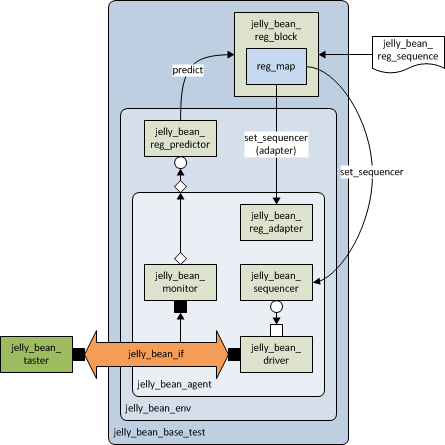
Verification Platform
The figure below shows the diagram of the RAL-related classes. The standard UVM classes are shown in pink, while the jelly-bean classes are shown in light blue. The diagram looks busy, but bear in mind that I will explain each jelly-bean class one by one.

Diagram of the Jelly-Bean-Register Related Classes
Register Definitions
In the previous posts, the DUT had no accessible registers. We are going to add the registers that hold jelly-bean recipe information and its taste. We will also add a command input port to the DUT so that we can write a jelly-bean recipe to the register and read its taste. The figure below shows the register definition of the DUT.

DUT Registers
The source code of the DUT (jelly_bean_taster) is shown below. When the command input is WRITE, the values of flavor, color, sugar_free, and sour input ports are written to the RECIPE register (line 22 to 25). When the command input is READ, the TASTE register is read out and the taste output is driven accordingly (line 27).
1

2

3

4

5

6

7

8

9

10

11

12

13

14

15

16

17

18

19

20

21

22

23

24

25

26

27

28

29

30

31

32

33

34

35

36

37

38

39
|
module jelly_bean_taster( jelly_bean_if.slave_mp jb_slave_if );

   import jelly_bean_pkg::*;


   reg [2:0] flavor;

   reg [1:0] color;

   reg       sugar_free;

   reg       sour;

   reg [1:0] command;

   reg [1:0] taste;


   initial begin

      flavor     = 0;

      color      = 0;

      sugar_free = 0;

      sour       = 0;

      command    = 0;

      taste      = 0;

   end


   always @ ( posedge jb_slave_if.clk ) begin

      if ( jb_slave_if.command == jelly_bean_types::WRITE ) begin

         flavor     < = jb_slave_if.flavor;         color      <= jb_slave_if.color;         sugar_free <= jb_slave_if.sugar_free;         sour       <= jb_slave_if.sour;      end else if ( jb_slave_if.command == jelly_bean_types::READ ) begin

         jb_slave_if.taste <= taste;      end

   end


   always @ ( posedge jb_slave_if.clk ) begin

      if ( jb_slave_if.flavor == jelly_bean_types::CHOCOLATE &&

           jb_slave_if.sour ) begin

         taste <= jelly_bean_types::YUCKY;

      end else if ( jb_slave_if.flavor != jelly_bean_types::NO_FLAVOR ) begin

         taste <= jelly_bean_types::YUMMY;

      end

   end

endmodule: jelly_bean_taster
|
Register Model
The model of the RECIPE register is defined by extending the uvm_reg class. Each field of the register is defined as a uvm_reg_field (line 4 to 7). The fields are configured in the build function. Note that the name, build, is used for convenience. Do not confuse it with the build_phase of the uvm_component because the uvm_reg is not a uvm_component.
1

2

3

4

5

6

7

8

9

10

11

12

13

14

15

16

17

18

19

20

21

22

23

24

25

26

27

28

29

30

31

32

33

34

35

36

37

38

39

40

41

42

43

44

45

46

47

48

49

50

51

52

53

54

55

56

57

58

59

60

61

62

63

64

65

66

67
|
class jelly_bean_recipe_reg extends uvm_reg;

   `uvm_object_utils( jelly_bean_recipe_reg )


   rand uvm_reg_field flavor;   rand uvm_reg_field color;   rand uvm_reg_field sugar_free;   rand uvm_reg_field sour;

   constraint flavor_color_con {

      flavor.value != jelly_bean_types::NO_FLAVOR;

      flavor.value == jelly_bean_types::APPLE

                   -> color.value != jelly_bean_types::BLUE;

      flavor.value == jelly_bean_types::BLUEBERRY

                   -> color.value == jelly_bean_types::BLUE;

      flavor.value < = jelly_bean_types::CHOCOLATE;

   }


   function new( string name = "jelly_bean_recipe_reg" );

      super.new( .name( name ), .n_bits( 7 ), .has_coverage( UVM_NO_COVERAGE ) );

   endfunction: new


   virtual function void build();

      flavor = uvm_reg_field::type_id::create( "flavor" );

      flavor.configure( .parent                 ( this ),

                        .size                   ( 3    ),

                        .lsb_pos                ( 0    ),

                        .access                 ( "WO" ),

                        .volatile               ( 0    ),

                        .reset                  ( 0    ),

                        .has_reset              ( 1    ),

                        .is_rand                ( 1    ),

                        .individually_accessible( 0    ) );


      color = uvm_reg_field::type_id::create( "color" );

      color.configure( .parent                 ( this ),

                       .size                   ( 2    ),

                       .lsb_pos                ( 3    ),

                       .access                 ( "WO" ),

                       .volatile               ( 0    ),

                       .reset                  ( 0    ),

                       .has_reset              ( 1    ),

                       .is_rand                ( 1    ),

                       .individually_accessible( 0    ) );


      sugar_free = uvm_reg_field::type_id::create( "sugar_free" );

      sugar_free.configure( .parent                 ( this ),

                            .size                   ( 1    ),

                            .lsb_pos                ( 5    ),

                            .access                 ( "WO" ),

                            .volatile               ( 0    ),

                            .reset                  ( 0    ),

                            .has_reset              ( 1    ),

                            .is_rand                ( 1    ),

                            .individually_accessible( 0    ) );


      sour = uvm_reg_field::type_id::create( "sour" );

      sour.configure( .parent                 ( this ),

                      .size                   ( 1    ),

                      .lsb_pos                ( 6    ),

                      .access                 ( "WO" ),

                      .volatile               ( 0    ),

                      .reset                  ( 0    ),

                      .has_reset              ( 1    ),

                      .is_rand                ( 1    ),

                      .individually_accessible( 0    ) );

   endfunction: build

endclass: jelly_bean_recipe_reg
|
The model of the TASTE register is similarly defined.
1

2

3

4

5

6

7

8

9

10

11

12

13

14

15

16

17

18

19

20

21

22
|
class jelly_bean_taste_reg extends uvm_reg;

   `uvm_object_utils( jelly_bean_taste_reg )


   rand uvm_reg_field taste;

   function new( string name = "jelly_bean_taste_reg" );

      super.new( .name( name ), .n_bits( 2 ), .has_coverage( UVM_NO_COVERAGE ) );

   endfunction: new


   virtual function void build();

      taste = uvm_reg_field::type_id::create("taste");

      taste.configure( .parent                 ( this ),

                       .size                   ( 2    ),

                       .lsb_pos                ( 0    ),

                       .access                 ( "RO" ),

                       .volatile               ( 1    ),

                       .reset                  ( 0    ),

                       .has_reset              ( 1    ),

                       .is_rand                ( 1    ),

                       .individually_accessible( 1    ) );

   endfunction: build

endclass: jelly_bean_taste_reg
|
Register Block
The jelly_bean_reg_block contains the two registers created above and defines a register map.
1

2

3

4

5

6

7

8

9

10

11

12

13

14

15

16

17

18

19

20

21

22

23

24

25

26

27

28
|
class jelly_bean_reg_block extends uvm_reg_block;

   `uvm_object_utils( jelly_bean_reg_block )


   rand jelly_bean_recipe_reg jb_recipe_reg;

   rand jelly_bean_taste_reg  jb_taste_reg;

   uvm_reg_map                reg_map;


   function new( string name = "jelly_bean_reg_block" );

      super.new( .name( name ), .has_coverage( UVM_NO_COVERAGE ) );

   endfunction: new


   virtual function void build();

      jb_recipe_reg = jelly_bean_recipe_reg::type_id::create( "jb_recipe_reg" );      jb_recipe_reg.configure( .blk_parent( this ) );      jb_recipe_reg.build();

      jb_taste_reg = jelly_bean_taste_reg::type_id::create( "jb_taste_reg" );      jb_taste_reg.configure( .blk_parent( this ) );      jb_taste_reg.build();

      reg_map = create_map( .name( "reg_map" ), .base_addr( 8'h00 ),                            .n_bytes( 1 ), .endian( UVM_LITTLE_ENDIAN ) );      reg_map.add_reg( .rg( jb_recipe_reg ), .offset( 8'h00 ), .rights( "WO" ) );      reg_map.add_reg( .rg( jb_taste_reg  ), .offset( 8'h01 ), .rights( "RO" ) );      lock_model(); // finalize the address mapping

   endfunction: build


endclass: jelly_bean_reg_block
|
Register Adapter
The jelly_bean_reg_adapter class provides two functions to convert between a uvm_reg_bus_op and a jelly_bean_transaction. The reg2bus function converts a uvm_reg_bus_op into a jelly_bean_transaction, whereas the bus2reg function converts a jelly_bean_transaction back to a uvm_reg_bus_op.
The uvm_reg_adapter is a uvm_object, not a uvm_component.
Advanced Topic: Even though a uvm_sequence is a uvm_sequence_item, you cannot let the reg2bus() function create a uvm_sequence and return it. This is because when a register is read/written, the uvm_reg_map calls uvm_sequence_base::start_item() passing the object returned by the reg2bus(), but the start_item() does not expect a uvm_sequence. This will cause a fatal error. For more details, please see Register Access Methods.
1

2

3

4

5

6

7

8

9

10

11

12

13

14

15

16

17

18

19

20

21

22

23

24

25

26

27

28

29

30

31

32

33

34

35

36

37

38

39

40
|
class jelly_bean_reg_adapter extends uvm_reg_adapter;

   `uvm_object_utils( jelly_bean_reg_adapter )


   function new( string name = "" );

      super.new( name );

      supports_byte_enable = 0;

      provides_responses   = 0;

   endfunction: new


   virtual function uvm_sequence_item reg2bus( const ref uvm_reg_bus_op rw );

      jelly_bean_transaction jb_tx

        = jelly_bean_transaction::type_id::create("jb_tx");


      if ( rw.kind == UVM_READ )       jb_tx.command = jelly_bean_types::READ;      else if ( rw.kind == UVM_WRITE ) jb_tx.command = jelly_bean_types::WRITE;      else                             jb_tx.command = jelly_bean_types::NO_OP;      if ( rw.kind == UVM_WRITE )        { jb_tx.sour, jb_tx.sugar_free, jb_tx.color, jb_tx.flavor } = rw.data;      return jb_tx;   endfunction: reg2bus


   virtual function void bus2reg( uvm_sequence_item bus_item,

                                  ref uvm_reg_bus_op rw );

      jelly_bean_transaction jb_tx;


      if ( ! $cast( jb_tx, bus_item ) ) begin

         `uvm_fatal( get_name(),

                     "bus_item is not of the jelly_bean_transaction type." )

         return;

      end


      rw.kind = ( jb_tx.command == jelly_bean_types::READ ) ? UVM_READ : UVM_WRITE;      if ( jb_tx.command == jelly_bean_types::READ )        rw.data = jb_tx.taste;      else if ( jb_tx.command == jelly_bean_types::WRITE )        rw.data = { jb_tx.sour, jb_tx.sugar_free, jb_tx.color, jb_tx.flavor };      rw.status = UVM_IS_OK;   endfunction: bus2reg


endclass: jelly_bean_reg_adapter
|
Register Predictor
The register predictor updates the values of the register model based on observed bus transactions. As the jelly-bean register predictor is not involved with any kind of extended features, the uvm_reg_predictor is used as is.
typedef uvm_reg_predictor#( jelly_bean_transaction ) jelly_bean_reg_predictor;
|
Agent
The jelly_bean_agent instantiates the jelly_bean_reg_adapter (line 35).
1

2

3

4

5

6

7

8

9

10

11

12

13

14

15

16

17

18

19

20

21

22

23

24

25

26

27

28

29

30

31

32

33

34

35

36

37

38

39

40

41

42

43

44

45

46

47

48
|
class jelly_bean_agent extends uvm_agent;

   `uvm_component_utils( jelly_bean_agent )


   uvm_analysis_port#( jelly_bean_transaction ) jb_ap;


   jelly_bean_agent_config jb_agent_cfg;

   jelly_bean_sequencer    jb_seqr;

   jelly_bean_driver       jb_drvr;

   jelly_bean_monitor      jb_mon;

   jelly_bean_reg_adapter  jb_reg_adapter;


   function new( string name, uvm_component parent );

      super.new( name, parent );

   endfunction: new


   function void build_phase( uvm_phase phase );

      super.build_phase( phase );


      if ( ! uvm_config_db#( jelly_bean_agent_config )::get( .cntxt( this ),

                                                             .inst_name ( "" ),

                                                             .field_name( "jb_agent_cfg" ),

                                                             .value( jb_agent_cfg ))) begin

         `uvm_error( "jelly_bean_agent", "jb_agent_cfg not found" )

      end


      jb_ap = new( .name( "jb_ap" ), .parent( this ) );

      if ( jb_agent_cfg.active == UVM_ACTIVE ) begin

         jb_seqr = jelly_bean_sequencer::type_id::create( .name( "jb_seqr" ),

                                                          .parent( this ) );

         jb_drvr = jelly_bean_driver::type_id::create( .name( "jb_drvr" ),

                                                       .parent( this ) );

      end

      jb_mon = jelly_bean_monitor::type_id::create( .name( "jb_mon" ),

                                                    .parent( this ) );

      jb_reg_adapter = jelly_bean_reg_adapter::type_id::create( .name( "jb_reg_adapter" ) );   endfunction: build_phase


   function void connect_phase( uvm_phase phase );

      super.connect_phase( phase );


      jb_mon.jb_if = jb_agent_cfg.jb_if;

      if ( jb_agent_cfg.active == UVM_ACTIVE ) begin

         jb_drvr.seq_item_port.connect( jb_seqr.seq_item_export );

         jb_drvr.jb_if = jb_agent_cfg.jb_if;

      end

      jb_mon.jb_ap.connect( jb_ap );

   endfunction: connect_phase

endclass: jelly_bean_agent
|
Environment Configuration
The jelly_bean_env_config has a handle to the jelly_bean_reg_block so that the jelly_bean_env can access the register model.
1

2

3

4

5

6

7

8

9

10

11

12

13
|
class jelly_bean_env_config extends uvm_object;

   `uvm_object_utils( jelly_bean_env_config )


   bit has_jb_agent = 1;

   bit has_jb_sb    = 1;


   jelly_bean_agent_config jb_agent_cfg;

   jelly_bean_reg_block    jb_reg_block;

   function new( string name = "" );

      super.new( name );

   endfunction: new

endclass: jelly_bean_env_config
|
Environment
The jelly_bean_env instantiates the jelly_bean_agent and the jelly_bean_reg_predictor (line 28 to 31), then connects register-related objects:
Firstly, in the connect_phase(), the set_sequencer() function associates the jelly-bean sequencer and the register adapter with the register map (line 45 and 46). The set_sequencer() must be called before starting the sequence based on a uvm_reg_sequence. A register block may have more than one register map.
Secondly, the register map and the register adapter are associated with the register predictor (line 49 and 50). The register predictor will use the register map and the register adapter to convert a jelly_bean_transaction back to a register operation.
Lastly, the register predictor is connected to the agent to subscribe the jelly_bean_transactions from the agent (line 51).
1

2

3

4

5

6

7

8

9

10

11

12

13

14

15

16

17

18

19

20

21

22

23

24

25

26

27

28

29

30

31

32

33

34

35

36

37

38

39

40

41

42

43

44

45

46

47

48

49

50

51

52

53

54
|
class jelly_bean_env extends uvm_env;

   `uvm_component_utils( jelly_bean_env )


   jelly_bean_env_config    jb_env_cfg;

   jelly_bean_agent         jb_agent;

   jelly_bean_fc_subscriber jb_fc_sub;

   jelly_bean_scoreboard    jb_sb;

   jelly_bean_reg_predictor jb_reg_predictor;


   function new( string name, uvm_component parent );

      super.new( name, parent );

   endfunction: new


   function void build_phase( uvm_phase phase );

      super.build_phase( phase );

      if ( ! uvm_config_db#( jelly_bean_env_config )::get

           ( .cntxt( this ),

             .inst_name( "" ),

             .field_name( "jb_env_cfg" ),

             .value( jb_env_cfg ) ) ) begin

         `uvm_fatal( get_name(), "jb_env_cfg not found" )

      end


      uvm_config_db#( jelly_bean_agent_config )::set( .cntxt( this ),

                                                      .inst_name( "jb_agent*" ),

                                                      .field_name( "jb_agent_cfg" ),

                                                      .value( jb_env_cfg.jb_agent_cfg ) );

      jb_agent = jelly_bean_agent::type_id::create( .name( "jb_agent" ),                                                    .parent( this ) );      jb_reg_predictor = jelly_bean_reg_predictor::type_id::create( .name( "jb_reg_predictor" ),                                                                    .parent( this ) );      if ( jb_env_cfg.has_jb_sb ) begin

         jb_sb = jelly_bean_scoreboard::type_id::create( .name( "jb_sb" ),

                                                         .parent( this ) );

      end

      jb_fc_sub = jelly_bean_fc_subscriber::type_id::create( .name( "jb_fc_sub" ),

                                                             .parent( this ) );

    endfunction: build_phase


   function void connect_phase( uvm_phase phase );

      super.connect_phase( phase );

      jb_agent.jb_ap.connect( jb_fc_sub.analysis_export );

      jb_agent.jb_ap.connect( jb_sb.jb_analysis_export );

      if ( jb_env_cfg.jb_reg_block.get_parent() == null ) begin // if the top-level env

         jb_env_cfg.jb_reg_block.reg_map.set_sequencer( .sequencer( jb_agent.jb_seqr ),                                                        .adapter( jb_agent.jb_reg_adapter ) );      end

      jb_env_cfg.jb_reg_block.reg_map.set_auto_predict( .on( 0 ) );

      jb_reg_predictor.map     = jb_env_cfg.jb_reg_block.reg_map;      jb_reg_predictor.adapter = jb_agent.jb_reg_adapter;      jb_agent.jb_ap.connect( jb_reg_predictor.bus_in );   endfunction: connect_phase


endclass: jelly_bean_env
|
Base Test
The base test instantiates a jelly_bean_reg_block (line 16 and 17) and stores its handle in the jelly_bean_env_config (line 19 and 20).
1

2

3

4

5

6

7

8

9

10

11

12

13

14

15

16

17

18

19

20

21

22

23

24

25

26

27

28

29

30

31

32

33

34

35

36

37

38

39

40

41

42

43

44

45

46
|
class jelly_bean_base_test extends uvm_test;

   `uvm_component_utils( jelly_bean_base_test )


   jelly_bean_env          jb_env;

   jelly_bean_env_config   jb_env_cfg;

   jelly_bean_agent_config jb_agent_cfg;

   jelly_bean_reg_block    jb_reg_block;


   function new( string name, uvm_component parent );

      super.new( name, parent );

   endfunction: new


   function void build_phase(uvm_phase phase);

      super.build_phase(phase);


      jb_reg_block = jelly_bean_reg_block::type_id::create( "jb_reg_block" );      jb_reg_block.build();

      jb_env_cfg = jelly_bean_env_config::type_id::create( "jb_env_cfg" );      jb_env_cfg.jb_reg_block = jb_reg_block;

      jb_agent_cfg = jelly_bean_agent_config::type_id::create( "jb_agent_cfg" );


      if ( ! uvm_config_db#( virtual jelly_bean_if )::get( .cntxt( this ),

                                                           .inst_name( "" ),

                                                           .field_name( "jb_if" ),

                                                           .value( jb_agent_cfg.jb_if ))) begin

         `uvm_error( "jelly_bean_test", "jb_if not found" )

      end


      jb_env_cfg.jb_agent_cfg = jb_agent_cfg;


      uvm_config_db#(jelly_bean_env_config)::set( .cntxt( null ),

                                                  .inst_name( "*" ),

                                                  .field_name( "jb_env_cfg" ),

                                                  .value( jb_env_cfg ) );

      jb_env = jelly_bean_env::type_id::create( .name( "jb_env" ),

                                                .parent( this ) );

   endfunction: build_phase


   virtual function void start_of_simulation_phase( uvm_phase phase );

      super.start_of_simulation_phase( phase );

      uvm_top.print_topology();

   endfunction: start_of_simulation_phase


endclass: jelly_bean_base_test
|
Sequence without Register Abstraction
We have created all the components by now and we are ready to create a register sequence. But before doing that, let’s create a “regular” sequence without using the register abstraction for comparison. The jelly_bean_sequence is a sequence to generate a sour-green-apple jelly bean. The body of the sequence creates a jelly_bean_transaction, which will be used by the driver to do pin wiggling.
1

2

3

4

5

6

7

8

9

10

11

12

13

14

15

16

17

18

19
|
class jelly_bean_sequence extends uvm_sequence#( jelly_bean_transaction );

   `uvm_object_utils( jelly_bean_sequence )


   function new( string name = "" );

      super.new( name );

   endfunction: new


   task body();

      jelly_bean_transaction jb_tx;

      jb_tx = jelly_bean_transaction::type_id::create( .name( "jb_tx" ),

                                                       .contxt( get_full_name()));

      start_item( jb_tx );

      jb_tx.flavor     = jelly_bean_types::APPLE;      jb_tx.color      = jelly_bean_types::GREEN;      jb_tx.sugar_free = 0;      jb_tx.sour       = 1;      finish_item(jb_tx);

   endtask: body

endclass: jelly_bean_sequence
|
Sequence Using Register Abstraction
The jelly_bean_reg_sequence is another sequence to generate a sour-green-apple jelly bean, but using the register abstraction. This sequence is extended from the uvm_reg_sequence class so that we can use the convenience functions such as write_reg() and read_reg(). The body of the sequence writes a recipe (line 23) to the RECIPE register, then reads back its taste from the TASTE register (line 24). Note that we do not create a jelly_bean_transaction in the sequence. The register adapter will convert the register operations into the corresponding jelly_bean_transactions.
1

2

3

4

5

6

7

8

9

10

11

12

13

14

15

16

17

18

19

20

21

22

23

24

25

26

27
|
class jelly_bean_reg_sequence extends uvm_reg_sequence;

   `uvm_object_utils( jelly_bean_reg_sequence )


   function new( string name = "" );

      super.new( name );

   endfunction: new


   virtual task body();

      jelly_bean_reg_block       jb_reg_block;

      jelly_bean_types::flavor_e flavor;

      jelly_bean_types::color_e  color;

      bit                        sugar_free;

      bit                        sour;

      uvm_status_e               status;

      uvm_reg_data_t             value;


      $cast( jb_reg_block, model );

      flavor     = jelly_bean_types::APPLE;

      color      = jelly_bean_types::GREEN;

      sugar_free = 0;

      sour       = 1;


      write_reg( jb_reg_block.jb_recipe_reg, status, { sour, sugar_free, color, flavor } );      read_reg ( jb_reg_block.jb_taste_reg,  status, value );   endtask: body


endclass: jelly_bean_reg_sequence
|
Register Test
The jelly_bean_reg_test creates a jelly_bean_reg_sequence we have just created and starts the sequence (line 12 to 15).
1

2

3

4

5

6

7

8

9

10

11

12

13

14

15

16

17

18

19

20

21
|
class jelly_bean_reg_test extends jelly_bean_base_test;

   `uvm_component_utils( jelly_bean_reg_test )


   function new( string name, uvm_component parent );

      super.new( name, parent );

   endfunction: new


   task main_phase( uvm_phase phase );

      jelly_bean_reg_sequence jb_reg_seq;


      phase.raise_objection( .obj( this ) );

      jb_reg_seq = jelly_bean_reg_sequence::type_id::create( .name( "jb_reg_seq" ),                                                             .contxt( get_full_name()));      jb_reg_seq.model = jb_reg_block;      jb_reg_seq.start( .sequencer( jb_env.jb_agent.jb_seqr ) );

      #100ns;

      phase.drop_objection( .obj( this ) );


   endtask: main_phase

endclass: jelly_bean_reg_test
|
Simulation
Let’s look at a simulation result. The simulation successfully generated a sour-green apple and read back its taste from the DUT.
1

2

3

4

5

6

7

8

9

10

11

12

13

14

15

16

17

18

19

20

21

22

23

24

25
|
UVM_INFO jb3.sv(727) @ 30: uvm_test_top.jb_env.jb_sb [jelly_bean_scoreboard] You have a good sense of taste.

---------------------------------------------------------

Name          Type                         Size  Value

---------------------------------------------------------

jb_tx         jelly_bean_transaction       -     @7929

  flavor      jelly_bean_types::flavor_e   3     APPLE  color       jelly_bean_types::color_e    2     GREEN  sugar_free  integral                     1     'h0  sour        integral                     1     'h1  command     jelly_bean_types::command_e  2     WRITE  taste       jelly_bean_types::taste_e    2     NO_TASTE

---------------------------------------------------------


UVM_INFO jb3.sv(727) @ 60: uvm_test_top.jb_env.jb_sb [jelly_bean_scoreboard] You have a good sense of taste.

----------------------------------------------------------

Name          Type                         Size  Value

----------------------------------------------------------

jb_tx         jelly_bean_transaction       -     @7928

  flavor      jelly_bean_types::flavor_e   3     NO_FLAVOR

  color       jelly_bean_types::color_e    2     NO_COLOR

  sugar_free  integral                     1     'h0

  sour        integral                     1     'h0

  command     jelly_bean_types::command_e  2     READ  taste       jelly_bean_types::taste_e    2     YUMMY----------------------------------------------------------
|
I hope this tutorial helped you to understand the UVM Register Abstraction.
Get source code

You can view and run the code on EDA Playground.
参考:
http://cluelogic.com/2012/10/uvm-tutorial-for-candy-lovers-register-abstraction/
- uvm Register Access Methods(16)
转载: 译文:https://blog.csdn.net/zhajio/article/details/80731435 原文:http://cluelogic.com/2013/02/uvm-tut ...
- ( 转)UVM验证方法学之一验证平台
在现代IC设计流程中,当设计人员根据设计规格说明书完成RTL代码之后,验证人员开始验证这些代码(通常称其为DUT,Design Under Test).验证工作主要保证从设计规格说明书到RTL转变的正 ...
- UVM RAL模型和内置seq
转载:UVM RAL模型:用法和应用_寄存器 (sohu.com) 在系统设计中通常会面临两大挑战:缩小技术节点的规模和上市时间(TTM,Time to Market).为了适应激烈的市场竞争,大多数 ...
- SQL Abstraction and Object Hydration
SQL Abstraction and Object Hydration In the last chapter, we introduced database abstraction and a n ...
- Block abstraction view(Create & Reference)
在hierarchical design 中,一般需要调用 hard macro,top调用 macro 的方法有多种: 1. 调用macro对应的db 2. 调用 macro 的 ilm 模型(20 ...
- PatentTips - Control register access virtualization performance improvement
BACKGROUND OF THE INVENTION A conventional virtual-machine monitor (VMM) typically runs on a compute ...
- No-args constructor for class X does not exist. Register an InstanceCreator with Gson for this type to fix this problem.
Gson解析JSON字符串时出现了下面的错误: No-args constructor for class X does not exist. Register an InstanceCreator ...
- C语言基础(8)-const,volatile,register关键字
1 const const是定义一个常量 2 volatile 代表定义一个变量,这个变量值可能在CPU指令之外被改变 volatile int a;//定义了一个volatile类型的int变量 通 ...
- C和指针 第三章 变量的储存类型 auto、static、register以及static关键词
变量的储存类型决定标量何时创建,何时销毁以及他的值保持多久.有三个地方可以储存变量: 普通内存static 运行时堆栈auto 硬件寄存器register 变量的缺省储存类型取决于它的声明位置: 静态 ...
随机推荐
- 383 day10缓冲流、转换流、序列化流
day10[缓冲流.转换流.序列化流] 主要内容 缓冲流 转换流 序列化流 打印流 教学目标 [ ] 能够使用字节缓冲流读取数据到程序 [ ] 能够使用字节缓冲流写出数据到文件 [ ] 能够明确字符缓 ...
- 一起学习PHP的runkit扩展如何使用
这次又为大家带来一个好玩的扩展.我们知道,在 PHP 运行的时候,也就是部署完成后,我们是不能修改常量的值,也不能修改方法体内部的实现的.也就是说,我们编码完成后,将代码上传到服务器,这时候,我们想在 ...
- JDBC-1(概述&建立)
基于宋红康老师所讲JDBC所作笔记 1.JDBC概述 1.1 数据持久化 持久化:将数据保持到可掉电式存储设备中以供之后使用. 数据持久化意味着将内存中的数据保存到硬盘上加以固化,实现过程大多通过各种 ...
- IDEA - 2019中文版安装教程
前言 个人安装备忘录 软件简介 IDEA 全称IntelliJ IDEA,是java语言开发的集成环境,在业界被公认为最好的java开发工具之一,尤其在智能代码助手.代码自动提示.重构.J2EE支持. ...
- Docker系列(18)- 具名挂载和匿名挂载
容器数据卷挂载方式 容器的数据卷可以看成就是容器的挂载方式:一个宿主机有多个容器,多个容器挂载方式不同,因此宿主机就有多个卷 每一个挂载方式在宿主机上都有一个名称,即卷名 宿主机如何查看这些卷,对使用 ...
- Jmeter系列(22)- 常用逻辑控制器(1) | 随机控制器Random Controller
随机控制器(Random Controller) 该控制器下的请求,请求顺序随机,适用场景一般为顺序性依赖不强的请求,比如:下载文件:浏览商品:访问查询接口 随机控制器下的请求随机,如果勾选了[忽略控 ...
- Shell系列(21)- 字符截取命令printf
作用 printf是标准格式输出命令,控制输出格式,不会自动加入换行符.awk会用到该条命令 命令 printf '输出类型输出格式' 输出内容 #''双引号不能少,输出类型和输出格式之间没有空格 输 ...
- TP框架 商城前台用户注册方法
//注册 public function register(){ if(IS_POST){ //接收数据 $data = I('post.'); $model = D('User'); $data[' ...
- django 如何在HMTL中使用媒体media_url
django 如何在HMTL中使用媒体media_url中指定的路径 第一种: 一. setting.py里,一般图片或者文件上传路径都是是以下设置, MEDIA_URL = '/media/' ...
- docker run 参数
一.格式 docker run [OPTIONS] IMAGE [COMMAND] [ARG...] 二.OPTIONS 参数 简写, 名称参数 默认参数 描述 --add-host 添加自定义主机到 ...
