
压测工具Locuse的使用
我是听朋友提起的"蝗虫"(Locust),然而她不想用python,我就拿来试一试~
http的 各种压测工具也已经太多了,所以主要是试试locust在当前比较流行的rpc协议上的效果
目的 -- 调研locust应用于grpc协议
服务 -- grpc的helloworld
一 环境准备
1 需要python环境,我使用的是python2.7
2 安装locust
pip install locustio

pip install pyzmq        // 分布式运行多个起压locust时使用
pip install gevent==1.1  // 据说是因为升级后的gevent不能很好的支持python2系列?
locust -h // 查看可用参数
二 被测服务编写
1 windows的web界面测试
① python代码,写好保存在为test_001.py
from locust import HttpLocust,TaskSet,task

import subprocess

import json

class UserBehavior(TaskSet):

    def on_start(self):

        pass

    @task()

    def list_header(self):

        r = self.client.get("/")

class WebUserLocust(HttpLocust):

    weight =

    task_set = UserBehavior

    host = "http://www.baidu.com"

    min_wait =

    max_wait =
② 在命令行执行
locust -f E:\Work\PyCharmTest\locusttest\test_001.py
③ 打开浏览器,输入网址:localhost:8089 (locust 的默认监听端口为8089)
在显示页面输入模拟用户数和每个用户的req/s,点击 start swarming 即可开始 
④ 需要手动结束,在页面点击stop或者在命令行ctrl+c退出locust启动命令,即可查看结果如下:
显示总请求数、失败请求数、请求的耗时分布、qps、传输字节数等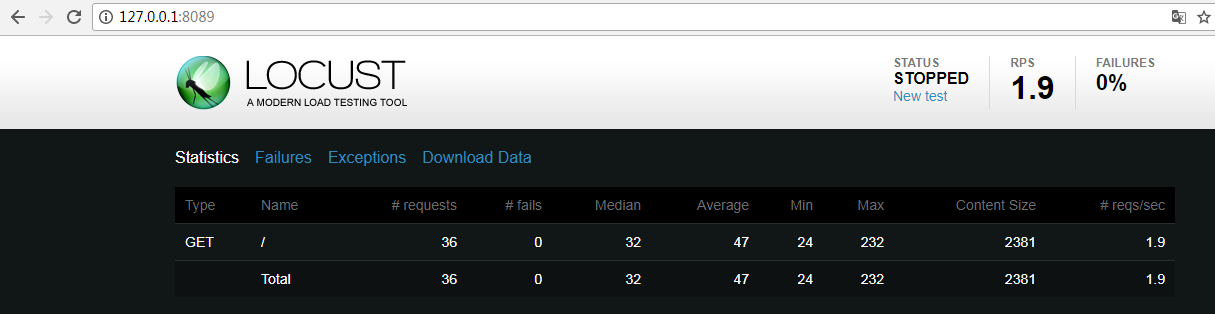
2 linux运行
① python代码 -- 此处写的proto文件,helloworld
syntax = "proto3";

option java_package = "io.grpc.examples";

package helloworld;

// The greeter service definition.

service Greeter {

    // Sends a greeting

    rpc SayHello (HelloRequest) returns (HelloReply) {}

}

// The request meesage containing the user'name.

message HelloRequest {

    string name = ;

}

// The response message containing the greetings

message HelloReply {

    string message = ;

}
② 转成python
执行如下命令,生成helloworld_pb2.py和helloworld_pb2_grpc两个文件
protoc --python_out=. helloworld.proto
③ 启动helloworld的server(该部分随意,根据实际设置)
该部分用的python的server,启动端口设置为50052
import sys

import grpc

import time

sys.path.append("..")

from concurrent import futures

from helloworld.helloworld import helloworld_pb2, helloworld_pb2_grpc

_ONE_DAY_IN_SECONDS =  *  *

_HOST = 'localhost'

_PORT = ''

class Greeter(helloworld_pb2_grpc.GreeterServicer):

    def SayHello(self, request, context):

        str = request.name

        return helloworld_pb2.HelloReply(message='hello, '+str)

def serve():

    grpcServer = grpc.server(futures.ThreadPoolExecutor(max_workers=))

    helloworld_pb2_grpc.add_GreeterServicer_to_server(Greeter(), grpcServer)

    grpcServer.add_insecure_port(_HOST + ':' + _PORT)

    grpcServer.start()

    try:

        while True:

            time.sleep(_ONE_DAY_IN_SECONDS)

    except KeyboardInterrupt:

        grpcServer.stop()

if __name__ == '__main__':

    serve()
④ 编写locust文件,对端口50052的服务进行压测,locust文件如下:
我抄的,从这儿:http://codegist.net/code/grpc%20locust/
#!/usr/bin/env python 2.7

# -*- coding:utf- -*-

import os,sys, argparse

sys.path.append("..")

import grpc

import json

import requests

import time

import random

import string

from helloworld.helloworld import helloworld_pb2, helloworld_pb2_grpc

from locust import Locust, TaskSet, task, events

from locust.stats import RequestStats

from locust.events import EventHook

def parse_arguments():

    parser = argparse.ArgumentParser(prog='locust')

    parser.add_argument('--hatch_rate')

    parser.add_argument('--master', action='store_true')

    args, unknown = parser.parse_known_args()

    opts = vars(args)

    return args.host, int(args.clients), int(args.hatch_rate)

#HOST, MAX_USERS_NUMBER, USERS_PRE_SECOND = parse_arguments()

HOST, MAX_USERS_NUMBER, USERS_PRE_SECOND = '127.0.0.1:50052', ,


# 分布式,需要启多台压测时,有一个master,其余为slave

slaves_connect = []

slave_report = EventHook()

ALL_SLAVES_CONNECTED = True

SLAVES_NUMBER =

def on_my_event(client_id, data):

    global ALL_SLAVES_CONNECTED

    if not ALL_SLAVES_CONNECTED:

        slaves_connect.append(client_id)

    if len(slaves_connect) == SLAVES_NUMBER:

        print "All Slaves Connected"

        ALL_SLAVES_CONNECTED = True

#        print events.slave_report._handlers

        header = {'Content-Type': 'application/x-www-form-urlencoded'}

import resource

rsrc = resource.RLIMIT_NOFILE

soft, hard = resource.getrlimit(rsrc)

print 'RLIMIT_NOFILE soft limit starts as : ', soft

soft, hard = resource.getrlimit(rsrc)

print 'RLIMIT_NOFILE soft limit change to: ', soft

events.slave_report += on_my_event

class GrpcLocust(Locust):

    def __init__(self, *args, **kwargs):

        super(GrpcLocust, self).__init__(*args, **kwargs)

class ApiUser(GrpcLocust):

    min_wait =

    max_wait =

    stop_timeout =

    class task_set(TaskSet):

        def getEnviron(self, key, default):

            if key in os.environ:

                return os.environ[key]

            else:

                return default

        def getToken(self):

            consumer_key = self.getEnviron('SELDON_OAUTH_KEY', 'oauthkey')

            consumer_secret = self.getEnviron('SELDON_OAUTH_SECRET', 'oauthsecret')

            params = {}

            params["consumer_key"] = consumer_key

            params["consumer_secret"] = consumer_secret

            url = self.oauth_endpoint + "/token"

            r = requests.get(url, params=params)

            if r.status_code == requests.codes.ok:

                j = json.loads(r.text)

                # print j

                return j["access_token"]

            else:

                print "failed call to get token"

                return None

        def on_start(self):

            # print "on start"

#            self.oauth_endpoint = self.getEnviron('SELDON_OAUTH_ENDPOINT', "http://127.0.0.1:50053")

#            self.token = self.getToken()

            self.grpc_endpoint = self.getEnviron('SELDON_GRPC_ENDPOINT', "127.0.0.1:50052")

            self.data_size = int(self.getEnviron('SELDON_DEFAULT_DATA_SIZE', ""))

        @task

        def get_prediction(self):

            conn = grpc.insecure_channel(self.grpc_endpoint)

            client = helloworld_pb2_grpc.GreeterStub(conn)

            start_time = time.time()

            name = string.join(random.sample(['a','b','c','d','e','f','g'], )).replace(" ","")

            request = helloworld_pb2.HelloRequest(name=name)

            try:

                reply = client.SayHello(request)

            except Exception,e:

                total_time = int((time.time() - start_time) * )

                events.request_failure.fire(request_type="grpc", name=HOST, response_time=total_time, exception=e)

            else:

                total_time = int((time.time() - start_time) * )

                events.request_success.fire(request_type="grpc", name=HOST, response_time=total_time, response_length=)
⑤ 启动locust,查看结果
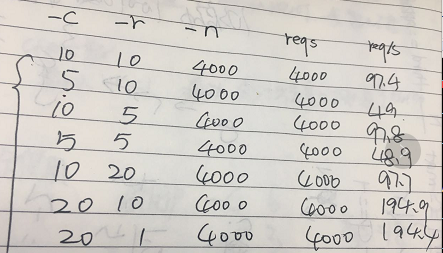
locust --help可以看到命令的使用帮助。注意 -c -n -r 参数的使用需要配合 --no-web

三 问题及解决
问题倒是有,但是我没解决,我不知道这个起压的req怎么设置的
原本以为 -c 模拟用户数 -r 每个用户发出的秒请求数 --- 那么服务每秒承受的压力就应该为-c * -r
但是我跑出来的结果确实这样的,特别像是-c * 10 ,大脸懵逼了
压测工具Locuse的使用的更多相关文章
- Http压测工具wrk使用指南
用过了很多压测工具,却一直没找到中意的那款.最近试了wrk感觉不错,写下这份使用指南给自己备忘用,如果能帮到你,那也很好. 安装 wrk支持大多数类UNIX系统,不支持windows.需要操作系统支持 ...
- web压测工具http_load原理分析
一.前言 http_load是一款测试web服务器性能的开源工具,从下面的网址可以下载到最新版本的http_load: http://www.acme.com/software/http_load/ ...
- [软件测试]网站压测工具Webbench源码分析
一.我与webbench二三事 Webbench是一个在linux下使用的非常简单的网站压测工具.它使用fork()模拟多个客户端同时访问我们设定的URL,测试网站在压力下工作的性能.Webbench ...
- Http压测工具wrk使用指南【转】
用过了很多压测工具,却一直没找到中意的那款.最近试了wrk感觉不错,写下这份使用指南给自己备忘用,如果能帮到你,那也很好. 安装 wrk支持大多数类UNIX系统,不支持windows.需要操作系统支持 ...
- python服务端多进程压测工具
本文描述一个python实现的多进程压测工具,这个压测工具的特点如下: 多进程 在大多数情况下,压测一般适用于IO密集型场景(如访问接口并等待返回),在这种场景下多线程多进程的区分并不明显(详情请参见 ...
- 内存压测工具Memtester
在做压力测试时,发现一个内存压测工具Memtester,可以随意设置内存占用大小,非常方便 下载地址:http://pyropus.ca/software/memtester/old-versions ...
- Http 压测工具 wrk 基本使用
Http 压测工具 wrk 基本使用 Intro wrk 是一款现代HTTP基准测试工具,能够在单个多核CPU上运行时产生显着负载.它将多线程设计与可扩展事件通知系统(如epoll和kqueue)结合 ...
- 压测工具使用(vegeta)
一.压测工具vegeta 1.介绍 Vegeta 是一个用 Go 语言编写的多功能的 HTTP 负载测试工具,它提供了命令行工具和一个开发库. 官方地址:https://github.com/tsen ...
- 003_ab http压测工具
一. ab -r -k -c 20000 -n 25000000 https://www.uuwatch.me/abtest #ab压测工具单机最大并发为20000,可以在多台机器上执行以增大并发 y ...
随机推荐
- python中对文件的处理
1.当文件中存放的用户名的密码,是以字符串的形式存储时,怎么进行读取和操作 eg:MLing,123456 niuniu,234567 luoluo,345678 方法一:将字符串转为字典 1)字典查 ...
- [Python] print中的左右对齐问题
一.数值类型(int.float) # %d.%f是占位符>>> a = 3.1415926>>> print("%d"%a) #%d只 ...
- 开发Java web应用程序的介绍
本文将介绍使用Eclipse来开发web应用程序的基础知识.它演示了如何创建一个简单的web应用程序,将其部署到服务器,查看其呈现在浏览器中.应用程序使用JavaServer Pages™(JSP)页 ...
- BZOJ2303: [Apio2011]方格染色 【并查集】
Description Sam和他的妹妹Sara有一个包含n × m个方格的表格.她们想要将其的每个方格都染成红色或蓝色.出于个人喜好,他们想要表格中每个2 × 2的方形区域都包含奇数个(1 个或 3 ...
- 再也不用克隆多个仓库啦!git worktree 一个 git 仓库可以连接多个工作目录
我在 feature 分支开发得多些,但总时不时被高优先级的 BUG 打断需要临时去 develop 分一个分支出来解 BUG.git 2.6 以上开始提供了 worktree 功能,可以解决这样的问 ...
- 深入了解 WPF Dispatcher 的工作原理(Invoke/InvokeAsync 部分)
深耕 WPF 开发的各位程序员大大们一定避不开使用 Dispatcher.跨线程访问 UI 当然免不了用到它,将某个任务延迟到当前任务之后执行也会用到它.Dispatcher.Invoke.Dispa ...
- git 第一次提交至仓库
可以打开Idea 的 terminal直接进行命令操作 1.git init 2.git add src(这个src意思是添加src目录下的所有文件,有些会说add .. 那就是提交工程下的所有 ...
- MVC之前的那点事儿 ---- 系列文章
MVC之前的那点事儿系列,是笔者在2012年初阅读MVC3源码的时候整理的,主要讲述的是从HTTP请求道进入MVCHandler之前的内容,包括了原创,翻译,转载,整理等各类型文章,当然也参考了博客园 ...
- 一次解决spark history server日志不见
通过cloudera的旧版VM(centos6版本)跑spark,之后,想看一下日志研究一下job,stage以及task,压力很大的发现完全没有日志,180088页面打开后: Event log d ...
- 自定义显示提示一段时间自动消失ShowMsgText控件
public partial class ShowMsgText : Label { public string TextMsg { get { return Text; } set { timer1 ...