
(六)6.10 Neurons Networks implements of softmax regression
softmax可以看做只有输入和输出的Neurons Networks,如下图:

其参数数量为k*(n+1) ,但在本实现中没有加入截距项,所以参数为k*n的矩阵。
对损失函数J(θ)的形式有:

算法步骤:
首先,加载数据集{x(1),x(2),x(3)...x(m)}该数据集为一个n*m的矩阵,然后初始化参数 θ ,为一个k*n的矩阵(不考虑截距项):

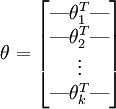
首先计算 ,该矩阵为k*m的:

然后计算 :
:
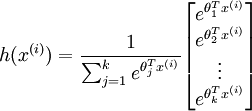
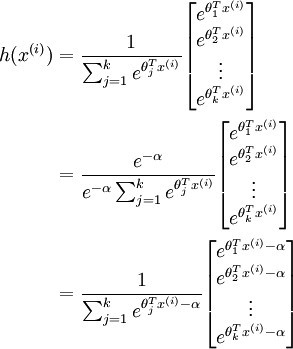
该函数参数可以随意+-任意参数而保持值不变,所以为了防止 参数 过大,先减去一个常量,防止数据运算时产生溢出.
这里减去每一类的最大值, 代表第i列最大值。
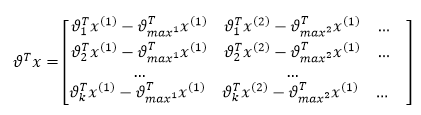
对于上述矩阵,每列除以该列的总和,并且取log即可求得其归一化后的概率,用P来表示,上述矩阵的每一列表示训练数据 分别属于类别k的概率,每一列的和为1.
下面计算Ground Truth 矩阵,该矩阵即代表了损失函数中的: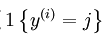 ,Ground Truth 矩阵为k*m的矩阵,每一列代表一个标签,该列中除第k行为1外,其他的元素均为0,k即为该列标签对应的值,比如对于K=4时,的四个样本:

上图代表了 ,把上述矩阵扩展为k*m即可。用符号G来表示该矩阵,即可得到下面的cost function:
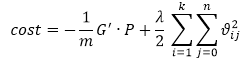
下面需要对损失函数求导,来得到:

以上公式得到一个k*n的矩阵,每一列即为对参数 的导数。
的导数。

接下来梯度检验,验证上一句的正确性,若正确,则用L-BFGS求解最优解,直接用最优解来进行预测即可。下面是matlab代码:
%% STEP 0: 初始化参数与常量

%

%  Here we define and initialise some constants which allow your code

%  to be used more generally on any arbitrary input.

%  We also initialise some parameters used for tuning the model.

inputSize = 28 * 28; % Size of input vector (MNIST images are 28x28)

numClasses = 10;     % Number of classes (MNIST images fall into 10 classes)

lambda = 1e-4; % Weight decay parameter

%%======================================================================

%% STEP 1: Load data

%

%  In this section, we load the input and output data.

%  For softmax regression on MNIST pixels,

%  the input data is the images, and

%  the output data is the labels.

%

% Change the filenames if you've saved the files under different names

% On some platforms, the files might be saved as

% train-images.idx3-ubyte / train-labels.idx1-ubyte

images = loadMNISTImages('mnist/train-images-idx3-ubyte');

labels = loadMNISTLabels('mnist/train-labels-idx1-ubyte');

labels(labels==0) = 10; % 注意下标是1-10,所以需要 把0映射到10

inputData = images;

% For debugging purposes, you may wish to reduce the size of the input data

% in order to speed up gradient checking.

% Here, we create synthetic dataset using random data for testing

DEBUG = true; % Set DEBUG to true when debugging.

if DEBUG

    inputSize = 8;

    inputData = randn(8, 100);%randn产生每个元素均为标准正态分布的8*100的矩阵

    labels = randi(10, 100, 1);%产生1-10的随机数,产生100行,即100个标签

end

% Randomly initialise theta

theta = 0.005 * randn(numClasses * inputSize, 1);

%%======================================================================

%% STEP 2: Implement softmaxCost

%

%  Implement softmaxCost in softmaxCost.m.

[cost, grad] = softmaxCost(theta, numClasses, inputSize, lambda, inputData, labels);

%%======================================================================

%% STEP 3: Gradient checking

%

%  As with any learning algorithm, you should always check that your

%  gradients are correct before learning the parameters.

%

% h = @(x) scale * kernel(scale * x);

% 构建一个自变量为x,因变量为h,表达式为scale * kernel(scale * x)的函数。即

% h=scale* kernel(scale * x),自变量为x

if DEBUG

    numGrad = computeNumericalGradient( @(x) softmaxCost(x, numClasses, ...

                                    inputSize, lambda, inputData, labels), theta);

    % Use this to visually compare the gradients side by side

    disp([numGrad grad]);

    % Compare numerically computed gradients with those computed analytically

    diff = norm(numGrad-grad)/norm(numGrad+grad);

    disp(diff);

    % The difference should be small.

    % In our implementation, these values are usually less than 1e-7.

    % When your gradients are correct, congratulations!

end

%%======================================================================

%% STEP 4: Learning parameters

%

%  Once you have verified that your gradients are correct,

%  you can start training your softmax regression code using softmaxTrain

%  (which uses minFunc).

options.maxIter = 100;

softmaxModel = softmaxTrain(inputSize, numClasses, lambda, ...

                            inputData, labels, options);

% Although we only use 100 iterations here to train a classifier for the

% MNIST data set, in practice, training for more iterations is usually

% beneficial.

%%======================================================================

%% STEP 5: Testing

%

%  You should now test your model against the test images.

%  To do this, you will first need to write softmaxPredict

%  (in softmaxPredict.m), which should return predictions

%  given a softmax model and the input data.

images = loadMNISTImages('mnist/t10k-images-idx3-ubyte');

labels = loadMNISTLabels('mnist/t10k-labels-idx1-ubyte');

labels(labels==0) = 10; % Remap 0 to 10

inputData = images;

% You will have to implement softmaxPredict in softmaxPredict.m

[pred] = softmaxPredict(softmaxModel, inputData);

acc = mean(labels(:) == pred(:));

fprintf('Accuracy: %0.3f%%\n', acc * 100);

% Accuracy is the proportion of correctly classified images

% After 100 iterations, the results for our implementation were:

%

% Accuracy: 92.200%

%

% If your values are too low (accuracy less than 0.91), you should check

% your code for errors, and make sure you are training on the

% entire data set of 60000 28x28 training images

% (unless you modified the loading code, this should be the case)

end

%%%%对应STEP 2: Implement softmaxCost

function [cost, grad] = softmaxCost(theta, numClasses, inputSize, lambda, data, labels)

% numClasses - the number of classes

% inputSize - the size N of the input vector

% lambda - weight decay parameter

% data - the N x M input matrix, where each column data(:, i) corresponds to

%        a single test set

% labels - an M x 1 matrix containing the labels corresponding for the input data

theta = reshape(theta, numClasses, inputSize);% 转化为k*n的参数矩阵

numCases = size(data, 2);%或者data矩阵的列数,即样本数

% M = sparse(r, c, v) creates a sparse matrix such that M(r(i), c(i)) = v(i) for all i.

% That is, the vectors r and c give the position of the elements whose values we wish

% to set, and v the corresponding values of the elements

% labels = (1,3,4,10 ...)^T

% 1:numCases=(1,2,3,4...M)^T

% sparse(labels, 1:numCases, 1) 会产生

% 一个行列为下标的稀疏矩阵

% (1,1)  1

% (3,2)  1

% (4,3)  1

% (10,4) 1

%这样改矩阵填满后会变成每一列只有一个元素为1,该元素的行即为其lable k

%1 0 0 ...

%0 0 0 ...

%0 1 0 ...

%0 0 1 ...

%0 0 0 ...

%. . .

%上矩阵为10*M的 ,即 groundTruth 矩阵

groundTruth = full(sparse(labels, 1:numCases, 1));

cost = 0;

% 每个参数的偏导数矩阵

thetagrad = zeros(numClasses, inputSize);

% theta(k*n) data(n*m)

%theta * data = k*m , 第j行第i列为theta_j^T * x^(i)

%max(M)产生一个行向量,每个元素为该列中的最大值,即对上述k*m的矩阵找出m列中每列的最大值

M = bsxfun(@minus,theta*data,max(theta*data, [], 1)); % 每列元素均减去该列的最大值,见图-

M = exp(M); %求指数

p = bsxfun(@rdivide, M, sum(M)); %sum(M),对M中的元素按列求和

cost = -1/numCases * groundTruth(:)' * log(p(:)) + lambda/2 * sum(theta(:) .^ 2);%损失函数值

%groundTruth 为k*m ,data'为m*n,即theta为k*n的矩阵,n代表输入的维度,k代表类别,即没有隐层的

%输入为n,输出为k的神经网络

thetagrad = -1/numCases * (groundTruth - p) * data' + lambda * theta; %梯度,为 k *

% ------------------------------------------------------------------

% Unroll the gradient matrices into a vector for minFunc

grad = [thetagrad(:)];

end

%%%%对应STEP 3: Implement softmaxCost

% 函数的实际参数是这样的J = @(x) softmaxCost(x, numClasses, inputSize, lambda, inputData, labels)

% 即函数的形式参数J以x为自变量,别的都是以默认的值为相应的变量

function numgrad = computeNumericalGradient(J, theta)

% theta: 参数,向量或者实数均可

% J: 输出值为实数的函数. 调用y = J(theta)将会返回函数在theta处的值

% numgrad初始化为0,与theta维度相同

numgrad = zeros(size(theta));

EPSILON = 1e-4;

% theta是一个行向量,size(theta,1)是求行数

n = size(theta,1);

%产生一个维度为n的单位矩阵

E = eye(n);

for i = 1:n

	% (n,:)代表第n行,所有的列

	% (:,n)代表所有行,第n列

	% 由于E是单位矩阵,所以只有第i行第i列的元素变为EPSILON

    delta = E(:,i)*EPSILON;

	%向量第i维度的值

    numgrad(i) = (J(theta+delta)-J(theta-delta))/(EPSILON*2.0);

end

%%%%对应STEP 4: Implement softmaxCost

function [softmaxModel] = softmaxTrain(inputSize, numClasses, lambda, inputData, labels, options)

%softmaxTrain Train a softmax model with the given parameters on the given

% data. Returns softmaxOptTheta, a vector containing the trained parameters

% for the model.

%

% inputSize: the size of an input vector x^(i)

% numClasses: the number of classes

% lambda: weight decay parameter

% inputData: an N by M matrix containing the input data, such that

%            inputData(:, i) is the ith input

% labels: M by 1 matrix containing the class labels for the

%            corresponding inputs. labels(c) is the class label for

%            the cth input

% options (optional): options

%   options.maxIter: number of iterations to train for

if ~exist('options', 'var')

    options = struct;

end

if ~isfield(options, 'maxIter')

    options.maxIter = 400;

end

% initialize parameters,randn(M,1)产生均值为0,方差为1长度为M的数组

theta = 0.005 * randn(numClasses * inputSize, 1);

% Use minFunc to minimize the function

addpath minFunc/

options.Method = 'lbfgs'; % Here, we use L-BFGS to optimize our cost

                          % function. Generally, for minFunc to work, you

                          % need a function pointer with two outputs: the

                          % function value and the gradient. In our problem,

                          % softmaxCost.m satisfies this.

minFuncOptions.display = 'on';

[softmaxOptTheta, cost] = minFunc( @(p) softmaxCost(p, ...

                                   numClasses, inputSize, lambda, ...

                                   inputData, labels), ...

                              theta, options);

% Fold softmaxOptTheta into a nicer format

softmaxModel.optTheta = reshape(softmaxOptTheta, numClasses, inputSize);

softmaxModel.inputSize = inputSize;

softmaxModel.numClasses = numClasses;

end

%%%%对应 STEP 5: Implement predict

function [pred] = softmaxPredict(softmaxModel, data)

% softmaxModel - model trained using softmaxTrain

% data - the N x M input matrix, where each column data(:, i) corresponds to

%        a single test set

%

% Your code should produce the prediction matrix

% pred, where pred(i) is argmax_c P(y(c) | x(i)).

% Unroll the parameters from theta

theta = softmaxModel.optTheta;  % this provides a numClasses x inputSize matrix

pred = zeros(1, size(data, 2));

%C = max(A)

%返回一个数组各不同维中的最大元素。

%如果A是一个向量,max(A)返回A中的最大元素。

%如果A是一个矩阵,max(A)将A的每一列作为一个向量,返回一行向量包含了每一列的最大元素。

%根据预测函数找出每列的最大值即可。

[nop, pred] = max(theta * data);

end
∇ϑ1 J(ϑ)
(六)6.10 Neurons Networks implements of softmax regression的更多相关文章
- CS229 6.10 Neurons Networks implements of softmax regression
softmax可以看做只有输入和输出的Neurons Networks,如下图: 其参数数量为k*(n+1) ,但在本实现中没有加入截距项,所以参数为k*n的矩阵. 对损失函数J(θ)的形式有: 算法 ...
- (六)6.13 Neurons Networks Implements of stack autoencoder
对于加深网络层数带来的问题,(gradient diffuse 局部最优等)可以使用逐层预训练(pre-training)的方法来避免 Stack-Autoencoder是一种逐层贪婪(Greedy ...
- (六)6.11 Neurons Networks implements of self-taught learning
在machine learning领域,更多的数据往往强于更优秀的算法,然而现实中的情况是一般人无法获取大量的已标注数据,这时候可以通过无监督方法获取大量的未标注数据,自学习( self-taught ...
- (六) 6.1 Neurons Networks Representation
面对复杂的非线性可分的样本是,使用浅层分类器如Logistic等需要对样本进行复杂的映射,使得样本在映射后的空间是线性可分的,但在原始空间,分类边界可能是复杂的曲线.比如下图的样本只是在2维情形下的示 ...
- CS229 6.13 Neurons Networks Implements of stack autoencoder
对于加深网络层数带来的问题,(gradient diffuse 局部最优等)可以使用逐层预训练(pre-training)的方法来避免 Stack-Autoencoder是一种逐层贪婪(Greedy ...
- CS229 6.11 Neurons Networks implements of self-taught learning
在machine learning领域,更多的数据往往强于更优秀的算法,然而现实中的情况是一般人无法获取大量的已标注数据,这时候可以通过无监督方法获取大量的未标注数据,自学习( self-taught ...
- (六)6.5 Neurons Networks Implements of Sparse Autoencoder
一大波matlab代码正在靠近.- -! sparse autoencoder的一个实例练习,这个例子所要实现的内容大概如下:从给定的很多张自然图片中截取出大小为8*8的小patches图片共1000 ...
- (六)6.8 Neurons Networks implements of PCA ZCA and whitening
PCA 给定一组二维数据,每列十一组样本,共45个样本点 -6.7644914e-01 -6.3089308e-01 -4.8915202e-01 ... -4.4722050e-01 -7.4 ...
- CS229 6.5 Neurons Networks Implements of Sparse Autoencoder
sparse autoencoder的一个实例练习,这个例子所要实现的内容大概如下:从给定的很多张自然图片中截取出大小为8*8的小patches图片共10000张,现在需要用sparse autoen ...
随机推荐
- DF学Mysql(三)——索引操作
概要: 数据库对象索引其实与书的目录非常相似,主要是为了提高从表中检索数据的速度. 由于数据存储在数据库表中,所以索引是创建在数据库表对象上的,由表中的一个字段或多个字段生成的键组成,这些键存储在数据 ...
- log4net 一分钟上手
1. 首先从apache网站下载log4net, http://logging.apache.org/log4net/download_log4net.cgi .我下的是最新版本 log4net- ...
- 有N个大小不等的自然数(1--N),请将它们由小到大排序。要求程序算法:时间复杂度为O(n),空间复杂度为O(1)。
#include<stdio.h> int main() { ]={,,,,,,,,}; int i,tmp; ;i<;i++) { ) { tmp=a[i]; a[i]=a[a[i ...
- tomcat console
1.大家都知道,在Tomcat5及其以后的版本中,当启动tomcat之后,是看不到控制台中的manager应用的.Manager的应用还是很有好处的,可以直接在控制台上(类似于weblogic上的co ...
- IOS中延时执行的几种方式的比较
本文列举了四种延时执行某函数的方法及其一些区别.假如延时1秒时间执行下面的方法. - (void)delayMethod { NSLog(@"execute"); } 1.perf ...
- Spring MVC配置DispatcherServlet的url-pattern
在配置Spring MVC的核心过滤器DispatcherServlet的url-pattern时是有要求的. <servlet> <servlet-name>...</ ...
- Spring-Boot初始篇
Spring Boot 项目旨在简化创建产品级的 Spring 应用和服务.你可通过它来选择不同的 Spring 平台.可创建独立的 Java 应用和 Web 应用,同时提供了命令行工具来允许 ‘sp ...
- PowerDesigner如何自定义报表模板
PowerDesigner如何自定义报表模板 帅宏军 使用PowerDesigner设计数据库非常方便,但是它自带的报表模板一般不符合中国的使用情况.如何设计一个自己的报表模板,并在做项目的数据库设计 ...
- git - 简易指南
http://www.bootcss.com/p/git-guide/ git - 简易指南
- Data Flow ->> Import Column & Export Column
这两个transformation的作用是把DT_TEXT, DT_NTEXT, DT_IMAGE类型的数据在文件系统和数据库间导出或者导入.比如把某个数据库表的image类型的字段导出到文件系统成为 ...