
php内置函数分析之trim()
官方手册中:
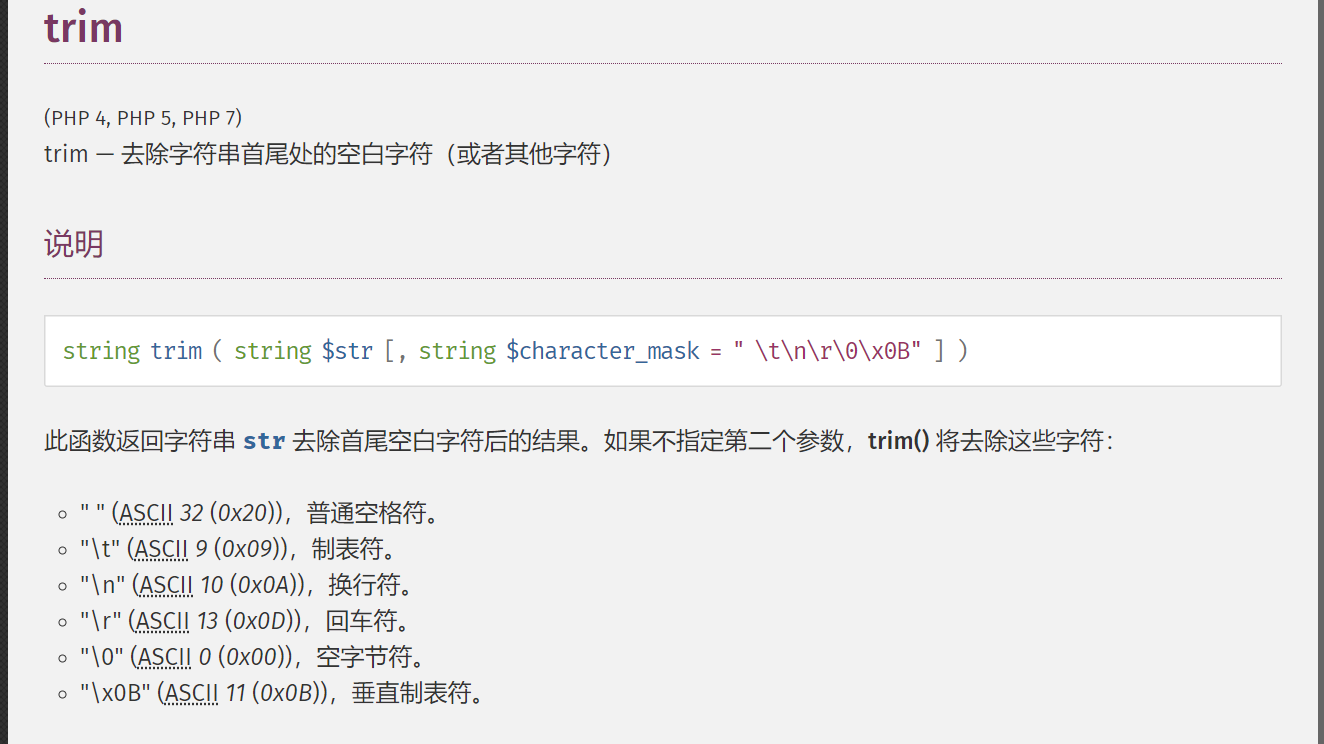
类似函数还有两个:ltrim() 和 rtrim()。分别处理字符串的左侧、右侧。
trim()的具体实现位于:ext/standard/string.c
/* {{{ proto string trim(string str [, string character_mask])

   Strips whitespace from the beginning and end of a string */

PHP_FUNCTION(trim)

{

    php_do_trim(INTERNAL_FUNCTION_PARAM_PASSTHRU, );

}

/* }}} */
/* {{{ php_do_trim

 * Base for trim(), rtrim() and ltrim() functions.

 */

static void php_do_trim(INTERNAL_FUNCTION_PARAMETERS, int mode)

{

    zend_string *str;

    zend_string *what = NULL;

    ZEND_PARSE_PARAMETERS_START(, )

        Z_PARAM_STR(str)

        Z_PARAM_OPTIONAL

        Z_PARAM_STR(what)

    ZEND_PARSE_PARAMETERS_END();

    ZVAL_STR(return_value, php_trim(str, (what ? ZSTR_VAL(what) : NULL), (what ? ZSTR_LEN(what) : ), mode));

}

/* }}} */
具体实现:
 /* {{{ php_trim()

  * mode 1 : trim left

  * mode 2 : trim right

  * mode 3 : trim left and right

  * what indicates which chars are to be trimmed. NULL->default (' \t\n\r\v\0')

  */

 PHPAPI zend_string *php_trim(zend_string *str, char *what, size_t what_len, int mode)

 {

     const char *c = ZSTR_VAL(str);

     size_t len = ZSTR_LEN(str);

     register size_t i;

     size_t trimmed = ;

     char mask[];

     if (what) {

         if (what_len == ) {

             char p = *what;

             if (mode & ) {

                 for (i = ; i < len; i++) {

                     if (c[i] == p) {

                         trimmed++;

                     } else {

                         break;

                     }

                 }

                 len -= trimmed;

                 c += trimmed;

             }

             if (mode & ) {

                 if (len > ) {

                     i = len - ;

                     do {

                         if (c[i] == p) {

                             len--;

                         } else {

                             break;

                         }

                     } while (i-- != );

                 }

             }

         } else {

             php_charmask((unsigned char*)what, what_len, mask);

             if (mode & ) {

                 for (i = ; i < len; i++) {

                     if (mask[(unsigned char)c[i]]) {

                         trimmed++;

                     } else {

                         break;

                     }

                 }

                 len -= trimmed;

                 c += trimmed;

             }

             if (mode & ) {

                 if (len > ) {

                     i = len - ;

                     do {

                         if (mask[(unsigned char)c[i]]) {

                             len--;

                         } else {

                             break;

                         }

                     } while (i-- != );

                 }

             }

         }

     } else {

         if (mode & ) {

             for (i = ; i < len; i++) {

                 if ((unsigned char)c[i] <= ' ' &&

                     (c[i] == ' ' || c[i] == '\n' || c[i] == '\r' || c[i] == '\t' || c[i] == '\v' || c[i] == '\0')) {

                     trimmed++;

                 } else {

                     break;

                 }

             }

             len -= trimmed;

             c += trimmed;

         }

         if (mode & ) {

             if (len > ) {

                 i = len - ;

                 do {

                     if ((unsigned char)c[i] <= ' ' &&

                         (c[i] == ' ' || c[i] == '\n' || c[i] == '\r' || c[i] == '\t' || c[i] == '\v' || c[i] == '\0')) {

                         len--;

                     } else {

                         break;

                     }

                 } while (i-- != );

             }

         }

     }

     if (ZSTR_LEN(str) == len) {

         return zend_string_copy(str);

     } else {

         return zend_string_init(c, len, );

     }

 }

 /* }}} */
ltrim()、rtrim() 或 trim()的参数二(what)存在时进入15行处的分支,参数二不存在时进入68行处的分支。
没有参数二时,会去除空格、"\t"、"\n"、"\r"、"\0"、"\v"
存在参数二时,会去除参数二中指定的字符。
其中函数 php_charmask() 用于处理 trim("abc123456fjsklsf", "a..z") 中 字符范围 a...z
 static inline int php_charmask(unsigned char *input, size_t len, char *mask)

 {

     unsigned char *end;

     unsigned char c;

     int result = SUCCESS;

     memset(mask, , );

     for (end = input+len; input < end; input++) {

         c=*input;

         if ((input+ < end) && input[] == '.' && input[] == '.'

                 && input[] >= c) {

             memset(mask+c, , input[] - c + );

             input+=;

         } else if ((input+ < end) && input[] == '.' && input[] == '.') {

             /* Error, try to be as helpful as possible:

                (a range ending/starting with '.' won't be captured here) */

             if (end-len >= input) { /* there was no 'left' char */

                 php_error_docref(NULL, E_WARNING, "Invalid '..'-range, no character to the left of '..'");

                 result = FAILURE;

                 continue;

             }

             if (input+ >= end) { /* there is no 'right' char */

                 php_error_docref(NULL, E_WARNING, "Invalid '..'-range, no character to the right of '..'");

                 result = FAILURE;

                 continue;

             }

             if (input[-] > input[]) { /* wrong order */

                 php_error_docref(NULL, E_WARNING, "Invalid '..'-range, '..'-range needs to be incrementing");

                 result = FAILURE;

                 continue;

             }

             /* FIXME: better error (a..b..c is the only left possibility?) */

             php_error_docref(NULL, E_WARNING, "Invalid '..'-range");

             result = FAILURE;

             continue;

         } else {

             mask[c]=;

         }

     }

     return result;

 }
第二个参数是字符范围的时候,源码中并没有严格限制成 a..z 这样的格式。
总的流程就是,待处理的字符串左侧(或右侧)逐字符去匹配是否在将要去除的字符中(第二个参数设置的字符 或者 默认的那6个字符),
如果字符匹配到则进行下一个比较,否则中断匹配查找。返回余下字符串。
php内置函数分析之trim()的更多相关文章
- map内置函数分析所得到的思路
map:会根据提供的函数对指定序列做映射. map(func, *iterables) --> map object Make an iterator that computes the fun ...
- php内置函数分析之array_diff_assoc()
static void php_array_diff_key(INTERNAL_FUNCTION_PARAMETERS, int data_compare_type) /* {{{ */ { uint ...
- php内置函数分析之array_combine()
PHP_FUNCTION(array_combine) { HashTable *values, *keys; uint32_t pos_values = ; zval *entry_keys, *e ...
- php内置函数分析之ucwords()
PHP_FUNCTION(ucwords) { zend_string *str; char *delims = " \t\r\n\f\v"; register char *r, ...
- php内置函数分析之strtoupper()、strtolower()
strtoupper(): PHP_FUNCTION(strtoupper) { zend_string *str; ZEND_PARSE_PARAMETERS_START(, ) Z_PARAM_S ...
- php内置函数分析之ucfirst()、lcfirst()
ucfirst($str) 将 str 的首字符(如果首字符是字母)转换为大写字母,并返回这个字符串. 源码位于 ext/standard/string.c /* {{{ php_ucfirst Up ...
- php内置函数分析之str_pad()
PHP_FUNCTION(str_pad) { /* Input arguments */ zend_string *input; /* Input string 输入字符串*/ zend_long ...
- php内置函数分析之array_fill_keys()
PHP_FUNCTION(array_fill_keys) { zval *keys, *val, *entry; if (zend_parse_parameters(ZEND_NUM_ARGS(), ...
- php内置函数分析range()
PHP_FUNCTION(range) { zval *zlow, *zhigh, *zstep = NULL, tmp; , is_step_double = ; double step = 1.0 ...
随机推荐
- POJ 1434 Fill the Cisterns! (模拟 or 二分)
Fill the Cisterns! 题目链接: http://acm.hust.edu.cn/vjudge/contest/129783#problem/F Description During t ...
- centos 6.9 mysql 安装配置
1.全新系统,安装mysql yum -y install mysql mysql-server mysql-devel 2.启动mysql service mysqld start 3.修改密码 登 ...
- WinForm实现最小化右下角
首先,要在窗体里面加入这么两个控件,左边的是托盘控件,右边的是菜单控件. 然后设置窗体的FormClosing事件: if (e.CloseReason == CloseReason.UserClos ...
- day50—JavaScript鼠标拖拽事件
转行学开发,代码100天——2018-05-05 今天通过鼠标拖拽事件复习巩固一下鼠标事件. 鼠标拖拽事件需要记住两点: 1.距离不变 2.鼠标事件(按下,移动,抬起) <div id=&quo ...
- 阶段1 语言基础+高级_1-3-Java语言高级_09-基础加强_第2节 反射_11_反射_案例
student定义sleep方法 用反射+配置文件 定义配置文件 src下new file.新建 加载配置文件.Properties里面有一个load方法,可以加载.properties结尾的配置文件 ...
- SoapUI乱码问题处理方法
前言 每个工具都会有一些意想不到的“坑”,SoapUI也不例外.无论是参数或者响应报文,大家可能都遇到过乱码问题,这里记录一下几种解决乱码的方法. 一.修改显示字体 在File>>> ...
- python自动化测试接口测试http请求报404的其中一个坑
在敲代码的路上 ,总是会遇到报错找半天原因,最后发现是个低级错误的时候! 这不今天为了这个错误找了半天原因.......... http请求接口测试中报404我遇到的大部分都是url的问题: 但是今天 ...
- spring中@Autowired与 @Resource区别
@Autowired 与@Resource的区别: 1. @Autowired与@Resource都可以用来装配bean. 都可以写在字段上,或写在setter方法上. 2. @Autowired默认 ...
- StringBuffer 和Stringbuilder源码分析
首先看一下他们的继承关系 这个两个对象都继承了AbstractStringBuilder抽象类. 1.他们的实现方式都一样的,唯一区别的StringBuffer在多线程的时候是保证了数据安全, ...
- c#工厂模式
创建一个抽象类: public abstract class Test { public abstract void Print();//输出信息} 创建输出123的测试类 public class ...