
ch1 About thinking skills
When confronted with a problem , we think about it.
The issue, of course, is that our efforts may be fruitful or they may not, depending on the effectiveness of the thinking done.
Good thinking is focused thinking: we need to find the right focus for our thinking if it is to be most productive. the consequence of not doing so may see us engaging in unfocused thought that may be biased, incomplete, uninformed and a waste of our time and energy.
This chapter explains the importance of knowing how to think in different ways, and of thinking in the most effective way for any given problem or task, it also provides some key facts about what we use to think with – our brains.
A thinking toolbox
Perhaps the most useful thing we can have at our disposal as we work to make sense of texts might be to have a great “thinking toolbox’ -- a toolbox full of strategies and thinking tools that will enable us to work confidently and competently with the tasks set for us.
Very recent research confirms the importance of good thinking skills. Dr. John Hattie and his team form Auckland University tell us the most significant things that can assist our learning are to be taught thinking skills and to receive quality feekback –particularly about our own thinking!
Different tools for different situations
Obviously , we are required to think differently in different situations. It is important to understand, therefore, The qualitatively different ways to think. In a science context, for example, we are often asked to think scientifically. This type of thinking requires us to be:
- self-directed
- self-disciplined
- self-monitored
- self-correcting.
In other contexts we may be encouraged to think in very different ways:
- In the arts we may be asked to think creatively (创造性的)
- In mathematics we may need to think hypothetically. (假设性的)
- In the social sciences we may be required to think laterally.(横向的)
There are many different ways to think. and a skillful thinker knows what form of thinking is required in order to be successful in any given context.
Moreover,we all come to know and understand the world in our own unique way, and so we need to know our learning strengths and to develop alternative ways to view the world. Some of the tools in this section will assist you to do just this.
Different tools for English tasks
In English studies a ‘toolbox’ of thinking skills is invaluable, as many different types of thinking are required. Knowing a range of thinking tools and strategies helps us to :
- engage deeply with texts --- as readers , viewers, listeners, writers and speakers
- gain the deepest understanding of the methods and intentions of the creator of texts.
- find the ways that we might best come to know, understand and show our understanding.
Analytical thinking of Englis
We need analytical thinking in English whenever we are asked to identify the elements of an idea. an argument or a text. this might mean identifying the elements that contribute to our understanding of a character or theme in a novel; or the techniques used to create the style and ‘lool’ of a film; or the language features that contribute to the persuasive effect of a letter to the editor in a newspaper. Analytical thinking is partly about breaking down texts and it is also about understanding how components of a text work together to create particular effects for readers and viewers.
Critical thinking in English
We use critical thinking in English when we make judgements and justify a point of view. It is an essential part of studying literary texts, as we assess the actions and attitude of characters in response to the forces acting on them and the contexts in which they find themselves, Responding to an essay topic requires critical thinking because we need to know what our stance is and how we will suppport it with evidence. Critical thinking is a key part of our thinking whenever we work with language that is used to argue or persuade. from reading the newspaper to participating in debates and public speaking.;
Creative thinking in English
Creative thinking most obviously relates to English studies when we are asked to create an original, imaginative piece of writing. such as a short story, poem or dialogue. However , creative thinking skills also encompasss the thinking we do when we come up with a new angle or perspective on an issue. develop an argument, write a speech or present our own interpretation of a literary text.
Caring thinking in English
Brain research tells us that thinking, feeling and learning are difficult to separate, Feelings have immense(巨大的,浩瀚的,无限的) influence on thinking. Almost every thought is accompanied by an emotion and many people view emotional intelligence (EI or EQ) as being at least as important as IQ.
Caring thinking goes beyond mere empathy; It is very much about values, Within the study of English, we are constantly considering a range of perspectives(愿景), viewpoints and experiences, both real and imagined. Our cultureal upbringing influences our perception and our personal experiences may colour our ethical and moral viewpoints. We need to respect and acknowledge these differences as we strive to understand ethical perspectives in texts or discuss with others issues raised in texts.
When considering an ethical issue or viewpoint we need to ask ourselves four fundamental questions:
- What I do think about this viewpoint… what do I value about it ?
- What I do feel about this viewpoint… do I have clear sense of what is right and what is wrong about this?
- What should I do as a result of what I think and feel in this instance?
- What is the reality here… and how is it different from the ideal situation?
As a values clarification process, caring thinking provides both the time and opportunity to reflect, internalise and come to terms with the issue(与现实妥协) at hand, it means understanding what an issue may mean to you personally and what it may mean to others who feel differently.
Our amazing brains
If we are going to make the best use of them, there are some significant things we should all know about our brains.
Firstly, it is important to realise that everyone is born with a brain that is composed of more than 1000 billion nerve cells, call neurons, and their support cells, call glia(神经胶质),
The bad news is that we regularly lose some of our brain cells from adolescence onward: research suggests that from the age of 35 about 7000 neurons are lost daily, the good news is the brain is capable of modifying and improving itself even as we age. the adage ‘use it or lose it’ absolutely applies in the instance.
The brain consists of about 40 per cent grey matter, which is the ‘thinking part’ of the brain, it is supported by the white matter, which makes up the remaining 60 percent, To use a computer analogy, if the brain was a computer, the grey matter would be the computer itself and thne white matter its cables. Interestingly, we rarely use our computers to their full capacity and thne same may be said about our brains!
there are several distinct sections to the human brain, the left and right sides of the brain are called hemispheres, each controlls the opposite side of the body, the hemispheres are divided into four lobes;
- the frontal lobe controls decision-making, predicts consequences and regulates social responses.
- the temporal lobe, located behind the frontal lobe, controls hearing, speech and memory,
- the prietal lobe, located under the temporal lobe, combines all sensory information and produces spatial awareness.
- the occipital lobe , at the back of the brain, controls vision.
All the thinking in the brain involves electrical and chemical exchanges .. these exchanges are never-ending as the brain is always active, Even as we sleep our brain is busy filtering the massive amount of information we have received through our senses during our waking hours.
Keeping our brains amazing
Brains are hungry organs, They use:
- 15-20 per cent of all blood pumped out of the heart
- about one- fifth of the oxygen that we breathe
- roughly 20 per cent of our daily calories even though they represent only about two per cent of bodyweight.
Our bodies need certain basic requirements to operate at peak efficiency. and our brain is no different. Good nutrition is an important part of kepping our brains healthy.
Proper nutrition
- helps protect the brain against toxins
- improves mental alertness
- assists in the formation of memory.
The essentials
Perhaps the brain’s most crucial needs are for oxygen and water: We know the brain consists mainly of water, so keeping our brain hydrated (补水)is essential. Beyond that , the main fuel of the brain is glucose ( an energising sugar ) , which reacts with the oxygen in the brain to produce oxygen feee radicals that are released into the bloodstream, these are important in the myelination process, which helps in the formation of memory and in the development of the part of the brain that repeats rote movements or habits , As part of this process, the brain need anti-oxidants the help neutralise the free radicals.
The best brain foods 巧克力,各种豆类,坚果, 西红柿,西兰花,菠菜,牛油果, 浆果, 葡萄,西梅, 鱼,猪肉,鸡蛋,牛奶制品, 茶叶 (Omega-3 抗氧化剂),蛋白质,络氨酸
bloom’s taxonomy
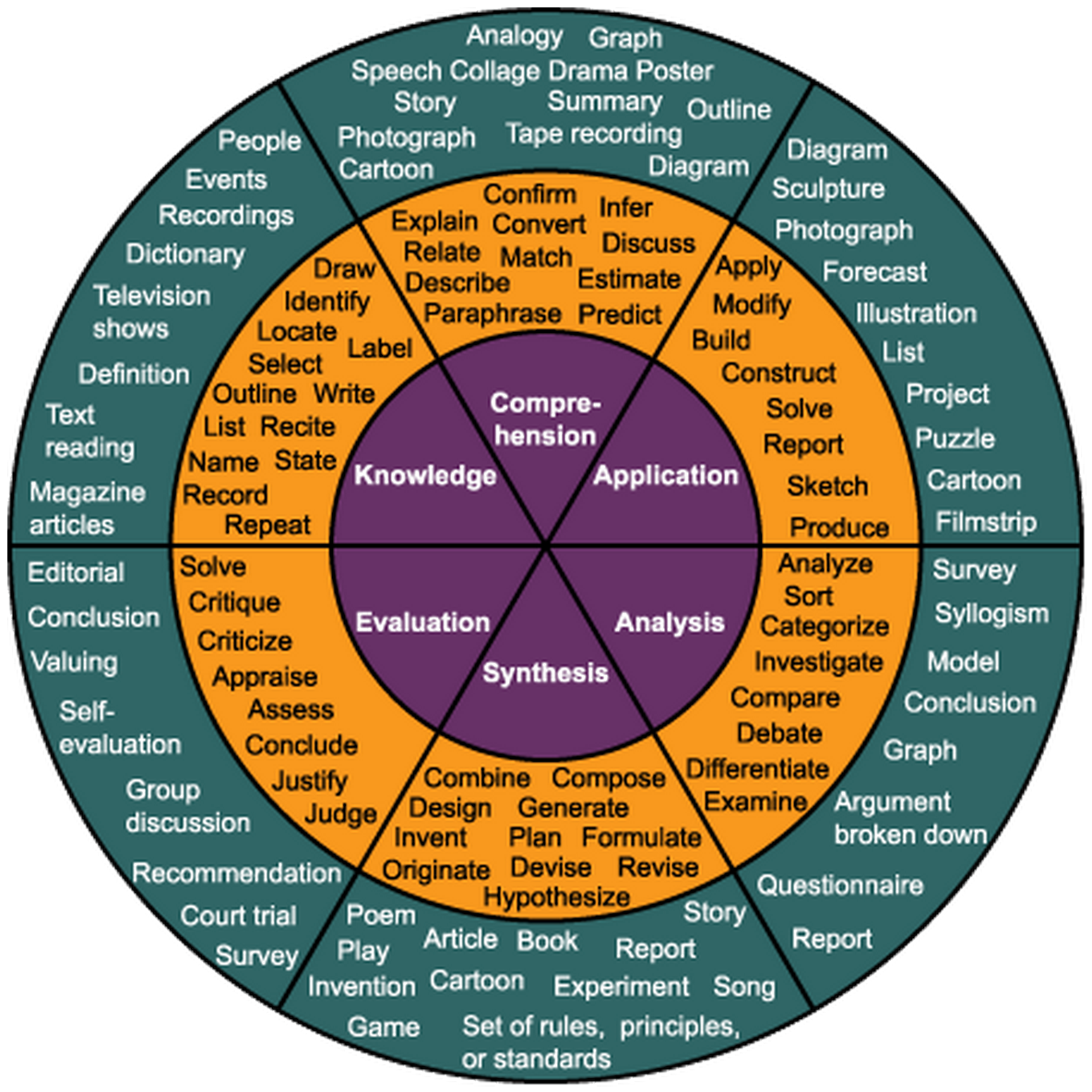

thinking at the remembering level
this is thinking at its simplest, but nonetheless it should not be underestimated – it is an important form of thinking. if we cannot recall basic elements, such as names or events in a text, we are not going to be able to answer questions about them. Working at the remembering level of the taxonomy will help you learn essential information about a text , it is the sort of thinking we do when we are retrieving relevant knowledge from either our short-term or long-term memory.
Question starters like the ones below typically evoke thinking at the Remembering level of the taxonomy.
What happened after ….?
What is …
Can you name…
Describe what happened after …
Which is true and which is false…
How many…
Who was it that …
Find the meaning of
who spoke to …
Identify who…
Remembering a text
Typical questkions or prompts at the Remembering level for each of the text elements below would include the following :
- What background information is given to help understand the storyline? (PLOT)
- Describe characters / character traits. (CHARACTERISATION)
- Show where significant events took place . (SETTING)
- Are there any links or similarities with other books you have read?(THEME)
- Research the author/historical period/setting (STYLE)
ch1 About thinking skills的更多相关文章
- How to Develop blade and soul Skills
How to Develop Skills Each skill can be improved for variation effects. Some will boost more strengt ...
- Top Five Communication Skills for Project Managers
Research among project managers globally identifies top communication skills for leading teams. Lead ...
- codeforces 613B B. Skills(枚举+二分+贪心)
题目链接: B. Skills time limit per test 2 seconds memory limit per test 256 megabytes input standard inp ...
- Computer skills one can learn within one day
Computer related technical skills are usually thought as complicated and difficult to understand. It ...
- Advice on improving your programming skills
Programming is cool. But behind the scenes it's also difficult for many people. Many people are defe ...
- Codeforces Round #322 (Div. 2) C. Developing Skills 优先队列
C. Developing Skills Time Limit: 1 Sec Memory Limit: 256 MB 题目连接 http://codeforces.com/contest/581/p ...
- cf581C Developing Skills
Petya loves computer games. Finally a game that he's been waiting for so long came out! The main cha ...
- What skills are needed for machine learning jobs
What skills are needed for machine learning jobs?机器学习工作必须技能 原文: http://www.quora.com/Machine-Learnin ...
- How do I improve my English speaking skills in a very short time?
You have asked some very important questions. I think the first step is to prioritize the issues: Yo ...
随机推荐
- Codeforces 803F(容斥原理)
题意: 给n个正整数,求有多少个GCD为1的子序列.答案对1e9+7取模. 1<=n<=1e5,数字ai满足1<=ai<=1e5 分析: 设f(x)表示以x为公约数的子序列个数 ...
- SHARP AR-2048D/2348D
http://www.sharp.cn/printer/AR-2048D%7C2348D/support/download.html
- 苹果装WIN 7
一.准备:1.8G或以上的正版U盘或者移动硬盘,提前备份U盘数据(2013款air要求安装64位系统,市面上比较多U盘不是正版盘,一般做不成功,要换盘) 2.64位纯净版Windows7 ISO的下载 ...
- 基于cocos2d开发的android小游戏——採花仙
/*cocos 2d 已经成为了如今移动端游戏开发的强有力的工具,眼下主流游戏中多採用cocos 2d游戏引擎. 我也尝试了一下该引擎.我是用的是cocos2d-android,以后要移植到Cocos ...
- php & 和 &amp; (主要是url 问题)
ini_set('arg_separator.output','&'); 也能够在php.ini 改动
- Spring——IoC
控制反转(Inversion ofControl,英文缩写为IoC)是一种能够解耦的方法,不是什么技术.是一种思想,也是轻量级的Spring框架的核心.控制反转一般分为两种类型.依赖注入(Depend ...
- hdu 1258 Sum It Up (dfs+路径记录)
pid=1258">Sum It Up Time Limit: 2000/1000 MS (Java/Others) Memory Limit: 65536/32768 K (J ...
- C++ - 使用copy函数打印容器(container)元素
使用copy函数打印容器(container)元素 本文地址: http://blog.csdn.net/caroline_wendy C++能够使用copy函数输出容器(container)中的元素 ...
- 使用 FFmpeg 处理高质量 GIF 图片
使用 FFmpeg 处理高质量 GIF 图片 - 为程序员服务 http://ju.outofmemory.cn/entry/169845
- npm安装以及命令行
安装visual studio的时候,安装Node.js会同时安装npm 查看版本 PS C:\Users\clu\Desktop> npm --version5.6.0 PS C:\Users ...