
FMM和BMM的python代码实现
FMM和BMM的python代码实现
FMM和BMM的编程实现,其实两个算法思路都挺简单,一个是从前取最大词长度的小分句,查找字典是否有该词,若无则分句去掉最后面一个字,再次查找,直至分句变成单词或者在字典中找到,并将其去除,然后重复上述步骤。BMM则是从后取分句,字典中不存在则分句最前去掉一个字,也是重复类似的步骤。
readCorpus.py
import sys

output = {}

with open('语料库.txt', mode='r', encoding='UTF-8') as f:

    for line in f.readlines():

        if line is not None:

            # 去除每行的换行符

            t_line = line.strip('\n')

            # 按空格分开每个词

            words = t_line.split(' ')

            for word in words:

                # 按/分开标记和词

                t_word = word.split('/')

                # 左方括号去除

                tf_word = t_word[0].split('[')

                if len(tf_word) == 2:

                    f_word = tf_word[1]

                else:

                    f_word = t_word[0]

                # 若在输出字典中,则value+1

                if f_word in output.keys():

                    output[f_word] = output[f_word]+1

                # 不在输出字典中则新建

                else:

                    output[f_word] = 1

            big_word1 = t_line.split('[')

            for i in range(1, len(big_word1)):

                big_word2 = big_word1[i].split(']')[0]

                words = big_word2.split(' ')

                big_word = ""

                for word in words:

                    # 按/分开标记和词

                    t_word = word.split('/')

                    big_word = big_word + t_word[0]

                # 若在输出字典中,则value+1

                if big_word in output.keys():

                    output[big_word] = output[big_word]+1

                # 不在输出字典中则新建

                else:

                    output[big_word] = 1

f.close()

with open('output.txt', mode='w', encoding='UTF-8') as f:

    while output:

        minNum = sys.maxsize

        minName = ""

        for key, values in output.items():

            if values < minNum:

                minNum = values

                minName = key

        f.write(minName+": "+str(minNum)+"\n")

        del output[minName]

f.close()
BMM.py
MAX_WORD = 19

word_list = []

ans_word = []

with open('output.txt', mode='r', encoding='UTF-8')as f:

    for line in f.readlines():

        if line is not None:

            word = line.split(':')

            word_list.append(word[0])

f.close()

#num = input("输入句子个数:")

#for i in range(int(num)):

while True:

    ans_word = []

    try:

        origin_sentence = input("输入:\n")

        while len(origin_sentence) != 0:

            len_word = MAX_WORD

            while len_word > 0:

                # 从后读取最大词长度的数据,若该数据在字典中,则存入数组,并将其去除

                if origin_sentence[-len_word:] in word_list:

                    ans_word.append(origin_sentence[-len_word:])

                    len_sentence = len(origin_sentence)

                    origin_sentence = origin_sentence[0:len_sentence-len_word]

                    break

                # 不在词典中,则从后取词长度-1

                else:

                    len_word = len_word - 1

            # 单词直接存入数组

            if len_word == 0:

                if origin_sentence[-1:] != ' ':

                    ans_word.append(origin_sentence[-1:])

                len_sentence = len(origin_sentence)

                origin_sentence = origin_sentence[0:len_sentence - 1]

        for j in range(len(ans_word)-1, -1, -1):

            print(ans_word[j] + '/', end='')

        print('\n')

    except (KeyboardInterrupt, EOFError):

        break
FMM.py
MAX_WORD = 19

word_list = []

with open('output.txt', mode='r', encoding='UTF-8')as f:

    for line in f.readlines():

        if line is not None:

            word = line.split(':')

            word_list.append(word[0])

f.close()

#num = input("输入句子个数:")

#for i in range(int(num)):

while True:

    try:

        origin_sentence = input("输入:\n")

        while len(origin_sentence) != 0:

            len_word = MAX_WORD

            while len_word > 0:

                # 读取前最大词长度数据,在数组中则输出,并将其去除

                if origin_sentence[0:len_word] in word_list:

                    print(origin_sentence[0:len_word]+'/', end='')

                    origin_sentence = origin_sentence[len_word:]

                    break

                # 不在字典中,则读取长度-1

                else:

                    len_word = len_word - 1

            # 为0则表示为单词,输出

            if len_word == 0:

                if origin_sentence[0] != ' ':

                    print(origin_sentence[0]+'/', end='')

                origin_sentence = origin_sentence[1:]

        print('\n')

    except (KeyboardInterrupt, EOFError):

        break
效果图
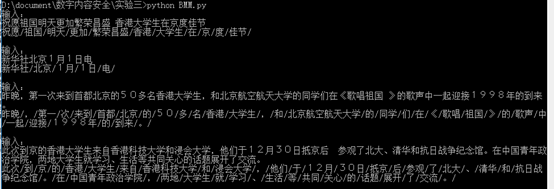
- BMM.py(不含大粒度分词)

- BMM.py(含大粒度分词)
- FMM.py(不含大粒度分词)

- FMM.py(含大粒度分词)
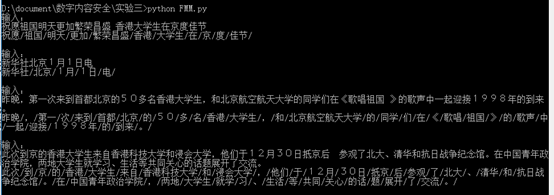
我们可以观察到含大粒度分词的情况将香港科技大学,北京航空航天大学等表意能力强的词分在了一起而不是拆开,更符合分词要求。
FMM和BMM的python代码实现的更多相关文章
- 可爱的豆子——使用Beans思想让Python代码更易维护
title: 可爱的豆子--使用Beans思想让Python代码更易维护 toc: false comments: true date: 2016-06-19 21:43:33 tags: [Pyth ...
- if __name__== "__main__" 的意思(作用)python代码复用
if __name__== "__main__" 的意思(作用)python代码复用 转自:大步's Blog http://www.dabu.info/if-__-name__ ...
- Python 代码风格
1 原则 在开始讨论Python社区所采用的具体标准或是由其他人推荐的建议之前,考虑一些总体原则非常重要. 请记住可读性标准的目标是提升可读性.这些规则存在的目的就是为了帮助人读写代码,而不是相反. ...
- 一行python代码实现树结构
树结构是一种抽象数据类型,在计算机科学领域有着非常广泛的应用.一颗树可以简单的表示为根, 左子树, 右子树. 而左子树和右子树又可以有自己的子树.这似乎是一种比较复杂的数据结构,那么真的能像我们在标题 ...
- [Dynamic Language] 用Sphinx自动生成python代码注释文档
用Sphinx自动生成python代码注释文档 pip install -U sphinx 安装好了之后,对Python代码的文档,一般使用sphinx-apidoc来自动生成:查看帮助mac-abe ...
- 上传自己的Python代码到PyPI
一.需要准备的事情 1.当然是自己的Python代码包了: 2.注册PyPI的一个账号. 二.详细介绍 1.代码包的结构: application \application __init__.py m ...
- 如何在batch脚本中嵌入python代码
老板叫我帮他测一个命令在windows下消耗的时间,因为没有装windows那个啥工具包,没有timeit那个命令,于是想自己写一个,原理很简单: REM timeit.bat echo %TIME% ...
- ROS系统python代码测试之rostest
ROS系统中提供了测试框架,可以实现python/c++代码的单元测试,python和C++通过不同的方式实现, 之后的两篇文档分别详细介绍各自的实现步骤,以及测试结果和覆盖率的获取. ROS系统中p ...
- 让计算机崩溃的python代码,求共同分析
在现在的异常机制处理的比较完善的编码系统里面,让计算机完全崩溃无法操作的代码还是不多的.今天就无意运行到这段python代码,运行完,计算机直接崩溃,任务管理器都无法调用,任何键都用不了,只能强行电源 ...
随机推荐
- hdu 1506 Largest Rectangle in a Histogram 构造
题目链接:HDU - 1506 A histogram is a polygon composed of a sequence of rectangles aligned at a common ba ...
- 如何快速搜索SQL数据库数据和对象
原文 如何快速搜索SQL数据库数据和对象 Frequently, developers and DBAs need to search databases for objects or data. I ...
- Linux expect 用法
expect是建立在tcl基础上的一个工具,它用来让一些需要交互的任务自动化地完成. 因为expect是基于tcl的,所以需要你的系统中安装有tcl 检查是否安装tcl,expect [root@ma ...
- JS或jQuery获取当前屏幕宽度
Javascript: 网页可见区域宽: document.body.clientWidth网页可见区域高: document.body.clientHeight网页可见区域宽: document.b ...
- [Tips + Javascript] Make a unique array
To make an array uniqued, we can use Set() from Javascript. const ary = ["a", "b" ...
- charles抓https包
Charles是一款非常好用的抓包工具,有Window,Linux,Mac OS三个版本,个人觉得比shark和TCPDump好用多了. 闲话不多说,公司将服务从http转到https,导致今天因为抓 ...
- XP中如何配置和共享打印机
Win XP中如何配置和共享打印机 一.配置 打印机 在"控制面板"打开"打印机和传真",在左边的选项或单击右键选择" ...
- 百度兴趣点下载V1.4版
好东西就是不断的更改,升级出来的,经过连续四个版本的升级,本次版本受到用户的一致好评,也拿来在这里做个分享,期望对更多地用户起到一定的帮助! 还是一样,介绍一下其功能: 1.全国范围内的兴趣点任意区域 ...
- OS之os.fork()
有两种方式来实现并发性, 一种方式是让每个“任务"或“进程”在单独的内在空间中工作,每个都有自已的工作内存区域.不过,虽然进程可在单独的内存空间中执行,但除非这些进程在单独的处理器上执行,否 ...
- python数据类型整理
Python中常见的数据结构可以统称为容器(container).序列(如列表和元组).映射(如字典)以及集合(set)是三类主要的容器. 一.序列(列表.元组和字符串) 序列中的每个元素都有自己的编 ...