
POJ1556 The Doors [线段相交 DP]
| Time Limit: 1000MS | Memory Limit: 10000K | |
| Total Submissions: 8334 | Accepted: 3218 |
Description
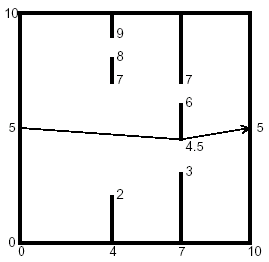
Input
2
4 2 7 8 9
7 3 4.5 6 7
The first line contains the number of interior walls. Then there is a line for each such wall, containing five real numbers. The first number is the x coordinate of the wall (0 < x < 10), and the remaining four are the y coordinates of the ends of the doorways in that wall. The x coordinates of the walls are in increasing order, and within each line the y coordinates are in increasing order. The input file will contain at least one such set of data. The end of the data comes when the number of walls is -1.
Output
Sample Input
1

5 4 6 7 8

2

4 2 7 8 9

7 3 4.5 6 7

-1
Sample Output
10.00

10.06
Source
题意:从(0,5)走到(10,5)最短路
我太傻逼了,查了好长时间计算几何的错,结果是求DAG的DP忘清空vis了
#include <iostream>

#include <cstdio>

#include <cstring>

#include <algorithm>

#include <cmath>

#include <vector>

using namespace std;

typedef long long ll;

const int N=,M=1e4+;

const double INF=1e9;

const double eps=1e-;

inline int read(){

    char c=getchar();int x=,f=;

    while(c<''||c>''){if(c=='-')f=-; c=getchar();}

    while(c>=''&&c<=''){x=x*+c-''; c=getchar();}

    return x*f;

}

inline int sgn(double x){

    if(abs(x)<eps) return ;

    else return x<?-:;

}

struct Vector{

    double x,y;

    Vector(double a=,double b=):x(a),y(b){}

    bool operator <(const Vector &a)const{

        return x<a.x||(x==a.x&&y<a.y);

    }

    void print(){

        printf("%lf %lf\n",x,y);

    }

};

typedef Vector Point;

Vector operator +(Vector a,Vector b){return Vector(a.x+b.x,a.y+b.y);}

Vector operator -(Vector a,Vector b){return Vector(a.x-b.x,a.y-b.y);}

Vector operator *(Vector a,double b){return Vector(a.x*b,a.y*b);}

Vector operator /(Vector a,double b){return Vector(a.x/b,a.y/b);}

bool operator ==(Vector a,Vector b){return sgn(a.x-b.x)==&&sgn(a.y-b.y)==;}

double Cross(Vector a,Vector b){

    return a.x*b.y-a.y*b.x;

}

double DisPP(Point a,Point b){

    Point t=a-b;

    return sqrt(t.x*t.x+t.y*t.y);

}

struct Line{

    Point s,t;

    Line(){}

    Line(Point p,Point v):s(p),t(v){}

}l[N];

int cl;

bool isLSI(Line l1,Line l2){

    Vector v=l1.t-l1.s,u=l2.s-l1.s,w=l2.t-l1.s;

    return sgn(Cross(v,u))!=sgn(Cross(v,w))&&sgn(Cross(v,u))!=&&sgn(Cross(v,w))!=;

}

bool isSSI(Line l1,Line l2){

    return isLSI(l1,l2)&&isLSI(l2,l1);

}

bool can(Point a,Point b){

    Line line(a,b);

    for(int i=;i<=cl;i++)

        if(isSSI(l[i],line)) return false;

    return true;

}

int n,s,t;

struct edge{

    int v,ne;

    double w;

}e[M<<];

int h[N],cnt=;

inline void ins(int u,int v,double w){//printf("ins %d %d %lf\n",u,v,w);

    cnt++;

    e[cnt].v=v;e[cnt].w=w;e[cnt].ne=h[u];h[u]=cnt;

}

double d[N];

int vis[N];

double dp(int u){

    if(vis[u]) return d[u];

    vis[u]=;

    for(int i=h[u];i;i=e[i].ne){

        int v=e[i].v;

        d[u]=min(d[u],dp(v)+e[i].w);

    }

    return d[u];

}

void DAG(){

    for(int i=s;i<=t;i++) d[i]=INF;

    memset(vis,,sizeof(vis));

    d[t]=;vis[t]=;

    dp(s);

}

Point p[N][];

Point S(,),T(,);

inline int idx(int u){return u%==?u/:u/+;}

inline int idy(int u){return u%==?:u%;}

double x;

int main(int argc, const char * argv[]) {

    while(true){

        n=read();s=;t=*n+;

        if(n==-) break;

        cnt=;memset(h,,sizeof(h));

        cl=;

        for(int i=;i<=n;i++){

            scanf("%lf%lf%lf%lf%lf",&x,&p[i][].y,&p[i][].y,&p[i][].y,&p[i][].y);

            p[i][].x=p[i][].x=p[i][].x=p[i][].x=x;

            int num=(i-)*;

            //for(int j=1;j<=4;j++) p[i][j].print();

            if(i==){

                for(int j=;j<=;j++)

                    ins(s,num+j,DisPP(S,p[i][j]));

            }else{

                for(int j=;j<=;j++){

                    for(int u=;u<=num;u++){

                        if(can(p[idx(u)][idy(u)],p[i][j]))

                            ins(u,num+j,DisPP(p[idx(u)][idy(u)],p[i][j]));

                    }

                    if(can(S,p[i][j])) ins(s,num+j,DisPP(S,p[i][j]));

                }

            }

            l[++cl]=Line(Point(x,),p[i][]);

            l[++cl]=Line(p[i][],p[i][]);

            l[++cl]=Line(p[i][],Point(x,));

        }

        int num=n*;

        for(int u=;u<=num;u++)

            if(can(p[idx(u)][idy(u)],T))

                ins(u,t,DisPP(p[idx(u)][idy(u)],T));

        if(can(S,T)) {puts("10.00");continue;}

        DAG();

        printf("%.2f\n",d[s]);

    }

    return ;

}
POJ1556 The Doors [线段相交 DP]的更多相关文章
- POJ1556 最短路 + 线段相交问题
POJ1556 题目大意:比较明显的题目,在一个房间中有几堵墙,直着走,问你从(0,5)到(10,5)的最短路是多少 求最短路问题,唯一变化的就是边的获取,需要我们获取边,这就需要判断我们想要走的这条 ...
- POJ 1556 - The Doors 线段相交不含端点
POJ 1556 - The Doors题意: 在 10x10 的空间里有很多垂直的墙,不能穿墙,问你从(0,5) 到 (10,5)的最短距离是多少. 分析: 要么直达,要么 ...
- POJ 1556 The Doors【最短路+线段相交】
思路:暴力判断每个点连成的线段是否被墙挡住,构建图.求最短路. 思路很简单,但是实现比较复杂,模版一定要可靠. #include<stdio.h> #include<string.h ...
- 简单几何(线段相交+最短路) POJ 1556 The Doors
题目传送门 题意:从(0, 5)走到(10, 5),中间有一些门,走的路是直线,问最短的距离 分析:关键是建图,可以保存所有的点,两点连通的条件是线段和中间的线段都不相交,建立有向图,然后用Dijks ...
- POJ 1066 Treasure Hunt (线段相交)
题意:给你一个100*100的正方形,再给你n条线(墙),保证线段一定在正方形内且端点在正方形边界(外墙),最后给你一个正方形内的点(保证不再墙上) 告诉你墙之间(包括外墙)围成了一些小房间,在小房间 ...
- 简单几何(线段相交) POJ 1066 Treasure Hunt
题目传送门 题意:从四面任意点出发,有若干障碍门,问最少要轰掉几扇门才能到达终点 分析:枚举入口点,也就是线段的两个端点,然后选取与其他线段相交点数最少的 + 1就是答案.特判一下n == 0的时候 ...
- poj 1066 线段相交
链接:http://poj.org/problem?id=1066 Treasure Hunt Time Limit: 1000MS Memory Limit: 10000K Total Subm ...
- POJ 1066 Treasure Hunt(线段相交判断)
Treasure Hunt Time Limit: 1000MS Memory Limit: 10000K Total Submissions: 4797 Accepted: 1998 Des ...
- 线段相交 poj 1066
// 线段相交 poj 1066 // 思路:直接枚举每个端点和终点连成线段,判断和剩下的线段相交个数 // #include <bits/stdc++.h> #include <i ...
随机推荐
- spring如何控制事务
Spring 的事务,可以说是 Spring AOP 的一种实现. AOP面向切面编程,即在不修改源代码的情况下,对原有功能进行扩展,通过代理类来对具体类进行操作. spring是一个容器,通过spr ...
- echarts图表里label文字过长换行的方法
在做一些图标时,有时会出现显示文字过长的问题,需要将其按照指定的字数换行,像下图这样 而echarts没有提供换行的方法,但是可以使用fomatter方法进行设置,代码如下 formatter: fu ...
- [随笔] 简单操作解决Google chrome颜色显示不正常的情况
最近在用Linuxmint 真的是极友好的桌面Linux啊,然后用最新的Linuxmint自带的Firefox浏览器上网,发现颜色都变成了红色黄色变绿色,以为是显卡的问题,搞了一阵,无果.果断换Goo ...
- webpack优化之code splitting
作为当前风头正盛的打包工具,webpack风靡前端界.确实作为引领了一个时代的打包工具,很多方面都带来了颠覆性的改进,让我们更加的感受到自动化的快感.不过最为大家诟病的一点就是用起来太难了. 要想愉快 ...
- 为什么选择.NETCore?
为什么.NETCore? 学习新的开发框架是一项巨大的投资.您需要学习如何在新框架中编写,构建,测试,部署和维护应用程序.作为开发人员,有许多框架可供选择,很难知道什么是最适合的工作.即使您正在使用. ...
- linux如何安装java环境
linux安装jdk7步骤: 1.首先使用命令查看linux系统版本号: lsb_release -a 11 2.下载对应的jdk版本,笔者使用的是jdk-7u79-linux-x64.tar.gz: ...
- id,is的用法,小数据池的概念及编码知识进阶
一:id 查询内存地址 name = 'alex' print(id(name)) li = [1,2,3] print(id(li)) 二:is 判断的是内存地址 name1 = 'alex@' ...
- 阿里java开发手册中命名规约解读之DO/BO/DTO/VO/AO
前言 在阅读<阿里巴巴Java开发手册>时,看到命名规则中有这样一条 虽然知道这些是根据Java对象的角色所分配名称的后缀,但是没有弄清楚分别是什么意思,日常开发中也没有使用到. 网上查找 ...
- android imageview按钮按下动画效果
private ImageView today_eat: today_eat = (ImageView) view.findViewById(R.id.today_eat); today_eat.se ...
- 02_HTML5+CSS详解第二天
html5大纲分析工具:https://gsnedders.html5.org/outliner/ <section> <h1>HTML部分</h1> <se ...